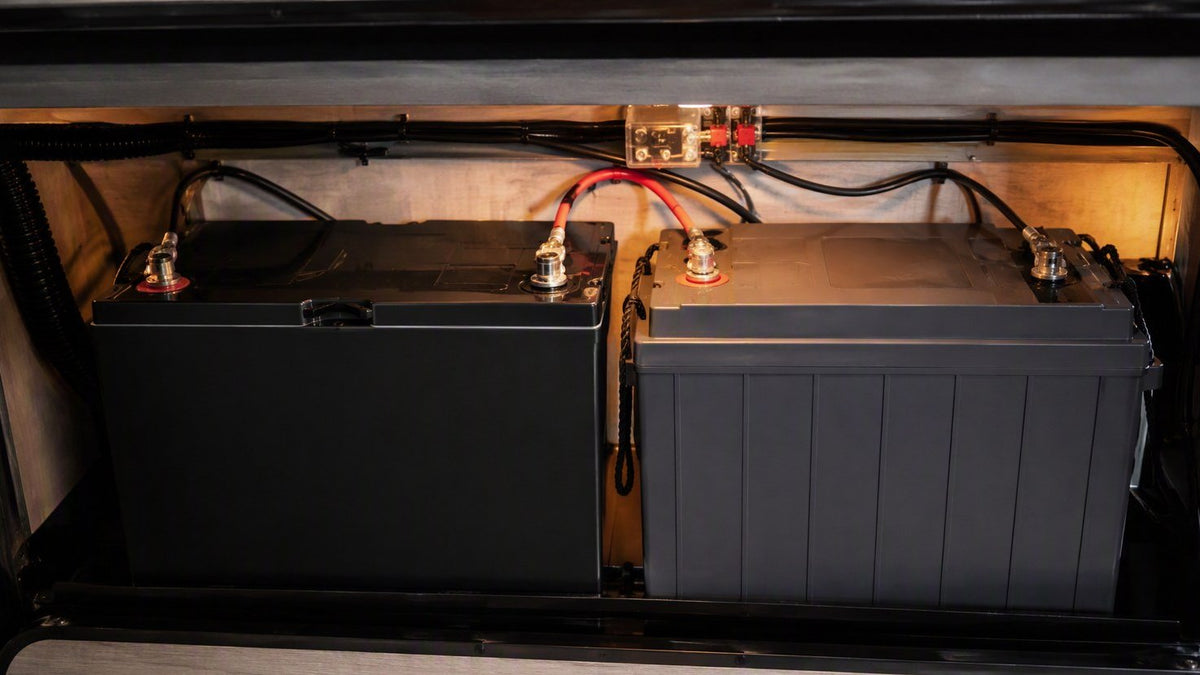
Battle Born vs EG4 12V LiFePO4: Premium vs Value for RV/Off-Grid
Same chemistry, same capacity, triple the price difference. We sell both lines — here's the cycle-life math, the warranty fine print, and who should actually pay for premium.
The Battle Born BB10012 and the EG4 LifePower4 12V 100Ah are, on paper, the same battery: 12.8V nominal, 100Ah, 1.28 kWh of LiFePO4 in a drop-in lead-acid case. One costs around $850. The other costs around $300. Our counter staff gets asked weekly whether Battle Born is "worth it," and the honest answer is: for about a third of buyers, yes — for everyone else, the EG4 is the smartest buy in the 12V lithium market. Let's do the math that separates them, because the difference isn't in the cells. It's in the BMS engineering, the warranty mechanics, and what happens at mile 40,000 of washboard forest road.
Quick context on why this comparison matters: 12V LiFePO4 drop-ins are the heart of the RV, van, marine, and small off-grid market. Both of these are in our LiFePO4 battery collection — EG4 under EG4 batteries and the broader EG4 line — and between them they cover the two buying philosophies in this market: buy once, cry once, versus buy value and bank the savings for more solar.
| Specification | Battle Born BB10012 | EG4 LifePower4 12V 100Ah |
|---|---|---|
| Nominal voltage / capacity | 12.8V / 100Ah (1.28 kWh) | 12.8V / 100Ah (1.28 kWh) |
| Cell chemistry | Cylindrical LiFePO4 | Prismatic LiFePO4 |
| Continuous discharge | 100A (200A surge, 30 s) | 100A (surge ~200A class) |
| Max charge current | 50A recommended, 100A max | 100A |
| Rated cycle life | 3,000–5,000 cycles @ 80–100% DOD | 4,000+ cycles @ 80% DOD (manufacturer rating) |
| Warranty | 10 years, US-based support | 5 years |
| Low-temp charge cutoff | Yes — BMS blocks charge below −4°C (25°F) | Yes — BMS low-temp protection |
| Series/parallel config | Up to 4S (48V) / parallel unlimited | 4S4P supported |
| Weight | ≈ 31 lb (14 kg) | ≈ 24–28 lb class |
| Case / mounting | Group 27/31 drop-in, any orientation | Group 31 drop-in |
| Certifications | UL 1973 cell pack, UN38.3 | UL 1973 / UN38.3 class listings |
| Street price (2026) | ≈ $800–$900 | ≈ $280–$330 |
Read that table and you'll spot the punchline: the electrical specs are nearly identical. Both deliver 100A continuous, both protect against cold charging (the #1 lithium killer — charging below freezing plates lithium metal inside the cell), both series to 48V. The EG4 even matches on cycle rating. So what exactly does the extra $550 buy?
1. The BMS is engineered for abuse, not just protection. Battle Born's BMS tolerances, MOSFET sizing, and surge handling are built for mobile vibration and ham-fisted installs. We've warrantied exactly two Battle Borns in years of selling them by the pallet; both were user error, both replaced fast. Value-tier BMS boards are competent — EG4's is genuinely good for the price — but component derating margins are thinner, and we've seen more nuisance low-voltage disconnects under inverter surge loads on value packs. For a coffee-maker-and-lights van build, you'll never notice. For a 3,000W inverter on a 2-battery bank, you might.
2. The warranty is a mechanism, not a sticker. Ten years with US-based phone support versus five years with email-ticket support. On a battery you expect to own for a decade, the replacement logistics matter more than the paper terms. Battle Born (Dragonfly Energy, Reno, Nevada) answers the phone. EG4's support has improved enormously since 2023, but warranty turnaround runs weeks, not days.
3. Resale and system paper-trail. Van builders and marine insurers increasingly ask for battery brand on surveys. Battle Born is the recognized name that moves resale value; EG4 is the recognized value name among DIYers. Know your exit.
We've run both in our own demo rigs — a BB bank in the sales trailer, EG4s in the warehouse test wall. Both perform. The trailer bank has survived three winters of below-freezing storage with the BMS doing its job; the EG4 wall cycles daily and hasn't lost measurable capacity in 18 months. That's the whole story: both are good batteries at different price philosophies.
Battery value is dollars per delivered kilowatt-hour over life. Using 80% DOD (1.024 kWh per cycle) and rated cycle life:
| Metric | Battle Born BB10012 | EG4 LifePower4 100Ah |
|---|---|---|
| Street price | $850 | $300 |
| Rated cycles @ 80% DOD | ≈ 3,500 (mid-range) | ≈ 4,000 |
| Lifetime energy delivered | 3,500 × 1.024 ≈ 3,584 kWh | 4,000 × 1.024 ≈ 4,096 kWh |
| Cost per lifetime kWh | ≈ $0.237/kWh | ≈ $0.073/kWh |
| Warranty-covered years | 10 | 5 |
| Cost per warranty-year | $85/yr | $60/yr |
| Grid-price comparison (avg US retail) | ≈ $0.17/kWh — both beat renting watts from the utility in daily-cycle service | |
On pure lifetime-energy economics, EG4 wins by a factor of three. There's no honest way to spin that table. If your use is a stationary off-grid cabin bank where the batteries sit warm, dry, and un-vibrated for a decade, buy EG4s, buy more of them, and spend the difference on panels. Four EG4 100Ah batteries (~$1,200, 5.1 kWh) cost barely more than one Battle Born.
Where the math bends back toward Battle Born: mobile applications with real vibration, builds where a BMS failure strands you (think Alaska in February), buyers who value the 10-year single-point warranty, and anyone whose installer/insurer specifies a recognized premium brand. The $0.16/kWh premium is insurance plus resale, and for a $60,000 van build it's noise in the budget.
Either battery dies young on a lead-acid charge profile. Set your system to LiFePO4 values: absorb 14.2–14.6V (both manufacturers publish 14.4V ± 0.2), float 13.6V or disabled, equalization OFF, temperature compensation OFF (lead-acid tempco drives voltage up when cold — exactly wrong for lithium), and never charge below freezing unless the pack has internal heating. Both these packs have low-temp charge cutoff, but treat that as the safety net, not the plan. Our charge controller sizing guide and the controller lineup all carry LiFePO4 profiles; the Morningstar and Victron units have them preloaded. Charging rates: both take 0.5C happily (50A), and our piece on charging a 100Ah battery with a 200W panel shows why a single panel needs about two good sun-days for a full refill either way.
On depth of discharge: the 20–80 rule doubles-to-triples cycle life on any lithium pack — Battle Born's own data shows roughly 6,000+ cycles at 60% DOD versus 3,000 at 100%. LiFePO4 tolerates full cycling far better than NMC, but the calendar still rewards shallower cycling. Size the bank 25% bigger than your math says and both batteries will outlive their warranties. Our battery bank sizing guide builds in that headroom by default.
Both batteries want identical LiFePO4 charging, which makes swapping or mixing ecosystems easy on the charger side. Program any quality controller or inverter-charger to these values and either pack lives a long life:
| Charge Parameter | Battle Born BB10012 Spec | EG4 LifePower4 Spec | Why It Matters |
|---|---|---|---|
| Bulk/absorb voltage | 14.2–14.6V (14.4V target) | 14.2–14.6V (14.4V target) | Under-absorb leaves 5–8% capacity on the table |
| Absorb time | 15–30 min per 100Ah | 20–30 min | LiFePO4 needs short tail, not hours |
| Float voltage | 13.6V or disabled | 13.6V or disabled | High float ages lithium slowly but surely |
| Equalization | Disabled — never | Disabled — never | Lead-acid equalize (15.5V+) trips BMS and ages cells |
| Temperature compensation | Off | Off | Lead tempco raises voltage in cold — wrong direction |
| Max charge current | 50A recommended / 100A max | 100A rated | Stay at 0.5C for longest life |
| Charge below 0°C (32°F) | BMS blocks below −4°C | BMS blocks below −4°C class | Insulate the box; cutoff is the safety net |
The gotcha we see monthly: customers drop lithium into a rig with an old converter/charger stuck on a flooded profile, the BMS protects the pack by disconnecting at 14.6V+ equalize spikes, and the customer concludes "the battery is defective." The battery is doing its job; the charger is the problem. Any lithium-ready unit from the controller lineup or a modern inverter-charger solves it in five minutes of programming.
Battle Born's process: call Reno, talk to a tech who knows the product, run two or three diagnostics over the phone (resting voltage, charge acceptance, BMS state), and if the pack is bad, a replacement ships — usually inside a week. In our experience they err toward replacement. EG4's process: open a ticket, run similar diagnostics by email or phone, ship the suspect unit back (freight policies vary), replacement follows inspection — typically two to four weeks end to end. Both companies honor their paper. The difference is elapsed time and who pays freight, and on a full-time rig where the battery is the house power, two weeks down is a real cost. For a stationary cabin with a redundant parallel pack, it's an inconvenience. That asymmetry — not cell quality — is the core of the premium argument.
Both brands support 4S series strings, and both work fine if you follow the rules: same model, same batch, fully charged individually before first connection, and a periodic rebalance (charge each 12V unit solo once or twice a year) because series lithium drifts — there's no per-cell balancing across the string, only per-pack. Skip the rebalance and within a couple hundred cycles one pack runs 0.3V hot, its BMS disconnects first, and your 48V bank opens mid-discharge. It protects the cells; it also kills your lights. This is why, for banks above ~5 kWh, we increasingly steer people to purpose-built 48V rackmount packs from the battery storage lineup — one BMS, one comms bus, per-cell balancing, and per-kWh pricing that undercuts even the value 12V drops. The buyer's guide walks that fork in the road.
Since both of these batteries end up in parallel banks, the wiring discipline is identical for both — and it's the number-one install error we troubleshoot. The rules are short and absolute. One: equal-length cables from each battery to a common busbar, never daisy-chained battery-to-battery, because the "first" battery in a daisy chain carries more of the load and ages faster than its siblings. Two: fuse each battery within seven inches of the positive terminal — a 100A-class Class T or equivalent per pack — because a shorted parallel bank without per-pack fusing is a four-figure fire. Three: identical packs, same model, same purchase batch, charged individually to 100% before first connection. Four: torque the terminals to spec (both brands publish it — typically 8–10 Nm class on M8 terminals) with an actual torque wrench, not a calibrated elbow. Follow those four and either battery will deliver its rated cycle life. Skip them and the best battery in the world becomes an expensive argument with a warranty department. Our bank sizing guide includes the wiring diagrams, and the busbars, fuses, and hardware are shelf stock.
The three-year ownership picture. Here's what actually differs after the honeymoon: Battle Born owners mostly forget the batteries exist — the deliberate "no app, no drama" design means the bank just works, and the only recurring task is a quarterly voltage sanity check. EG4 owners get a little more engagement: occasional firmware attention via the app, Bluetooth SOC glances, and earlier visibility into anything drifting. Neither is burdensome; they're different ownership textures. If you're the person who enjoys watching the system dashboard at breakfast, the value tier's visibility is a feature. If you want the electrical equivalent of a cast-iron pan, premium sealed packs earn their keep.
| Application | Our Pick | Why |
|---|---|---|
| Full-time van/RV, heavy inverter loads, rough roads | Battle Born | BMS surge margin, vibration tolerance, 10-yr support |
| Weekend RV / travel trailer, modest loads | EG4 | Value wins; bank the savings for panels |
| Off-grid cabin bank (stationary, 4+ kWh) | EG4 | $0.073/kWh lifetime economics are unbeatable |
| Marine house bank (insured vessel) | Battle Born | Survey recognition, support network |
| 48V build (4S strings) | Either — or step up to rackmount 48V packs | See rackmount storage before series-building 12V |
| First lithium build, tight budget | EG4 | Learn on value gear; upgrade path stays open |
And one piece of advice we give everyone: whichever you buy, buy them all at once. Parallel banks want matched packs of the same age and batch. Mixing a 2024 EG4 with a 2026 EG4, or Battle Borns of different vintages, creates subtle imbalance the BMS can't fix. Also grab the solar battery buyer's guide before checkout, and if your build is bigger than 5 kWh, price the 48V rackmount class before committing to a dozen 12V drops — the wiring savings alone often pays for the upgrade.
Strip the marketing off both boxes and here's the coffee-shop version. The EG4 is one of the best values in the entire battery market — honest cells, competent BMS, a price that lets you buy capacity instead of badge. The Battle Born is the battery you buy when the cost of a failure exceeds the cost of the premium: full-time rigs, remote sites, critical loads, resale-sensitive builds. We've put our own families in vehicles powered by both. The only truly wrong answer in this comparison is a no-name pack with a printed sticker and a PO box for support — spend the EG4 money at minimum, spend the Battle Born money when it matters, and size the bank 25% deep no matter whose logo is on the case.
Whatever brand you buy, keep this table taped inside the battery compartment — it's the quick sanity check for any 12V LiFePO4 bank at rest (no charge or discharge for 30+ minutes):
| Resting Voltage | Approx. State of Charge | What To Do |
|---|---|---|
| 14.2–14.6V | 100% (just finished absorb) | Normal — chargers tapering |
| 13.6V | ~99% / float holding | Normal on float-enabled systems |
| 13.3–13.4V | ≈ 90% | Normal |
| 13.1–13.2V | ≈ 50–70% | Normal — the flat part of the curve |
| 12.8–13.0V | ≈ 20–30% | Plan to charge soon |
| 12.0–12.5V | ≈ 5–10% | Charge now; you're at the knee |
| <11.5V or zero | BMS protection disconnect | Apply charge to wake; check for the fault that drained it |
Notice how little the voltage moves between 90% and 30% — that's the flat LiFePO4 curve, and it's exactly why we keep insisting on a shunt monitor for any build where state of charge matters. Voltage tells you "fine" or "emergency"; a shunt tells you "63% and falling 4% an hour." Both of these batteries reward the owner who instruments the system instead of guessing at it.
And if you take one habit from this entire comparison, make it this: log your bank's resting voltage and shunt reading on the first of every month. Thirty seconds, twelve data points a year, and you'll spot a drifting pack or a parasitic load six months before it becomes a dead bank in a campground. Both brands' warranty departments love that log too — it turns a claim from an argument into a formality.
Is Battle Born worth triple the price of EG4? For stationary off-grid and budget builds, no — EG4's lifetime cost per kWh is roughly a third of Battle Born's. For full-time mobile use, heavy inverter surge loads, or anyone who values 10-year US-based warranty support and resale recognition, the premium is defensible insurance.
Can I mix Battle Born and EG4 batteries in one bank? No. Never mix brands, ages, or batches in parallel lithium banks. Different internal resistances and BMS behaviors cause chronic imbalance — one pack works harder, ages faster, and drags the bank down. Build each string from identical same-vintage packs.
How long will each battery actually last? At 80% DOD daily cycling, expect 9–11 years to 80% capacity from either — LiFePO4 calendar aging (roughly 10–15 years regardless of use) usually ends the story before cycle count does. Cycle shallower (20–80%) and 12+ years is realistic for both.
Do both work in freezing temperatures? Both discharge fine in the cold and both have low-temperature charge cutoff (~25°F/−4°C). Neither should be charged below freezing without internal heating. For winter installs, insulate the battery box or spec self-heating packs — the cutoff is a last resort, not a feature to rely on daily.
Can these run a 2,000W inverter? One battery, no — 2,000W at 12V pulls ~170A, over either pack's 100A continuous rating. Two in parallel (200A) handles 2,000W comfortably; three for a 3,000W inverter. This is why we steer big-inverter builds toward 24V or 48V architectures — the same power at half or quarter the current.
Which has the better low-temperature protection? Both block charging below about −4°C (25°F), which is the non-negotiable lithium feature. Neither classic model self-heats; for four-season mobile use, insulate the battery compartment or look at self-heating variants in the value tier. Discharging in the cold is fine for both — expect 15–20% less available capacity at −10°C, recovering as the pack warms.
How do I know the battery is actually full? Not by voltage — LiFePO4 sits at 13.2–13.4V across most of its range. Use a shunt-based monitor (SmartShunt class) counting amp-hours, or charge until the pack holds 14.2–14.6V with tail current under ~2A. On either brand, a $150 shunt is the best accuracy upgrade in the whole system.
Sources: manufacturer datasheets and warranty documents (Dragonfly Energy, EG4 Electronics), NEC 2023 Article 706 context, PES field and test-wall data. Ready to build your bank? Get a free quote — we'll size the bank and the charging system together.