Dirty panels are lost revenue — that part everyone agrees on. The argument starts when you price the equipment to clean them. A $40 brush on a pole is the right answer for a 20-panel residential roof and a terrible answer for a 2 MW carport portfolio. A six-figure robotic fleet is brilliant in the desert Southwest and absurd in Oregon drizzle. We outfit installers and O&M crews across both extremes, and this guide matches equipment to project scale with real costs, real water chemistry, and the soiling math that tells you when cleaning pays and when it does not.

Choosing the Right Solar Panel Cleaning Equipment
Equipment selection starts with three numbers: how many panels, how often they need cleaning, and what an uncleaned month costs you. Everything else — brush stiffness, water purity, automation — hangs off those three.
| Equipment Category | Best For (Project Scale) | Primary Use Case | Upfront Cost Range | Key Decision Factors |
|---|---|---|---|---|
| Manual brush + hose/deionized water | 1–50 panels | Residential, small commercial roofs | $150 – $800 | Roof access, water quality, labor time per panel |
| Water-fed pole + DI/RO system | 50–500 panels | Residential fleets, ground mounts, small commercial | $800 – $6,000 | Pole reach, DI resin consumption, flow rate |
| Rotary brush (tractor- or operator-carried) | 500–5,000 panels | Ground-mount arrays, large flat commercial roofs | $3,000 – $25,000 | Array row spacing, terrain, water logistics |
| Semi-automated (rail- or gantry-mounted) | 5,000–50,000 panels | Utility-scale sites with uniform racking | $25,000 – $150,000 | Racking uniformity, row length, labor displacement |
| Fully robotic (autonomous dry or wet) | Utility-scale, water-scarce regions | Nightly dry cleaning, high-soiling desert sites | $100,000+ fleet economics | Soiling rate, water cost/scarcity, financing model |
Manual Cleaning Tools for Installers and Small Projects
Brushes and Water Systems
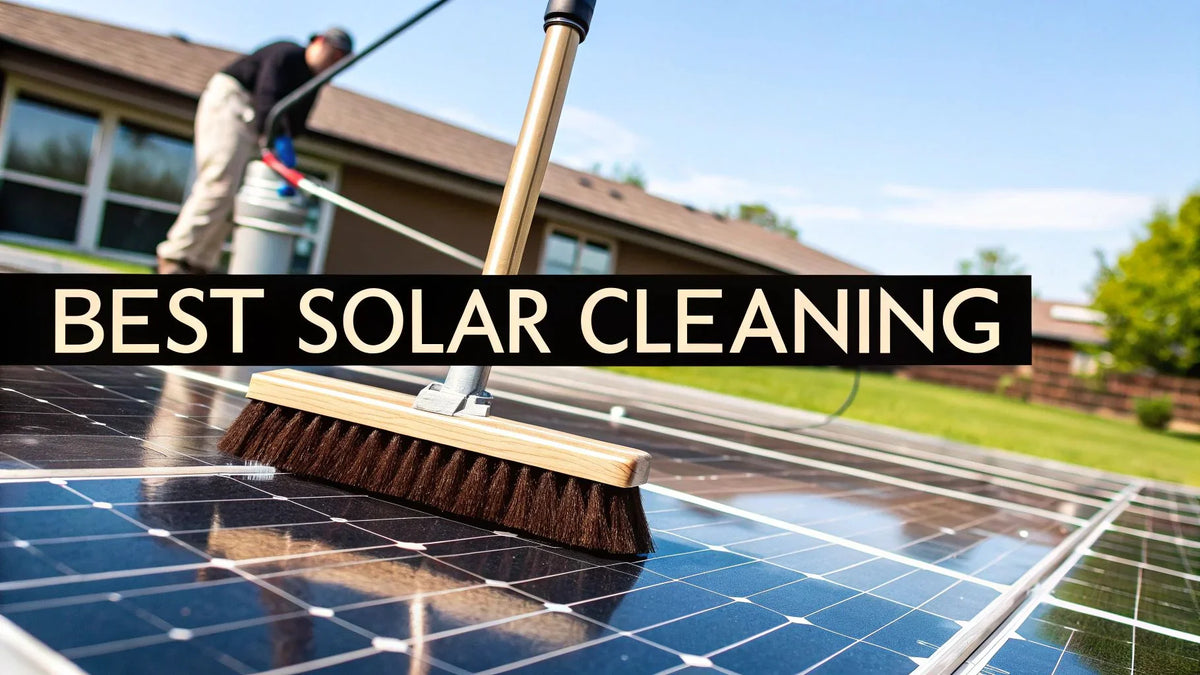
The manual kit that actually works has three components, and the cheap versions of each one cause damage. First, the brush: soft flagged bristles or a purpose-built solar brush with non-abrasive filament. Never a stiff deck brush, never anything with metal ferrules touching glass. The anti-reflective coating on modern modules scratches, and scratched AR coating is a permanent production loss. Second, the pole: a rigid water-fed pole in the 20–30 foot class covers most residential roofs from a ladder or the ground. Flex is the enemy — a whippy fiberglass pole turns a cleaning job into a fencing match. Third, the water: this is where most DIY rigs fail, and it deserves its own section below.
I've cleaned arrays with everything from a garden hose to a trailer-mounted RO system, and the single upgrade that transforms results is water purity. Tap water at 200+ ppm TDS leaves mineral spotting that bakes on in the sun and can cost you more production than the dust you removed. The professionals run deionized or reverse-osmosis water under 10 ppm, which dries spot-free with zero squeegee work.
| Water Source | Typical TDS | Spotting Risk | Treatment Needed | Cost per 100 Gallons |
|---|---|---|---|---|
| Hard municipal tap | 200–500 ppm | Severe — visible mineral film | DI or RO required | $2–$6 treatment cost |
| Soft municipal tap | 50–150 ppm | Moderate — light spotting | DI polishing recommended | $1–$3 |
| Well water (varies wildly) | 100–1,000+ ppm | Severe; iron can stain | RO + DI, sediment pre-filter | $4–$10 |
| DI-treated (single-bed) | <10 ppm | None — dries spot-free | Resin replacement as needed | Resin amortized $1–$4 |
| RO + DI polished | 0–2 ppm | None | Membrane + resin maintenance | $2–$5 |
Practical Scenarios for Manual Equipment
Manual wins on a 24-panel residential roof needing two cleanings a year: a $600 water-fed pole kit and $40 of DI resin beat a service call-out fee by the second visit. Manual also wins on fragmented commercial rooftops — HVAC units, parapets, and multiple roof planes defeat automation. Where manual loses: anything over a few hundred panels, where labor time per panel (90 seconds to 3 minutes depending on access) turns cleaning into a recurring payroll line that automation eventually undercuts.
Evaluating Robotic and Semi-Automated Cleaning Systems

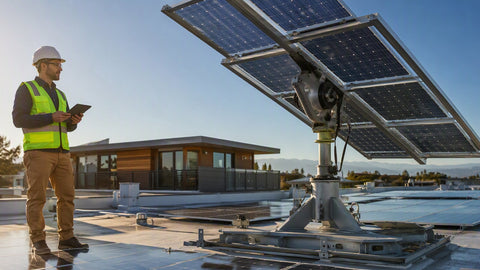
Above roughly 5,000 panels, the conversation shifts from tools to systems. Semi-automated rigs — rail-mounted brushes that travel a row, or gantry systems spanning a table — trade capital for labor at predictable rates. Fully autonomous robots, mostly dry-cleaning designs, run nightly on utility-scale sites and exist to solve one problem: water. In high-soiling desert regions where a site might otherwise need monthly wet cleaning, a robotic fleet can pay for itself in recovered production within two to four years. In low-soiling humid climates cleaned twice a year by rain and one manual pass, the same fleet never pencils.
| Feature | Fully Automated Robotic Systems | Semi-Automated Systems |
|---|---|---|
| Labor per cleaning cycle | Near zero after deployment | 1–2 operators per machine |
| Water use | Zero (dry brush/microfiber) to minimal | Moderate — typically wet cleaning |
| Cleaning frequency economics | Daily/nightly cleaning becomes affordable | Weekly to monthly cycles |
| Racking requirements | Uniform tracker or fixed-tilt rows, minimal obstructions | Tolerates some variation; rail systems need uniform rows |
| Best climate fit | Arid, high-soiling, water-scarce | Moderate soiling, water available |
| Capital structure | Fleet purchase or cleaning-as-a-service contract | Equipment purchase, owner-operated |
| Failure mode risk | Fleet downtime affects whole site; needs service plan | Single machine failure pauses work; simpler repairs |
| Payback driver | Recovered soiling losses at high soiling rates | Labor cost displacement vs. manual crews |
Key Evaluation Criteria for Automated Systems
- Soiling rate first. Measure before you buy: two identical reference panels, one cleaned weekly, one left alone, with monitoring on both. Sixty days of data tells you your site's soiling rate in percent loss per week. Automation pencils above roughly 0.5–1% weekly loss; below that, manual wins.
- Mechanical load limits. Every module datasheet specifies maximum mechanical load, and every robotic vendor's brush pressure must stay under it — typically a fraction of the 5,400 Pa snow-load rating, but verify with the module manufacturer in writing. This is the warranty conversation nobody wants to have after the fact.
- Row geometry. Measure your row lengths, gaps, and pier spacing. Rail systems hate irregular sites.
- Water logistics. Wet systems at utility scale move thousands of gallons per cycle. If water comes by truck, dry robots start looking very smart.
How Soiling Impacts Your Solar Project ROI
Soiling is not a fixed tax — it is local, seasonal, and measurable. Typical field observations across U.S. sites:
| Site Environment | Typical Soiling Loss (uncleaned) | Rainfall Self-Cleaning | Reasonable Cleaning Frequency | Annual Production at Stake (100 kW array) |
|---|---|---|---|---|
| Humid, regular rainfall (Pacific NW, Gulf) | 1–3% average | Largely effective | 0–1 per year (inspect-driven) | 1,500–4,500 kWh |
| Mixed four-season (Mid-Atlantic, Midwest) | 2–5% average | Partial | 1–2 per year | 3,000–7,500 kWh |
| Dry summer climates (Central Valley CA) | 5–15% by end of dry season | Minimal in summer | 2–4 per year | 7,500–22,000 kWh |
| Desert, dust + agriculture (SW, Imperial Valley) | 10–30% between events | Negligible | Monthly to robotic nightly | 15,000–45,000 kWh |
| Near highways/industry (oily particulate) | 5–12%, rain-resistant film | Poor — film survives rain | 2–4 per year with wet cleaning | 7,500–18,000 kWh |
Run your own site through the solar ROI calculator with and without a soiling adjustment — the delta is the budget ceiling for your cleaning program. If recovered production is worth $900 a year, a $2,000 annual cleaning contract is a bad deal and a $400 DIY kit is a great one. Our runtime and system sizing tools help quantify the production side of that equation.
The Financial Consequences of Neglect
Beyond lost kilowatt-hours, neglect has three compounding costs. Hot spots: localized soiling — bird droppings, leaf dams — forces shaded cells to dissipate power as heat, degrading backsheets and, in bad cases, cracking glass over years. Warranty exposure: several module manufacturers' warranties expect "reasonable maintenance," and documented neglect can complicate claims. And soiling measurement error: owners who never clean cannot distinguish a failing inverter from dirty glass, so real faults hide behind assumed dirt. A monitoring platform — see our monitoring and communications gear — pays for itself just by making soiling visible as a distinct, quantified loss channel.
Cleaning Technique: What the Warranty Actually Allows
Module manufacturers publish cleaning guidelines, and violating them risks warranty coverage. The common denominators across Tier 1 manuals: clean with water and a soft, non-abrasive brush or sponge; no metal tools, no abrasive pads, no harsh solvents; avoid high-pressure spray directed at the junction box and cable entries (keep pressure washers under roughly 1,500 psi, at distance, fan tip — many manufacturers say skip pressure entirely); never clean hot glass with cold water — thermal shock can crack modules, so clean early morning or on cool overcast days; and never walk on modules. Kneeling or standing on laminate causes invisible cell microcracks that show up as underperformance years later. We have inspected arrays where you could literally map the cleaner's footpath in the electroluminescence images. Use the pole. That is what it is for.
Frequency guidance, condensed: inspect quarterly, clean when monitoring shows a sustained 3–5% soiling loss or when visual buildup is obvious, and always after pollen season and wildfire smoke events — ash and pollen films are disproportionately expensive because they cling. On tilt under about 10 degrees, expect edge soiling where the frame dams runoff; low-tilt arrays need attention roughly twice as often.
Safety: The Part That Saves Lives, Not Just Watts

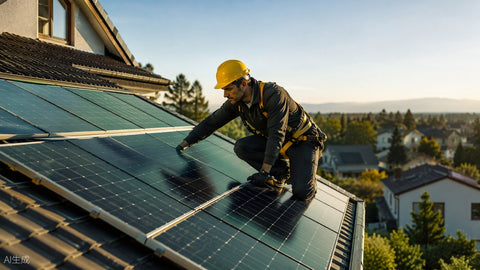
Solar arrays are energized whenever the sun shines — there is no off switch on the DC side. Roof work adds fall exposure on top of electrical exposure. The non-negotiables: fall protection compliant with OSHA 1926 Subpart M on any roof work, which means anchors, harnesses, and lanyards or guardrails, not "being careful"; treating every conductor and connector as live; avoiding water spray on electrical enclosures, junction boxes, and connectors; and staying clear of the array edges and skylights — skylights hidden under grime kill roof workers every year. Ladders get tied off. Wet roofs get treated like ice. If the cleaning plan for a steep residential roof is "careful footing," the plan is wrong — that is a professional-crew roof or a ground-accessible pole job. Our safety requirements guide for solar crews covers the OSHA and NFPA framework in full.
Building Your Kit: Recommended Packages by Scale
For the residential installer adding cleaning as a service line: a 24–30 ft rigid water-fed pole, a purpose-built solar brush head, a DI tank system with TDS meter, and a submersible or booster pump. Total investment $1,200–$2,500, billable at $150–$350 per residential cleaning. For the commercial O&M shop: add a trailer-mounted RO/DI system (300–600 gallon capacity), a rotary brush head for ground mounts, and a spare resin inventory — $8,000–$20,000 all-in, supporting contracts in the low five figures annually. For asset managers: buy monitoring first, measure soiling for a season, then let the data choose between manual contracts, semi-automated equipment, or robotic service agreements. Panels, cleaning, and monitoring are one system — browse panels, tools and test equipment, and wash accessories in our catalog, and our best solar panels roundup covers which modern modules carry the strongest coatings and frames for low-maintenance sites. Racking choices affect cleanability too — see the racking systems overview for how tilt and row spacing change your cleaning math.
Water Systems Deep Dive: DI vs. RO vs. Tap
The water question deserves its own math because it is the recurring consumable in every wet-cleaning program. A single-bed DI cartridge system is the entry point: tap water flows through mixed-bed resin that strips dissolved solids to under 10 ppm. It is simple and cheap to buy — but resin is consumed in proportion to the incoming TDS. At 300 ppm tap water, a standard cartridge might polish 200–400 gallons before exhaustion; at 100 ppm, triple that. Crews cleaning daily in hard-water territory burn resin faster than filters on a dusty jobsite. The answer at volume is RO pretreatment: a reverse-osmosis membrane strips 95–98% of dissolved solids mechanically, and a small DI stage polishes the remainder. Resin life stretches by an order of magnitude, and cost per gallon drops to the point where water purity stops being a line item you think about. Trailer-mounted RO/DI systems in the 300–600 gallon class are the standard commercial rig for exactly this reason. We learned this the expensive way early on — a season of buying resin cartridges weekly — and the RO upgrade paid for itself in under four months of crew work. One operational note: DI water is aggressive. It wants to dissolve things, including metals it sits in. Keep it in plastic or stainless plumbing, use it fresh, and never store it in contact with bare steel.
Cleaning Contracts: The Pricing Math

For installers considering cleaning as a service line, the unit economics are straightforward. Residential cleanings run $150–$350 per visit depending on array size, pitch, and access; a two-person crew with a water-fed pole and DI system completes three to five residential jobs per day. Commercial O&M pricing typically lands at $3–$8 per panel per cleaning for accessible ground mounts, climbing with access difficulty and water logistics, or $0.01–$0.03 per watt per visit. The margin killer is windshield time, so route density matters more than equipment sophistication — a book of 40 rooftops in one zip code out-earns a fancier rig scattered across a county. On the customer side, the pitch writes itself once you have their production data: show the monitoring curve before and after a cleaning, annualize the recovered kilowatt-hours against their retail rate, and the contract price either justifies itself or it does not. When it does not — rainy climates, steep self-cleaning tilts — say so. The credibility of an honest "you do not need this" sells the next three jobs to people who do.
A Seasonal Cleaning Calendar
Timing cleanings to the soiling calendar recovers more production than adding cleanings at random. The pattern that holds across most U.S. regions: clean in late spring after pollen season ends — pollen film is sticky, rain-resistant, and lands right as production peaks; inspect and spot-clean after any wildfire smoke event, because ash clings and bakes; clean again in early fall in dry-summer climates to reset before the low-sun months; and let winter rain and snow handle themselves, since freeze risk makes winter washing a bad trade in cold regions. Desert and agricultural sites replace this calendar with a simple rule: measure soiling weekly and clean at 5% loss. Low-tilt arrays under about 10 degrees deserve one extra inspection per season regardless of region — frame-edge soiling builds silently and concentrates right at the cell edge where shading hurts most.
Ground-Mount vs. Rooftop: Different Jobs, Different Rigs
Ground mounts are where cleaning scales gracefully: no fall exposure, vehicle access to the row, water tanks on a trailer, and rotary brushes that let one operator cover a megawatt in days. Rooftops are the opposite — every panel is overhead work at height, and the equipment decision is really a fall-protection decision wearing a cleaning costume. We learned this boundary early: our first large commercial "cleaning job" quote assumed ground-mount logistics on a split-level rooftop, and the access plan alone — anchors, harness rigging, skylight flagging — consumed the margin. The rules we now quote by: ground mounts get mechanized equipment and per-panel pricing; rooftops get water-fed poles, OSHA-compliant fall protection, and per-visit pricing that reflects setup time; and anything steeper than 7:12 or taller than two stories goes to a crew with dedicated rope-access experience. Never let a cleaning quote ignore the roof it is cleaning.
Documentation and Inspection: Making Cleaning Auditable
Asset managers increasingly require proof, not promises, and the documentation workflow is simple enough that every crew should run it. Before-and-after photos of a fixed reference set of panels; a production snapshot from the monitoring platform captured the morning of the cleaning and again 48 hours later; a one-page log noting date, crew, water TDS at the brush, method, and any damage observed — cracked glass, loose clamps, chewed cables, hot junction boxes. That log does double duty: it satisfies the client's maintenance records and it catches array problems early, when they are still warranty claims instead of failures. Crews that report a delaminating backsheet or a scorched connector are worth their contract twice over; cleaning is the only regular close inspection most arrays ever get. Bundle that inspection into the service scope explicitly — a written "observations" line on every invoice turns a commodity cleaning visit into an O&M deliverable, and it is the difference between a vendor and a partner in the asset manager's eyes. The crews that understand this never lack for contract renewals, because reliability compounds: the client who trusts your inspection notes stops bidding the work out every season, and the array that gets inspected four times a year simply fails less, because small problems get caught at the cheap stage instead of the catastrophic one. A loose clamp tightened in March never becomes a cracked module in July, and a chewed cable replaced under warranty never becomes a ground fault on a wet morning when the array is live and the crew is an hour away.
Buy the Gear or Hire the Service: The Break-Even Math
The final equipment question is whether to own cleaning capability at all. The break-even is simple arithmetic. Owning a residential-grade kit (pole, brush, DI system) costs $1,200–$2,500 plus resin — call it $2,000 amortized over five years plus $100 a year in consumables, or about $500 a year. A professional residential cleaning costs $150–$350 per visit. If your site needs two cleanings a year, owning the kit breaks even in year two or three and wins thereafter — provided your roof is safely accessible, which is the real gate. For commercial arrays, the same math runs against contract pricing of $3–$8 per panel: a 1,000-panel ground mount paying $5,000 per cleaning, three times a year, justifies a $15,000 semi-automated rig in about three years, faster if water is expensive or crews are scarce. We've run this break-even with dozens of customers, and the answer flips on three variables: cleaning frequency (driven by your measured soiling rate), site access (driven by roof vs. ground), and labor availability (driven by your region). Measure the first, walk the second, and price the third honestly before signing either a contract or an equipment invoice. One hybrid option worth knowing: many solar O&M providers and window-cleaning outfits rent water-fed pole kits and DI tanks by the week, which lets an owner-operator test the DIY route for a season before committing to a purchase — a cheap way to learn whether the roof, the water, and your schedule actually cooperate.
Frequently Asked Questions
How often should solar panels be cleaned?
Let data decide: inspect quarterly and clean when monitoring shows a sustained 3–5% production loss from soiling, or when buildup is visually obvious. In rainy climates that may be once a year or never; in dry agricultural or desert regions it can mean monthly cycles. Always clean after pollen season and wildfire smoke events.
Can I use a pressure washer on solar panels?
With great caution. Many module manufacturers advise against pressure washing entirely; where permitted, keep pressure under roughly 1,500 psi, use a wide fan tip, keep distance from the glass, and never spray directly at junction boxes, cable entries, or frame seals. Water intrusion into a junction box is an expensive, unglamorous failure.
Does tap water damage solar panels?
The water does not scratch, but hard tap water (200+ ppm TDS) leaves mineral deposits that bake onto the glass and reduce output — sometimes more than the dirt you removed. Deionized or RO-filtered water under 10 ppm TDS dries spot-free and is the professional standard.
How much production do dirty panels lose?
Site-dependent: 1–3% in rainy climates, 2–5% in mixed four-season regions, 5–15% by the end of a dry California summer, and 10–30% between cleaning events in desert and agricultural areas. A two-panel side-by-side measurement on your own site replaces all generalizations with your number.
Is it safe to walk on solar panels while cleaning?
No. Walking or kneeling on modules creates invisible microcracks in the cells that degrade output for years and can void warranties. Clean from ladders, the ground, or proper roof anchors using water-fed poles — never from on top of the array.
When is robotic panel cleaning worth the investment?
Robotic cleaning pencils at utility scale in high-soiling, water-scarce regions — typically sites measuring above 0.5–1% soiling loss per week. Below that, or in wet climates, manual and semi-automated methods carry better economics. Measure your site's actual soiling rate for at least a season before committing capital.