Updated September 2026 — refreshed against the live PES catalog; product pricing verified 2026-09-26.
Heat Pump vs AC: Which Is Best for Central Air? The 2026 Field Guide
Same box, different job: how heat pumps and air conditioners actually differ, what SEER2 and HSPF2 really mean for your bill, and the climate math that decides which one belongs on your pad.

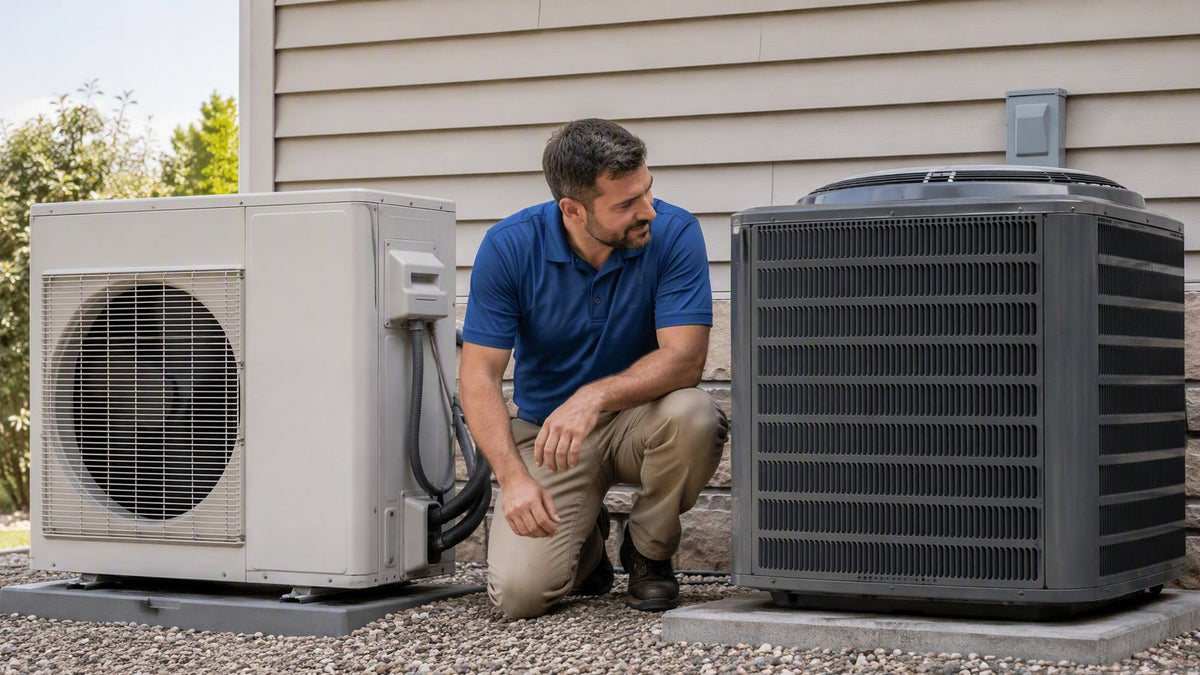
Here's the truth that surprises most homeowners standing in front of two nearly identical outdoor units: a heat pump and a central air conditioner are the same machine with one extra part. Both move heat out of your house in summer using a refrigerant loop. The heat pump adds a reversing valve that flips the loop in winter so it moves heat into your house instead. That single valve — plus some controls and a defrost board — is the entire mechanical difference. Everything else in this comparison flows from it: cost, efficiency ratings, climate limits, electrical requirements, and whether your furnace stays or goes.
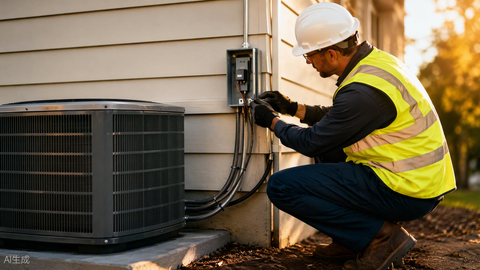
We supply both configurations and the electrical infrastructure behind them — disconnects, whip kits, breakers, and wire — so we watch the installed jobs, not just the brochures. We've wired hundreds of condenser circuits, and the pattern is consistent: the people who regret their choice almost always skipped the climate math or the electrical panel math, not the brand research. This guide walks through the working differences, the 2026 efficiency-rating landscape (SEER2 and HSPF2), real operating-cost arithmetic, installation cost, electrical requirements, and a climate-by-climate decision framework.
In cooling mode, a heat pump and an AC are functionally identical — same compressor, same coil, same airflow, same thermostat behavior. If you stood in front of the supply registers in July, you could not tell which one was outside. The differences appear in October:
- Heating capability: The heat pump reverses and heats; the AC sits idle while your furnace or air-handler heat strips do the winter work. One box versus two.
- Defrost cycle: In heating mode below ~40°F outdoor temp, frost builds on the outdoor coil and the heat pump periodically reverses briefly to melt it — you'll hear a whoosh and see steam. Normal operation, not a fault. An AC never does this because it never runs in winter.
- Auxiliary heat: Heat pumps pair with backup heat — electric strips in the air handler, or a gas furnace in a "dual fuel" setup — for the coldest hours. An AC's backup is simply the heating system you already own.
- Efficiency ratings: Both carry SEER2 for cooling; heat pumps additionally carry HSPF2 for heating. More on decoding those below.
- Upfront cost: The heat pump version of a given condenser typically runs $300–$900 more than the straight-cool version, before any incentives.
The strategic difference is bigger than the mechanical one: a heat pump lets you heat with electricity at 200–350% effective efficiency (moving heat beats making heat), while a furnace tops out at 80–98.5% burning gas. Whether that trade wins depends on your climate and your utility rates — the two calculations we walk through next.
Since January 2023, every residential unitary system sold in the US is rated under the DOE's M1 test procedure — that's the "2" in SEER2. The test uses higher external static pressure than the old M procedure, so SEER2 numbers run roughly 4–5% lower than the old SEER for identical hardware. Comparing a 2019 "16 SEER" unit to a 2026 "15.2 SEER2" unit is closer to apples-to-apples than it looks.
| Rating | Measures | Applies To | 2026 Minimum (split systems) | Good / Better / Best |
|---|---|---|---|---|
| SEER2 | Seasonal cooling efficiency (BTU per watt-hour, weighted across temps) | Both AC and heat pumps | 14.3 northern states / 13.4 southeast & southwest (regional rules apply) | 15.2 / 17–19 / 20+ |
| HSPF2 | Seasonal heating efficiency (BTU per watt-hour across heating season) | Heat pumps only | 7.5 (DOE national minimum for split heat pumps) | 8.1 / 8.5–9.5 / 10+ |
| EER2 | Steady-state efficiency at 95°F — hot-climate truth serum | Both (required disclosure in southwest region) | Regional requirements in the southwest | 11.7 / 12.2+ |
| COP | Instantaneous heating efficiency at a given temp | Heat pumps | — | COP ~3.0–3.5 at 47°F; ~2.0–2.4 at 17°F for cold-climate units |
Two field notes on ratings. First, SEER2 is a seasonal average, not a promise — a 20 SEER2 variable-speed unit earns its rating partly by running long, low-speed cycles that also dehumidify beautifully, which is a comfort upgrade you feel even before the bill arrives. Second, for hot climates (Phoenix, Las Vegas, inland Texas), EER2 matters as much as SEER2 because your expensive hours are all at 100°F+, and the southwest region's EER2 minimums exist for exactly that reason. Our HVAC and air conditioning collection and complete HVAC systems list current-rated equipment.
Cooling cost is a wash — identical hardware, identical SEER2, identical bill. The money question is entirely about winter: can the heat pump beat your furnace's cost per delivered BTU? Here's the arithmetic we run for customers, with the formula so you can plug in your own utility rates.
Cost per million BTU (MMBTU) of delivered heat:
- Heat pump: (1,000,000 ÷ 3,412 BTU/kWh) ÷ COP × your electric rate. At COP 3.0 and $0.14/kWh: 293 kWh × $0.14 ÷ 3.0 ≈ $13.68/MMBTU.
- Gas furnace: (1,000,000 ÷ 100,000 BTU/therm) ÷ efficiency × gas rate. At 96% AFUE and $1.20/therm: 10.4 therms × $1.20 ≈ $12.50/MMBTU.
- Propane furnace: at 96% AFUE and $2.50/gal (91,500 BTU/gal): ≈ $28.50/MMBTU. Heat pump wins by half.
- Electric resistance (strips/baseboard): COP 1.0 by definition: ≈ $41.00/MMBTU at $0.14/kWh. Heat pump wins by two-thirds.
| Your Current Heat | Fuel Cost Assumption | Heat Pump Wins When... | Verdict Pattern We See |
|---|---|---|---|
| Natural gas furnace | $1.00–$1.40/therm | Electric under ~$0.17/kWh at COP 3 | Roughly a wash in moderate climates; heat pump wins where gas is pricey or electricity cheap |
| Propane furnace | $2.25–$3.00/gal | Almost always | Strong heat-pump conversion case at nearly any electric rate |
| Oil boiler/furnace | $3.50–$4.50/gal | Almost always | Strongest conversion economics in the country (Northeast especially) |
| Electric resistance | Any rate | Always, by ~60–65% | Not converting is leaving money on the table every single winter |
| No existing heat (new construction) | — | One system instead of two | Heat pump is the default modern answer in most climate zones |
We ran this math with a propane customer last winter: $3.10/gallon LP against $0.16/kWh electricity, and the heat pump paid back its price premium over straight AC in the first heating season. Natural gas customers need to run the actual numbers — at $1.10/therm and $0.18/kWh, the furnace keeps a modest edge until the heat pump's COP stays above ~3.3, which is where dual-fuel designs come in. For whole-home energy planning beyond HVAC, our can solar power a whole house analysis and solar ROI calculator fold HVAC electrification into the bigger picture.
Climate Reality: Where Each System Wins

The old rule — heat pumps quit below freezing — died with modern cold-climate equipment. Current cold-climate heat pumps (look for ENERGY STAR cold-climate designation or NEEP-listed units) hold 70–80% of rated capacity at 5°F and keep running at -13°F and below, with COPs around 2.0 even at 17°F. That changed the map:
| Climate Zone (DOE) | Example Cities | Our Recommendation | Why |
|---|---|---|---|
| 1–2 (hot/humid, hot/dry) | Miami, Houston, Phoenix | Either — straight AC is fine; heat pump adds nearly free winter heat | Heating season is trivial; buy on cooling efficiency (EER2) and dehumidification |
| 3 (mixed/warm) | Atlanta, Dallas, LA | Heat pump, usually | Long mild winters sit in the heat pump's maximum-efficiency band |
| 4 (mixed/cool) | Nashville, Raleigh, Portland, Kansas City | Heat pump, often dual-fuel if gas exists | Heat pump carries 85–95% of heating hours; furnace covers the coldest 5% |
| 5 (cool/cold) | Chicago, Denver, Boston | Cold-climate heat pump or dual fuel | Cold-climate units work; dual fuel hedges rate risk and peak cold |
| 6–7 (cold/very cold) | Minneapolis, Fargo, Duluth | Dual fuel, or cold-climate HP with real backup | Honest answer: extended -20°F stretches still favor combustion backup |
The dual-fuel pattern deserves emphasis because it's the one most comparison articles skip: keep the gas furnace, add a heat pump instead of a straight AC, and let the thermostat switch to the furnace below an economic balance point (typically 25–40°F, set by your utility rates). You get heat-pump efficiency for the 70% of heating hours that are mild, and combustion for the genuinely brutal nights. We've spec'd this hybrid for customers from Kansas City to Columbus, and it's the configuration nobody regrets.
Sizing is identical physics for both systems: Manual J load calculation, not rules of thumb. The table below is a starting orientation only — a leaky 1920s colonial and a tight 2015 build of the same square footage need different tonnage.
| Home Size (typical modern construction) | Cooling Tonnage | Typical Condenser Circuit | Breaker (NEC 240.6 standard size) |
|---|---|---|---|
| 900–1,300 sq ft | 1.5–2 ton | 240V, 14–12 AWG copper | 15–20A (per unit MCA/MOCP label) |
| 1,300–1,800 sq ft | 2.5–3 ton | 240V, 10 AWG copper typical | 25–30A |
| 1,800–2,400 sq ft | 3–3.5 ton | 240V, 10–8 AWG copper | 30–40A |
| 2,400–3,200 sq ft | 4–5 ton | 240V, 8–6 AWG copper | 40–60A |
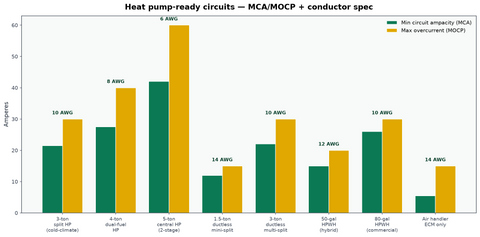
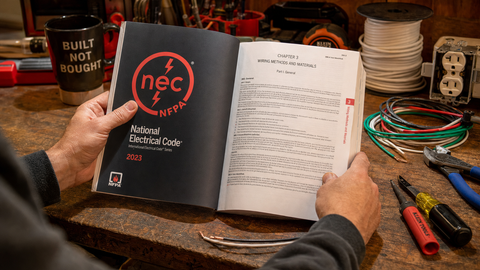
Every condenser nameplate lists MCA (minimum circuit ampacity) and MOCP (maximum overcurrent protection) — those two numbers, not a chart, legally define your wire and breaker per NEC 440. The wire comes from NEC 310.16 ampacity at 75°C; the breaker must be a standard NEC 240.6 size at or under the MOCP. Our NEC wire ampacity chart and wire sizing guide carry the full tables, and we stock breakers and disconnects like the DU221RB safety disconnect for exactly these circuits.
The panel-capacity gotcha on heat-pump conversions
Converting from gas heat to a heat pump often adds an auxiliary heat-strip circuit — 10 kW of strips is a 60-amp 240V circuit on top of the condenser's 30–40 amps. On a 100-amp service, that can tip you into NEC 220 load-calculation failure and a panel upgrade. We've seen $9,000 heat-pump quotes become $13,000 jobs after the electrician opened the panel. Ask for the load calculation in writing before you sign — a 200A service usually swallows it easily; a 100A service deserves the arithmetic.
| Scope | Straight AC Replacement | Heat Pump Replacement | Notes |
|---|---|---|---|
| Condenser + coil swap, like-for-like, 3 ton | $4,500–$7,500 | $5,200–$8,500 | Existing line set and electrical reused |
| Full system: condenser + air handler/furnace + controls | $7,500–$12,000 | $8,500–$14,000 | Matched systems earn their efficiency ratings; mismatched coils lose them |
| Cold-climate heat pump, full system | — | $10,000–$16,000 | Variable-speed inverter equipment costs more, saves more |
| Add: panel upgrade if needed | — | +$2,000–$4,500 | Most common on gas-to-electric conversions with heat strips |
| Add: line set replacement (if contaminated or wrong size) | +$800–$2,000 | +$800–$2,000 | R-410A to R-454B/A2L transitions may force this |
On refrigerants: the industry is mid-transition from R-410A to lower-GWP A2L refrigerants (R-454B and R-32). New equipment increasingly ships A2L-charged; it performs equivalently but requires A2L-rated tools and practices from your installer. Not a reason to delay a purchase — just a reason to hire a crew that's current. On incentives: the federal 25C efficiency credit ended for property placed in service after December 31, 2025; what remains in 2026 is a patchwork of utility rebates (many still offer $300–$1,500 for qualifying heat pumps) and state programs. Check your utility's rebate page before you sign — that money is real and unclaimed more often than you'd think.
Ownership rhythm is nearly identical: change or wash the indoor filter every one to three months (the single highest-leverage thing a homeowner can do — a choked filter kills airflow, freezes coils, and shortens compressor life on both system types), keep two feet of clearance around the outdoor unit, hose the condenser coil gently each spring, and book a professional service annually. The tech's visit should include a refrigerant-charge verification (systems don't "use up" refrigerant — low charge means a leak), capacitor and contactor inspection, condensate drain flush, and amp-draw readings on the compressor and fan against nameplate values.
The heat pump adds two winter-specific habits. First, after defrost cycles in hard cold, check that the unit sits level and the meltwater drains away — a unit that's settled into soft ground pools its own defrost water and ices up. Second, resist the urge to cover the outdoor unit in winter. Heat pumps run all winter and need to breathe; a wrapped unit is a suffocated, sometimes damaged unit. We've unwrapped more than one lovingly tarped heat pump that cooked its own fan motor against the cover. AC-only owners can cover in the off-season if they must, though a simple top board that sheds debris without blocking airflow does the job with less risk.
Lifespan expectations: both systems average 12–15 years, with the compressor usually writing the ending. Variable-speed inverter compressors run gentler duty cycles and often outlast single-stage units, partly offsetting their repair cost risk. Heat pumps accumulate roughly double the annual run hours of a straight AC in the same house — they're working in January when the AC sleeps — so the maintenance discipline matters more. Skip it, and you'll meet the expensive end of the distribution early on either machine.
Choose a straight AC if...
You have cheap natural gas and a furnace with years of life left, you live in a genuinely cold climate (zone 6–7) and don't want dual-fuel complexity, or the price premium buys nothing you'll use. In cooling-dominated climates with cheap gas, a high-EER2 straight AC is a completely respectable choice.
Choose a heat pump if...
You heat with propane, oil, or resistance (the payback is fast and certain), you're in climate zones 1–4 where winters sit in the efficiency sweet spot, you want one system instead of two, or you're planning solar and want to heat with your own electrons. Cold-climate models extend this answer into zone 5–6.
Choose dual fuel if...
You have gas service and real winters. Heat pump carries mild hours at 250–350% efficiency; the furnace covers the balance point below 25–40°F. It's the configuration that hedges both energy-price risk and polar-vortex risk — boring, sensible, and consistently the happiest customers we follow up with.
Is a heat pump as good as an AC at cooling?
Yes — in cooling mode they're the same machine. A heat pump with a given SEER2 cools identically to a straight AC with the same SEER2. The difference only shows up in winter, when the heat pump reverses and heats. If anything, variable-speed heat pumps often dehumidify better because they run longer, lower-speed cooling cycles.
Do heat pumps work below freezing?
Modern cold-climate heat pumps hold 70–80% of rated capacity at 5°F and operate down to -13°F or lower. Capacity and COP do fall as temperature drops — that's physics — which is why zones 6–7 typically pair them with backup heat or choose dual fuel. Zones 1–4 rarely need anything else.
What's the difference between SEER2 and HSPF2?
SEER2 measures seasonal cooling efficiency; HSPF2 measures seasonal heating efficiency. Both are BTU-per-watt-hour figures under the DOE's 2023 M1 test procedure. Heat pumps carry both ratings; straight ACs only need SEER2. Higher is better in both, and the "2" versions run ~4–5% lower than the equivalent old SEER/HSPF numbers for identical hardware.
Is a heat pump cheaper to run than a gas furnace?
Depends on your rates: at COP 3.0, a heat pump at $0.14/kWh delivers heat at about $13.70/MMBTU versus about $12.50 for a 96% furnace at $1.20/therm — near a wash. Against propane at $2.50/gal (~$28.50/MMBTU) or resistance heat (~$41/MMBTU), the heat pump wins by half to two-thirds. Run your actual utility rates through the formulas in this guide.
Do I need to upgrade my electrical panel for a heat pump?
Often not on a 200-amp service. On 100-amp services, adding a condenser circuit plus auxiliary heat strips (a 10 kW strip bank is a 60A circuit) can fail the NEC 220 load calculation and force a panel upgrade. Get the load calc in writing before signing — it's the difference between a $9,000 job and a $13,000 surprise.
How long do heat pumps last compared to ACs?
Both average 12–15 years in the field. Heat pumps run year-round, so they accumulate compressor hours faster — annual maintenance (coil cleaning, refrigerant check, capacitor and contactor inspection) matters more, not less. A maintained heat pump in a moderate climate and a maintained AC-plus-furnace pair land in the same lifespan territory.
Get the circuit right the first time
Condensers, air handlers, disconnects, breakers, and wire — with the MCA/MOCP math done by people who pull these circuits weekly.
Shop HVAC equipmentRelated reading
Sources & standards: DOE appliance efficiency standards (10 CFR 430) and the M1 test procedure; AHRI certification directory data; NEC 2023 Articles 220, 240.6, 310.16, 440; ENERGY STAR cold-climate heat pump criteria. Ratings and prices reflect published documentation and market ranges as of early 2026 — verify current rebate programs and exact equipment ratings before purchase.
Need pricing or availability on anything in this guide?
Portlandia Electric Supply dropships direct from the manufacturer — most items Ship Direct with lead times stated up front, no surprises.
Get a quote from PESBulk, pallet and contractor pricing available.