Last Updated: 2026 • Specs from current EG4 Electronics and BYD Battery-Box documentation • Prices are contractor-class estimates, verify at quote
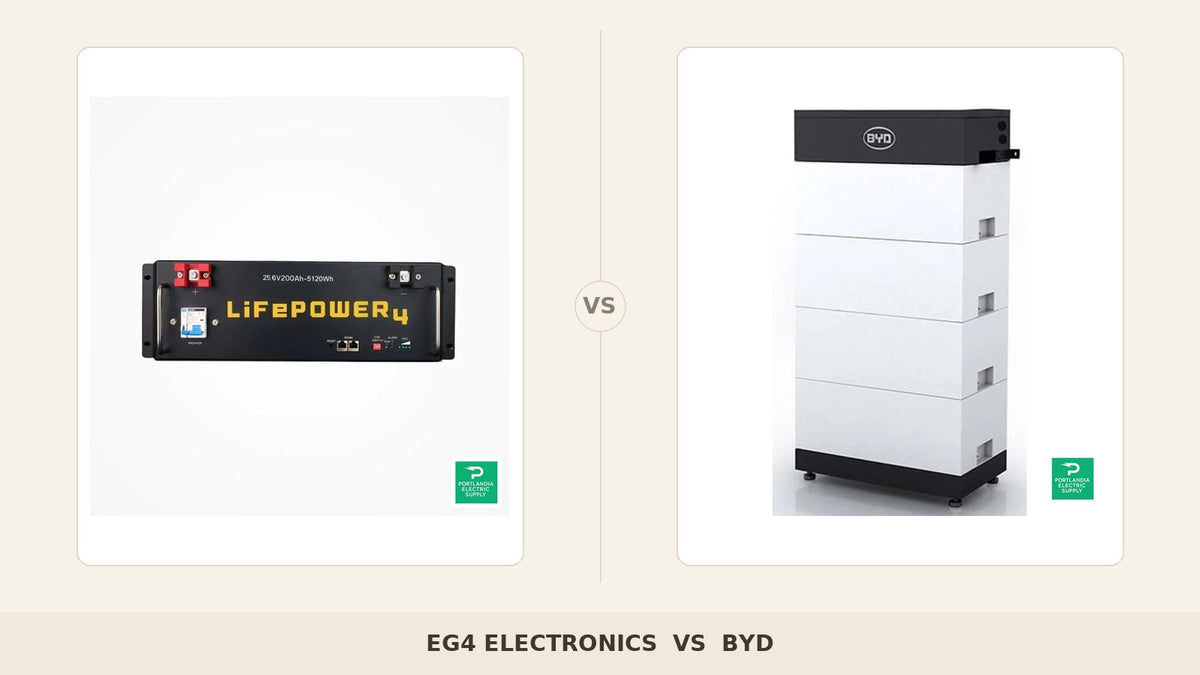
EG4 and BYD solve the same problem from opposite ends of the voltage spectrum. EG4 is the 48V path: 5.12 kWh server-rack LFP modules that pair with the huge North American ecosystem of 48V hybrid inverters — the default for off-grid, backup, and value-driven builds. BYD Battery-Box is the high-voltage path: stackable ~2.76 kWh LFP modules forming 8.3–22.1 kWh floor-standing towers at 153–409V class, engineered for closed-loop pairing with European-style HV hybrids like the Fronius GEN24 and compatible SMA and Sungrow units.
Here's the thing we tell every customer who calls the counter asking "which battery is better": your inverter already answered that question. A 48V hybrid can't see a BYD tower; an HV hybrid can't use an EG4 rack. This matchup is decided by system architecture first, budget second, brand preference a distant third. What follows is the full comparison — specs, scaling behavior, real sizing math, cost per kWh, and the decision rules we use when we quote both options side by side.
⚡ Quick Answer
Choose EG4 if your build runs a 48V hybrid inverter (EG4, Sol-Ark, Schneider, Victron class), if cost per kWh matters, or if the project is off-grid or DIY-friendly — rack modules run roughly $0.20–0.25/Wh at contractor pricing. Choose BYD if the system is built on a certified high-voltage hybrid (Fronius GEN24, compatible SMA/Sungrow), where BYD's closed-loop integration is the engineered pairing. Both are cobalt-free LiFePO4 with ~6,000–7,000-cycle-class longevity and 10-year warranties. You cannot mix the two architectures — pick the inverter first.
| Specification | EG4 Electronics (48V) | BYD Battery-Box (HV) |
|---|---|---|
| Architecture | 48V nominal low-voltage bus (51.2V class) | High-voltage stack, ~153–409V class by tower configuration |
| Chemistry | LiFePO4 prismatic (cobalt-free) | LiFePO4 (cobalt-free) |
| Building block | 5.12 kWh rack module (51.2V 100Ah); also 14.3 kWh wall-mount class | HVM: ~2.76 kWh modules; HVS: ~2.56 kWh modules |
| Scaling | Parallel rack modules to 80 kWh-class banks | HVM towers 8.3–22.1 kWh; HVS towers 5.1–12.8 kWh; towers parallel for more |
| Cycle life | ~7,000 cycles @ 80% DoD class | ≥6,000 cycles class |
| Inverter pairing | CAN/RS485 closed-loop with EG4 hybrids; broad third-party 48V list | Closed-loop with certified HV hybrids (Fronius GEN24, SMA, Sungrow) |
| Form factor | 19-inch server-rack modules — rack, stack, or wall-mount variants | Floor-standing tower, tool-free module stacking |
| Warranty | 10 years (current models) | 10 years class |
| Price class | ~$0.20–0.25/Wh contractor class (~$1,050–1,300 per 5.12 kWh module) | Mid-premium per kWh class |
Why does the industry split at the battery bus? Current. Power is volts times amps, and at 48V a 10 kW discharge pulls over 200 amps — fat copper, serious overcurrent protection, real voltage drop management. High-voltage towers deliver the same 10 kW at a tenth of the current: smaller conductors, less heat, and a couple of points better round-trip efficiency because less energy dies as I²R losses between battery and inverter.
So why does 48V dominate the North American off-grid and backup market? Ecosystem and cost. The 48V hybrid inverter class — Sol-Ark, EG4, Schneider XW, Victron — is broad, mature, DIY-serviceable, and cheap per watt. Rack batteries parallel on busbars with commodity cabling, and a tech with a multimeter and basic training can service the whole system. The HV world is tighter: certified installer commissioning, engineered pairing lists, and premium European hybrids. Neither is wrong. They are different trades.
The efficiency question deserves one honest paragraph, because it's the HV side's best argument. At 48V, every charge and discharge crosses the inverter's low-frequency transformer stage, and the resistive losses in fat battery cables are real — call it a couple of points of round-trip efficiency surrendered versus a well-matched HV stack. Over a 20 kWh bank cycling daily for fifteen years, two points of round-trip efficiency is a few thousand kilowatt-hours of lost throughput. Whether that outweighs EG4's price advantage depends on your electricity value and how hard you cycle — daily-cycling off-grid systems feel it; occasional-backup systems barely notice.
Field note: I've spec'd both architectures into the same neighborhood. The 48V customer was a hands-on rancher who wanted to add a module every year as budget allowed — EG4 rack, no brainer. The BYD tower went to a homeowner with a Fronius GEN24 already on the wall who wanted one clean factory-integrated stack. Both systems are running beautifully, because each battery matched its inverter ecosystem instead of fighting it.
| Inverter Class | Examples | Battery Path |
|---|---|---|
| 48V hybrid (split-phase) | EG4 12000XP / 18KPV / FlexBOSS21, Sol-Ark 12K/15K | EG4 rack/wall-mount (closed-loop CAN) — also compatible with other listed 48V LFP |
| 48V off-grid classic | Schneider XW Pro, Victron MultiPlus/Quattro, Midnite | EG4 or any listed 48V LFP bank |
| HV hybrid (European style) | Fronius GEN24, compatible SMA / Sungrow HV units | BYD Battery-Box HVM/HVS — the engineered closed-loop match |
Check the manufacturer's current compatibility list before you order — closed-loop pairings are firmware-dependent and the lists move. Both EG4 and BYD publish them, and our counter team keeps the current PDFs because "the battery won't talk to the inverter" is a commissioning-day problem nobody wants. If you're building around a specific hybrid, our inverter buyer's guide walks the architecture decision upstream of the battery one.
Battery sizing starts from the loads, not the product page. Take a common target: backing up a home's critical loads — refrigerator, furnace blower, lights, networking, some outlets — averaging 1.2 kW draw with 18 kWh/day of critical-load consumption, with a goal of one full day of autonomy. The math on both platforms:
| Step | EG4 (48V Rack) | BYD HVM Tower |
|---|---|---|
| Daily critical-load energy | 18 kWh | 18 kWh |
| Usable energy per building block @ 90% DoD | 5.12 kWh × 0.9 = 4.6 kWh per module | 2.76 kWh × 0.9 = 2.5 kWh per module |
| Blocks needed for 18 kWh usable | 18 ÷ 4.6 = 3.9 → 4 modules (20.5 kWh nameplate) | 18 ÷ 2.5 = 7.2 → 8 modules (22.1 kWh tower) |
| Round-trip efficiency allowance | ~95% — covered by the 4th module's margin | ~96–97% — covered by tower margin |
| Result | 4× 5.12 kWh rack bank | 1× full HVM 22.1 kWh tower |
Same house, same autonomy target — both platforms land at roughly 20–22 kWh nameplate. The difference is path and price: the EG4 bank is four rack modules on busbars feeding a 48V hybrid; the BYD is one clean tower behind an HV hybrid. Scale the same math to your own numbers with our battery sizing calculator or the full walkthrough in the off-grid battery sizing guide.
Customers consistently overestimate how long a battery bank runs heavy loads. Here's the honest table — usable energy at 90% DoD against continuous load, before inverter losses:
| Usable Bank | 1 kW Load | 3 kW Load | 5 kW Load (central AC class) |
|---|---|---|---|
| ~10 kWh usable (2× EG4 rack / ~4 HVM modules) | ~9.5 hours | ~3.2 hours | ~1.9 hours |
| ~20 kWh usable (4× EG4 rack / 8-module HVM tower) | ~19 hours | ~6.3 hours | ~3.8 hours |
| ~40 kWh usable (8× EG4 rack / 2 towers) | ~38 hours | ~12.7 hours | ~7.6 hours |
Read the right-hand column and internalize it: a single 5 kW central air conditioner cuts a 20 kWh bank to under four hours. This is why whole-home backup designs either load-manage the big 240V appliances or size the bank and inverter around them — and why honest load conversations at the quote stage save angry phone calls during the first real outage.
EG4 scales horizontally. Rack modules parallel onto busbars; a bank grows one 5.12 kWh module at a time, up to 80 kWh-class banks. Per-module pricing makes incremental expansion genuinely cheap — we've watched customers start with three modules and add two more a year later without touching the inverter. The wall-mount 14.3 kWh class units cover the "one box on the garage wall" use case.
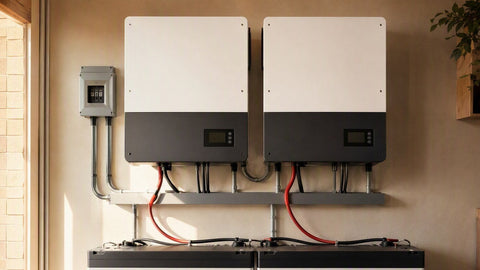
BYD scales vertically. Modules stack tool-free into a tower — HVM from 8.3 to 22.1 kWh, HVS from 5.1 to 12.8 kWh — and towers parallel when you outgrow one. The tower is the cleanest residential form factor in the business: no rack, no busbars, no visible cabling, and a footprint that fits a utility room corner. Expansion happens in 2.76 kWh steps within the tower's capacity, and adding a module later is a stack-and-recommission job rather than a wiring project.
For small-to-mid banks, both work. For large capacity on a tight budget, EG4's per-kWh pricing usually wins. For HV-hybrid system owners, BYD is simply the engineered match — and trying to save money by fighting the architecture costs more in commissioning pain than it saves in hardware.
| Configuration | Nameplate | Typical Contractor-Class Hardware Cost | Effective $/kWh |
|---|---|---|---|
| EG4 rack, 4× 5.12 kWh modules | 20.5 kWh | ~$4,200–5,200 (modules only) | ~$205–255/kWh |
| BYD HVM tower, 8 modules + BCU | 22.1 kWh | Mid-premium tier (quote-specific) | Meaningfully above EG4 per kWh |
| EG4 wall-mount 14.3 kWh class | 14.3 kWh | ~$2,900–3,600 class | ~$205–250/kWh |
The pattern is stable: EG4 runs roughly $0.20–0.25 per watt-hour at contractor class, and BYD prices at a mid-premium tier. At a 20 kWh bank the gap is real money — several thousand dollars of hardware. What the premium buys on the BYD side is the HV tower's efficiency edge, the tool-free form factor, and factory-engineered pairing with the HV hybrid ecosystem. What EG4's price buys is capacity headroom: at the same budget, you carry more kWh. Prices move, so treat these as classes, not quotes — we price both side by side on request, and current stock is in the EG4 and BYD collections.
One total-cost note the per-kWh tables miss: balance of system. The 48V path needs rack hardware, busbars, and heavier-gauge battery cabling — a few hundred dollars of BOS on a typical bank. The HV tower path bundles its racking into the tower itself but usually travels with a premium-priced hybrid inverter. On full installed cost — battery, inverter, BOS, and labor — the gap narrows from the hardware-only comparison, though EG4's value position typically holds at residential scale. We quote it both ways because the honest number is the whole system, not the battery line item.
Off-grid and homestead builds: EG4 country. When there's no grid to lean on, the serviceability and expandability of a 48V rack bank is decisive. Parts are commodity, documentation is deep, and a mechanically inclined owner can add capacity or swap a module without a factory tech. Pair with a 48V hybrid like the EG4 18KPV or Sol-Ark class and the whole system is maintainable with hand tools and a laptop. The LiFePO4 rack ecosystem around 48V is the deepest in the residential market — multiple vendors, interchangeable form factors, competitive pricing pressure that keeps working in the buyer's favor.
Grid-tied backup with European-style hybrids: BYD country. A Fronius GEN24 install with a Battery-Box tower is a factory-integrated appliance — one commissioning flow, one monitoring platform, one warranty conversation. For installers selling premium grid-tied backup, that integration is worth the per-kWh premium because it compresses labor and eliminates finger-pointing between vendors.
Partial-home backup on a budget: EG4 again. Critical-loads panels fed by a 48V hybrid and two to four rack modules deliver the highest backup-hours-per-dollar in the residential market. It's the configuration we quote most, because it's the one where the customer's outage experience per dollar is best.
Space-constrained or aesthetic-sensitive installs: BYD's edge. A tower in a utility room corner beats a rack frame when floor space and clean sightlines matter — condos, finished garages, light commercial.
Both platforms carry 10-year warranties with capacity-retention terms, and both chemistries are LFP with multi-thousand-cycle ratings — but warranty paper only pays if the company behind it answers the phone in year seven. EG4's support reputation in the North American DIY and installer community is built on reachable, US-based technical support; BYD's warranty flows through the certified installer and distributor channel, which suits professionally installed systems. Either way, register the product, keep commissioning records, and buy through an authorized channel — grey-market batteries are where 10-year warranties become 0-year warranties.
Choose EG4 Electronics if:
- The build uses a 48V hybrid inverter — EG4 FlexBOSS21, Sol-Ark 12K, Schneider, or Victron class.
- Cost per kWh is a deciding factor, or you want to expand the bank module by module over time.
- The project is off-grid, DIY-friendly, or needs straightforward service with common tools.
Choose BYD if:
- The system is built on a certified high-voltage hybrid — Fronius GEN24, compatible SMA or Sungrow — where BYD Battery-Box is the closed-loop engineered pairing.
- Form factor and clean installation aesthetics matter (utility room, garage wall, finished space).
- You want the efficiency and conductor-size advantages of the HV bus at residential scale.
Either way, respect the chemistry's operating habits: LFP is happiest cycling mid-band, and the 20–80% rule plus the maintenance habits in our battery life guide will stretch either platform toward its cycle-life rating.
The spec sheets won't tell you what the install day looks like. On the EG4 side, rack builds are honest carpentry: assemble the rack, torque the busbar connections to spec, land the CAN communications, and set the charge profile in the inverter — the FlexBOSS and 18KPV families auto-negotiate closed-loop with EG4 batteries over CAN, which kills most of the commissioning guesswork. Budget a half day for a four-module bank including labeling and a discharge test. Watch two things: keep inter-module cable lengths matched so parallel modules share current evenly, and respect the working clearances — a rack crammed against a wall runs warmer and ages faster.
On the BYD side, the tower assembles tool-free — modules stack and lock, the BCU caps the stack — but commissioning is a certified-installer affair: the HV hybrid must recognize the battery through its pairing procedure, firmware versions on both sides matter, and the whole stack lives or dies on that closed-loop handshake. Budget the install around the inverter manufacturer's checklist, and verify the current compatibility matrix before the truck rolls, not on the customer's Wi-Fi. Done right, it's the cleanest residential battery install in the business; done casually, it's a callback.
Whichever architecture you land on, the electrical fundamentals don't move: NEC 706 covers energy storage systems, 705 covers the interconnection, and the battery circuit conductors and overcurrent protection size from the inverter's maximum continuous current — our NEC compliance guide and battery installation guide cover the code path end to end.
One last decision rule we use at the counter when a customer is truly torn: buy the architecture you can get serviced locally. A slightly better battery five states from the nearest qualified tech loses to a good battery with a two-day parts pipeline. Both EG4 and BYD clear that bar through normal distribution in most of the US — which is exactly why they're the two names in this comparison.
Can I use BYD batteries with an EG4 inverter?
No. BYD Battery-Box HVM/HVS are high-voltage systems (153–409V class) designed for certified HV hybrid inverters such as the Fronius GEN24 and compatible SMA/Sungrow units. EG4 inverters are 48V low-voltage. The architectures are not interchangeable — pick the inverter first and the battery follows.
Which is cheaper per kWh, EG4 or BYD?
EG4, substantially. Rack modules run roughly $0.20–0.25/Wh at contractor-class pricing (about $1,050–1,300 per 5.12 kWh module), while BYD towers price at a mid-premium tier per kWh. At a 20 kWh bank size, the hardware gap is typically several thousand dollars.
Which battery lasts longer?
Effectively a tie. Both are cobalt-free LiFePO4 rated in the ~6,000–7,000 cycle class with 10-year warranties. In typical residential duty — one cycle per day — either platform's rating implies 15+ years of service before warrantied capacity thresholds. Operating habits (depth of discharge, temperature, charge discipline) matter more than the brand at this tier.
Is high voltage better than 48V for home batteries?
Neither is universally better. HV systems carry the same power at lower current — smaller conductors, less heat, a couple of points better round-trip efficiency. 48V systems offer a broader inverter ecosystem, lower entry cost, easier DIY service, and cheap incremental expansion. HV suits premium European-style hybrid installs; 48V suits North American off-grid, backup, and value builds.
How many EG4 modules do I need for whole-home backup?
Size from loads, not product pages. A home with 18 kWh/day of critical loads needs roughly 20 kWh nameplate — four 5.12 kWh EG4 rack modules — for one day of autonomy. Heavy 240V loads like central air change the picture fast: a 5 kW continuous load drains a 20 kWh bank in under four hours, so whole-home designs either load-manage big appliances or size the bank and inverter around them.
Which is more common in the US?
EG4's 48V ecosystem is far more common in North American off-grid and backup builds, driven by the Sol-Ark/EG4/Schneider/Victron inverter base. BYD HV towers appear mostly in European-style hybrid installs through certified HV-inverter installers. Both are proven at scale globally — BYD in HV residential worldwide, EG4 in the North American 48V market.
Both Options. One Quote. Contractor Pricing.
We stock EG4 Electronics and BYD Battery-Box product lines plus the hybrid inverters they pair with — 50,000+ SKUs, 169 brands, nationwide freight from Louisville, KY.
Shop LiFePO4 Batteries Get a Side-by-Side QuoteRelated Guides & Resources
About PES Supply
PES Supply is a nationwide distributor of battery storage, Tier 1 solar panels, hybrid inverters, and complete electrical project kits — 50,000+ SKUs across 169 authorized brands with full OEM warranties and nationwide LTL freight from our Louisville, Kentucky supply house. Phone: 1-888-876-0007 • portlandiaelectric.supply
Sources: EG4 Electronics product documentation (eg4electronics.com); BYD Battery-Box HVM/HVS datasheets (bydbatterybox.com); Fronius GEN24 compatibility documentation.
Disclaimer: Specifications, compatibility lists, and pricing change with firmware and market conditions. Verify current datasheets and inverter compatibility lists before purchase.