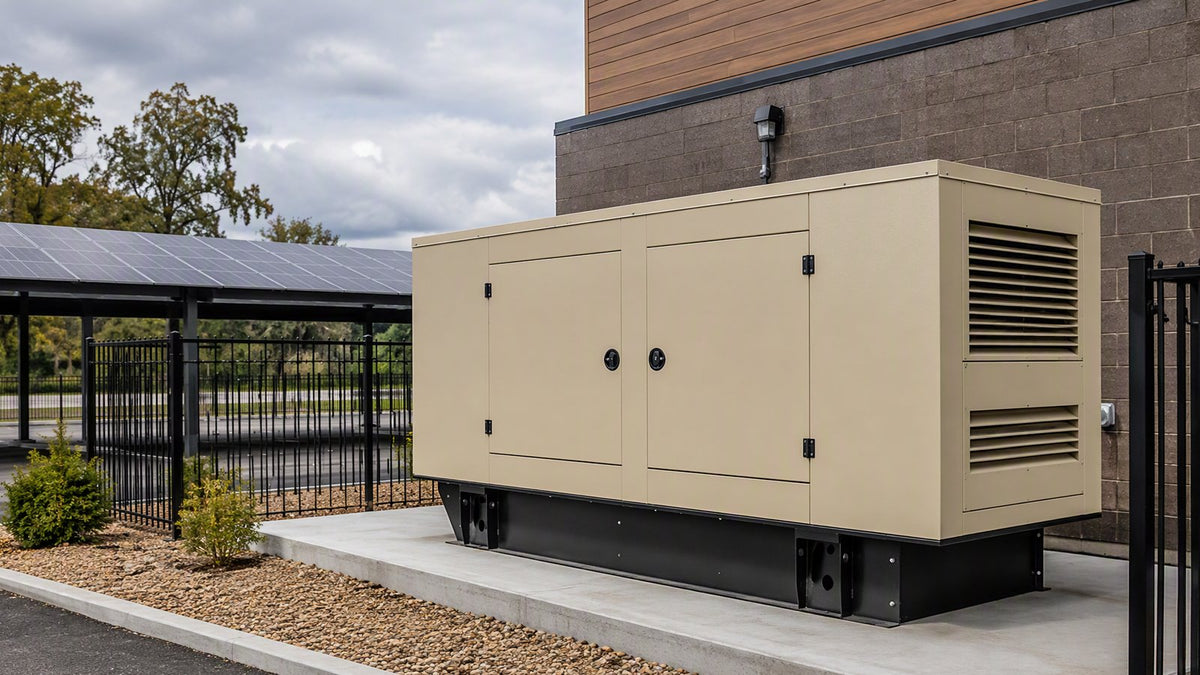
At 125kW you've left the residential world entirely behind. This is the class that keeps grocery stores cold, keeps water-treatment pumps turning, keeps mid-size manufacturing lines alive, and keeps 50-bed medical facilities on the right side of their licensing requirements. I've commissioned 125kW sets for a cold-storage warehouse outside Salem and a regional grocery that lost power for 61 hours during an ice storm — the generator paid for itself in saved inventory before the utility trucks even arrived. This guide covers what 125kW really delivers in amps and fuel, how the load math works, and how to know whether you need this much machine or something closer to the 48kW class.

125kW in Amps: The Number That Matters More Than the kW


Generators in this class are almost always three-phase machines, because the loads they serve are three-phase loads. Here's the amp math, with the NEC 445.13 115% conductor sizing rule applied:
| Voltage / Phase | Full-Load Amps | 115% per NEC 445.13 | Copper THHN (75°C, NEC 310.16) | Breaker (NEC 240.6) |
|---|---|---|---|---|
| 480V / 3-phase | 150 A | 173 A | 3/0 AWG (200 A) | 200 A |
| 208V / 3-phase | 347 A | 399 A | 600 kcmil (420 A) or parallel 4/0 | 400 A |
| 240V / 1-phase | 520 A | 598 A | Parallel 350 kcmil (2 × 350 A) | 600 A |
Two lessons jump out of that table. First, at 480V a 125kW generator is a manageable 200A-class installation — the same wire size as a big residential service. Second, at 208V the same generator is a 400A installation with 600 kcmil copper, and the conduit, labor, and switchgear costs climb fast. If your facility has any choice in the matter, a 480V generator with a step-down transformer for 208/120V loads is usually cheaper to install than a native 208V machine. Verify any feeder run against the NEC wire sizing guide and the NEC ampacity chart before mobilizing the crew.
What 125kW Actually Carries: A Grocery Store Load Study
Abstract kW ratings don't mean much until you see a real load tally. Here's a worked example in the style of an actual survey — a 28,000 sq ft grocery:
| Load | Running kW | Notes |
|---|---|---|
| Medium-temp refrigeration racks (produce, dairy, meat) | 34 kW | Defrost cycles add 12 kW intermittent |
| Low-temp freezer racks | 18 kW | Anti-sweat heaters included |
| HVAC — 4 × 12.5-ton rooftop units | 28 kW | Staged start via load-shed sequence |
| Lighting (LED retrofit, full store) | 9 kW | Down from 22 kW pre-retrofit |
| POS, servers, security, network | 6 kW | UPS-bridged for transfer gap |
| Deli / bakery electric equipment | 14 kW | Ovens load-shed during generator operation |
| Miscellaneous receptacles, signage, office | 5 kW | — |
| Design running load | ~102 kW (82% of rating) | ~86 kW (69%) with load shedding active |
With the load-shed sequence engaged — ovens off, HVAC stages staggered 30 seconds apart — the store runs at about 69% of the generator's rating, right in the efficient band. Without shedding, it's at 82%, which works but leaves less headroom for a hot afternoon when every refrigeration rack calls at once. That store rode out the 61-hour outage I mentioned at about 71% average load, burned roughly 390 gallons of diesel, and lost zero inventory while competitors within a mile wrote off entire freezer cases.
Fuel Consumption and Runtime Planning
Class-typical consumption figures for a 125kW machine (confirm against your model's spec sheet — engine choice swings these numbers):
| Load Level | Diesel (gal/hr) | Natural Gas (cu ft/hr) | Propane LP (gal/hr) |
|---|---|---|---|
| 100% (125 kW) | ~9.4 | ~1,800 | ~18.0 |
| 75% (94 kW) | ~7.3 | ~1,450 | ~14.2 |
| 50% (63 kW) | ~5.2 | ~1,100 | ~10.1 |
| 25% (31 kW) | ~3.1 | ~720 | ~6.4 |
Checked math on storage: a 500-gallon diesel sub-base tank holds about 475 usable gallons. At 75% load (7.3 gal/hr) that's 475 ÷ 7.3 ≈ 65 hours; at 50% load, about 91 hours. Most commercial diesel installs in this class add an external day tank or a 1,000-gallon skid to reach the 72–96 hour autonomy that insurers and emergency plans increasingly demand. Natural gas removes the storage question entirely but introduces a dependency question: at ~1,800 cu ft/hr full load, you need a utility capacity letter confirming the meter and lateral can deliver — and you need to know whether your gas utility keeps pressure during regional emergencies.
The Sizing Decision: Where 125kW Fits
| Class | Sweet Spot | Move Up When |
|---|---|---|
| 48kW (guide) | Small commercial, estates, medical/dental | Running load exceeds ~33 kW |
| 60kW / 80kW | Mid-size commercial, churches, small schools | Multiple large HVAC units plus refrigeration |
| 100kW | Restaurants, small grocery, light industrial | Design load above ~70 kW |
| 125kW | Grocery, cold storage, manufacturing, mid-size medical | Design load above ~90 kW, or growth planned |
| 150kW / 200kW | Industrial plants, big-box retail, hospitals | — |
The rule of thumb I use on site: size the generator so your design running load lands between 50% and 75% of rating. Below 40%, diesels wet-stack and gaseous engines glaze; above 85%, you're one hot afternoon from a protective shutdown. 125kW is the answer for design loads in the 65–90kW band — below that, look at the 100kW class; above it, step to 150kW and revisit the feeder math.
Demand Factor and the NEC 220 Reality Check
Customers regularly hand me a panel schedule that sums to 160kW and ask for a 175kW generator. Almost always, the right answer is 125kW — because panel schedules sum nameplate ratings, and nameplate ratings ignore diversity. NEC Article 220 exists precisely because real buildings never run everything at once: receptacle loads apply demand factors after the first 10 kVA, kitchen equipment gets Table 220.56 factors, and HVAC doesn't run concurrently with electric heat. On the grocery example above, the raw panel sum was 141kW; the demand-factored design load was 102kW; the shed-managed running load was 86kW. Each layer of honest analysis shrank the generator. A contractor who sizes off the panel sum is selling you 30% more machine than you need — and an oversized diesel that spends its life at 25% load is a maintenance problem, not a bargain.
The cleanest data source is your utility's interval data — most commercial meters record 15-minute demand peaks, and twelve months of that data shows your true worst hour. I ask for it on every commercial quote. If the utility won't share it, a week with a power logger on the mains during your busiest season tells you the same story. Either way, measure before you buy.
Specifying the Unit: Options That Actually Matter
The quote for a 125kW set will come with an options sheet, and some lines matter far more than others:
- Block heater: Not optional in any climate that sees freezing weather. A cold 6.8L diesel at 15°F without a block heater is a coin flip at the moment you need it most. Specify a thermostatically controlled heater and verify it's on during every winter inspection.
- Sound enclosure level: Standard weather enclosures run loud — 78–82 dB at 23 feet. Level 2 or Level 3 sound packages bring that to 68–72 dB, which is the difference between a permit approval and a variance hearing in most municipalities.
- Alternator upsizing / motor-starting kVA: The engine kW rating and the alternator's starting kVA are different specs. If your load tally includes big across-the-line motor starts, ask for the sub-transient reactance numbers and confirm the voltage dip at starting stays under 15% — sensitive electronics start misbehaving beyond that.
- Battery chargers and dual batteries: NFPA 110 Level 1 requires redundant battery systems on emergency sets; even on optional-standby installs, a quality float charger is the cheapest reliability insurance on the options sheet.
- Remote monitoring: Cellular monitoring that reports run status, fuel level, and fault codes pays for itself the first time it catches a failed battery charger in October instead of during the ice storm in January.
Paralleling, Redundancy, and the N+1 Question
At 125kW you're at the threshold where paralleling two smaller units — say, two 60kW or 80kW sets — becomes a legitimate alternative to one big machine. The argument for paralleling is redundancy: a refrigeration-heavy business that loses everything when the generator fails gets N+1 protection, and each unit can be serviced without taking the facility dark. The argument against is complexity and cost: paralleling switchgear, synchronization controls, and double the maintenance typically add 40–60% over the single-unit price.
My rule of thumb after years of these conversations: if the load includes life-safety equipment or inventory worth more than the paralleling premium, parallel. A cold-storage warehouse holding $400,000 of product should not hang on a single alternator. A machine shop that loses an afternoon of production can live with one well-maintained unit and a service contract with a 4-hour response guarantee.
Emissions Tiers and What They Mean for Used Equipment

New diesel stationary generators in the US are built to EPA Tier 4 Final for prime-rated units, while emergency-standby sets are generally certified under Tier 2 or Tier 3 allowances depending on horsepower and use — the exact tier affects whether you can legally run the unit for demand response or peak shaving. This matters if you're shopping the used market, where 125kW-class sets from the 1990s and 2000s trade at attractive prices: an older Tier 0 or Tier 1 unit may be restricted to emergency-only operation with strict annual hour limits, and some air districts (California's CARB most aggressively) won't permit them at all. I've watched buyers win an auction at $18,000 and then spend $9,000 discovering they couldn't permit the machine. Verify the emissions tier against your air district's rules before you bid, and if you plan any non-emergency running — peak shaving, demand response programs — say so up front, because it changes the engine you need.
Installation and Code: Where 125kW Gets Serious
- Transfer equipment: At 480V you're buying a 200–400A service-rated ATS; at 208V you're in 400–600A territory. Look at 400A+ transfer switches and, for whole-service transfers, service-entrance-rated automatic transfer switches. In this class, electronically actuated breakers with programmable transition delays are worth the money — inrush on transfer can nuisance-trip uncoordinated gear.
- NFPA 110: If the generator serves life-safety loads (egress lighting, fire pumps, medical gas), it's an emergency system under NEC 700 and NFPA 110, and the Level (1 or 2) dictates everything from battery charger specs to weekly inspection logging. Don't discover this at the final inspection.
- Load shedding: Almost every 125kW install I approve includes at least two stages of load shedding — priority loads and deferrable loads. It lets a smaller, cheaper generator do the job and keeps operating loads in the efficient band.
- Emissions and permitting: Diesel sets over certain thresholds trigger air-quality permits in many states; Oregon's DEQ and Washington's Ecology both have specific stationary-source rules. Gaseous units generally slide through with less paperwork.
- Concrete and crane: These units weigh 6,000–10,000 lbs. The pad is engineered, the delivery is a crane pick, and both belong in the budget from day one.
Maintenance at the 125kW Level
| Interval | Task | Field Note |
|---|---|---|
| Weekly | Exercise run + inspection log (NFPA 110 if applicable) | Log every run — inspectors ask for the book |
| Monthly | Fluid levels, battery load test, block heater check | Block heater failure is the classic winter no-start |
| Every 250–500 hrs / annually | Oil, filters, coolant analysis | Coolant analysis catches liner cavitation early on diesels |
| Annually | Load-bank test at 50–75% for 2–4 hours | Non-negotiable for units that rarely see real load |
| Every 2–3 years | Batteries, belts, hoses; diesel fuel polishing | Stored diesel needs polishing; algae clogs filters mid-outage |
Cost Picture
Equipment-only for the 125kW class typically runs $35,000–$60,000 depending on fuel, voltage, enclosure, and emissions package. Fully installed — pad, crane, fuel system, transfer switchgear, feeders, permits, and engineering — projects commonly land between $70,000 and $130,000, with 208V installs at the top of the range because of the heavier copper and switchgear. Operating cost at 75% load is roughly $29/hour on diesel at $4/gal, $16–20/hour on typical commercial natural gas rates, and around $50/hour on propane at $3.50/gal. Over a 20-year life, fuel and maintenance dwarf the purchase price — pick the fuel for the outage profile you actually face.
Ten-Year Ownership Cost: Diesel vs. Natural Gas
Purchase price gets all the attention, but the decade view tells the real story. Here's a modeled comparison for a typical commercial duty cycle — 30 outage hours per year, weekly exercise, scheduled maintenance — using class-typical consumption and average 2026 fuel costs. Your numbers will vary; the structure of the math won't:
| Cost Line (10-Year) | Diesel | Natural Gas |
|---|---|---|
| Equipment (typical, installed delta) | $48,000 | $52,000 |
| Fuel — outage running (300 hrs @ 65% avg load) | ~$7,800 | ~$5,900 |
| Fuel — weekly exercise (520 hrs @ ~15% load) | ~$2,700 | ~$2,300 |
| Maintenance contract | $18,000 | $15,000 |
| Fuel polishing / tank testing | $4,000 | — |
| 10-year total | ~$80,500 | ~$75,200 |
The totals land within 7% of each other, which surprises people — but the risk profiles don't. Diesel's exposure is storage management; natural gas's exposure is utility dependency during regional disasters. In the Pacific Northwest, where our worst outages come with ice storms that can also interrupt gas distribution, I lean diesel for refrigeration-critical sites and natural gas for everything else. Your region's failure modes should drive this choice more than the spreadsheet does.
Altitude, Temperature, and Derating
Nameplate kW assumes sea level and moderate ambient temperature. Real sites derate. Naturally aspirated gaseous engines lose roughly 3–4% of output per 1,000 feet of elevation; turbocharged diesels lose less but still derate 1–2% per 1,000 feet above their rating altitude, and all engines lose output as intake air temperature climbs — typically about 1% per 10°F above 77°F. Put those together for a site at 4,500 feet on a 100°F day and a naturally aspirated 125kW gas unit can be effectively a 105kW machine. I've had exactly one customer get burned by this — a mountain resort that bought to nameplate and discovered the shortfall on the first hot holiday weekend — and once was enough for both of us. If your site sits above 2,000 feet or sees summers over 95°F, run the derate math before you sign.
Transfer Time and Sensitive Loads
A standard open-transition ATS transfers in about 10 seconds after the generator stabilizes — fine for refrigeration and HVAC, potentially not fine for the server rack, the POS system, or the MRI-adjacent imaging gear. The architecture that works: UPS units bridge the transfer gap for electronics (even 5 minutes of UPS runtime covers any transfer scenario), while the generator carries the heavy mechanical loads. Closed-transition and soft-loading transfer switches exist for facilities that can't tolerate even a momentary blip — hospitals, data rooms, some manufacturing — but they cost multiples of an open-transition switch and require utility approval for momentary paralleling. Most 125kW commercial customers are best served by open transition plus targeted UPS coverage, and I say that having quoted both.
The Commissioning Day Checklist
Commissioning is where a 125kW project proves itself or exposes every shortcut. The sequence I insist on: megger and continuity tests on the feeders before energizing; torque verification on every lug with a calibrated wrench; ATS transition test under actual building load, not just a control-power simulation; a full-load run of at least two hours with fuel consumption logged against the spec sheet; and a failover drill where the building engineer — not the commissioning tech — operates the system. That last one matters. The fanciest generator in the county is a sculpture if the person on call at 2 a.m. doesn't know how to read its alarms. I've made customers run the drill twice, and nobody has ever complained afterward.
Why Facilities Choose 125kW: The Performance Profile
Three characteristics define this class. First, voltage regulation: quality 125kW sets hold steady-state voltage within ±1% and recover from a 50% load step in under two seconds, which keeps building automation systems and VFDs from faulting during the messy first minute of an outage. Second, motor-starting capability: with a properly specified alternator, a 125kW machine can deliver 300+ starting kVA, enough to start a 40-horsepower across-the-line motor without blinking. Third, durability: engines in this class — the 6.7L to 9.0L diesels and their gaseous counterparts — are industrial blocks with 20,000+ hour overhaul intervals when maintained. You're buying a machine whose engine will likely outlast the building's roof.
Frequently Asked Questions
What size building can a 125kW generator run? Typically 20,000–45,000 sq ft of commercial space, depending on refrigeration and HVAC intensity. The deciding factor is the design running load: 125kW fits loads in the 65–90kW band.
How much diesel does a 125kW generator use? Class-typical figures are ~9.4 gal/hr at full load, ~7.3 at 75%, and ~5.2 at half load. A 500-gallon sub-base tank provides roughly 65 hours at 75% load.
Can a 125kW generator run on natural gas? Yes. Most manufacturers offer gaseous configurations in this class, consuming roughly 1,800 cu ft/hr at full load. Confirm gas meter and lateral capacity with the utility before committing.
What wire size does a 125kW generator need? At 480V three-phase: 3/0 copper with a 200A breaker after applying NEC 445.13's 115% rule. At 208V three-phase: 600 kcmil copper (or parallel 4/0) with a 400A breaker.
Is 125kW single-phase or three-phase? Almost always three-phase in this class. Single-phase 125kW machines exist but are rare, expensive to wire (520A full-load at 240V), and usually the wrong tool.
How much does a 125kW generator cost installed? Typically $70,000–$130,000 all-in, depending on voltage, fuel system, transfer switchgear, and permitting requirements.
125kW is a serious commitment of capital, concrete, and copper — get the load study right and everything downstream falls into place. The stores, warehouses, and shops that come through multi-day outages without losing a dollar of inventory all share one trait: somebody did the load math honestly, sized the fuel storage against the region's real outage history, and maintained the machine on schedule. Our team at Portlandia Electric Supply works these calculations with contractors and facility managers every week; bring us your interval data and load list, and we'll help you land on the right class, whether that's 125kW or something smaller like the 60kW or 80kW machines.