A 100 kW standby generator is not a typical suburban purchase. It is what we quote for 10,000-square-foot estates, small clinics, working farms, and light-commercial buildings that cannot tolerate a dark afternoon. At this size you are in liquid-cooled, three-phase-capable, permit-and-engineering territory — and the buying process is closer to speccing a piece of industrial equipment than picking a portable off a pallet. We have kitted and shipped dozens of 100 kW-class Cummins packages, and this guide walks the exact sequence our team uses: fuel choice, the specs that matter, installation planning, maintenance reality, and what the whole thing costs.

Key Takeaways
- 100 kW is the crossover class: liquid-cooled engines, permanent concrete pads, engineered gas plumbing or large propane storage, and a service-rated automatic transfer switch — usually 400A or larger.
- Natural gas is the default fuel where a utility line exists; propane wins where it does not, but fuel storage sizing drives the design.
- Budget $45,000–$85,000 fully installed for a 100 kW package in 2026, depending on fuel system, transfer equipment, and site work.
- The generator is the easy part. The gas supply, the pad, the ATS, and the permits are where schedules and budgets slip.
Why Cummins for a 100 kW Home Generator
In the 100 kW class, the shortlist is genuinely short: Cummins, Generac Industrial, Kohler, and a handful of others. Cummins earns its place on our trucks for three reasons. First, the service network — Cummins has one of the deepest authorized dealer and parts networks in North America, which matters enormously when a unit throws a fault code at 11 p.m. during an ice storm. Second, the PowerCommand control platform is a mature, genuinely serviceable ecosystem; our technicians can pull event logs and exercise history without proprietary gymnastics. Third, parts commonality: Cummins engines and Stamford-type alternators share components across the range, so filters, sensors, and wear items are shelf parts, not six-week specials.
That said, brand loyalty should never override the site math. We have talked customers out of 100 kW entirely — a 26 kW unit plus a battery does more for less on many large homes; see our 26 kW generator guide before you assume bigger is the answer. And if you are still in the sizing stage, start with what generator size do I need rather than this page.
Fuel Options: Natural Gas vs. Propane for 100 kW

Fuel choice is the first real decision, and it is made by your address more than by your preferences. A 100 kW unit at full load burns on the order of 900–1,400 cubic feet of natural gas per hour or roughly 10–14 gallons of propane per hour, depending on the specific engine and load — always verify against the data sheet of the exact model you are quoting, because consumption varies meaningfully between engines. Those numbers drive everything downstream: gas meter sizing, propane tank sizing, and runtime planning.
| Attribute | Natural Gas | Propane (LP) | Dual-Fuel Configurations |
|---|---|---|---|
| Fuel supply | Utility line; requires adequate pressure and meter capacity | On-site tank; sized for desired runtime | Field-selectable on many 100 kW-class sets |
| Full-load consumption (typical) | ~900–1,400 ft³/hr | ~10–14 gal/hr | Per selected fuel |
| Half-load consumption (typical) | ~500–800 ft³/hr | ~6–8 gal/hr | Per selected fuel |
| Output derate | Baseline rating | Usually 5–10% below NG rating | Follows selected fuel |
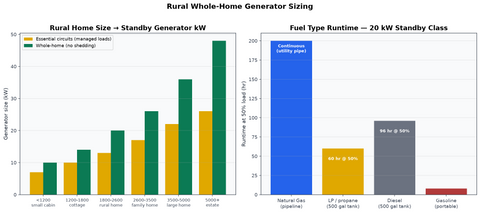
| Runtime limit | Effectively unlimited (utility-dependent) | Tank capacity — a 500-gal tank (~400 gal usable) gives roughly 1.5–3 days at half load | Flexible |
| Fuel system cost | Lower if service exists; meter/regulator upgrades can add $1,000–$5,000 | Tank(s), regulators, trenching: $3,000–$12,000+ | Modest premium |
| Outage resilience | Fails if utility gas fails (rare, but happens in disasters) | Independent of all utilities | Best of both |
| Maintenance impact | Cleanest burning; longest oil life | Clean burning | Same as selected fuel |
The natural-gas trap we see on almost every big residential job: the existing meter and service line cannot feed a 100 kW engine plus the house's existing gas appliances. A 100 kW unit can demand more gas than the rest of the house combined. The utility may need to upsize the meter, the regulator, or the service line — sometimes free, sometimes a $5,000 line item and a six-week wait. We call the gas utility before the customer signs anything. I've watched a $70,000 install sit idle for eight weeks because nobody checked meter capacity until the startup tech asked for full load and the engine starved.
Key Specifications to Compare Across 100 kW Models
Spec sheets at this class run two pages. These are the lines that actually decide the purchase:
| Specification | What to Verify | Why It Matters |
|---|---|---|
| Standby vs. prime rating | Confirm the kW is a standby (emergency) rating; prime ratings are lower | A "100 kW" prime-rated unit is really a ~110 kW standby unit — pricing comparisons get distorted |
| Voltage and phase | 120/240V single-phase vs. 208V or 480V three-phase | Most homes need single-phase; three-phase units are cheaper used but useless without phase conversion |
| Motor-starting kVA / voltage dip | Published motor-starting capability and acceptable voltage dip (e.g., ≤20–30% dip at stated kVA) | Decides whether your 5-ton AC or well pump starts on generator without dimming the whole house |
| Alternator type | Brushless, dedicated winding, permanent-magnet excitation | Better motor starting and cleaner waveform for electronics |
| Total harmonic distortion | <5% THD at rated linear load | Protects sensitive electronics, VFDs, and solar hybrid inverters sharing the bus |
| Sound level | dBA at 23 ft (7 m) under load, with enclosure specified | 60–70 dBA is the working range; zoning and neighbors care |
| Enclosure rating | Aluminum vs. steel, wind rating, corrosion protection | Coastal and snow-belt sites need the right package |
| Controller | PowerCommand or equivalent with remote monitoring, exercise scheduling, event logs | You will diagnose the unit remotely far more often than you will stand next to it |
| Emissions certification | EPA stationary emergency certification; state rules (California) vary | Determines what you can legally install and run for non-emergency hours |
| Warranty | Years, hours, and what voids it (missed maintenance, non-emergency use) | Five-year/2,000-hour class warranties are standard; read the exclusions |
Sizing Verification: Does 100 kW Actually Fit the Load?
Before you commit, run the load math. At 240V single-phase, 100 kW is roughly 416 amps of capacity — but what matters is what starts simultaneously. The table below is the worksheet format our estimators use:
| Load | Running Watts (typical) | Starting Surge (typical) | Load-Management Strategy |
|---|---|---|---|
| 5-ton central AC | ~6,000W | 15,000–25,000W (soft-start cuts this 60–70%) | Soft starter + staged start |
| Second 5-ton AC | ~6,000W | 15,000–25,000W | Stagger 30+ seconds behind first |
| Electric range | 3,000–12,000W | None | Load-shed module if needed |
| Electric water heater | 4,500W | None | Load-shed priority 2 |
| Well pump (2 HP) | ~2,000W | 5,000–7,000W | Dedicated start window |
| Pool equipment | 2,000–3,500W | Moderate | Sheddable |
| EV charger (48A) | 11,500W | None | Shed first, always |
| Lighting + receptacles + refrigeration | 3,000–6,000W | Compressor surges ~1,200W each | Never shed |
Add the running watts of everything that must run together, then add the single largest starting surge. If the total sits comfortably under 80% of rated output — 80 kW for a 100 kW set — you are sized correctly. Consistently loading a diesel or gaseous engine below 30% of rating creates its own problems (wet stacking on diesels, poor ring seating on gaseous units), so grossly oversizing is not free either. The whole-home generator sizing guide and our kilowatt-hours to amps reference make the arithmetic painless.
Installation Planning: Site Selection, Permits, and Transfer Switch

The Pad and the Placement
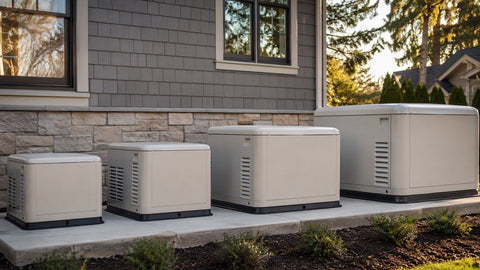
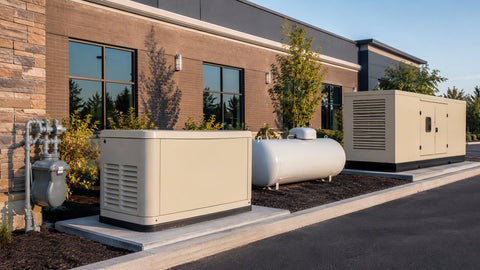
A 100 kW package weighs 4,000–7,000 pounds wet. It goes on a poured or precast concrete pad, engineered for the weight and any seismic or wind zone requirements, with clearances per the installation manual — typically 3–5 feet on service sides, more at the exhaust. Placement rules come from NEC 445, NFPA 37 (installation of stationary combustion engines), and the manufacturer: minimum distances from windows, doors, vents, and combustible walls are hard requirements, and CO detector placement inside the home is standard practice for good reason. We also verify the exhaust points away from operable windows and that snow drift patterns in the site plan will not bury the intake.
Transfer Switch and Interconnection
At 100 kW you are almost always looking at a 400A service-rated automatic transfer switch — or a pair of 200A ATS units splitting the load — plus load-shed modules for the big discretionary circuits. Browse 400A+ transfer switches and automatic transfer switches to see the class of equipment involved. The ATS senses utility loss, signals the generator to start, waits for stable voltage and frequency, then transfers — typically 10–30 seconds from outage to restored power. NEC 702 governs the installation; the interconnection must make utility and generator physically incapable of paralleling, full stop. Our service upgrade guide covers the panel side when the existing service equipment cannot accept the switchgear.
Permits and Inspections
Expect, at minimum: an electrical permit, a mechanical/plumbing permit for the gas work, and in many jurisdictions a zoning or setback review for the pad. HOA approval is its own timeline — start it the day you order. Inspections typically cover the pad and anchoring, the gas line pressure test, the electrical rough-in, and a final witnessed startup and transfer test. Budget four to twelve weeks of total project timeline; the generator itself is rarely the long pole.
Performance, Emissions, and Noise Considerations
Liquid-cooled 100 kW sets run at 1,800 RPM — slower, quieter, and longer-lived than the 3,600 RPM air-cooled units in the 10–26 kW class. Sound-attenuated enclosures bring most packages into the low-to-mid 60s dBA at 23 feet, roughly conversation volume. On emissions: stationary emergency generators carry EPA certification that permits unlimited emergency runtime but sharply limits non-emergency operation (demand response, peak shaving) — read the rules before planning revenue-grade grid services. Weekly self-exercise, typically 12–20 minutes unloaded or under building load, keeps rings seated and oil circulated; schedule it mid-morning when it disturbs nobody.
Maintenance, Warranties, and Service Network
A 100 kW engine is a commercial engine and wants commercial maintenance. The schedule below reflects typical manufacturer intervals — always follow the specific unit's manual:
| Interval | Service Task |
|---|---|
| Weekly (automatic) | Self-exercise cycle; verify via remote monitoring that it ran |
| Monthly | Visual inspection: leaks, rodent damage, coolant and oil levels, enclosure condition, battery voltage |
| Every 6 months or 100–150 hours | Oil and filter change (follow manual; some engines stretch to 200 hours), fuel system check |
| Annually | Full service: plugs (gaseous), air filter, coolant test, belt inspection, valve lash check where specified, battery load test, transfer-test under load |
| Every 2–3 years | Coolant replacement, thermostat, battery replacement (budget every 3–4 years regardless), ATS contact inspection and exercise |
| Every 5 years | Full fluid and wear-item overhaul; consider professional load-bank test to verify rated output |
Two field notes from our service customers. First, the battery kills more generators than any engine fault — a $200 battery on a $50,000 machine. Load-test it annually and replace on schedule. Second, propane regulators and gas valves want exercise too; a unit that only self-runs unloaded for years can stumble when finally asked for real load. An annual under-load transfer test is the cheapest insurance in the whole system. Stock the consumables ahead of time from our maintenance kits and coolant shelves so a scheduled service never waits on freight.
Smart Integration, Monitoring, and Solar + Battery Coexistence

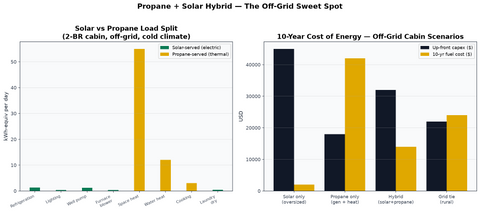
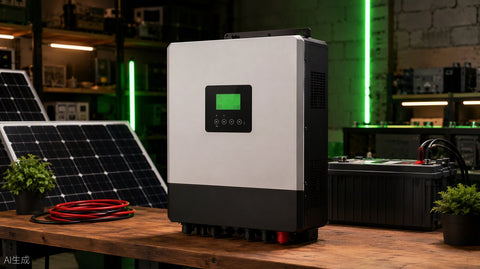
Modern 100 kW packages ship with cellular or Ethernet monitoring — fault codes, exercise logs, fuel status, and runtime hours on your phone. More interesting is the integration question we now get on nearly every estate job: can the generator coexist with solar and batteries? Yes, with planning. The generator and the battery system must agree on who is the grid — typically the battery's hybrid inverter islands first, the generator connects as an AC source behind it, and the inverter throttles or curtails solar so the generator is never backfed. NEC 705.12 interconnection math and UL 1741 SB functionality govern the details; the energy storage overview and our wire sizing guide for solar and generator installations cover the electrical side. Done right, solar handles daily economics, the battery handles the first hours of any outage, and the generator starts only for extended events — cutting runtime, fuel cost, and maintenance hours by 80% or more.
Cost, Financing, and ROI
All-in 2026 budgeting for a turnkey 100 kW Cummins-class installation:
| Line Item | Typical Range | What Moves It |
|---|---|---|
| Generator package (enclosed, with controller) | $28,000 – $42,000 | Enclosure level, voltage configuration, emissions package |
| Transfer switchgear (400A class + load management) | $4,000 – $10,000 | Single 400A vs. dual 200A, service-rated vs. subpanel style |
| Pad, placement, and crane/set | $2,500 – $7,000 | Access, engineered pad requirements, crane day |
| Gas work (NG service upgrade or LP tanks) | $1,000 – $12,000 | Meter/service capacity, tank size and count, trench distance |
| Electrical labor and materials | $6,000 – $14,000 | Run lengths, panel condition, conduit method |
| Permits, engineering, inspections | $800 – $3,500 | AHJ and state requirements |
| Turnkey total | $45,000 – $85,000 | Site work dominates the spread |
Financing through home-improvement or equipment lenders is routine at this price, and some insurers discount premiums for permanently installed standby power. The ROI case is not bill savings — a standby generator never pays for itself in kilowatt-hours. It pays in avoided losses: a flooded basement from a dead sump pump, a spoiled walk-in, a canceled event, a home office dark for a week. On rural estates where outages run long, the arithmetic gets easy fast.
What Is New in 2025–2026: Trends in the 100 kW Class
| Trend | What Is Changing | Owner/Installer Benefit |
|---|---|---|
| Hybrid integration | Factory-supported generator + battery + solar architectures | Generator runs only on extended outages; fuel and maintenance costs drop sharply |
| Remote fleet monitoring | Cellular telemetry standard, dealer-facing diagnostic portals | Faults get diagnosed before the truck rolls |
| Quieter enclosures | Improved attenuation packages at 1,800 RPM | Easier zoning approvals, happier neighbors |
| Load-management intelligence | ATS-level smart shedding of EV chargers, water heaters, and second ACs | Smaller generator covers bigger apparent loads |
| Alternative gaseous fuels | Growing interest in renewable natural gas compatibility | Future-proofs fuel supply where available |
What Commissioning Day Looks Like

Startup on a 100 kW set is a scheduled event, not a switch flip — budget a full day with the installing electrician, the gas fitter, and ideally the dealer's commissioning tech. The sequence we follow: verify oil, coolant, and battery charge; verify gas pressure at the unit under static and cranking conditions (this is where undersized gas lines reveal themselves — pressure that holds static but collapses under cranking means the meter or line is too small); crank and verify oil pressure and stable idle; step the unit to rated speed and check voltage and frequency at no load; then close the ATS under building load and watch voltage dip as the big loads come online. We log every reading. The exercise clock gets set for a mid-morning weekday slot, remote monitoring gets registered and tested with a forced fault, and the owner gets walked through the controller, the weekly exercise expectation, and the one rule that matters: never work on the unit with the controller in AUTO, because AUTO means it can start while your hands are inside it.
Five Mistakes That Sink 100 kW Projects
1. Skipping the gas utility call. Already covered above, but it bears repeating because it remains the number-one schedule killer: confirm meter and service capacity in writing before ordering.
2. Buying three-phase because the deal was good. Used 208V three-phase units flood the market at tempting prices. Serving a single-phase residential service from one requires either a phase converter (expensive, lossy) or rewiring the building (absurd). Match the voltage configuration to the service, every time.
3. Undersizing the ATS. A 100 kW set feeding a 400A service needs service-rated 400A transfer equipment or a properly engineered dual-200A arrangement. Lighter switchgear fails inspection and, worse, fails in service.
4. Ignoring sound and placement until after the pour. The pad location is permanent. Verify setback, exhaust direction, window distances, and neighbor sightlines before the concrete truck is scheduled, not after.
5. No under-load testing after commissioning. A generator that only ever self-exercises unloaded can hide weak batteries, sticky governors, and marginal fuel delivery for years. One genuine transfer test under real building load each year is the cheapest diagnostic there is — schedule it with the annual service.
Noise, Zoning, and the Neighbor Problem
At 100 kW, sound stops being a footnote. Even a sound-attenuated package in the low-60s dBA at 23 feet is a steady industrial hum that carries across open lots at night, and the weekly exercise cycle runs whether anyone is watching or not. Three moves keep projects out of trouble. First, site the unit with sound in mind from day one: exhaust and radiator discharge pointed away from bedrooms and property lines, solid fencing or landscape berms on the neighbor side, and maximum practical distance — sound drops roughly 6 dB per doubling of distance. Second, check the local noise ordinance before finalizing placement; many jurisdictions set residential nighttime limits at 50–55 dBA at the property line, and some require acoustic analysis for equipment in this class. Third, schedule exercise for mid-morning weekdays, when ambient noise masks it and nobody is asleep. I have mediated exactly one generator-neighbor dispute, and the fix — relocating a set after the pad was poured — cost more than the pad. Aim the exhaust thoughtfully the first time.
Working With Dealers, Installers, and the Utility
A 100 kW project has four counterparties, and sequencing them correctly is half the job. The dealer quotes and supplies the package and holds the warranty relationship; the installing electrician and gas fitter execute; the gas utility confirms service capacity (in writing, early); and the AHJ permits and inspects. Get the dealer's installation manual to the electrician and the gas fitter before anyone mobilizes — the manual specifies gas pressure and flow requirements, pad dimensions, clearances, and electrical terminations, and it settles arguments before they start. On the warranty side, register the unit at commissioning and calendar the maintenance intervals the same day; most warranty disputes we have watched trace back to undocumented maintenance, not manufacturing defects. A folder with the manual, the commissioning log, and every service record is worth real money at resale, too — buyers pay for documented machines. Keep the folder with the electrical panel, tell the next owner where it lives, and add a page for every annual service the day it happens.
Sizing the Gas Line: The Detail That Decides the Schedule
Since fuel supply is the make-or-break line on every 100 kW project, the working details deserve their own space. For natural gas, the unit's data sheet specifies required inlet pressure (typically 5–14 inches water column at the unit, depending on model) and full-load flow; the gas fitter sizes the run from the meter to hold that pressure at full flow across the actual pipe length and fitting count, which is why long runs jump a pipe size. For propane, the constraint is vaporization: a cold tank in January delivers less vapor than a warm one, and a 100 kW engine at full load can out-pull the vaporization capacity of a single 500-gallon tank in cold weather — which is why northern installs get multiple manifolded tanks or larger vessels. Neither of these is exotic engineering, but both are exactly the sort of detail that a rushed site survey skips and a startup day exposes. Get the gas fitter the data sheet on day one, not on commissioning morning.
Frequently Asked Questions
What loads can a 100 kW Cummins generator power?
Roughly 416 amps at 240V single-phase — enough for a very large home with two or three central air conditioners, a well pump, electric cooking, and general circuits, provided big loads start in a managed sequence. With load-shed modules on discretionary circuits like EV charging and water heating, a 100 kW set covers estates and light-commercial buildings comfortably.
How long does a Cummins 100 kW generator last?
Liquid-cooled 1,800 RPM sets in this class routinely deliver 10,000–20,000 hours with proper maintenance — decades of standby duty at typical residential outage rates. The limiting factors are usually maintenance discipline, battery replacement, and environmental corrosion, not engine wear.
Do I need a permit to install a 100 kW standby generator?
Yes — expect an electrical permit, a gas/plumbing permit, and often a zoning or setback review, plus a witnessed startup and transfer test at final inspection. HOA approval, where applicable, runs on its own clock; start it early.
What is the difference between a transfer switch and an automatic transfer switch (ATS)?
A manual transfer switch requires you to be present to start the generator and throw the switch. An ATS senses the outage, starts the generator, waits for stable output, and transfers the load automatically — then reverses the process when utility power returns. For a permanently installed standby system, the ATS is what makes it "standby."
Can a 100 kW Cummins generator work with a solar + battery system?
Yes, and it is an increasingly common architecture. The battery and its hybrid inverter island the home first; the generator connects as a managed AC source and runs only when the battery needs support. Coordination settings must prevent backfeed into the generator and comply with NEC 705 interconnection rules.
How much fuel does a 100 kW generator use?
Typical full-load consumption runs about 900–1,400 cubic feet per hour of natural gas or 10–14 gallons per hour of propane, with half-load figures around 55–65% of that. Always verify against the specific engine's data sheet before sizing meters, regulators, or tanks.
Ready to Source Your 100 kW Generator?
We quote complete 100 kW-class packages — generator, ATS, pad hardware, and maintenance consumables — with freight coordinated to your site. Start at 100 kW generators or the broader Cummins generators and natural gas / propane generator collections, and loop our team in early on the gas-supply question — it is the line item that sets your timeline. If 100 kW turns out to be more machine than the load math supports, the 22 kW class and whole-house generator guide cover the smaller end of standby power.