🇺🇸/🇲🇽 Versión en español →

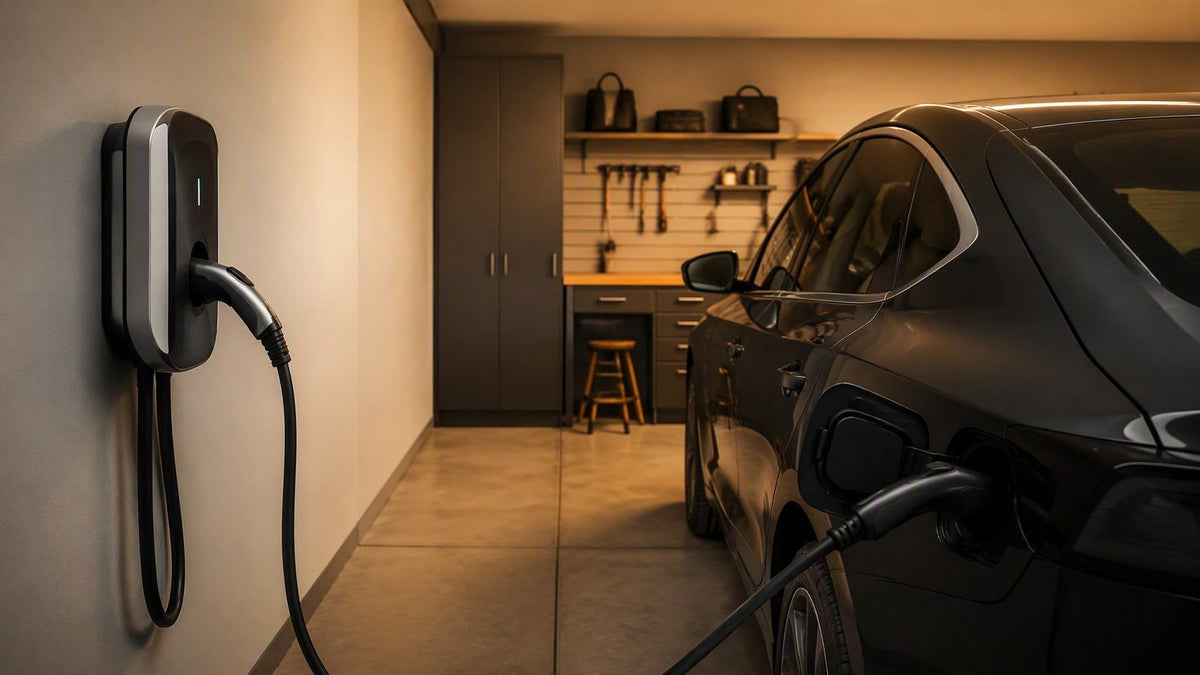
"EV charger" covers everything from a $200 portable cord to a six-figure DC fast charging site, and most buyer confusion starts with mixing those categories. This guide is for contractors and informed homeowners speccing Level 2 residential and light-commercial charging — the 240V equipment that handles 90%+ of daily EV charging in North America. I sized a 48A charger circuit last month for a Tesla Model Y in Beaverton where the homeowner's 200A panel had exactly one slot left — the load calc passed by 400W, which is closer than I like to cut it, but it worked. We cover the amperage decision and the NEC continuous-load math behind it, plug-in versus hardwired, panel capacity and load management, the J1772-to-NACS connector transition as it stands in 2026, outdoor ratings, incentive status, and what a legitimate install quote should itemize. For equipment, browse our EV charger collection and Level 2 chargers.
Ready to install? Browse home EV fast chargers (240V) or get an install-ready quote.
Spec Sheet — Level 2 Charging at a Glance
- Sweet spot: 32–40A charger (7.7–9.6 kW) replaces ~250 miles overnight — covers almost every driver
- NEC rule: continuous load → circuit = 125% of charger output · 48A charger needs a 60A breaker
- Connection: EV-rated NEMA 14-50 with GFCI breaker up to 40A · hardwire at 48A and above
- Connector (2026): buy native — NACS (SAE J3400) for most new EVs, J1772 for pre-transition vehicles
- 100A panel pinch: load management (NEC 625.42 / 220.57) routinely saves $1,500–$3,000 vs a service upgrade
Level 1 is a 120V cord plugged into a standard receptacle — 3–5 miles of range per hour, fine for plug-in hybrids and emergency use only. Level 2 is 208–240V AC charging at 16–80 amps, adding roughly 12–60 miles of range per hour depending on amperage and the vehicle's onboard charger — this is the home and workplace standard. DC fast charging (DCFC) bypasses the vehicle's onboard charger and feeds DC directly to the battery at 50–350 kW — highway corridor and fleet infrastructure, not something you install in a garage. Everything below is about Level 2.
EV charging is a continuous load under the NEC (it can run at full current for 3+ hours), so NEC 210.19(A) and 210.20(A) require the circuit to be sized at 125% of the charger output. This is the single most misunderstood spec in the category — a "48-amp charger" cannot go on a 50A breaker. I've seen homeowners buy a 48A unit and try to land it on their existing 50A range circuit; the inspector red-tagged it before I even pulled my meter out.
| Charger Output | Required Breaker | Min Wire (Cu, 75°C) | Approx. Power (240V) | Range Added / Hour |
|---|---|---|---|---|
| 16A | 20A | 12 AWG | 3.8 kW | ~12–14 mi |
| 24A | 30A | 10 AWG | 5.8 kW | ~18–22 mi |
| 32A | 40A | 8 AWG | 7.7 kW | ~25–30 mi |
| 40A | 50A | 6 AWG | 9.6 kW | ~30–37 mi |
| 48A | 60A | 6 AWG | 11.5 kW | ~37–44 mi |
| 64A | 80A | 4 AWG | 15.4 kW | ~50–55 mi |
| 80A | 100A | 3 AWG | 19.2 kW | ~60+ mi |
Practical guidance: 32–40A covers overnight charging for almost every driver (a 10-hour night at 32A replaces ~250 miles). Step to 48A only when the vehicle can accept it (many onboard chargers cap at 32–40A — check the car, not just the wall unit) and the panel has headroom. 80A units are for trucks with large batteries, dual-charger setups, and small fleets, and they demand a 100A dedicated circuit. Wire sizing follows the breaker: 6 AWG copper for a 60A circuit, 8 AWG for 40–50A in most conduit runs — and don't forget breakers from our circuit breaker collection need to match the panel brand and the GFCI requirement below. For longer runs, voltage drop becomes the deciding factor, not just ampacity.
NEC 310.16 gives you the ampacity table, but for EV chargers the real-world limiting factor is often voltage drop. A 48A charger pulling 11.5 kW at 240V will drop significant voltage over a long garage run, and the EVSE may throttle or fault if supply voltage sags below ~208V. We size for 3% drop max on branch circuits per NEC 210.19(A)(1) Informational Note No. 4. Here's what that looks like in practice for a 240V circuit:
| Breaker Size | Wire Gauge | Max Run (3% drop) | Max Run (5% drop) | Application |
|---|---|---|---|---|
| 40A | 8 AWG Cu | ~55 ft | ~90 ft | 32A charger, detached garage |
| 50A | 6 AWG Cu | ~70 ft | ~115 ft | 40A charger, standard run |
| 60A | 6 AWG Cu | ~55 ft | ~90 ft | 48A charger, up to 55 ft |
| 60A | 4 AWG Cu | ~90 ft | ~145 ft | 48A charger, long run |
| 80A | 4 AWG Cu | ~65 ft | ~110 ft | 64A charger, standard |
| 100A | 3 AWG Cu | ~75 ft | ~125 ft | 80A charger, heavy duty |
Last summer I ran a 4 AWG THHN pull through 1-inch EMT for a 48A JuiceBox install where the panel was 110 feet from the garage — the voltage drop calc came in at 2.8%, and the unit has been fault-free since. If you're eyeing a run over 75 feet, upsize the wire one gauge or plan on 4 AWG minimum for any 48A+ install. Browse AWG 4 wire and AWG 6 wire options for your project.
- Plug-in (NEMA 14-50): A 50A receptacle limits you to 40A continuous. Advantages: the charger is portable and swappable, installation is cheaper when a 14-50 already exists, and some inspectors prefer the visible disconnect. Requirements: NEC 625.54 mandates GFCI protection for the receptacle (a GFCI breaker — notably more expensive than a standard 2-pole), and you should spec an EV-rated receptacle — standard range outlets overheat and fail under nightly 40A continuous duty. This is a real and documented failure mode. We've replaced three melted 14-50s in the Portland metro in the past two years where homeowners used standard range receptacles.
- Hardwired: Required above 40A continuous (48A+ chargers), cleaner for outdoor pedestal mounts, eliminates the receptacle failure point, and often avoids the GFCI breaker cost since most hardwired EVSE has integral ground-fault protection (CCID20). Check local code — some jurisdictions require a local disconnect for hardwired EVSE above 60A.
Field default: hardwire anything 48A and up; a quality EV-rated 14-50 is acceptable at 40A and below where flexibility matters. For hardwired outdoor installs, our NEMA-rated cords and connectors can supplement the main run.
Before quoting, run the NEC 220.83 optional-method load calc with the EV circuit added. The worksheet we use in the field:
- General load: square footage × 3 VA + 1,500 VA per small-appliance circuit + 1,500 VA laundry.
- Fixed appliances at nameplate: range, dryer, water heater (if electric), dishwasher, disposal.
- Diversify: first 10 kW at 100%, remainder at 40%.
- HVAC: 100% of the larger of heating or cooling.
- Add the EV circuit at 100% — continuous loads get no diversity. A 48A charger adds 11.5 kW, full stop.
- Compare against service size: 200A service ≈ 48 kW theoretical, ~38 kW practical ceiling; 100A service ≈ 24 kW theoretical, ~19 kW practical.
| Service Size | Heat Type | Typical Diversified Load | Max EV Charger | Recommendation |
|---|---|---|---|---|
| 200A | Gas | 12–18 kW | 48A (11.5 kW) | Fits with margin; straightforward permit |
| 200A | Electric | 22–28 kW | 32–40A (7.7–9.6 kW) | Load calc required; consider load management |
| 100A | Gas | 10–14 kW | 32A (7.7 kW) | Usually passes; 48A often fails calc |
| 100A | Electric | 16–22 kW | Load-managed only | Assume failure; use EVEMS or upgrade service |
What the worksheet says in practice: a 200A service with all-gas appliances typically has 15–20 kW of headroom. An all-electric 200A home with heat pump, induction range, and electric dryer can push past 25 kW diversified, leaving tight margin for a 48A charger. We always run the numbers before ordering equipment — saves everyone a return trip.
When the panel fails the load calc, an Energy Management System (EVEMS) or a dedicated load-management device is usually the cheapest code-compliant fix. NEC 625.42 and 220.57 recognize these systems, and most AHJs now accept them:
- Dedicated relay devices (e.g., DCC-9 / DCC-10 / DCC-12 class): a current transformer on the service conductors watches total house load and interrupts or throttles the EV circuit when the panel approaches capacity. Charging pauses during dinner-prep peaks and resumes automatically overnight. Typical installed cost $800–$1,500 — versus $2,500–$6,000+ for a service upgrade.
- Smart EVSE with integral power sharing: chargers that measure panel or circuit load directly and throttle output in real time. Cleanest retrofit when the charger is being bought anyway; also the right answer for two-EV households sharing one circuit.
- Smart-panel breakers / whole-panel systems: the premium path — per-circuit metering and control of the entire panel. Makes sense when other electrification loads (heat pump, induction range, water heater) are coming in the next few years.
The selling point to homeowners is simple: the car still charges fully overnight because household peak load and charging hours almost never overlap. The compromise is invisible in practice. Pairing load management with a Fortress Power Avalon 7.6kW ESS gives you whole-home backup plus intelligent load management in one install.
The connector landscape has settled: the Tesla-developed connector is now the SAE J3400 (NACS) standard, and nearly every major automaker shipping new EVs in North America has transitioned or committed to native NACS ports. Legacy J1772 vehicles remain a large installed base. The 2026 landscape:
| J1772 | NACS (SAE J3400) | |
|---|---|---|
| Vehicle base (2026) | Pre-transition EVs and most PHEVs — large installed base, shrinking new sales | Tesla plus most new North American EVs from transitioned brands |
| Max Level 2 power | 19.2 kW (80A) | 19.2 kW (80A) — same AC ceiling |
| DC fast charging access | CCS1 networks; NACS Supercharger access via adapter where enabled | Native Supercharger access; CCS via adapter |
| Adapter strategy | NACS-to-J1772 adapter for destination charging | J1772-to-NACS adapter covers legacy public Level 2 posts |
| Buy guidance | If the current car is J1772, buy J1772 native + keep a NACS adapter | Default for new purchases; future-proofs the install for the next vehicle |
Buyer's guidance: buy the connector your current vehicle uses natively — NACS for most new EVs, J1772 for pre-transition vehicles — and keep a quality adapter for the other standard rather than paying a premium for dual-cord units. Many current EVSE models ship either way or with replaceable cables. Our Enphase HCS-40R plug-in solution and SolarEdge HD-WAVE with integrated EV charging both support native NACS cables.
Charger enclosures carry NEMA ratings that matter more than marketing suggests. NEMA 3R is rain-resistant — adequate under an eave or in a carport. NEMA 4 (or 4X) is hose-directed-water and corrosion resistant — the correct spec for an exposed exterior wall or pedestal. Also verify the operating temperature range (quality units run -22°F to 122°F), a 23–25 ft cable (NEC 625.17 caps cords at 25 ft and longer cables reach the next parking spot anyway), and holster/cable-management hardware that keeps the connector off the ground. For outdoor pedestal installs, pair with a Generac service-rated transfer switch if you're integrating with a standby generator system.
Two updates every buyer should know. First, the federal 30C alternative fuel refueling credit expired for property placed in service after June 30, 2026 under the 2025 budget reconciliation law — installs completed before that date may still qualify for 30% up to $1,000 (residential, eligible census tracts); have customers confirm their situation with a tax advisor. Second, utility rebates remain the better deal in most markets: many utilities offer $250–$1,500 per residential Level 2 install, plus ongoing bill credits for enrolling in managed-charging programs that let the utility throttle charging during peak events. State programs stack in CA, CO, NY, and the Northeast. Contractors who lead with the utility rebate paperwork close more jobs.
When comparing electrician bids — or writing your own — every line below should be explicit:
- Load calculation (NEC 220.83) with the EV circuit added, and the resulting amperage decision
- Permit and inspection fees, included — an unpermitted charger install is a resale and insurance liability
- Breaker: type (GFCI where required), brand matched to the panel, amperage per the 125% rule
- Wire gauge, conduit type, and linear footage of the run — distance is the biggest cost variable after panel work
- Receptacle (EV-rated 14-50) or hardwire connection, plus disconnect if required locally
- Load management device, if the panel can't support the circuit outright
- Commissioning: Wi-Fi setup, amperage dial/breaker-matching configuration, firmware update, and a labeled directory card
Typical all-in installs run $400–$800 for a garage-adjacent panel with existing capacity, $1,200–$2,500 for long runs or load-managed 100A panels, and $2,500+ when a service upgrade is genuinely required. A quote that is one line — "EV charger install, $1,900" — tells you nothing and should be re-itemized before signing.
Run the load calculation
Use NEC 220.83 optional method. Add the EV circuit at 100% of nameplate — no diversity for continuous loads. Confirm the service has headroom or specify a load-management device.
Size the breaker and wire
Breaker = 125% of charger output. 48A charger = 60A breaker. Size wire per NEC 310.16 at 75°C column, then check voltage drop for the actual run length. Upsize one gauge if the run exceeds 75 feet.
Pull permits
Every jurisdiction requires an electrical permit for a new 240V circuit. Some also require a separate EVSE permit. Schedule the inspection before closing walls — the inspector will want to see the breaker, wire labeling, and grounding.
Install the circuit
Run appropriate conduit (EMT for garages, PVC Schedule 40 for underground). Keep the EV circuit dedicated — no taps, no shared neutrals. Bond the EMT at both ends. Use an EV-rated NEMA 14-50 receptacle if plug-in, or whip directly to the EVSE terminal block if hardwired.
Connect and commission
Set the EVSE amperage dip-switch or app setting to match the breaker (not the charger output — the breaker size). Update firmware. Test at full load for 30 minutes and verify the breaker temperature stays under 40°C above ambient. Hand the homeowner the commissioning sheet and the rebate paperwork.
Field takeaway: Match the charger to the car's onboard limit, size the circuit at 125% of output (48A needs a 60A breaker), hardwire above 40A, run the 220.83 calc before promising anything on a 100A panel, and buy the connector standard the vehicle actually has. The 30C federal credit is gone for new installs — sell the utility rebate instead. For backup power integration, pair your EV charging circuit with a Fortress Power Avalon ESS or browse our generator collection for whole-home standby options.
Is a 40-amp or 48-amp charger better for home use?
For most drivers, the difference never matters: 40A adds ~30–37 miles per hour and 48A adds ~37–44, and both refill a full night easily. Choose 48A only if your vehicle's onboard charger accepts 48A (many cap at 32–40A) and your panel has the headroom for a 60A breaker. Otherwise 40A on a 50A circuit — or 32A on a 40A circuit — is the value answer.
Can I install a Level 2 charger on a 100A panel?
Often, yes — at reduced amperage or with load management. A 32A charger on a gas-heat 100A home usually passes the NEC 220.83 load calc. Where it fails, a load-management device (NEC 625.42 / 220.57) throttles charging during household peaks and typically costs $1,500–$3,000 less installed than a service upgrade.
Is it cheaper to plug into a NEMA 14-50 or hardwire?
Plug-in is cheaper when a 14-50 already exists, but a new plug-in install needs a GFCI breaker (NEC 625.54) and an EV-rated receptacle, which narrows the gap. Hardwiring eliminates the receptacle failure point, is required above 40A continuous, and often avoids the GFCI breaker cost via the EVSE's integral CCID20 protection. Hardwire at 48A and up; either is acceptable below.
Do I need a GFCI breaker for an EV charger?
For a plug-in install, yes — NEC 625.54 requires GFCI protection for the receptacle, which means a GFCI breaker. For hardwired EVSE, most units include integral CCID20 ground-fault protection, so a standard breaker is typically acceptable. Verify the charger's listing and your AHJ's interpretation.
Should I buy a J1772 or NACS charger in 2026?
Buy the connector your current vehicle uses natively. NACS (SAE J3400) is the default for most new North American EVs and future-proofs the install; J1772 is correct for pre-transition vehicles. A quality adapter for the other standard costs far less than a dual-cord premium unit.
How much does a Level 2 charger installation cost in 2026?
Typical all-in: $400–$800 for a garage-adjacent panel with spare capacity, $1,200–$2,500 for long runs or load-managed 100A panels, and $2,500+ when a service upgrade is genuinely required. Utility rebates of $250–$1,500 apply in many markets; the federal 30C credit has expired for property placed in service after June 30, 2026.
What wire gauge do I need for a 48A EV charger?
Per NEC 310.16, 6 AWG copper THHN at 75°C is rated for 65A — sufficient for a 60A breaker feeding a 48A charger. For runs over 55 feet, upsize to 4 AWG to keep voltage drop under 3%. Aluminum is not recommended for EV circuits below 100A due to termination-compatibility issues with most EVSE terminals.
Can I share a 50A circuit between an EV charger and a welder?
No. NEC 625.40 requires the EV charging circuit to be dedicated — no shared loads, no taps. The rationale is simple: the EVSE expects the full circuit ampacity and will pull continuous current for hours. A welder's intermittent duty cycle is irrelevant; the inspector will flag any shared circuit.
- NEC Article 625 — Electric Vehicle Power Transfer System (nfpa.org)
- NEC Article 210.19(A), 210.20(A) — Branch circuit sizing for continuous loads
- NEC Article 310.16 — Ampacities for conductors rated 0–2000 volts
- UL 2594 / UL 2231 — EV Supply Equipment safety standards (ul.com)
- SAE J1772 / SAE J3400 — EV conductive charge coupler standards
- U.S. DOE Alternative Fuels Data Center — EV charging resources (energy.gov)
Ready to price your project? Quote My System — free from PES. Explore our EV charger catalog, solar panel selection, or battery storage systems to build your complete energy solution.