Updated September 2026 — content reviewed and refreshed by the PES team. For current pricing and availability, see the linked product pages or request a quote.
Harnessing AI and IoT: Transforming Solar Energy Production and Efficiency
~16 min read · PES Supply technical editorial

Strip away the buzzwords and "AI in solar" comes down to something every installer already understands: a system that tells you it's sick before the homeowner calls. The IoT side is sensors and data loggers bolted to real hardware — inverters, combiners, batteries, weather stations. The AI side is software that reads that data stream and answers three questions a human can't answer at scale: Is this array producing what it should today? Which component will fail next? What should the battery do in the next four hours?
We've built and serviced enough systems to have strong opinions here. The technology genuinely changed the economics of O&M and fleet management. It also spawned a lot of dashboard theater. This guide separates the two: what AI and IoT actually do inside a working PV system in 2026, the protocols and hardware that carry the data, the math behind forecasting and fault detection, and where the honest limits sit.
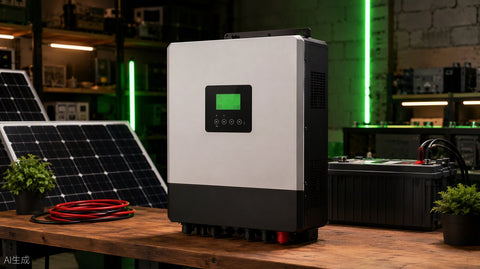
PES Supply stocks the connected hardware this stack runs on — smart inverters, MPPT charge controllers with data logging, battery systems with CAN-bus telemetry, and monitoring-capable transfer equipment — 50,000+ SKUs from 169 authorized brands, delivered in 7–10 business days.
Every "smart" solar feature starts with a sensor and a wire (or a radio). The measurement layer of a modern PV system is more granular than most owners realize:
| Measurement Point | Typical Sensor / Source | Sample Rate | What It Catches |
|---|---|---|---|
| Module/string DC voltage & current | Inverter MPPT inputs, optimizer telemetry | 1–15 min | String mismatch, shading, diode failure, soiling |
| Inverter AC output (V, A, W, PF, Hz) | Inverter metering chipset | 1–60 s | Grid faults, clipping, curtailment events |
| Cell/module temperature | Back-of-module RTD or estimate from Voc | 5–15 min | Thermal derating, hot-spot precursors |
| Battery voltage, current, SoC, temp | BMS over CAN/RS485 | Seconds | Cell imbalance, over-discharge, failing strings |
| Irradiance (W/m²) | Pyranometer or reference cell | 1–5 min | Performance ratio baseline |
| Ambient temp, wind, rain | Weather station or API feed | 5–60 min | Soiling estimates, storm response |
| Consumption metering | CT clamps at service entrance | 1–60 s | Self-consumption ratio, load profiles |
The protocols doing the hauling are unglamorous and decades-proven: Modbus RTU/TCP for inverter and meter data, CAN bus for battery BMS traffic, SunSpec models riding on top so a SolarEdge inverter and a Victron charge controller speak the same register language, and MQTT or HTTPS pushing it all to the cloud. When we design a system around an EG4 18kPV or a Victron SmartSolar MPPT, the telemetry spec sheet matters as much as the power spec sheet — a controller that won't export data is a controller you can't manage remotely.
Raw watts mean nothing without a baseline. The workhorse metric is the performance ratio (PR) — actual AC energy divided by the theoretical energy the array should produce given measured irradiance:
Performance ratio, worked example
An 8.4 kW array on a day with 5.2 kWh/m² of measured irradiance: theoretical DC harvest ≈ 8.4 × 5.2 = 43.7 kWh. Measured AC output: 33.9 kWh. PR = 33.9 ÷ 43.7 = 0.776 — a 77.6% performance ratio, which is a normal, healthy figure for a grid-tie string system (most run 0.75–0.85). If that same system prints PR = 0.61 next month with similar weather, something changed — and the monitoring platform's job is to flag it before the owner notices a higher utility bill.
This is where AI earns its keep. A threshold alarm ("production below X") cries wolf on every cloudy Tuesday. A learned baseline — trained on the system's own history, corrected for irradiance and temperature — only alarms when the system underperforms its own demonstrated capability. Modern platforms from SolarEdge, Enphase, EG4's monitoring portal, and third-party fleets tools all do some version of this; the difference between them is mostly how well they handle weather normalization.
| Alert Type | Dumb Threshold | AI-Normalized | False-Alarm Rate |
|---|---|---|---|
| Low production | Fires on any low-output day | Compares vs. weather-expected output | High → Low |
| String mismatch | Requires manual data review | Flags one string deviating from siblings | Medium → Low |
| Soiling | Invisible until severe | Tracks slow PR decay over weeks | N/A → actionable |
| Clipping | Often mistaken for healthy peak | Recognizes flat-top signature at high irradiance | Medium → Low |
The highest-ROI AI application in solar is boring: predicting component failure from drift in the telemetry. Three patterns dominate field data:
- Diode and junction-box degradation shows up as a string whose voltage sags under thermal stress before it fails open. Machine-learning models catch the sag signature weeks before the string drops out entirely.
- Inverter fan and capacitor wear correlates with internal temperature rise under identical load. A unit running 6°C hotter than its own baseline at the same output is telling you something — usually that its cooling path is clogged or a capacitor bank is aging.
- Battery cell imbalance is visible in per-cell or per-module voltage spread long before the BMS starts throwing faults. Catching it early means a balancing cycle; catching it late means a warranty RMA and a dead rack unit. Our server-rack battery lines expose per-module telemetry precisely because this data saves packs.
I've been on the receiving end of both versions. A fleet monitor flagging "inverter #4 trending hot" costs a filter cleaning and a ladder. The same inverter dying unannounced in August costs a truck roll, a week of downtime, and a customer who now checks their app every morning with suspicion. Predictive maintenance isn't futuristic — it's a scheduling advantage.
Production forecasting combines satellite weather data, on-site irradiance history, and the array's derate profile to predict tomorrow's harvest within a few percent. Pair that with consumption forecasting and rate schedules, and the battery stops being a dumb bucket:
| Strategy | Rule-Based Controller | AI-Optimized Controller | Typical Annual Delta |
|---|---|---|---|
| Self-consumption | Charge when surplus, discharge when deficit | Weights weather forecast + load prediction | +3–6% solar value |
| Time-of-use arbitrage | Fixed charge/discharge schedule | Learns rate windows, pre-charges before peak | +8–15% bill savings on TOU rates |
| Demand-charge management (commercial) | Discharge at fixed kW threshold | Predicts demand peaks, shaves precisely | +10–20% demand savings |
| Storm prep / backup reserve | Static reserve SoC | Raises reserve when severe weather is forecast | Availability when it matters |
The 20/80 cycling discipline matters here too — see our breakdown of the 20/80 battery rule for why smarter charge windows extend pack life. A controller that knows tomorrow is cloudy keeps the reserve higher; a controller that knows a heat wave is coming pre-cools the house on cheap midday solar instead of 5 PM peak-rate grid power. None of this is science fiction — hybrid inverters like the Sol-Ark 12K and the EG4 12kPV already expose the scheduling hooks, and platforms layer the intelligence on top.
Fleet-scale AI gets the headlines, but three diagnostic technologies do the physical verification work. Thermal drone surveys image every module from the air and flag cells running hotter than their neighbors — the classic hot-spot and failed-bypass-diode signature. What used to take a technician a full day with a clamp meter now takes a 20-minute flight and a software pass that geo-tags every anomaly on the array map. IV-curve tracing goes deeper electrically: a tracer sweeps a string through its operating range and compares the measured curve against the expected shape, exposing resistance faults, shading damage, and module degradation that voltage-current snapshots miss. And on the software side, computer-vision models trained on millions of thermal frames now classify faults automatically — hot cell, hot junction box, string outage, diode failure — instead of dumping raw images on a technician's desk.
The economics only work when detection connects to dispatch. A thermal report that sits in a folder saved nobody anything. The mature workflow is: platform flags PR decay → drone or tracer confirms the physical fault → truck rolls once, with the right part on board. That closed loop is where AI diagnostics actually pay for themselves.
The expensive failures in solar are rarely sudden. Panels degrade at roughly 0.4–0.6% per year; soiling steals 2–7% depending on climate and cleaning cadence; connectors corrode a tenth of an ohm at a time. None of these trip an alarm by themselves. All of them show up as a gently sloping performance-ratio line that a weather-normalized model separates from noise.
Soiling economics, worked example
A 10 kW system producing 14,000 kWh/year at $0.16/kWh is worth $2,240 annually. Five percent soiling loss is $112/year. If a professional cleaning costs $250, cleaning purely for energy value never pencils — but if soiling is concentrated (bird nesting under one edge, pollen season on a low-tilt array) the local loss can hit 15% of one string, and targeted cleaning suddenly makes sense. The monitoring data tells you which situation you're in; a calendar reminder cannot.
Long-horizon degradation modeling matters at warranty time too. A system with 12 years of clean telemetry and a demonstrated degradation rate of 0.7%/year on one string is a documented warranty claim. A system with no baseline is an argument. We tell every customer the same thing: the monitoring subscription feels optional in year one and priceless in year nine.
5. Grid-Scale AI: VPPs, DERMS, and Smart Inverter Functions

Above the fence line, the same stack scales up. Aggregators bundle thousands of residential batteries into virtual power plants (VPPs) that bid into utility demand-response markets; utilities run DERMS (distributed energy resource management systems) that dispatch fleets during peaks. UL 1741 SB smart inverters made this physical — volt-var and frequency-watt functions let the grid lean on distributed solar instead of fighting it. IEEE 1547-2018 is the interconnection standard underneath, and every inverter we stock in the inverter catalog at this point carries the grid-support certification.
For the homeowner the practical translation is simple: your battery may earn demand-response payments a few times a year, and your inverter's ride-through settings are why your lights stay on during a grid wobble that trips the neighbor's older system.
The monitoring architecture differs by scale, and speccing the wrong tier wastes money in both directions. A residential system needs module- or string-level telemetry, consumption CTs, battery BMS visibility, and a homeowner-readable app — the Enphase, SolarEdge, and EG4 ecosystems all deliver this out of the box. Commercial systems add revenue-grade metering (ANSI C12.20 accuracy class) when SREC or PPA settlements depend on the number, independent pyranometers so PR calculations aren't hostage to a satellite estimate, and SCADA integration when the array feeds a facility energy-management system. Utility-scale adds tracker control loops, where AI adjusts thousands of tracker angles against wind forecasts and diffuse-light conditions — a 1% yield improvement across 200 MW is a meaningful number, which is why tracker fleets were the first place solar AI actually proved its ROI.
One warning from the field: mixing monitoring tiers mid-fleet creates data silos that no dashboard fixes. Standardize on one telemetry ecosystem per fleet, or budget for the middleware to glue them together.
Vendor decks oversell. Here's what the technology still doesn't do well in 2026:
- Data deserts: A model trained on utility-scale trackers in the desert Southwest transfers poorly to a shaded residential roof in Ohio. Local data beats global models, and new systems need months of history before predictions sharpen.
- Connectivity dependence: Rural off-grid systems on marginal cell signal lose cloud AI features exactly where remote monitoring would help most. Spec local logging and store-and-forward upload — the MidNite and OutBack ecosystems have done this well for years.
- Cybersecurity: Every connected inverter is an attack surface on a network that also carries the homeowner's laptop. VLAN the energy gear, change default credentials, and keep firmware current. The 2023-era wave of inverter-botnet headlines was not a fluke.
- Alert fatigue: A platform that pages you for every cloud bank teaches the operator to ignore pages. Tune alerts to PR-normalized events, not raw output.
One more limit deserves its own paragraph: data ownership. When the monitoring platform is bundled free with the inverter, read the terms. Some ecosystems make historical export deliberately painful, and an installer who switches equipment brands mid-fleet can orphan a decade of performance history. We recommend exporting a raw data archive annually, regardless of platform. Twenty-five-year assets outlive software companies, app stores, and occasionally inverter manufacturers — your data should be able to survive all three.
There's also a skills gap worth naming honestly. The AI features work, but only when somebody configures the baselines, verifies the sensor suite reads correctly, and tunes the alert thresholds to the site. A misconfigured irradiance reference makes the smartest platform confidently wrong. Budget the commissioning hour for the monitoring layer the same way you budget it for torque and grounding.
| Capability | Why It Matters | What to Ask the Spec Sheet |
|---|---|---|
| Module-level monitoring | Finds single-panel failures and shade issues | Per-module telemetry (micros/optimizers) or string-level only? |
| Open data export | You own your data; third-party tools need it | Modbus/SunSpec registers documented? Local API or cloud-only? |
| Battery telemetry depth | Cell-level imbalance detection | Per-module voltage visible? CAN bus accessible? |
| Offline resilience | Rural and off-grid reliability | Local logging buffer? Store-and-forward on reconnect? |
| Grid-support certification | Utility approval and future VPP eligibility | UL 1741 SB / IEEE 1547-2018 listed? |
| Scheduling hooks | TOU arbitrage and storm-prep automation | Programmable charge windows? External control API? |
Equipment that passes this checklist spans our catalog — from Enphase IQ Battery 5P units with per-module IQ telemetry to EG4 battery banks with full BMS data export. For off-grid builds, the MidNite MNEMS4448PAECL150 pre-wired power center and OutBack Radian inverters bring local-first monitoring that never depends on a cloud account staying alive.
You don't need a new array to get the data layer. A legacy string system from 2015 can join the monitored world for the price of a service call: add CT-based consumption and production metering at the service (third-party meters talk Modbus and SunSpec and integrate with most monitoring platforms), swap a failing legacy inverter for a current UL 1741 SB unit with native telemetry when it dies anyway, and add a gateway that bridges older RS485 equipment to the cloud. The Victron monitoring ecosystem and EG4's FlexBOSS hybrid platform are common retrofit anchors because they aggregate other vendors' data instead of demanding brand purity.
The retrofit question we ask customers is blunt: what decision will this data change? If the answer is "none — I just like graphs," skip it. If the answer is warranty documentation, tenant billing, TOU optimization, or catching a degrading string on a 25-year asset, the retrofit pays for itself the first time it catches something.
AI and IoT didn't change what a solar system is — they changed what it costs to keep one healthy for 25 years. Normalized performance monitoring catches the slow failures. Predictive maintenance turns emergency truck rolls into scheduled service. Forecast-driven battery control squeezes real dollars out of rate schedules. And none of it works without the boring physical layer: listed inverters, documented protocols, and telemetry-capable hardware. Spec the data path with the same care you spec the wire size.
The trajectory from here is clear enough to plan around: edge computing pushing the inference onto the inverter itself, digital-twin models simulating array behavior before ground breaks, and interconnection standards making every new system grid-interactive by default. The systems being installed today will live through three more generations of this software. Buy hardware that speaks open protocols, and the software generations will keep making it smarter. Buy a locked box, and you've frozen the system at its 2026 intelligence for a quarter century.
What is the role of AI in solar energy systems?
AI analyzes the data stream from IoT sensors — production, weather, battery state, consumption — to normalize performance baselines, detect faults before they fail, forecast output, and optimize battery charge and discharge against rate schedules. It turns raw telemetry into scheduling and maintenance decisions.
What is performance ratio and why does it matter?
Performance ratio (PR) is actual AC energy divided by the theoretical energy an array should produce given measured irradiance. Healthy grid-tie systems run 0.75–0.85. A dropping PR with unchanged weather signals soiling, string faults, or equipment degradation — which is why AI monitoring platforms track PR instead of raw kilowatt-hours.
Can AI monitoring work on off-grid systems?
Yes, but connectivity is the constraint. Rural off-grid systems should spec local data logging with store-and-forward upload so analytics survive cell-signal gaps. MidNite, OutBack, and Victron ecosystems all support local-first monitoring that syncs when a connection returns.
How much can AI battery optimization actually save?
Field results vary by rate structure, but forecast-aware controllers typically add 3–6% solar value on self-consumption systems, 8–15% on time-of-use arbitrage, and 10–20% on commercial demand-charge management compared to fixed-schedule control.
What is a virtual power plant (VPP)?
A VPP aggregates thousands of distributed batteries and smart inverters into a dispatchable fleet that utilities call on during peak demand. Owners typically earn demand-response payments. Participation requires a UL 1741 SB-certified smart inverter and a compatible battery system.
Are smart inverters a cybersecurity risk?
Any internet-connected device is a risk if unmanaged. Mitigate by isolating energy equipment on its own network segment or VLAN, changing default credentials, and keeping firmware current. The documented register protocols (Modbus, SunSpec) are safe when the transport network is secured.