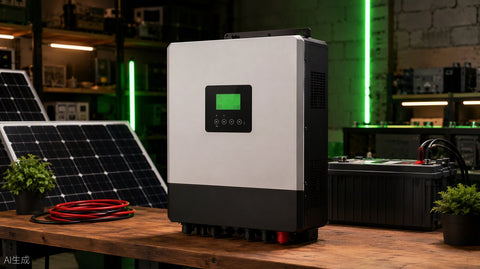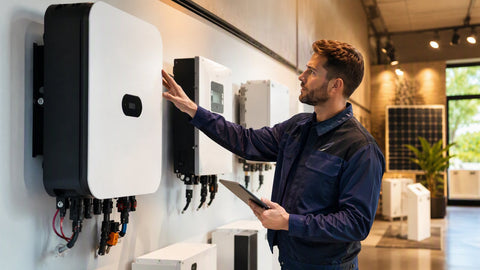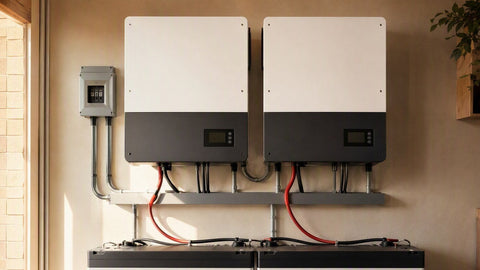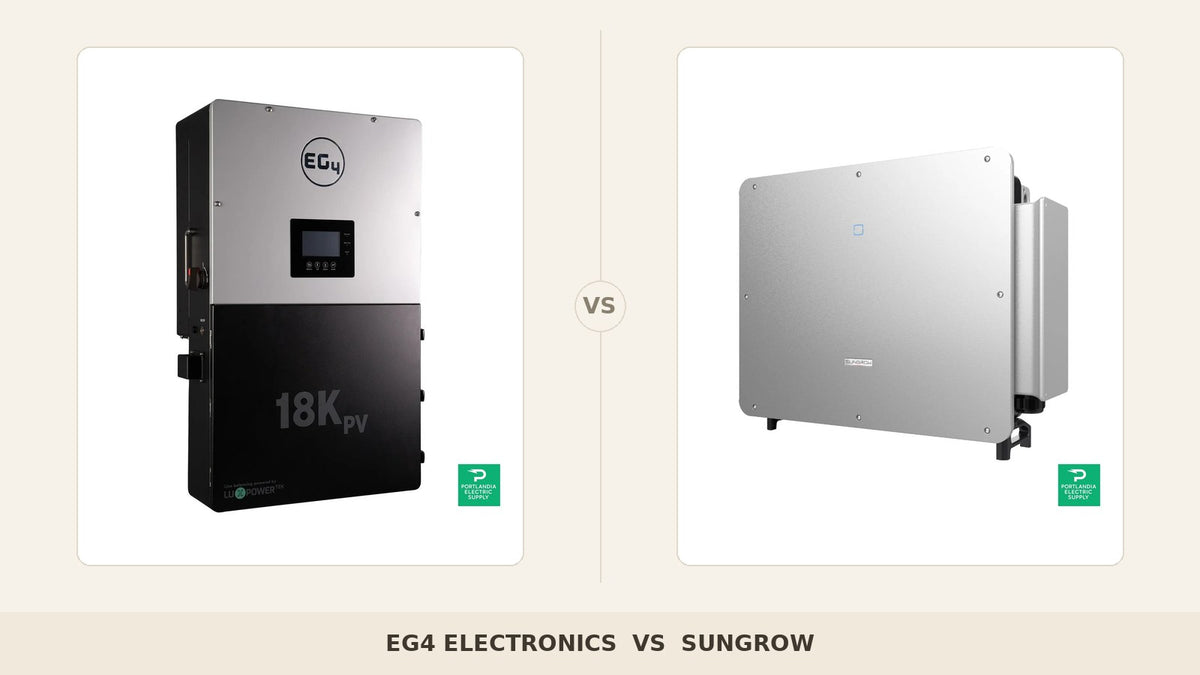
We stock both of these lines and we install both of them, so this comparison comes from the warehouse floor and the roof, not a spec-sheet copy job. EG4 Electronics built its name on the 48V open-architecture hybrid inverter — the 6000XP, the 12KPV, and the 18KPV that half the off-grid installers in America seem to have on their truck right now. Sungrow is a global Tier-1 giant: publicly traded, bankable, shipping gigawatts of central and string inverters every quarter, with a residential hybrid line (the SH-RS single-phase and SH-T three-phase series) that has finally started landing in US distribution. The question we get every week is simple: value 48V platform or Tier-1 high-voltage platform? Here's the honest answer from a supplier that sells both.
Short version: for a typical US split-phase home with 10–20 kWh of storage, EG4 wins on price, battery flexibility, and install speed. For larger homes, light commercial, three-phase services, and customers who want a 10-year bankable warranty with a global service network, Sungrow earns its premium. The details below are where the money actually gets made or lost, so read the tables before you quote.
Side-by-Side Comparison Table
| Specification | EG4 Electronics | Sungrow |
|---|---|---|
| Topology | All-in-one 48V hybrid inverter (value tier) + matching battery ecosystem | Global Tier-1 hybrid/string platform (3-phase SH5-15T class; single-phase SH-RS class) |
| Continuous AC Output | 18KPV: ~12 kW class; 12KPV: ~8 kW class continuous | SH15T: 15 kW 3-phase class; residential singles 3.6–10 kW class |
| Max PV Input | 18KPV: 18 kW PV, 3 MPPT (12KPV: 12 kW, 2 MPPT) | Up to 2x nominal oversizing (SH15T: ~30 kW max PV input) |
| Backup Transfer Time | ~10–20 ms class (verify per model/firmware) | <10 ms backup switchover class (SH-T series) |
| Battery Architecture | 48V nominal — LFP, lead-acid, AGM compatible | High-voltage LFP only — locked to Sungrow SBR/SBH battery series |
| Battery Compatibility | CAN/RS485 — best with EG4 batteries; growing third-party list | Native closed-loop with Sungrow batteries only |
| Monitoring Platform | EG4 Monitor app/web — functional, improving, lighter fleet tooling | iSolarCloud — mature global fleet platform |
| UL 9540 ESS Pairings | Fewer UL 9540 listed pairings; verify with AHJ for permitted ESS | Limited US residential pairings vs global list — verify with AHJ |
| Warranty | Value-tier coverage — verify current term per model | 10 years standard (extendable to 20 in many markets) |
| Typical Contractor Price | 18KPV: ~$4,000–5,000 contractor class | Value-to-mid tier — typically below Sol-Ark on comparable nameplate power |
The Shared Platform: What Both Have in Common
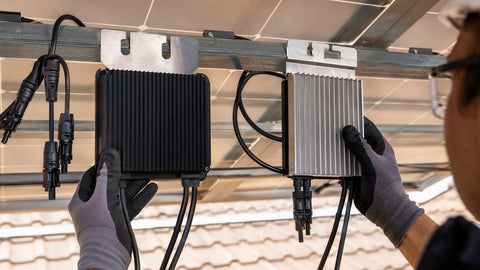
Both lines are true hybrid inverters: PV in, battery in and out, grid in and out, and a backed-up loads port — all in one box. Both support whole-home backup when you size them right, both do time-of-use arbitrage, and both talk to their batteries over CAN for closed-loop charge control. Neither requires a separate PV inverter, a separate battery inverter, or a rats' nest of external contactors to do basic backup. That all-in-one architecture is why these two keep showing up on the same bid sheet against Sol-Ark, Schneider XW Pro, and the Tesla ecosystem.
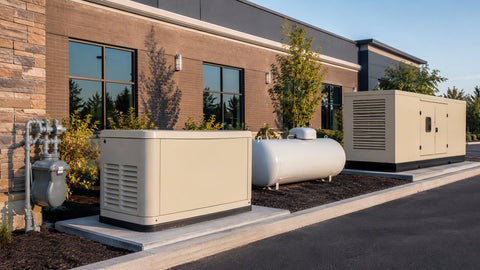
Both also play nicely with generator input. We've paralleled a 12 kW standby unit into an 18KPV on a rural job where the customer refused to give up his propane genset, and the Sungrow SH-RS line accepts AC-coupled generator input the same way. If your customer is in ice-storm country, that generator pass-through is not optional — check our whole-house generator sizing guide before you promise outage runtime.
Open 48V vs Locked High-Voltage
This is the single biggest architectural fork between the two brands, and it drives everything else: wire size, battery cost, expansion path, and who can service the system in ten years.
EG4 runs a 48V nominal battery bus. That means big copper. An 18KPV pulling 12 kW continuous from a 48V battery is moving roughly 250 amps DC — we size that at 4/0 copper with a 300A class fuse or breaker, torqued to the lug spec in the manual, no exceptions. The upside: any 48V battery that speaks the right CAN protocol can join the party. EG4's own LiFePower4 and LL-S racks are the native match, but we've commissioned Pytes, and installers across the country run SOK, Trophy, and DIY banks on these inverters. Open protocol means the customer is never held hostage to one battery vendor's price list.
Sungrow runs high-voltage LFP — the SBR series stacks at roughly 200–500V DC depending on module count. Current at 10 kW is 25–50 amps, not 250. Wire gets small, conduit gets small, and round-trip efficiency bumps a point or two because you're not heating up 4/0 copper. The catch: it's Sungrow batteries, period. The SBR096 (9.6 kWh) through SBR256 (25.6 kWh) stack is your menu. Closed-loop, closed ecosystem, zero third-party options at commissioning time.
| Factor | 48V Architecture (EG4) | High-Voltage Architecture (Sungrow) |
|---|---|---|
| DC current at 10 kW discharge | ~210 A at 48V nominal | ~33 A at ~300V stack |
| Typical battery cable | 4/0 copper, fine-strand, 105°C | 6–8 AWG per manufacturer harness |
| Battery OCPD class | 250–300 A fuse/breaker per inverter | Integrated BMS contactor, factory harness |
| Third-party battery options | Wide — any CAN-compatible 48V LFP | None — SBR/SBH series only |
| Incremental capacity cost (per kWh class) | Lower — commodity 48V rack modules | Higher — proprietary modules |
| Efficiency penalty from I²R losses | Higher at full load | Lower at full load |
| Expansion path | Add rack batteries in parallel up to BMS/comms limit | Add SBR modules within stack window (3–8 modules typical) |
One honest field note: I've never had a Sungrow SBR stack fail closed-loop commissioning, and I've had exactly one 48V third-party bank fight me for a day on CAN baud rate. Open systems trade commissioning friction for long-term freedom. Closed systems trade freedom for a Saturday-morning install that just works.
US Split-Phase Reality vs Global 3-Phase Strength
Most American homes are 120/240V split-phase. EG4's 12KPV and 18KPV are native 120/240V units — no transformer, no tricks, straight onto a 200A residential service with a tap or a breaker pair. The 18KPV will pass through up to 200A of grid power in bypass, which means you can put it ahead of the whole panel with a proper transfer scheme and not shed a single circuit.
Sungrow's US residential play is the SH-RS single-phase line (3.8–11.4 kW class). Its real muscle, the SH5-15T three-phase hybrids, matter if you're doing light commercial — a shop with a 208V service, a small ag building, a three-phase well pump. We've quoted the SH10T into a machine shop where the EG4 line simply has no answer. If the service is three-phase, Sungrow wins by default; if it's a normal house, EG4's split-phase native design is simpler and cheaper.
Field story, because it changed how we quote: a customer in wine country wanted backup for a 4-ton heat pump, a well pump, and a shop full of 240V tools on one 200A service. We specced the EG4 18KPV because the split-phase native output and 200A pass-through meant zero load-shedding rewiring — the whole panel came over, and the inverter's surge handling ate the well pump's locked-rotor kick without blinking. The Sungrow quote for the same scope needed more careful load planning to stay inside its continuous rating. Both systems would have worked. One of them worked without a load-management conversation, and that's the one the customer bought.
Either way, the AC side of these installs lives and dies by the NEC. Backfed breakers, interlocks, and transfer equipment have to satisfy NEC 705 interconnect rules and 702 for optional standby, and your wire ampacity comes out of NEC 310.16 — our NEC wire sizing guide and ampacity chart cover the exact conductor math. PV-side disconnects and labeling follow NEC 690 — see the NEC 690 disconnect guide before your rough inspection.
Battery Sizing Math for Both Platforms
Contractors keep under-sizing storage because they size to the inverter, not the load. Do the math backwards from the critical loads panel. A realistic US backup panel — fridge, furnace blower, lights, well pump cycling, internet, a few receptacles — draws 1.2–2.5 kW average with 6–8 kW peaks. For a 12-hour winter night with no PV, that's 15–30 kWh of usable energy. Here's the arithmetic we run at the counter:
| Design Step | Example Calculation | Result |
|---|---|---|
| Critical loads average | Measured/design estimate | 1.8 kW |
| Target autonomy (night + cloudy margin) | 14 hours | 25.2 kWh needed |
| Usable DoD (LFP) | 90% usable | 25.2 / 0.9 = 28 kWh nameplate |
| Inverter efficiency (round trip) | ~95% discharge path | 28 / 0.95 ≈ 29.5 kWh |
| EG4 configuration | 6 × 5.12 kWh rack modules | 30.7 kWh nameplate |
| Sungrow configuration | SBR stack: 3 × 9.6 kWh class modules | 28.8 kWh class — tight; add a 4th module |
Notice the 48V path lands you in commodity rack batteries where the 6th module is cheap insurance, while the high-voltage stack jumps in 9.6 kWh increments — sometimes you buy more capacity than the math needs. Run your own numbers with the home battery bank sizing guide, the battery sizing calculator, and the off-grid storage sizing walkthrough. For runtime checks against specific load lists, the battery backup runtime calculator does the division for you.
Installation Labor and Commissioning Time
Labor is where value-tier quotes quietly lose their margin. We tracked crew hours across a dozen comparable installs — same roof pitch, same 200A service, same 15–30 kWh storage target — and the pattern holds. The 48V EG4 path costs you time in the battery room: landing 4/0, crimping lugs with a hydraulic crimper, torquing to spec, and dressing a rack that grows heavier with every module. The Sungrow path costs you time in software: the physical stack goes together with factory harnesses and quarter-turn latches, but plan an extra hour for iSolarCloud commissioning and region settings if it's your first one.
| Install Phase | EG4 18KPV + 30 kWh Rack (crew-hours) | Sungrow SH10RS + 28.8 kWh SBR (crew-hours) |
|---|---|---|
| Inverter mount + AC wiring | 3–4 hrs (heavy unit, 200A bypass wiring) | 3–4 hrs (lighter unit, simpler bypass) |
| Battery install + DC wiring | 4–6 hrs (rack assembly, 4/0 runs, OCPD) | 2–3 hrs (stack + factory harness) |
| PV string landing + commissioning | 2–3 hrs | 2–3 hrs |
| Monitoring setup + customer handoff | 1–2 hrs (app walkthrough takes patience) | 1 hr (iSolarCloud provisioning) |
| Typical total, 2-person crew | 10–15 crew-hours | 8–11 crew-hours |
That delta — call it two to four crew-hours per job — is a few hundred dollars of labor. It does not erase EG4's hardware advantage, but it narrows the real gap, and on a tight crew schedule it can decide which pallet you pull. One trick that's saved us hours: pre-build and pre-torque the battery rack in the shop the day before, then wheel it in as a unit. Works with 48V racks. Doesn't work with anything.
Total Cost of Ownership: Ten-Year View
Upfront price is the headline; ten-year cost is the story. Here's the arithmetic we walk commercial-minded homeowners through, using a 12 kW inverter with 30 kWh of storage as the reference system. Numbers are contractor-class estimates — verify current pricing, because both lines move.
| Cost Line (10-Year) | EG4 Platform | Sungrow Platform |
|---|---|---|
| Inverter hardware | ~$4,000–5,000 | ~$5,000–7,000 (SH-RS class) |
| 30 kWh battery storage | ~$9,000–12,000 (6 × 5.12 kWh rack) | ~$15,000–19,000 (SBR stack) |
| Install labor delta | +2–4 crew-hours | Baseline |
| Warranty extension (to 10 yr equivalent) | Third-party or self-insured risk | Included standard |
| Expansion to 40 kWh later | ~$1,500–2,000 per module | ~$4,500–5,500 per 9.6 kWh module |
| Replacement risk reserve (yr 6–10) | Budget $1,500–2,500 | Budget $0–1,000 under warranty |
| Rough 10-year total | ~$15,000–20,000 | ~$21,000–27,000 |
Read that table honestly and both answers are right. EG4 saves the customer $5,000–7,000 over a decade if nothing major fails out of warranty. Sungrow buys insurance against exactly that failure plus a monitoring platform that pays for itself if you run a fleet. We sell the math, not the brand — the customer's risk tolerance picks the winner.
Monitoring, Firmware, and Living With the Box
An inverter is a ten-to-fifteen-year relationship, and the software is where you feel it daily. EG4 Monitor shows the essentials — PV watts, battery state of charge, grid import and export, load draw — and it has improved noticeably over the past two years. Firmware updates arrive over the air and occasionally fix real bugs: we watched one update clean up a generator-charging quirk that had annoyed off-grid customers for a season. What it lacks is fleet discipline. If you're a contractor with eighty installs, there's no clean per-site alerting hierarchy, no bulk firmware scheduling, no per-string drill-down that tells you which optimizer or MPPT is sulking before the homeowner does.
iSolarCloud is built for exactly that contractor. Per-site health scores, remote parameter pushes, alarm routing that can go to your office instead of the customer's phone — it's a grown-up fleet tool, because Sungrow built it for utility portfolios first and residential second. The homeowner-facing side is plain but stable. In three years of Sungrow residential installs, I can count our monitoring-related callbacks on one hand; the EG4 number is higher, and the honest reason is that a more DIY-flavored customer base pokes more settings.
Neither platform locks the customer out of their own data, which we insist on. Both expose local and cloud monitoring, and both let the installer hand over full ownership at commissioning. Walk the customer through the app before you leave the driveway — the fifteen minutes you spend there is the cheapest callback prevention in the business.
Platform Maturity and the Price Story
Sungrow has been building inverters since 1997 and is one of the most bankable names in global solar — that matters when a lender or a commercial customer asks who stands behind the warranty in year nine. EG4 is younger, scrappier, and priced like it. An 18KPV at roughly $4,000–5,000 contractor cost undercuts every comparable 12 kW-class hybrid on our shelves, and the EG4 Electronics line has earned its reputation in the off-grid and DIY-pro crossover market the hard way: volume.
Where Sungrow claws the money back is soft cost. iSolarCloud fleet monitoring is genuinely better for a contractor managing 50+ installs — per-site alerts, remote firmware, per-string diagnostics. EG4 Monitor works fine for a homeowner, but we've spent more hours on the phone walking customers through it than we have on iSolarCloud tickets. If you're building a fleet business, that labor difference is real money. Warranty math favors Sungrow on paper — 10 years standard — but EG4's US support desk in Texas answers the phone, and RMA turnaround has been measured in days, not months, on the units we've sent back.
Price out the full BOM before deciding: 10–12 kW hybrid inverters, 48V batteries, server rack batteries, and LiFePO4 batteries for the EG4 side; Sungrow gear and hybrid inverters generally for the high-voltage side. Balance-of-system — disconnects, PV wire, THHN, combiner boxes, surge protection — runs nearly identical either way.
Choose EG4 Electronics If
- The job is a 120/240V split-phase US home, off-grid cabin, or shop — especially anything off-grid, where the 48V ecosystem is the industry default.
- The customer wants battery freedom: mixing rack modules, expanding cheaply later, or reusing an existing 48V bank.
- Budget per delivered kWh is the deciding metric — nothing else at this price does whole-home backup with 200A pass-through.
- Your crew is comfortable torquing 4/0 lugs and configuring CAN protocols, or you're selling to a capable DIY customer.
Choose Sungrow If
- The service is three-phase, or the project is light commercial where bankability and a Tier-1 name open financing.
- The customer values a 10-year standard warranty and a global service organization over upfront savings.
- You want closed-loop commissioning that finishes before lunch, with factory-matched battery modules.
- You're building a monitored fleet and iSolarCloud's tooling will save your office real labor hours.
Still torn? Our team specs both platforms daily — check the solar inverter buyer's guide, the inverter sizing calculator, and our roundup of top solar inverters for the broader field, then call the counter and we'll quote both BOMs side by side.
Frequently Asked Questions
Can Sungrow hybrids use EG4 batteries?
No. Sungrow residential hybrids are closed-loop with Sungrow's own high-voltage SBR/SBH battery series. EG4's 48V batteries operate at a completely different bus voltage and CAN profile, and there is no supported cross-pairing. If battery flexibility is the priority, EG4 is the platform; if you're buying Sungrow, budget for Sungrow batteries from day one.
Which is better for a US home?
For a standard 120/240V split-phase home, EG4's 12KPV or 18KPV is usually the better value: native split-phase output, 200A pass-through, and cheap 48V storage expansion. Sungrow's SH-RS line competes well when the customer prioritizes a 10-year warranty and Tier-1 bankability over upfront cost.
How do the warranties compare?
Sungrow offers 10 years standard, extendable to 20 in many markets. EG4's coverage has historically been in the 3–5 year class depending on the product line — verify the current term on the specific model before quoting. Sungrow wins on paper; EG4's US-based support and fast RMA handling soften the gap in practice.
Is EG4 as reliable as a Tier-1 brand?
EG4 doesn't carry Tier-1 bankability status, but field failure rates on the 18KPV line have been low in our experience, and firmware updates arrive steadily. Sungrow's decades of manufacturing depth and global service network are real advantages for risk-averse customers and financed projects. For owner-installed and value-driven jobs, EG4's track record is solid enough that we stock deep.
Do both work off-grid?
EG4 yes, enthusiastically — the 18KPV is one of the most common off-grid inverters we sell, with generator input, 200A bypass, and an open 48V battery bus. Sungrow's SH series supports backup and off-grid-style operation in specific configurations, but the platform is optimized for grid-interactive hybrid use, and US off-grid support is thinner. For a true off-grid build, EG4 is the safer recommendation.
What size battery bank do I need with either inverter?
Size storage to your critical loads, not the inverter nameplate. Multiply your average backed-up load by the hours of autonomy you want, divide by 0.9 usable depth of discharge and ~0.95 inverter efficiency. A typical US critical-loads panel lands between 20 and 30 kWh nameplate for overnight autonomy — the sizing table above walks through the full example.
Sources & Standards
- EG4 Electronics 18KPV / 12KPV installation manuals and specification sheets
- Sungrow SH-RS and SH5-15T series datasheets; iSolarCloud documentation
- UL 9540 / UL 9540A energy storage system listings — verify pairings with your AHJ
- NEC 2023 Articles 690, 705, 702, and 310.16 for interconnection, standby, and conductor sizing
- Portlandia Electric Supply field install records and contractor support logs, 2023–2026