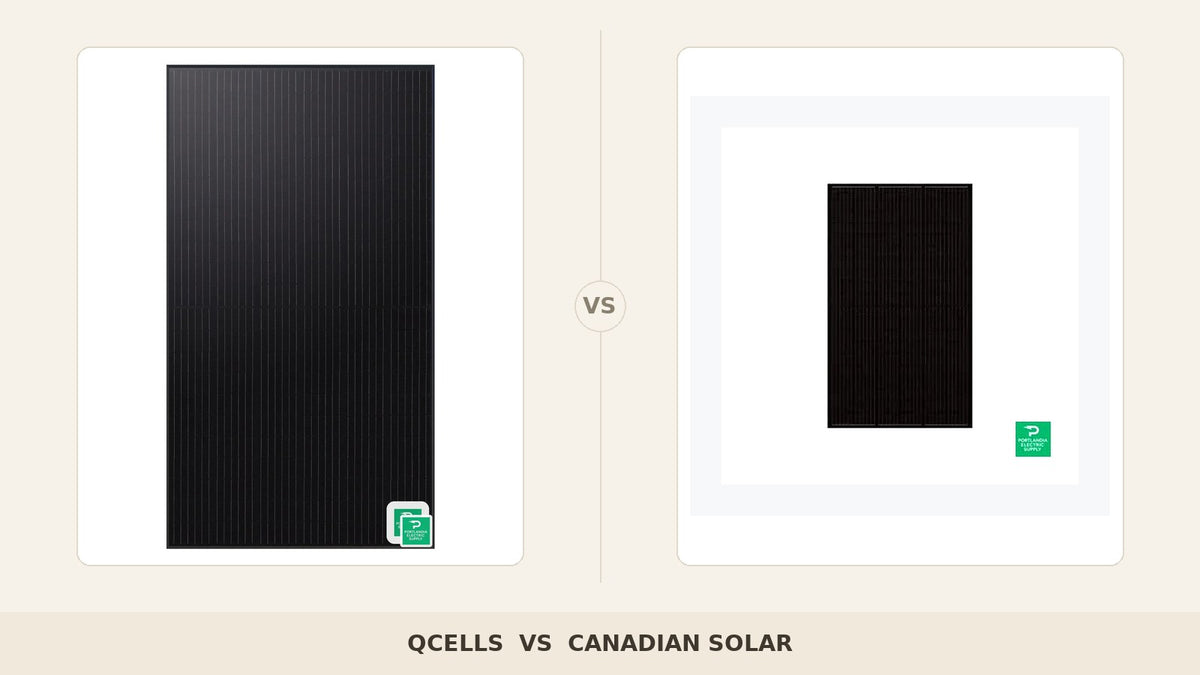
Two brands dominate the "I want American-made panels" conversation at our counter, and both can legitimately claim the label: QCells, assembling and now vertically integrating in Georgia, and Canadian Solar, running module lines in Texas with cell production ramping in Indiana. Both sell N-type TOPCon modules in the 420–440W residential class at prices within a few cents of each other. So which one goes on your roof? We've sold containers of both, and the honest answer comes down to warranty structure, efficiency margins, installer ecosystem, and how much weight you give the depth of each company's US manufacturing story. Numbers first, opinions after — and a standing caveat that module SKUs, factory ramps, and warranty terms move quarterly in this industry, so verify current documents at quote time rather than relying on any article, including this one.
The Shared Platform: What Both Have in Common
Start with what's identical, because it's most of the spec sheet. Both flagship residential lines are N-type TOPCon glass-backsheet (or glass-glass options) modules in the modern 108-half-cell residential format, roughly 68 × 45 inches and 45–50 lbs. Both carry 1,000V/1,500V UL listings, 5,400 Pa snow and 2,400 Pa wind load ratings (some SKUs higher), 25-year performance warranties, and CEC listing for the California market. Both qualify as domestic-manufactured for the purposes buyers care about in 2026, and both sit on the BloombergNEF Tier 1 list. If your installer hands you either one, you're getting a serious module from a serious company. The differences are in the margins — and margins compound over 30 years.
Side-by-Side: Flagship Residential Modules
| Attribute | QCells Q.TRON G2 (residential) | Canadian Solar TOPHiKu6 (residential) |
|---|---|---|
| Cell type | N-type TOPCon (Q.ANTUM NEO) | N-type TOPCon |
| Power class | 420–440W class | 420–440W class |
| Module efficiency | Up to ~22.5% | Up to ~22.3–22.5% |
| Temperature coefficient (Pmax) | −0.30 %/°C | −0.29 to −0.30 %/°C |
| First-year degradation | ≤1% | ≤1% |
| Annual degradation thereafter | ~0.40%/yr | ~0.40%/yr |
| Product warranty | 25 years | 12–15 years standard on many SKUs; 25 years on select premium lines — verify per model |
| Performance warranty | 25 yr, ≥86% class at year 25 | 25–30 yr depending on SKU, ~84.8–87.4% class |
| US manufacturing | Dalton, GA modules (multi-GW) + Cartersville, GA ingot/wafer/cell fab — the deepest US vertical integration | Mesquite, TX module assembly; Jeffersonville, IN cell plant ramping |
| Parent company | Hanwha Group (Korea) | Canadian Solar Inc. (Canada/global) |
| Street price (module, pallet) | ~$0.32–0.40/W | ~$0.30–0.38/W |
Read the warranty row twice — it's the biggest real difference on the page. QCells' 25-year product warranty on the Q.TRON line covers defects for the same horizon as the performance guarantee. Canadian Solar's residential product warranty varies by SKU, with 12–15 years common on volume lines and longer terms on premium glass-glass models. Panels rarely die at year fourteen, but when one does, that distinction is the difference between a replacement module and a lecture about pro-ration. Verify the exact SKU's warranty document before signing; our warranty reading guide shows you what to look for.
Efficiency and Temperature: The Production Math
Both are TOPCon, so the physics gap is narrow — but let's run it anyway, because small percentages are what module comparisons are made of. Take the 440W class on a 20-panel residential array (8.8 kW DC) in a 5.0-peak-sun-hour climate, and model a hot-roof afternoon at 60°C cell temperature:
| Metric | Q.TRON G2 440 | TOPHiKu6 440 |
|---|---|---|
| STC nameplate, 20 modules | 8,800W | 8,800W |
| At 60°C cell temp (×0.895 @ −0.30%/°C) | ~7,876W | ~7,876W |
| Year-1 est. production @ 5.0 PSH, 0.80 system factor | ~12,800 kWh | ~12,700–12,800 kWh |
| Year-25 production (0.40%/yr degradation) | ~11,600 kWh | ~11,500–11,600 kWh |
| 30-yr cumulative difference | Under 1% — statistically a coin flip | |
That's the truth about 2026 flagship modules: the production math is a draw. What separates installations isn't the module's efficiency third decimal — it's labor efficiency (both brands' similar form factors install at the same speed), availability, and bankability. If anyone at a kitchen table tells you one of these will massively out-produce the other, they're selling something. Our 2026 efficiency roundup puts both in context against the premium leaders, and TOPCon vs HJT explains the cell technology they share.
Watch the Canadian Solar Series Split
One nuance that bites buyers: Canadian Solar sells a wide family — TOPHiKu6 (N-type TOPCon), HiKu6/HiKu7 (P-type PERC), BiHiKu bifacial lines — and the warranty terms, efficiency, and pricing differ substantially across them. A quote that just says "Canadian Solar 445W panels" hasn't told you enough. The TOPCon TOPHiKu6 is the current-technology line you want; legacy PERC HiKu pricing can look tempting but buys yesterday's degradation curve. QCells' residential line is simpler to navigate — Q.TRON is the flagship, Q.PEAK DUO the outgoing PERC generation — but the same rule applies: get the exact model code on the contract, then look up its datasheet and warranty yourself. The Canadian Solar brand guide maps the whole family, and the big-format sibling is reviewed in our 710W TOPCon review for commercial buyers.
Georgia vs Texas: The Domestic Story Compared
Both companies have bet heavily on US manufacturing, and both deserve credit — but the bets differ in kind. Hanwha Qcells' Georgia complex is the deepest vertical integration in American solar: the Dalton module plants (multiple GW of capacity) plus the Cartersville facility bringing ingot, wafer, and cell production onshore. When fully ramped, a Q.TRON can carry a silicon-to-module US pedigree that no competitor currently matches, which maximizes domestic-content positioning for ITC adder purposes and insulates the supply chain from cell tariffs. Canadian Solar's Mesquite, Texas module plant (5 GW class) plus the Jeffersonville, Indiana cell fab is the second-strongest US footprint — assembly plus cells, with wafers still imported.
For buyers, the practical translation: both qualify as American-made in the ways that matter politically and commercially; QCells currently goes deeper up the supply chain. Both companies' US expansion also means real service infrastructure — warranty claims don't cross an ocean. Compare the broader field in QCells vs Silfab (the other US-made premium option), QCells vs VSUN, and Canadian Solar vs Trina.
Degradation, Warranties, and the 30-Year Ledger
Both flagships publish N-type TOPCon degradation curves: ≤1% first year, ~0.40%/yr thereafter. Modeled on the 8.8kW array above at $0.15/kWh:
| Year | Est. Annual Production (either brand) | Value @ $0.15/kWh |
|---|---|---|
| 1 | ~12,800 kWh | ~$1,920 |
| 10 | ~12,350 kWh | ~$1,853 |
| 20 | ~11,850 kWh | ~$1,778 |
| 25 | ~11,600 kWh | ~$1,740 |
| 30 (beyond performance warranty on 25-yr SKUs) | ~11,350 kWh | ~$1,703 |
The 30-year cumulative value difference between the two flagships is under $200 — noise. The warranty difference is not noise: a failed module at year 16 is a free swap under QCells' 25-year product warranty and a potential out-of-pocket event on a 12–15-year SKU. Price that risk however you like, but price it.
Installer Ecosystem and Real-World Availability
QCells invested early and hard in the US installer channel — training programs, the Q.PARTNER network, and the Q.HOME ecosystem that bundles modules with storage and energy management. If your installer leads with QCells, they're often inside that ecosystem, which smooths warranty service. Canadian Solar's channel runs through distribution breadth — CSI modules are everywhere, in every wholesaler, often the best-stocked Tier 1 option when supply chains hiccup, and the e-STORAGE/SolBank battery side gives them a credible storage pairing. Availability matters more than buyers think: a panel you can actually get in your install window beats a marginally better panel on a twelve-week backorder. We've juggled both sides of that equation across multiple supply crunches, and both brands have taken their turns being the hero and the waitlist.
One more ecosystem note buyers overlook: monitoring and service apps. QCells' Q.HOME and QOMMAND platforms give residential owners per-system visibility and give installers fleet dashboards, which shortens service calls because the tech arrives knowing what failed. Canadian Solar's residential monitoring rides the inverter partner's platform, which is fine — most systems are monitored through SolarEdge, Enphase, or the string inverter's app anyway — but it means the brand relationship is thinner after install day. If you like the idea of the module maker knowing your system exists five years from now, that tips a point toward Georgia.
Price and Value: Where Quotes Actually Land
| Scenario | QCells Q.TRON G2 | Canadian Solar TOPHiKu6 |
|---|---|---|
| Module street price (pallet, $/W) | $0.32–0.40 | $0.30–0.38 |
| 8.8kW module cost | $2,800–3,500 | $2,650–3,350 |
| Typical installed premium vs import PERC | ~$0.05–0.10/W | ~$0.03–0.08/W |
| Product warranty term | 25 yr | 12–25 yr by SKU |
| Value verdict | Pay a small premium, get the longer product warranty | Save a little, verify the SKU's warranty term |
At typical spreads, QCells asks roughly $150–300 more per residential system and answers with the longer product warranty and deeper US integration. That trade is worth it in our book — but it's close enough that installer quality should decide the final call. A great installer with Canadian Solar beats a mediocre installer with QCells every single time; workmanship kills more systems than modules ever will. Also cross-shop REC vs QCells and REC vs Canadian Solar if the premium tier is in budget, plus Canadian Solar vs JA Solar on the value end. The Jinko Tiger Neo and JA Solar DeepBlue lines round out the TOPCon field.
Supply Chain, Tariffs, and Why "Domestic" Became the Whole Ballgame
Context for buyers who haven't followed the trade news: US solar tariffs have bounced around for a decade, and the 2024–2025 rounds targeting Southeast Asian cells and modules reordered the entire import market. Modules built from imported cells face cost structures that shift with every Commerce Department ruling, while domestically integrated production sidesteps the volatility. That's the strategic core of both companies' US bets — and it's why "where was it made" moved from a patriotic preference to a procurement risk-management question. QCells' Cartersville fab addresses the most exposed link (cells and wafers); Canadian Solar's Indiana cell plant addresses the same link one step down. For a buyer signing a 30-year asset, both approaches de-risk the supply side of any future warranty or replacement need. The broader manufacturing landscape is tracked in our Tier 1 panel list.
Installation Notes: Form Factor, Clamping, and Racking Compatibility
Both residential flagships use the now-standard ~1.13 × 1.76 m half-cell format with 30–35mm frames, which means universal compatibility with mainstream racking — XR rails, SolarMount, Ultra Rail — and standard mid/end clamp ranges. Two install details worth checking on any quote. First, clamping zones: each module's installation manual defines permitted clamp positions along the frame, and deviating voids the mechanical load warranty; both brands publish clear zone diagrams, and both warranties have been denied over clamp placement. Second, wire management: 45–50 lb modules with long leads get heavy at panel eighteen of a hot afternoon, and sloppy lead dressing is where abrasion faults start. Neither brand has an edge here — this is workmanship territory, which is why we keep repeating that the installer matters more than the logo. Racking specifics live in our IronRidge guide and the SnapNrack guide.
Beyond Residential: Commercial Lines and Storage
If your project is bigger than a roof, the comparison widens. Canadian Solar runs deep in commercial and utility — the 600W+ BiHiKu and TOPBiHiKu bifacial utility lines, plus the e-STORAGE SolBank containerized battery business that has shipped gigawatt-hours of grid storage. QCells counters with Q.TRON commercial formats, a growing EPC arm, and the Q.HOME residential storage ecosystem, plus Hanwha's broader energy portfolio. For a commercial buyer weighing bifacial utility modules, Canadian Solar's track record in that segment is longer; for a residential buyer who wants panels-plus-storage from one vendor, Q.HOME is the more mature residential bundle. Different muscles — another reason the "which brand" question only resolves at the project level.
Quality Track Record: What the Field Data Says
Both brands have long PVEL scorecard histories with multiple Top Performer appearances across reliability tests — damp heat, thermal cycling, PID, mechanical load — and both have had individual SKUs miss a category in a given year, which is normal for every manufacturer. Neither carries a major recall history on the scale that has burned lesser brands. What we watch at the counter: DOA rates on container arrivals (low for both), frame finish consistency (both good), and junction-box adhesive quality after five summers (both holding). Boring, consistent, bankable — which is exactly what you want from the component expected to outlive every other part of the system except the roof itself.
Mechanical Ratings and Climate Fit
Load ratings deserve a look if you live where weather happens. Both brands publish strong numbers on their residential flagships, and both offer enhanced-load SKUs:
| Rating | Q.TRON G2 class | TOPHiKu6 class | Why It Matters |
|---|---|---|---|
| Snow (front) load | 5,400 Pa class | 5,400 Pa class | ~113 psf — deep-snow rooftops |
| Wind (rear) load | 2,400–4,000 Pa by SKU | 2,400–4,000 Pa by SKU | Coastal and high-wind zones; check per model |
| Hail rating | 25mm at 23 m/s class (IEC) | 25mm at 23 m/s class (IEC) | Hail-belt buyers should ask about enhanced-test SKUs |
| Frame depth | 30–35mm | 30–35mm | Deeper frames resist torsion on rough handling |
| Salt-mist / ammonia certs | Available | Available | Coastal and agricultural installs — verify per SKU |
For hail-belt buyers — Colorado, Texas, the front range — ask both brands about their enhanced hail-tested lines; several manufacturers now certify select SKUs beyond the base IEC 25mm test. For coastal installs, confirm the salt-mist certification on the exact model code, not the family brochure. These are five-minute email questions that prevent five-figure arguments later.
The Procurement Checklist We Hand Buyers
However the QCells-vs-Canadian decision lands, run this list on the final quote: exact model code written on the contract; the datasheet and warranty PDF for that code downloaded and saved; panel count and string layout shown on the plan set; clamping zones per the manual respected in the design; a production estimate that states its assumptions (PSH, system factor, degradation curve); and the installer's license, insurance, and years-in-business verified independently. Both brands make modules good enough that the paperwork, not the panel, is where deals go wrong. For the rest of the stack, our inverter types guide, the SolarEdge ecosystem review, and the Enphase brand guide cover the electronics decision that pairs with either module.
Choose QCells If
- You want the longest product warranty in the mainstream class (25 years) without paying premium-brand prices.
- Domestic supply-chain depth matters — Georgia's ingot-to-module integration is the strongest US story in the industry.
- Your installer is in the Q.PARTNER ecosystem and can service the warranty locally.
- You value channel stability: QCells has been a top-two US residential supplier for years running.
Choose Canadian Solar If
- The quote comes in a few cents per watt cheaper and the specific SKU carries a warranty term you accept.
- Availability is the constraint — CSI's distribution depth wins backorders.
- You're pairing with CSI's e-STORAGE batteries or want one vendor across modules and storage.
- Your installer knows the lineup cold and specifies the current TOPCon TOPHiKu6, not a legacy PERC line.
Bottom Line
These are the two best-justified "buy American" answers in residential solar, both built on current-generation N-type TOPCon, both from Tier 1 parents with real US factories. The production math is a draw within one percent over thirty years. QCells earns its small price premium with a 25-year product warranty and the deepest domestic supply chain; Canadian Solar counters with distribution breadth, slightly sharper pricing, and a strong Texas-Indiana manufacturing story of its own. Let the exact SKU's datasheet and warranty document — and your installer's track record — make the final call, and put the model code in the contract either way. For system planning beyond the modules, see our 400W vs 500W module comparison, the Tier 1 manufacturer list, and the full brand rankings.
Frequently Asked Questions
How do these two compare on degradation after year 10?
Both publish N-type TOPCon curves at roughly 0.40% per year after a ≤1% first-year step, which puts either flagship around 90% of nameplate at year 20 and 86–87% at year 25. Long-run field data on TOPCon is still maturing — the architecture only hit mass production this decade — but accelerated testing and early deployments support the published curves. Real-world killers remain the unglamorous ones: shading, soiling, poor flashing, and wiring faults, none of which care whose label is on the glass.
Are QCells and Canadian Solar panels really made in the USA?
Yes, with nuance. QCells operates multi-GW module plants in Dalton, Georgia, and is ramping ingot, wafer, and cell production in Cartersville, Georgia — the deepest US vertical integration in the industry. Canadian Solar assembles modules in Mesquite, Texas, and is ramping cell production in Jeffersonville, Indiana. Both are legitimately American-made; QCells currently reaches further up the supply chain.
Which brand has the better warranty?
QCells, on the product side: the Q.TRON residential line carries a 25-year product warranty, while Canadian Solar's residential product warranty runs 12–15 years on many SKUs with longer terms on select premium lines. Performance warranties are comparable (25–30 years, mid-80s percent retained capacity). Always verify the exact model's warranty document before signing.
Do both brands qualify for the domestic content ITC bonus?
Both position for it through US manufacturing, but qualification depends on the project's cost-percentage calculations and current Treasury guidance, which has evolved. Confirm the specific module's domestic-content certification with your installer and tax advisor rather than assuming the factory address settles it.
Which is more efficient?
Statistically tied: both flagship TOPCon residential modules reach about 22.3–22.5% efficiency with −0.30%/°C temperature coefficients and 0.40%/yr degradation. Over 30 years the production difference between them is under 1% — installer quality, shading, and orientation matter more than this choice.
Is Canadian Solar's PERC lineup still worth buying?
At a real discount and for budget-constrained projects, PERC HiKu modules remain solid Tier 1 hardware. But TOPCon's lower degradation and better heat behavior make TOPHiKu6 the better long-term buy at typical spreads. Get model codes on any quote so you know which generation you're buying.
Which brand is easier to warranty-claim with?
Both maintain US service operations — a genuine advantage over import-only brands. QCells claims route efficiently through its Q.PARTNER installer network; Canadian Solar's scale means broad distributor support. In practice, your installer's responsiveness determines your claim experience more than the brand's process.