EG4 vs SimpliPhi 2026: Budget vs Premium LiFePO4
The price leader against the aerospace-heritage original: $/kWh, cycle ratings, DoD philosophy, safety certifications, marine and mobile pedigree, warranty depth, and the honest math on when premium cells pay for themselves.
EG4 and SimpliPhi represent the two ends of the LiFePO4 market's respectable range. EG4 is the volume disruptor: 5.12 kWh rack modules at price points that forced the entire industry to reprice, backed by a fast-moving ecosystem and an enormous install base. SimpliPhi — now part of Briggs & Stratton's energy storage portfolio — is the category's premium original: California-built LFP modules with a decade-plus safety record in military, medical, marine, and film-industry applications where battery failure is not an inconvenience but an incident. Both are cobalt-free lithium iron phosphate. Both will run a house. The $500/kWh-class price gap between them is what this article explains, quantifies, and then either justifies or dismisses — depending on your application.
Browse the contenders in EG4 batteries and SimpliPhi, with the full field in LiFePO4 batteries and 48V batteries. Size the bank before the brand debate — the home battery bank sizing guide and off-grid sizing guide come first.
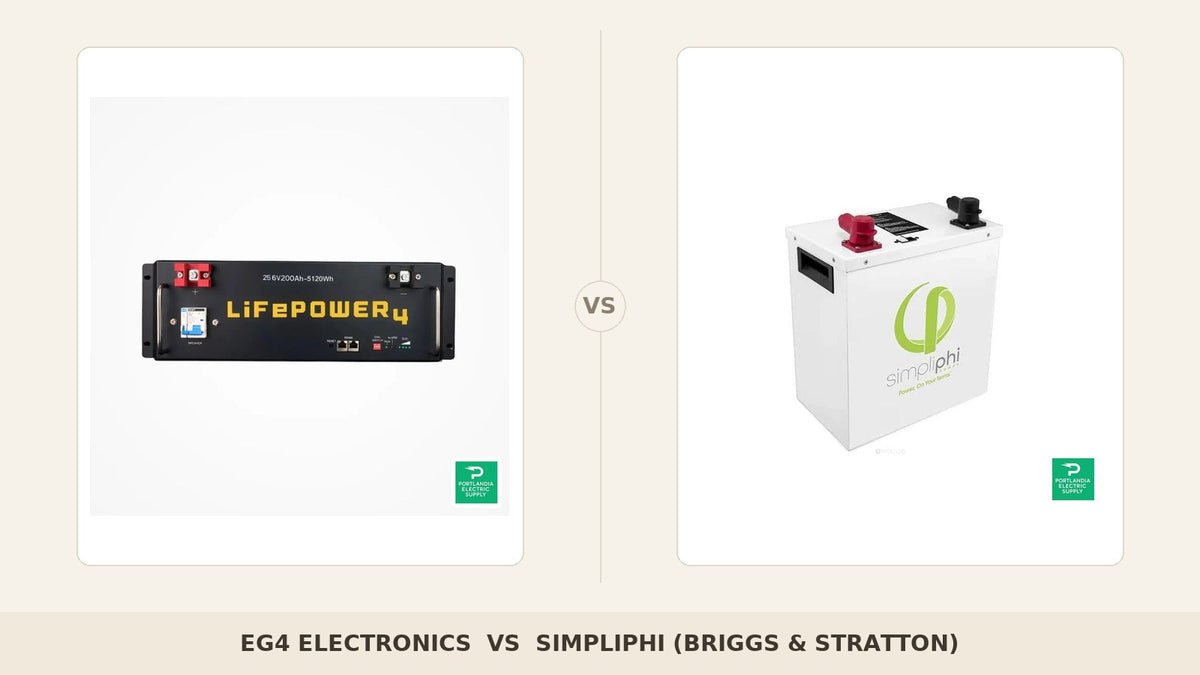
SimpliPhi's PHI line — the 3.8 kWh module family is the flagship — was engineered for applications with zero failure tolerance: forward operating bases, hospital backup, offshore platforms, broadcast trucks. The modules carry 10,000-cycle class ratings at 80% depth of discharge, 100% DoD operational capability, no thermal-runaway propagation requirements for ventilation-free installs in many configurations, and a build quality you feel the first time you lift one. SimpliPhi modules drop into 48V banks without proprietary comms requirements — voltage-based integration with any quality inverter, plus CAN options on current lines.
EG4's rack line — LifePower4 and LL series — is the mass-market answer: 51.2V, 100Ah, 5.12 kWh per module, 6,000+ cycle class at 80% DoD, closed-loop comms with the EG4 inverter ecosystem, heated variants on the LL series for cold climates, and pricing that made 20 kWh banks a middle-class purchase instead of a luxury line item. The PHI 3.8 product page — the PHI 3.8 family — shows the premium construction; the EG4 ecosystem shows the value integration.
Class-level specs; confirm exact SKU datasheets. The price row is the entire argument — the sections below decide what it buys.
| Spec | EG4 LifePower4 / LL class | SimpliPhi PHI 3.8 class |
|---|---|---|
| Capacity | 5.12 kWh (51.2V 100Ah) | 3.8 kWh (48V 75Ah class) |
| Cycle rating | 6,000+ @ 80% DoD class | 10,000 @ 80% DoD class |
| DoD capability | 80% rated daily | 100% rated capability |
| Round-trip efficiency | ~95% class | ~98% class |
| Comms | CAN/RS485 closed-loop, native EG4 integration | Voltage-based universal + CAN options |
| Origin | Global manufacturing | California-built class |
| Safety pedigree | UL 1973 class | UL 1973 + military/medical/marine field history |
| Warranty class | 5–10 yr by line/registration | 10 yr class |
| Street price class | $1,000–$1,300 | $2,800–$3,200 |
The punchline: EG4 wins day-one economics decisively; SimpliPhi reaches cost parity per lifetime kWh only if you actually use the full 10,000-cycle envelope.
| Metric | EG4 (5.12 kWh) | SimpliPhi PHI (3.8 kWh) | Reading |
|---|---|---|---|
| Street $/nameplate kWh | $195–$254 | $737–$842 | EG4 ≈ 3.5x cheaper |
| Usable kWh per cycle (rated DoD) | 4.10 kWh | 3.04–3.8 kWh | PHI's 100% DoD narrows it |
| Lifetime throughput @ rated cycles | ≈ 24,600 kWh | ≈ 30,400–38,000 kWh | PHI's 10k cycles pulls ahead |
| Cost per lifetime kWh (mid-price) | ≈ $0.0095 | ≈ $0.0080–$0.0100 | ≈ parity at full cycle utilization |
That last row deserves the emphasis it never gets in brand debates. SimpliPhi's 10,000-cycle rating means the cost-per-cycled-kWh converges with EG4's — if the application cycles daily for 15–25 years. Full-time off-grid homes, daily solar self-consumption, and commercial duty hit that envelope. Weekend cabins, occasional-backup systems, and grid-tied arbitrage with modest cycling never do — they will hit calendar aging long before cycle limits, and the premium buys durability those owners will never use. Honest sizing of your duty cycle is the whole decision. The 20–80 rule guide helps model realistic cycling.
SimpliPhi's pedigree is not marketing garnish. LFP chemistry is already the safe lithium chemistry — no cobalt, high thermal-runaway threshold — and SimpliPhi's engineering record in military and medical deployments adds a documentation and quality layer that certain applications genuinely require. Indoor installs without dedicated ventilation plans, mobile and marine duty with vibration and salt exposure, and commercial sites with strict insurance or authority requirements are the premium's home turf.
Our field experience mirrors the positioning: we spec SimpliPhi-class premium modules for boats, RVs with living quarters over the battery bay, and inspected commercial jobs where the safety dossier answers questions before the inspector asks them. We spec EG4 for stationary residential and off-grid builds where the install environment is controlled and the budget buys more kWh. Neither brand has given us a safety incident; one brand's paperwork ends certain conversations faster. For the install-environment side, the longevity and maintenance guide covers temperature and ventilation practice that matters more than brand.
The delta buys cycle envelope, safety documentation, and build pedigree — not more stored kWh.
| Bank target | EG4 path | SimpliPhi path | Delta |
|---|---|---|---|
| ~15 kWh nameplate | 3 modules ≈ $3,000–$3,900 | 4 × PHI 3.8 ≈ $11,200–$12,800 | ≈ +$8,000 |
| ~30 kWh nameplate | 6 modules ≈ $6,000–$7,800 | 8 × PHI 3.8 ≈ $22,400–$25,600 | ≈ +$16,500 |
| Rack/BOS (both) | $400–$700 | $500–$900 (PHI form factor) | ≈ comparable |
| Cycles available | 6,000 class | 10,000 class | PHI +67% |
| Cost per lifetime kWh | ≈ $0.0095 | ≈ $0.0080–$0.0100 | converges with duty |
Put plainly: for the price of a 15 kWh SimpliPhi bank you can field a 30-plus kWh EG4 bank with money left for the inverter. For outage-driven buyers, autonomy hours beat cycle depth — the runtime calculator translates bank size into the hours that matter. For daily-cycling off-grid lifers, the PHI envelope earns its premium across two decades. Know which customer you are before the quote, not after.
The two brands embody the industry's integration schism. EG4 is comms-first: closed-loop CAN between battery BMS and inverter governs charge parameters, SOC reporting, and protection behavior — superb with EG4's own hybrids (FlexBOSS21 class), standard-protocol with third parties. SimpliPhi historically champions voltage-based integration: set correct charge and discharge voltage windows on any quality inverter and the battery manages itself, with CAN available for those who want it. Off-grid veterans love the voltage-first philosophy because it survives inverter swaps, firmware changes, and dead comms cables — failure modes we have all chased at 10 p.m.
Pairing guidance from our commissioning log: EG4 batteries + EG4 inverter is the tightest value integration available. SimpliPhi + Schneider, Magnum-class, or Victron premium inverter is the classic bulletproof off-grid stack. Cross-pairings work in both directions with correct settings — PHI on an EG4 hybrid runs fine on voltage-based control, and we have two such installs in the field. Browse hybrid inverters and 48V inverters for the pairing side.
SimpliPhi's ~98% round-trip efficiency class versus EG4's ~95% class is a 3-point harvest difference that compounds quietly: across 10 MWh of annual throughput, about 300 kWh more energy retained per year. On off-grid systems where every harvested watt matters in December, that is not nothing. On grid-tied arbitrage at $0.15/kWh, it is $45 a year — meaningful against a $16,000 price delta only across very long horizons.
Operating windows favor SimpliPhi at the edges: the PHI line's thermal tolerance and no-heating-required class behavior across wider conditions suits unconditioned spaces better than unheated value modules, though EG4's heated LL variants close the cold-charging gap specifically. Both chemistries refuse charge near freezing without protection — that is physics, not branding — and both deserve the insulated, conditioned battery space the sizing guide and maintenance guides prescribe.
SimpliPhi's 10-year class warranty now rides on Briggs & Stratton's balance sheet — the same company whose generator service network spans the country — which answers the “will they exist in year nine” question more convincingly than most battery startups. EG4's 5–10-year class coverage (line and registration dependent) rides on a younger company with a massive and growing install base and deep channel documentation. Our claims experience with both has been professional; SimpliPhi's process feels like aerospace paperwork, EG4's like modern e-commerce — both got resolutions.
The deeper warranty question is architectural: comms-first systems inherit firmware-dependency over decades; voltage-first systems remain operable with whatever inverter exists in 2038. If your risk model includes outliving the manufacturer's software support, the PHI philosophy is the hedge. If your risk model is dominated by budget, EG4's price buys the redundancy — two banks for the price of one is its own insurance policy.
Three deployments from our log show the decision logic in practice better than any spec row:
Duty cycle picks the brand. The boat and the homestead justify SimpliPhi; the suburban backup case is EG4's home turf.
| Install | Duty profile | Chosen | Why it was right |
|---|---|---|---|
| Charter boat, Gulf Coast | Daily cycling, salt air, living space above battery bay | SimpliPhi 4 × PHI 3.8 | Marine pedigree + safety dossier; insurer approved without exception |
| Suburban outage backup, Texas | ~15 outage events/yr, shallow cycles | EG4 6-module bank + 12 kW hybrid | Autonomy hours per dollar won; cycle rating irrelevant at this duty |
| Full-time off-grid homestead, New Mexico | Daily deep cycling, 20-yr horizon | SimpliPhi 8-module bank | 10,000-cycle envelope will actually be used; premium amortizes |
The boat row deserves a footnote for mobile buyers: vibration, heel angles, and salt-mist exposure punish consumer-grade assemblies in ways a garage never will. SimpliPhi's mechanical build and documented marine history answer questions that value modules leave to faith. The homestead row is the mirror image of the same logic — twenty years of daily deep cycles is precisely the envelope where the PHI economics converge. And the Texas row is most of the residential market: backup duty that will log maybe 200 meaningful cycles in a decade.
Premium and value LFP fail differently, and the shapes matter for a 15-year ownership bet. Value-tier failures in our service log concentrate in electronics: a BMS board, a comms port, a firmware edge case after an inverter update. Parts are cheap, availability is good, and the module price means a whole-unit swap is a $1,100 event, not a crisis. Premium-tier failures are rarer per unit but the events are pricier — a PHI module replacement is a $3,000-class conversation, which is exactly what the 10-year warranty and the corporate balance sheet behind it exist to absorb.
Both brands share the non-failures worth stating: no thermal events in our combined install base, no cell-level defect clusters, and no capacity fade beyond linear expectation in monitored systems. LFP done right — at either price — is boring hardware. The premium buys the paperwork, the cycle envelope, and the build pedigree; it does not buy escape from physics, and the value tier's reliability record has earned the confidence the market now gives it.
Round-trip efficiency — 95% class for the value rack modules, 98% class for the PHI line — is the spec buyers skim and off-grid owners live with. Ten MWh of annual solar harvest cycled through the bank loses about 500 kWh at 95% versus 200 kWh at 98%. Over ten years that is roughly 3,000 kWh of difference: real energy on an off-grid December, a modest line item on a grid-tied arbitrage spreadsheet. Weigh it against the module price delta and the answer varies by site, which is exactly why we model it rather than assert it.
The companion spec nobody checks is standby self-consumption. Banks that idle for weeks — vacation homes, seasonal cabins — bleed charge through BMS electronics and cell self-discharge. Both brands idle respectably, but the install detail that matters is the same on both: a storage SOC around 50–60%, a disconnect plan for long absences, and a recommissioning check on return. The 20–80 operating rule covers the daily-use version of the same discipline, and it adds measurable calendar life to either brand's bank.
- How many deep cycles per year? Under 100 → EG4. Over 300 → SimpliPhi enters the conversation.
- Where does the bank live? Conditioned garage or utility room → either. Boat, RV, or unconditioned space → premium build quality earns its keep.
- Who insures or inspects it? Strict commercial or marine underwriters → SimpliPhi's dossier shortens the process.
- What is the 20-year plan? Daily cycling for two decades → cost per lifetime kWh converges and the PHI envelope wins. Backup and arbitrage → the value bank plus spare capacity wins.
- What does the budget buy instead? If the premium delta would otherwise buy six more kWh of autonomy or the hybrid inverter upgrade, take the capability.
Run those five honestly and the brand decision makes itself in about four minutes. The expensive errors in this category all come from skipping question one — buying a 10,000-cycle battery for a 200-cycle job, or a 6,000-cycle battery for a 7,000-cycle life. Match the envelope to the duty and either badge delivers everything it promises. For the rest of the system, our charge controller sizing guide, hybrid inverters, and backup kits complete the design.
SimpliPhi's acquisition into the Briggs & Stratton energy storage portfolio changed the ownership math more than the product. A premium battery is partly a bet that the warranty counter still exists in year nine; that bet is considerably easier to make when the brand sits inside a century-old power-equipment company with a national service network than when it sits inside a venture-funded startup with a burn rate. The PHI line's engineering culture survived the transition — the modules we receive today carry the same build quality as the pre-acquisition product — and the channel documentation has if anything improved.
EG4's side of the longevity question looks different but lands similarly: the company has scaled from scrappy value brand to category volume leader, with the install base, parts pipeline, and channel infrastructure that scale buys. Neither brand is a flight risk in the way a 2019-era battery startup was. Ten years ago, brand longevity was a top-three selection criterion in this category; today it is a tiebreaker, because both of these companies will clearly be answering phones for the duration of their warranties.
Choose SimpliPhi for full-time daily cycling where the 10,000-cycle envelope will actually be used, marine and mobile duty, indoor installs with strict safety documentation needs, and buyers who price 20-year risk over 1-year budget. The SimpliPhi line earns its premium in those applications.
Choose EG4 for residential backup, weekend and seasonal properties, grid-tied arbitrage, and any build where budget converts directly into autonomy hours. Three times the kWh per dollar is a compelling argument when the duty cycle will never touch either brand's cycle rating. The EG4 battery line and its native inverter ecosystem make the value case complete.
The honest summary: premium LFP and value LFP are both excellent; they are priced for different duty cycles, and the expensive mistake is buying either for the other's job. Measure your cycling reality, price both banks, and let the cost-per-lifetime-kWh table settle it. Cross-shop the rest of the field in battery storage, 10 kWh and 15 kWh bank classes, and the appliance-battery comparison.
Is SimpliPhi worth the premium over EG4?
For high-cycle daily use — full-time off-grid, daily self-consumption, marine or mobile duty — yes: the 10,000-cycle rating brings cost per lifetime kWh to rough parity with EG4, and the safety documentation suits strict installs. For backup and occasional cycling, no: calendar aging ends the bank long before either brand's cycle limit, and EG4 delivers three times the kWh per dollar.
How long do SimpliPhi and EG4 batteries last?
SimpliPhi rates 10,000 cycles at 80% DoD — 15–25 years of daily cycling; EG4 rates 6,000+ cycles at 80% DoD — 15-plus years of daily use. Both use cobalt-free LFP that degrades gradually rather than failing. Temperature management and discharge discipline determine real lifespan as much as the rating on the datasheet.
Do SimpliPhi batteries need special inverters?
No — that is a core design point. PHI modules operate on voltage-based integration with any quality 48V inverter: set correct charge/discharge windows and the battery manages itself, with CAN communication available on current lines. EG4 modules favor closed-loop CAN pairing, tightest with EG4's own hybrids and standard-protocol with third parties.
What is the real cost difference per kWh?
Day one: EG4 runs $195–$254 per nameplate kWh versus SimpliPhi at $737–$842 — about 3.5x. Per lifetime cycled kWh, the gap collapses toward parity ($0.0080–$0.0100 vs $0.0095 class) because SimpliPhi's 10,000-cycle rating delivers more total throughput — but only if your application actually cycles deeply and daily for decades.
Can I mix SimpliPhi and EG4 modules in one bank?
Never mix brands, models, or ages on a shared DC bus — mismatched internal resistance, BMS behavior, and discharge curves create imbalance that shortens both modules' lives and voids coverage. Expand within one product family, and plan the final bank size before the first purchase.
Which is safer for indoor installation?
Both are inherently safe LFP chemistry with UL 1973-class listings. SimpliPhi adds a decade-plus military/medical/marine safety record and documentation that satisfies the strictest insurance and authority reviews — relevant for living-space-adjacent and mobile installs. Either brand deserves a code-compliant, temperature-managed location; the NEC disconnect requirements apply equally to both.
PES Supply stocks both ends of the LFP range at wholesale: EG4 batteries, SimpliPhi, and the full LiFePO4 category with server-rack formats. Send the design desk your duty cycle — cycles per year, average load, autonomy target — and we will return both options priced per lifetime kWh so the decision is arithmetic, not allegiance.