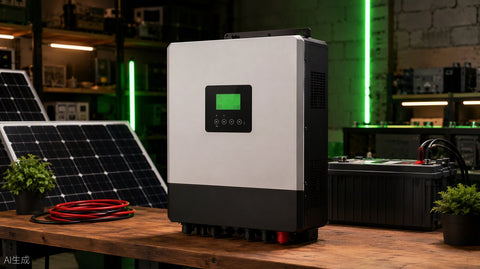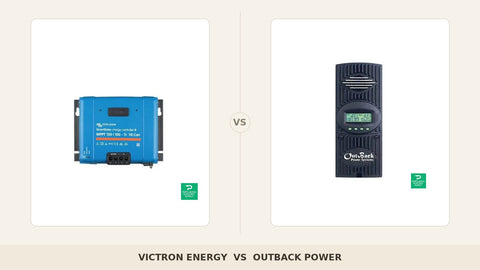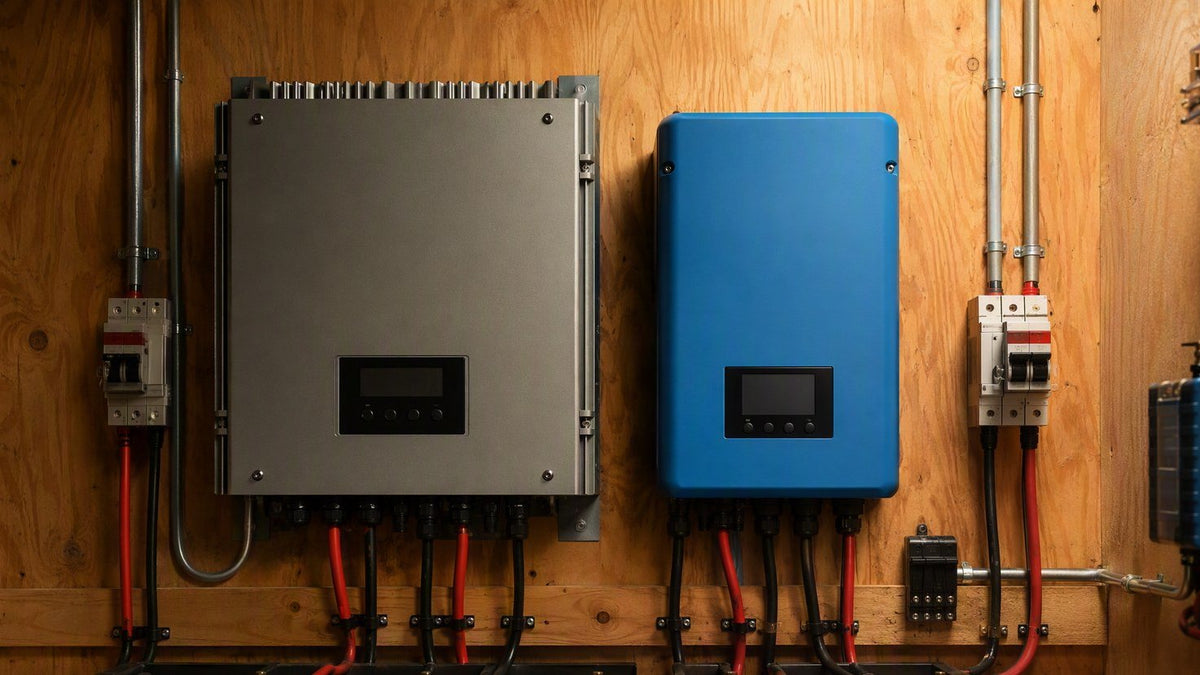
Arlington, Washington versus Almere, Netherlands. The MidNite Classic and the Victron SmartSolar are the two MPPT controllers we get asked about more than everything else combined, and the question always comes loaded: someone has already watched three hours of YouTube and formed a tribal loyalty. Here's the counter answer from people who stock both: the Classic is the better standalone controller for a hard-use off-grid site; the SmartSolar is the better node in a networked Victron system. Which one is "better" depends entirely on what surrounds it.
The Short Verdict
Pick the MidNite Classic when the controller must stand alone: maximum input-voltage headroom (150/200/250V plus HyperVOC), integrated arc-fault and ground-fault protection that smooths NEC inspections, an included display, and field-replaceable parts. Pick the Victron SmartSolar when you're inside (or entering) the Victron ecosystem: Bluetooth built into every unit, VE.Direct/VE.Can networking, VRM cloud monitoring free of charge, and seamless coordination with Victron inverter-chargers, BMSes, and Cerbo GX. Both are honest, efficient, properly listed MPPTs. The ecosystem question is the real decision.
The Shared Platform: Real MPPT, Done Right
Both controllers convert high-voltage array strings down to battery voltage with genuine maximum power point tracking — 97–98% peak efficiency, fast re-acquisition through cloud transients, multi-stage charging with fully programmable setpoints for flooded, AGM, and LiFePO4 banks. Both support 12/24/48V systems (SmartSolar 150/70 and up; the Classic auto-senses 12–72V nominal banks). Both carry real safety listings and publish real efficiency curves. If you're coming from a $90 marketplace "MPPT," either of these will feel like a revelation — the harvest difference on a cloudy shoulder-season day is not subtle.
Side-by-Side Comparison Table
| Specification | MidNite Classic 150 / 200 / 250 | Victron SmartSolar 150/70 – 250/100 |
|---|---|---|
| Max PV Input Voltage | 150 / 200 / 250V by model, plus HyperVOC margin above rating | 75 / 100 / 150 / 250V by model (hard ceiling) |
| Max Charge Current | Up to ~96A (model/battery-voltage dependent) | 70–100A by model |
| Battery Bank Voltages | 12 / 24 / 48V | 12 / 24 / 48V (36V on select models) |
| Ground Fault Protection | Integrated GFP (NEC 690.5-relevant for listed configurations) | External protection required |
| Arc Fault Protection | Available integrated (model/config dependent) | External protection required |
| Local Display | MNGP graphic display (included on most Classics) | None on unit — Bluetooth app or GX device display |
| Connectivity / Monitoring | Ethernet, Modbus; MidNite app and local network portal | Bluetooth built-in, VE.Direct; full VRM cloud via Cerbo GX |
| Ecosystem Integration | Standalone-first; integrates via Modbus | Native Cerbo GX / VRM / MultiPlus system coordination |
| Charge Profiles | Fully programmable, all chemistries, extensive legacy presets | Fully programmable, all chemistries, LiFePO4 presets |
| Origin / Support | Made in USA (Arlington, WA); factory repair program | Netherlands design; global dealer network, 5-year warranty |
| Typical Price (comparable class) | Classic 150: ~$700–850 | SmartSolar 150/70: ~$500–600 |
Voltage Headroom and HyperVOC: The Classic's Trump Card
NEC 690.7 makes you correct module Voc for your site's record low temperature, and that correction eats string length fast. With typical 400W modules (Voc ≈ 37V, -0.27%/°C coefficient), the series-string math looks like this:
| Record low | Correction factor | Corrected Voc/module | Max series @ 150V (SmartSolar 150) | Max series @ 250V (Classic 250) |
|---|---|---|---|---|
| 25°F (-4°C) | 1.10 | ~40.7V | 3 | 6 |
| 0°F (-18°C) | 1.14 | ~42.2V | 3 | 5 |
| -20°F (-29°C) | 1.18 | ~43.7V | 3 | 5 |
| -40°F (-40°C) | 1.25 | ~46.3V | 3 | 5 |
HyperVOC adds margin beyond the nameplate: the Classic tolerates input up to its nominal rating plus battery voltage (e.g., 250V + 48V ≈ 298V absolute on a 48V bank) without damage — it simply won't start charging until voltage falls into range. That buffer has saved more than one installer from an optimistic January morning. Victron's answer is a wide model ladder — SmartSolar comes in 75, 100, 150, and 250V input classes — so you buy the headroom you need rather than having it built into one chassis. Both approaches work; the Classic's is more forgiving of design drift, Victron's is more granular on price. Our controller sizing guide walks the full NEC 690.7/690.8 worksheet.
Output Sizing: Watts per Dollar at Each System Voltage
The output side decides how much array a controller can digest. Array watts ÷ battery voltage = charge amps; NEC 690.8 then applies the 1.25 continuous factor. What the popular models actually carry:
| Controller | Rated charge current | Max array @ 12V bank | Max array @ 24V bank | Max array @ 48V bank |
|---|---|---|---|---|
| SmartSolar 150/45 | 45A | ~650 W | ~1,300 W | ~2,600 W |
| SmartSolar 150/70 | 70A | ~1,000 W | ~2,000 W | ~4,000 W |
| SmartSolar 250/100 | 100A | ~1,450 W | ~2,900 W | ~5,800 W |
| Classic 150 (79–96A by version) | ~80–96A | ~1,150–1,400 W | ~2,300–2,750 W | ~4,600–5,500 W |
| Classic 250 | ~63–86A | ~900–1,250 W | ~1,800–2,450 W | ~3,600–4,900 W |
Two field notes. First, both brands tolerate reasonable oversizing — an overpowered array just clips at the current limit during perfect-cold-noon conditions, which are rare; a 20–30% oversize is standard practice and often economically smart. Second, 12V systems hit the current wall absurdly fast. If your array is past ~1,000W, a 24V or 48V bank isn't an upgrade, it's a rescue. The battery bank sizing guide covers the bank side of that decision.
The Victron Ecosystem Argument
SmartSolar's killer feature isn't in the charge algorithm — it's Bluetooth in every unit and the VE.Direct/VE.Can fabric underneath. Pair your phone, see live watts, change setpoints, done — no display purchase, no laptop. Add a Cerbo GX and the controller, the MultiPlus inverter-charger, the BMV shunt, and the battery BMS become one organism: DVCC shares battery-voltage and current sense across every charging source, so the whole system charges off one calibrated measurement instead of three drifting guesses. VRM cloud logging is free. For a full-time off-grid home — especially one with a lithium bank and a generator for dark weeks — that integration is worth real money and real reliability. I've watched VRM catch a failing panel string from a timezone away because the string's harvest curve went soft two weeks before the owner noticed anything. That's the ecosystem argument in one anecdote.
MidNite counters with the Local App (free, onboard, no cloud dependency), the MNGP display in the box, Whizbang Jr. current sensing, and aux-port diversion control for wind/hydro dump loads — the Classic remains the controller of choice for hybrid renewable sites. But there's no equivalent of VRM's multi-device orchestration, and mixing a Classic with a Victron inverter-charger means two independent charging brains negotiating by voltage alone. It works; people do it daily; it's just not a conversation.
Protection, Compliance, and the Inspection
The Classic integrates NEC 690.11 arc-fault protection and ground-fault protection as standard — on jobs where the AHJ scrutinizes Article 690, that integration answers questions before they're asked. SmartSolar carries UL 1741 listings on the relevant models and relies on external GFP/AFCI arrangements depending on the system design; Victron's documentation is excellent but the compliance architecture is yours to assemble. For permitted residential installs, budget the external protection devices into the Victron BOM comparison. Our NEC 690 disconnect and OCPD guide and the grounding and bonding guide cover what either controller needs around it.
Wire and Breaker Sizing for Either Brand
| Charge current | Design current (×1.25) | Min. copper THHN (75°C, NEC 310.16) | OCPD (NEC 240.6) |
|---|---|---|---|
| 45A | 56A | 6 AWG (65A) | 60A |
| 70A | 87.5A | 2 AWG (115A) | 90A or 100A |
| 80A | 100A | 1 AWG (130A) | 100A or 110A |
| 100A | 125A | 2/0 AWG (175A) | 125A |
Terminal torque matters more than brand: under-torqued DC lugs are the number-one burnt-connection photo in our inbox. Use the torque value in the manual and a calibrated driver. The NEC wire sizing guide covers ambient and conduit-fill derates, and the wire ampacity chart is the quick reference.
Cost and Warranty
Street pricing: SmartSolar 150/45 runs roughly $300–$350, the 150/70 around $500–$600, the 250/100 around $750–$900. The Classic 150 lists in the $650–$800 range with the MNGP display included, the Classic 250 around $900–$1,050. Warranty: Victron five years; MidNite five years. Parts availability favors both over the offshore competition — Victron through a deep global dealer network, MidNite through factory-direct spares including the cooling fan, which is the one wear item on the Classic. Fanless SmartSolar units eliminate even that.
Choose MidNite If / Choose Victron If
Choose the MidNite Classic if: the site is standalone off-grid with no inverter-charger network to join; you need 200/250V headroom and HyperVOC margin for cold-climate strings; integrated AFCI/GFP simplifies your permit; you run wind or hydro and need diversion control; or you want a display in the box and zero cloud dependency. See the MidNite collection and MidNite Solar lineup.
Choose the Victron SmartSolar if: you're building or joining a Victron system (MultiPlus, Cerbo, BMV, managed lithium); Bluetooth-from-the-box and free VRM cloud monitoring fit how you work; you want fanless convection cooling in the smaller classes; or granular model sizing lets you buy exactly the headroom you need. See the Victron Energy collection. For adjacent matchups, read Victron vs Morningstar and Victron MultiPlus vs Sol-Ark.
Worked Example: One Array, Two Designs
Take a 3,200W off-grid array, 48V lithium bank, record low -10°F, eight 400W modules (Voc 37V, -0.27%/°C). Corrected Voc ≈ 41.8V per module. Classic 250 design: one string of 5 (209V corrected) plus one of 3 (125V), single controller, ~67A charge current at 48V — inside the Classic 250's rating at 48V, HyperVOC covering the margin. SmartSolar design: strings capped at 3 per the 150V class — that's strings of 3+3+2, which pushes you to the 250/100 (one string of 5 plus one of 3, 100A headroom) or two 150/70 units. Both designs are legitimate. The Victron path adds free Bluetooth and VRM; the MidNite path adds integrated AFCI/GFP and a wall display. Price them both — the answer is usually within $200, and the deciding factor becomes which ecosystem the rest of the system speaks.
Installation Notes From the Field
A few practices that prevent the failures we actually see. Mount either controller vertically with the manual's clearance above and below — heat rises through these units by design. Use ferrules on stranded conductors in the Classic's terminals and torque to spec; re-torque after the first thermal cycle week. Keep battery-cable runs short and equal-length in parallel configurations. Put an SPD on the PV input in lightning country — cheap insurance on a $700 controller. Label the Voc and Isc of every string at the combiner. And photograph the completed install before closing it up; the day something faults in year six, that photo is worth an hour of diagnosis.
Self-Consumption, Heat, and Mounting Environment
Two specs that never make the brochure comparison but decide remote-site success. Self-consumption: SmartSolar units idle at single-digit milliamps with the display absent; the Classic idles higher with its display and networking alive. On a home system, irrelevant. On a telemetry site where every milliamp comes out of a battery through a dark week, it matters. Cooling: the Classic is fan-cooled (replaceable fan, ~$30 part), which keeps full output available in hot enclosures; SmartSolar's smaller classes are fanless and derate gracefully at high ambient. Mount either vertically with the manual's clearances, out of direct sun, with drip loops on every conductor entry. The controllers that die young die of heat and water, and both are installation failures, not product failures.
Total Cost of Ownership Over Ten Years
Adding it up honestly: controller hardware (SmartSolar typically $100–$300 less at equal amp class once you add MidNite's included display), one Classic fan replacement, zero subscriptions on either platform's local monitoring, and the cost of external AFCI/GFP devices if your Victron-based design needs them for the AHJ. The ten-year totals usually land within a couple hundred dollars of each other. Where the costs genuinely diverge is system-level: if the Victron ecosystem's coordinated charging prevents one premature battery-bank replacement on a managed lithium system, it has paid for itself several times over. If the Classic's diversion capability replaces a separate dump-load controller on a hydro site, same story. Buy the controller for the system around it.
Generator Support and Dark-Week Strategy
Serious off-grid systems plan for the dark week — the stretch in January when the array gives you 20% of June's harvest and the bank hits its floor. Both controllers play well with generator support, differently. The Classic's aux ports can drive a generator-start relay directly, with voltage-triggered logic configurable on the controller. In a Victron system, generator management lives in the GX device, which orchestrates the MultiPlus, the SmartSolar fleet, and the genset as one system — more moving parts, but the automation is deeper (state-of-charge triggers, quiet hours, run-time limits). Either approach beats the manual alternative, which is remembering to start the generator at 10 p.m. in a snowstorm. If generator integration is central to your design, spec it at the controller decision, not after.
Secondhand and Legacy Considerations
Both brands hold value on the used market, and both are common finds in decommissioned systems. Buying used: verify the firmware can still be updated (MidNite publishes update paths; Victron's VictronConnect handles it over Bluetooth), inspect the terminal blocks for heat discoloration, and factory-reset before commissioning. A used Classic at half price with a new fan is one of the best bargains in off-grid power; a used SmartSolar with intact Bluetooth is nearly as good. Skip any unit with corrosion inside the case or evidence of water entry — power electronics don't forgive moisture history.
Which One for Three Common Builds
Three archetypes from our recent quote history. The full-time off-grid homestead with a Victron MultiPlus already installed: SmartSolar, obviously — join the fabric, share the shunt data, let DVCC coordinate charging. The standalone cabin with a mixed brand pile and a wind turbine on the ridge: Classic, for the aux diversion and the onboard display that works when the satellite internet doesn't. The permitted suburban backup system with an inspector who reads Article 690 closely: Classic again, because integrated AFCI/GFP turns two code sections into a checkbox. Notice the pattern — the controller follows the system architecture, not the other way around. Decide what the whole system is before you decide whose logo is on the charge controller.
Warranty and Long-Term Support
Both brands carry five-year warranties, but the support cultures differ in ways that matter in year six. Victron's support flows through its global dealer network — deep, technically strong, but your first contact is usually the dealer you bought from, so buy from one that answers email. MidNite's support is factory-direct in Arlington; you can call and reach people who designed the Classic, and they'll bench-repair old units for reasonable flat fees. Both companies publish manuals that actual humans can follow, with real schematics and troubleshooting trees. Both maintain active community forums where the factory engineers post. In an industry where most brands evaporate in five years, either of these is a safe twenty-year bet. One practical note on firmware: keep both platforms updated. Victron pushes meaningful feature additions through VictronConnect updates, and MidNite's firmware revisions have historically added real charging improvements — free capability for hardware you already own. Check for updates twice a year, ideally before the season that matters most in your climate. Also worth saying plainly: both companies' documentation is good enough that a careful DIYer can commission either controller correctly — read the manual cover to cover before energizing, follow the wiring order it specifies (battery first, array last, and the reverse on shutdown), and your first power-up will be boring. Boring is the goal. And if your project sits on the fence between the two brands after all of this, call us with your array size, battery voltage, and site low temperature — that three-number answer usually resolves the choice in a single conversation, because one design or the other will pencil out cleaner almost every time — and we stock both, so our only incentive is that you buy the right one once.
Frequently Asked Questions
Is MidNite or Victron better for off-grid solar?
Standalone hard-use sites favor the MidNite Classic: more input-voltage headroom, integrated AFCI/GFP, included display, and diversion control for wind/hydro. Networked systems with a Victron inverter-charger or managed lithium bank favor SmartSolar, which joins the VE.Direct/VE.Can fabric and shares charging data across the whole system.
What is the maximum solar array voltage for a charge controller?
It depends on the model: SmartSolar comes in 75/100/150/250V input classes; the Classic runs 150/200/250V with HyperVOC buffering up to roughly battery voltage above nominal. Always apply the NEC 690.7 cold-temperature Voc correction to your string before choosing the class.
Do I need ground fault protection on my solar charge controller?
NEC 690.5/690.41 requires ground-fault protection for most PV systems. The MidNite Classic integrates GFP (and AFCI per 690.11) as standard. With Victron, GFP is typically handled at the system level or by external devices — confirm the architecture with your AHJ before rough-in.
Can I monitor my charge controller from my phone?
SmartSolar: yes, out of the box — every unit has Bluetooth and the VictronConnect app. MidNite Classic: yes, via the onboard Local App over your network, plus the included MNGP display on the wall. Victron's phone experience is simpler; MidNite's works with zero internet dependency.
How many watts of solar can a charge controller handle?
Rated charge current × battery voltage, roughly: a 70A controller on a 48V bank handles ~4,000W; the same controller on a 12V bank handles ~1,000W. Moderate array oversizing (20–30%) is standard practice and safe with both brands.
Can MidNite and Victron equipment work in the same system?
Yes, physically — they share the battery bus and negotiate by voltage setpoints. What you lose is orchestration: no shared battery sensing, no coordinated charge staging. Set the Classic's absorption a hair lower than the Victron gear (or vice versa) to establish a deliberate master. Many mixed systems run for years this way.
Sources & Standards
- Manufacturer documentation: MidNite Classic 150/200/250 manuals; Victron SmartSolar MPPT 150/45–250/100 datasheets and VictronConnect/VRM documentation — verify current revisions
- NFPA 70 (NEC): Articles 690.5, 690.7, 690.8, 690.11; Tables 240.6(A), 310.16; UL 1741
- Related reading: MPPT vs PWM explained, MidNite vs Morningstar 2026, all charge controllers, Victron deep catalog