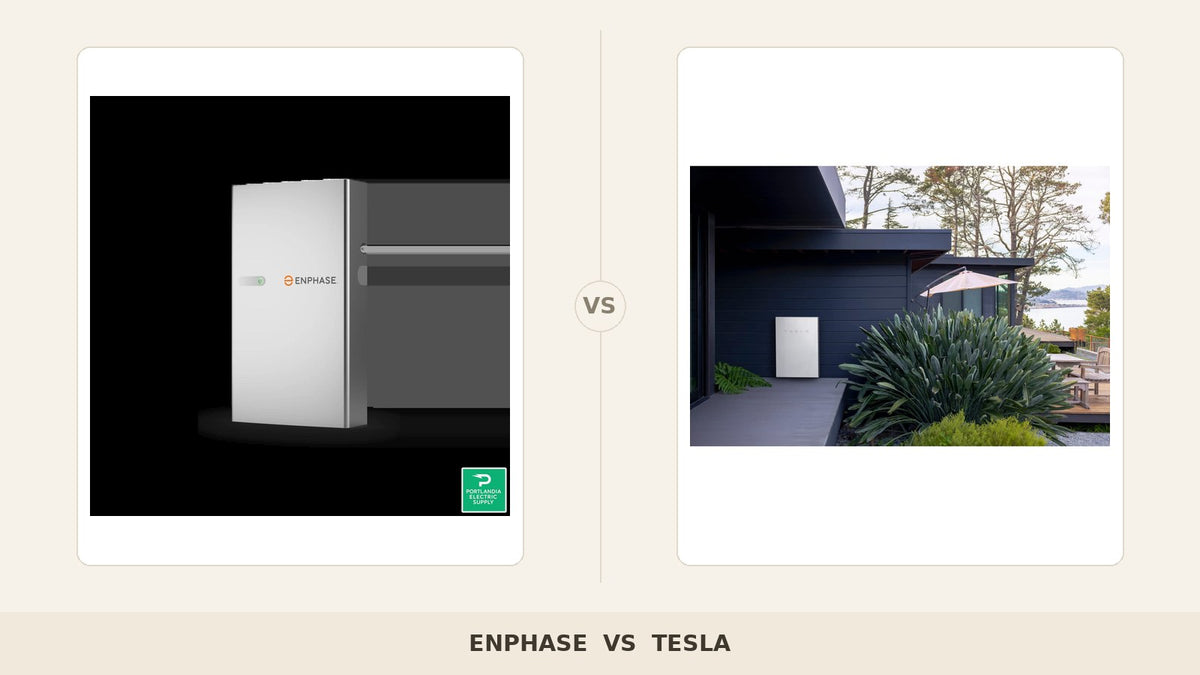
Two batteries, two religions. Tesla's Powerwall 3 is a big, simple, integrated box: one inverter, 13.5 kWh of LFP, and a brand your customer's neighbor already recognizes. Enphase's IQ Battery line is the modular swarm: stackable 5 kWh-class units full of the same IQ8 microinverter silicon that lives on the roof, from the company that basically invented module-level power electronics. We sell, ship, and support both, and we've fielded the warranty calls on both, so this is the comparison we actually give at the counter — with the math tables our estimators use.
The 60-second answer: Powerwall 3 delivers more continuous power per dollar and integrates PV beautifully in new installs; Enphase wins on modularity, on retrofitting onto existing Enphase solar, on warranty length, and on graceful degradation — one failed microinverter doesn't darken the battery. Everything below is the long version of that sentence.
Side-by-Side Comparison Table
| Specification | Enphase IQ Battery (5P class) | Tesla Powerwall 3 |
|---|---|---|
| Unit capacity | 5 kWh per unit, stackable | 13.5 kWh per unit, stackable to 4 units (54 kWh) |
| Continuous AC output per unit | 3.84 kVA class | 11.5 kW class |
| Peak / surge output | 7.68 kVA class for ~3 seconds (motor starting) | High surge class; integrated inverter handles motor starts well — verify per firmware |
| Chemistry | Lithium iron phosphate (LFP) | Lithium iron phosphate (LFP) |
| Power conversion | Embedded IQ8-series microinverters — many small inverters per battery | Single integrated hybrid inverter per unit |
| Solar integration | AC-coupled — pairs with existing IQ microinverter PV; works beside any AC solar | Integrated DC PV input with multiple MPPTs — solar lands directly on the unit in new builds; also AC-couples to existing PV |
| Round-trip efficiency class | ~90% class (AC-coupled path) | ~89–97.5% class depending on coupling path (solar-to-battery DC path is highest) |
| Warranty | 15-year limited warranty class on current 5P units | 10 years, 70% capacity retention, unlimited cycles under standard use |
| Monitoring | Enphase Enlighten — per-panel and per-battery visibility | Tesla app — polished, simple, whole-home view |
| Scalability | Add single 5 kWh-class increments up to system limits | Add 13.5 kWh increments, up to 4 units typical |
| Contractor price class | Higher per kWh; strong retrofit economics | Lower per kWh; strong new-install economics |
Architecture: Swarm vs Monolith
Open an IQ Battery 5P and you'll find four IQ8 microinverters sharing the work. Open a Powerwall 3 and you'll find one serious hybrid inverter doing everything — PV conversion, battery charge and discharge, grid forming, the lot. This isn't trivia; it decides how each system fails, how each system scales, and which one your electrician enjoys installing.
The swarm architecture degrades gracefully. We've had an IQ battery lose one microinverter in the field — the unit kept delivering three-quarters of its rated power, the customer never noticed, and Enlighten flagged the fault for a scheduled swap instead of an emergency truck roll. Monolith architecture fails binary: a Powerwall 3 inverter fault takes the whole 11.5 kW offline until the unit is serviced or swapped. Tesla's swap process is genuinely fast — the unit is designed for one-person replacement — but the house runs on grid or generator while you wait.
The flip side is parts count. More microinverters means more silicon that can eventually fail, and Enphase's bet is that statistics favor them: hundreds of thousands of IQ8s on roofs have given them the reliability data to warranty the battery for 15 years. Tesla's bet is manufacturing simplicity and cost. Both bets are defensible; your customer's tolerance for binary-vs-degraded failure modes is the tiebreaker.
Power Math: What Each System Actually Starts and Runs
The number that matters at 7 pm during an outage is not kWh — it's kW, and whether the battery can start the loads your customer refuses to live without. Here's the load-starting math we run before quoting either platform. Use nameplate LRA for motors, not running amps, or you'll be back with a soft-starter kit and an apology.
| Load | Running Draw | Starting Surge | 1 × PW3 (11.5 kW) | 2 × IQ 5P (7.7 kVA cont.) |
|---|---|---|---|---|
| Refrigerator (modern, inverter compressor) | 0.15–0.4 kW | ~1.2 kW | Easy | Easy |
| Furnace blower (½ HP ECM) | 0.3–0.6 kW | ~1.5 kW | Easy | Easy |
| Well pump (1 HP, 240V) | ~1.4 kW | 4–6 kW LRA | Yes, comfortable | Marginal — verify LRA, consider soft start |
| Mini-split heat pump (3-ton class, inverter) | 1.5–3.5 kW | Low surge (inverter-driven) | Yes | Yes, within continuous rating |
| Central AC (4-ton, single-stage) | 3.5–4.5 kW | 12–20 kW LRA | Yes with soft starter; verify | No — needs 3+ units or soft start; verify |
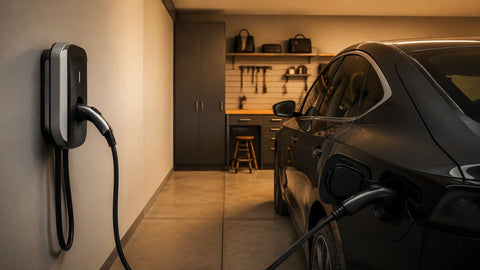
| EV charger (11.5 kW Level 2) | Up to 11.5 kW | N/A | One unit = full rate; app can throttle | Not practical on 2 units; needs larger stack |
One Powerwall 3 starts almost anything residential. Two IQ 5Ps run a sensible critical-loads panel all night but won't start a big single-stage compressor without help. Three or four 5Ps close that gap fast — and that's the Enphase scaling story in one line: you buy power in 3.84 kVA steps instead of 11.5 kW cliffs. For the energy side of the same math — how many kWh the night actually costs — run your load list through our battery backup runtime calculator and the home battery bank sizing guide.
Retrofit vs New Build: Where Each Platform Prints Money
This is the section that decides bids. If the house already has Enphase microinverters on the roof — and millions of American roofs do — the IQ Battery is the path of least resistance. Same monitoring platform, same installer portal, same commissioning app, AC-coupled so nobody touches the roof wiring. We've commissioned IQ battery retrofits in under a day on systems we installed five years earlier, with the batteries appearing in the customer's existing Enlighten app before we left the driveway.
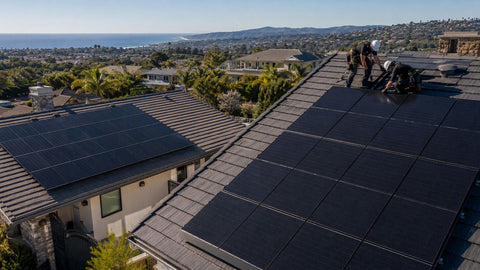
If it's a new build or a re-roof-and-solar combo, Powerwall 3's integrated inverter is legitimately elegant: PV strings land directly on the unit's MPPTs, there's no separate PV inverter to buy, mount, or permit, and the DC-coupled solar-to-battery path squeezes out the highest efficiency in the stack. Fewer boxes on the wall, fewer failure points, one app. For a customer starting from zero, the Powerwall 3 system is usually the cheaper total install at equal capacity.
Non-Enphase existing solar is the honest middle. Powerwall 3 AC-couples to any existing PV without drama, and so does the IQ Battery — at that point the decision comes back to power needs, warranty length, and price per kWh. If the existing system uses string inverters, also read our solar inverter overview and the inverter buyer's guide to sanity-check the coupling plan.
Installation Labor: Counter Data
| Install Phase | IQ Battery (2 × 5P retrofit) | Powerwall 3 (new solar + storage) |
|---|---|---|
| Wall/floor mount + positioning | 1–2 hrs (lighter units, indoor-rated flexibility) | 1–2 hrs (heavy single unit; plan the pad) |
| AC wiring + gateway/controller | 3–4 hrs (IQ System Controller, load circuits) | 3–4 hrs (Backup Gateway, service tap or panel work) |
| PV integration | 0 hrs (existing AC-coupled) to 2 hrs | 2–4 hrs (strings land on integrated MPPTs) |
| Commissioning + app handoff | 1–2 hrs (Enlighten, installer toolkit) | ~1 hr (Tesla app setup is fast) |
| Typical total, 2-person crew | 5–9 crew-hours (retrofit) | 7–11 crew-hours (new build incl. PV landing) |
Permitting note that saves callbacks: both systems are UL 9540 listed energy storage systems, but your AHJ cares about placement clearances, bollards in garages, and — for the AC side — NEC 705 interconnection, 702 transfer means, and 310.16 conductor ampacity. Our NEC wire sizing guide, ampacity chart, and NEC 690 disconnect guide cover the conductor and disconnect math inspectors actually check. Don't forget the surge protection — a properly sized SPD on the service is cheap insurance for ten grand of power electronics.
Cost of Ownership: The Ten-Year Ledger
| Cost Line | Enphase (20 kWh, 4 × 5P class) | Tesla (27 kWh, 2 × PW3) |
|---|---|---|
| Battery hardware, contractor class | Higher per kWh — modular premium | Lower per kWh — scale advantage |
| Controller/gateway + BOS | System Controller + combiner hardware | Gateway + integrated PV landing saves a PV inverter |
| Install labor | Lower on retrofit, higher per kWh on big systems | Lower on new build with integrated PV |
| Warranty coverage window | 15 years class — covers more of the finance term | 10 years — shorter than many loan terms |
| Expansion later | +5 kWh increments, small truck roll | +13.5 kWh increments, bigger spend each step |
| Degradation risk profile | Distributed — single-micro faults degrade output, not availability | Binary — unit fault takes full capacity offline until swap |
Run the specific numbers against your market with the solar ROI calculator and price the hardware from live stock: Enphase, Tesla Powerwall, 10 kWh batteries, 15–30 kWh batteries, and the broader solar batteries and energy storage systems categories. If the customer's real goal is bill arbitrage rather than outage survival, also compare against the Generac PWRcell cost picture — three-way bids close more deals than two-way ones.
Monitoring and the Apps Your Customer Will Actually Open
The Tesla app is the best consumer energy app in the business, and it isn't close. One screen shows solar production, home consumption, battery state of charge, and grid import as animated flows a fifth-grader understands. Storm Watch pulls weather data and pre-charges the battery before severe weather arrives — customers in hurricane and ice-storm country mention this feature by name at the counter. Time-based control for rate arbitrage is set-and-forget. When something's wrong, the alert language is plain English, and Tesla's remote diagnostics often resolve faults over the air before the customer calls anyone.
Enphase's Enlighten plays a different game: depth over polish. Per-panel production history, per-microinverter health, battery charge profiles, consumption metering if you installed the CTs — for a data-hungry homeowner or a contractor managing a fleet, Enlighten shows you things the Tesla app simply doesn't expose. The trade-off is a learning curve; budget fifteen extra minutes at handoff to walk the customer past the dashboard's first layer. For our service department, Enlighten's per-device fault isolation has repeatedly turned a "system down" panic call into a scheduled single-micro swap. Tesla's remote-fix rate is better; Enphase's diagnostic granularity is better. Pick your religion.
Both ecosystems integrate with the broader smart home reasonably well, and both support generator input for extended outages — on rural jobs we routinely pair either battery with a properly sized standby unit, which is where our generator sizing guide earns its keep.
Heat, Cold, and Where the Box Can Live
LFP chemistry made both of these products tougher than their NMC predecessors, but placement still matters. Powerwall 3 is rated for outdoor installation across a wide temperature band with an integrated thermal management system — we've got units on north-facing walls in freeze country performing fine, though sustained deep cold trims charge acceptance until the pack warms itself. Enphase rates the 5P for outdoor and indoor mounting with similar thermal behavior. The practical guidance we give every crew: shade is free battery life, direct afternoon sun on a black enclosure in August is not; garages need bollard protection per most AHJs; and clearances around the unit are code requirements, not suggestions — check the install manual against your local amendments before you set the anchors.
One more placement truth from the field: put the battery where the Wi-Fi or cellular signal actually reaches. A surprising share of "battery offline" tickets are network problems, not battery problems. Hardwired Ethernet or a decent access point within range saves everyone a headache.
Warranty, Support, and the RMA Reality
Warranties read alike on a brochure and behave differently at year seven. Tesla's 10-year, 70% retention, unlimited-cycle warranty is clean and well understood; their service network has matured enormously, and unit swaps are genuinely fast because the Powerwall is designed to be swapped by one technician with a dolly. What customers sometimes discover late is that "10 years" can expire inside a 20- or 25-year solar finance term — the battery goes out of coverage while the loan is still young. Price that risk into long finance deals or set the expectation in writing.
Enphase's 15-year limited warranty class on current 5P units covers more of that finance window, and the modular architecture changes what a "failure" even means: a degraded microinverter inside the battery is a parts replacement with the unit still online, not a full outage event. Our support logs show Enphase RMAs trending toward component-level replacements with short downtime, Tesla RMAs trending toward whole-unit swaps with slightly longer total resolution but fewer repeat visits. Both companies answer the phone. Both honor claims. The real differentiator is architectural: distributed failures versus binary failures, and a longer versus shorter coverage clock.
Whichever platform you install, document the commissioning report, register the product the same day, and photograph the serial labels before you button up. Every painful warranty story we've mediated started with missing registration or a missing photo, not with a defective battery.
Time-of-Use and Bill Arbitrage Behavior
If the customer's real goal is shrinking a brutal peak-rate bill rather than surviving outages, both platforms earn their keep differently. Tesla's time-based control is the simplest to configure: set the rate plan, let the app charge off-peak and discharge on-peak, done. Enphase's rate management inside Enlighten offers finer control for complex tariffs — useful in markets with demand charges or complicated export rules — at the cost of more setup attention. On net-billing-style tariffs where export value is low, both systems correctly prioritize self-consumption; the Powerwall 3's integrated PV path captures a small efficiency edge on the solar-to-battery leg, while Enphase's AC coupling trades that edge for universal compatibility with whatever is already on the roof. For most tariff-chasing customers we've analyzed, the annual savings difference between the two platforms is smaller than the difference made by choosing the right utility rate plan in the first place — run the scenario through the solar ROI calculator before promising payback numbers.
What Our Counter Data Actually Shows
Strip away the marketing and look at what moves through our warehouse: retrofit battery attach rates on existing Enphase roofs run heavily toward IQ Batteries — the monitoring unity and zero roof work close the deal by themselves. New-construction solar-plus-storage quotes, where the integrated inverter eliminates a separate PV inverter line item, trend toward Powerwall 3 on total installed cost. And the single most common regret call we field is under-sizing: the customer who bought one battery, loved it through the first outage, and wished they'd bought two. Size to the night, not to the brochure. If you're on the fence between configurations, quote both, show the ten-year ledger table above, and let the customer's load list — not the logo — make the decision.
Choose Enphase If
- The roof already wears IQ microinverters — retrofit labor and monitoring unity win outright.
- The customer wants to start small (one or two units) and expand in modest steps as budget allows.
- A 15-year warranty matters — financed systems whose loan term exceeds 10 years, or risk-averse buyers.
- Graceful degradation beats peak power: medical loads, home offices, customers who fear the word "offline."
Choose Tesla Powerwall 3 If
- It's a new solar-plus-storage build — the integrated PV inverter removes a whole box from the BOM.
- Whole-home backup with big motor loads is non-negotiable: central AC, well pump, EV charging.
- Lowest cost per kWh installed is the deciding metric at 13.5 kWh and up.
- The customer wants the simplest possible app experience and a brand their neighbors already trust.
Whichever way the customer leans, we stock both ecosystems and quote both honestly. Start the BOM at hybrid energy storage solutions, cross-check sizing with the battery sizing calculator, and read what an energy storage system actually is if the customer is new to the category. For general battery care after install, hand them our battery life and maintenance guide — it prevents the two most common support calls we get.
Frequently Asked Questions
Is Powerwall 3 or Enphase IQ Battery better for whole-home backup?
For whole-home backup with large motor loads, Powerwall 3 has the edge: one unit delivers roughly 11.5 kW continuous, enough to start most central air conditioners with a soft starter and run a full panel. Enphase reaches the same whole-home capability with three or more 5P-class units. For a curated critical-loads panel, two 5Ps are often sufficient and cheaper to stage over time.
Can I add a Powerwall or IQ Battery to my existing solar system?
Yes — both AC-couple to existing solar. The IQ Battery is the natural retrofit for homes already running Enphase microinverters, sharing the Enlighten monitoring platform. Powerwall 3 retrofits cleanly onto any existing PV and additionally offers integrated DC solar input if you're installing new panels at the same time.
Which battery lasts longer?
Both use LFP chemistry with strong cycle life. Enphase backs current 5P-class units with a 15-year limited warranty class; Tesla warrants the Powerwall 3 for 10 years with 70% capacity retention. For financed systems with loan terms past 10 years, the Enphase warranty window covers more of the payment period.
How many batteries do I need to run my house during an outage?
Count energy and power separately. Energy: multiply your critical loads' average draw by the hours you want to survive — a typical panel needs 20–30 kWh for overnight autonomy at 90% usable depth of discharge. Power: your biggest starting load (usually AC or well pump LRA) must fit inside the stack's surge rating. One PW3 covers most homes on power; the kWh count decides how long either system lasts.
Do these work without solar panels?
Yes. Both charge from the grid and provide backup and time-of-use bill savings without any PV. Powerwall 3's integrated solar MPPTs simply go unused until panels are added. Enphase batteries are always AC-coupled, so grid-only operation is native. Adding solar later is straightforward on both platforms.
Which is easier to expand later?
Enphase expands in smaller steps — one 5 kWh-class unit and a short truck roll. Tesla expands in 13.5 kWh units up to four total, a bigger spend per step but fewer total devices at high capacity. If the customer's load growth is uncertain (EV coming, ADU planned), Enphase's granularity is friendlier; if you know you need 40+ kWh eventually, Powerwall's per-kWh pricing wins.
Sources & Standards
- Tesla Powerwall 3 datasheet and installation manual; Tesla app documentation
- Enphase IQ Battery 5P datasheet, IQ System Controller documentation, Enlighten platform
- UL 9540 energy storage system listings — verify placement and pairing requirements with your AHJ
- NEC 2023 Articles 705, 702, 690, and 310.16 for interconnection, transfer, and conductor sizing
- Portlandia Electric Supply install records, RMA logs, and contractor feedback, 2023–2026