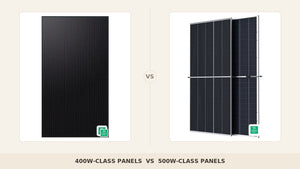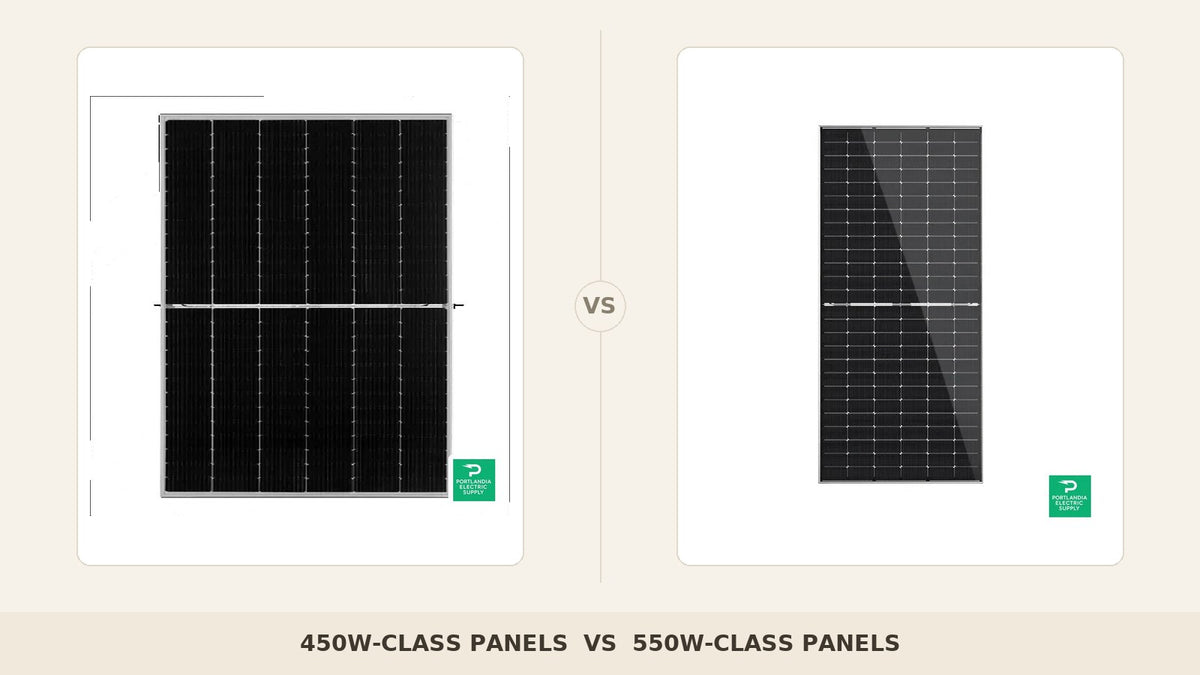
The 450W vs 550W question is really a format question. 450W-class panels are the residential standard: sized and weighted for pitched-roof crews, compatible with standard residential racking, and the highest-volume class in home solar. 550W-class panels are the large-format class: built for commercial roofs, ground mounts, and open residential roofs where fewer, bigger modules cut labor and racking cost — but at ~27-32 kg and over 2.2m long, they demand more from handling and layout. Homeowners should default to 450W class; commercial installers and ground-mount builders should price the 550W class first.
Spec Sheet — 450W-Class Panels vs 550W-Class Panels at a Glance
- Typical Wattage Range: ~430-470W (residential class) · ~530-580W (large-format class)
- Primary Market: Pitched residential roofs · Commercial rooftops, ground mounts, large simple roofs
- Module Efficiency: ~21.0-22.5% class · ~21.0-22.8% class
- Physical Size: ~1.9-2.0m x 1.1m class · ~2.2-2.4m x 1.1-1.3m class
- Weight: ~22-25 kg class · ~27-32 kg class — two-person minimum, mechanical assist on commerci…
The Shared Platform: What Both Have in Common
Both watt classes ship from Tier-1 manufacturers on current N-type cell technology with 25-30-year-class warranties. Both are stocked in US distribution and both work with mainstream racking ecosystems — though 550W-class panels often pair with commercial-rated hardware. The technology inside is increasingly the same; the difference is the frame around it.
Side-by-Side Comparison Table
| Specification | 450W-Class Panels | 550W-Class Panels |
|---|---|---|
| Typical Wattage Range | ~430-470W (residential class) | ~530-580W (large-format class) |
| Primary Market | Pitched residential roofs | Commercial rooftops, ground mounts, large simple roofs |
| Module Efficiency | ~21.0-22.5% class | ~21.0-22.8% class |
| Physical Size | ~1.9-2.0m x 1.1m class | ~2.2-2.4m x 1.1-1.3m class |
| Weight | ~22-25 kg class | ~27-32 kg class — two-person minimum, mechanical assist on commercial |
| Panels per 10 kW | ~21-23 panels | ~17-19 panels |
| Racking & BOS | Standard residential racking ecosystems | Fewer attachments per kW; commercial-rated hardware common |
| Handling & Install | Crew-friendly on pitched roofs and tight layouts | Best on open roofs/ground mounts; awkward on cut-up roofs |
Format Dictates Labor
Every panel on a roof costs crew time to carry, position, clamp, and wire. Moving from 450W to 550W class removes roughly 15-20% of the panels from a given system size — real labor and racking savings on jobs where the bigger format fits. On a cut-up residential roof with dormers and setbacks, the savings can evaporate: oversized panels lose layout flexibility, and the heavier units slow two-person crews on steep pitches. Format follows roof, not fashion.
Electrical Design Differences
Larger-format panels carry higher current, which affects string sizing, wire management, and rapid-shutdown device selection. Residential inverter and optimizer ecosystems are tuned around the 400-500W class; the 550W class pairs naturally with commercial string inverters and higher-amperage MLPE. Match the panel class to the electrical ecosystem, not just the roof.
Quoting this job? We stock 450W-Class Panels products and 550W-Class Panels products at contractor pricing — or get a system quote with both options priced side by side.
Choose 450W-Class Panels If / Choose 550W-Class Panels If
Choose 450W-Class Panels if: the job is a pitched residential roof — especially a complex one — where crew handling, layout flexibility, and residential racking compatibility rule.
Choose 550W-Class Panels if: the job is a commercial roof, ground mount, or large simple residential roof where fewer, bigger panels cut installed cost per watt.
Field takeaway: 450W class for homes, 550W class for commercial and ground mounts. The cells inside are the same generation — the frame size decides the labor math.
Frequently Asked Questions
Can I use 550W panels on my house?
Physically yes on a simple, structurally sound roof — but they are heavy (~27-32 kg) and long (~2.2-2.4m), which slows residential crews and complicates layouts with setbacks. Most installers recommend the 450W class for pitched residential roofs.
Are 550W panels more efficient?
Not meaningfully — both classes run ~21-23% efficiency on current N-type cells. The 550W panel makes more watts because it is bigger, not because its cells are much better.
How many panels for 10 kW in each class?
Roughly 21-23 panels at 450W class versus 17-19 at 550W class. Fewer panels means less racking, fewer attachments, and faster installation where the format fits.
Do 550W panels need different racking?
Often yes — many 550W-class modules pair with commercial-rated racking, and clamp zones differ from residential formats. Verify racking compatibility with the specific module datasheet before ordering.
Which class is cheaper installed?
For commercial and ground-mount jobs, 550W class usually wins on labor and BOS. For typical homes, 450W class usually wins on handling and layout. Quote the total system, not the panel.
Sources & Standards
- PES panel inventory by watt class (portlandiaelectric.supply)
- PVEL Module Reliability Scorecard (pvel.com)
- NEC Article 690 (nfpa.org)
Ready to price your project? Get a free system quote from PES Supply — both options, contractor pricing.
Related Resources: