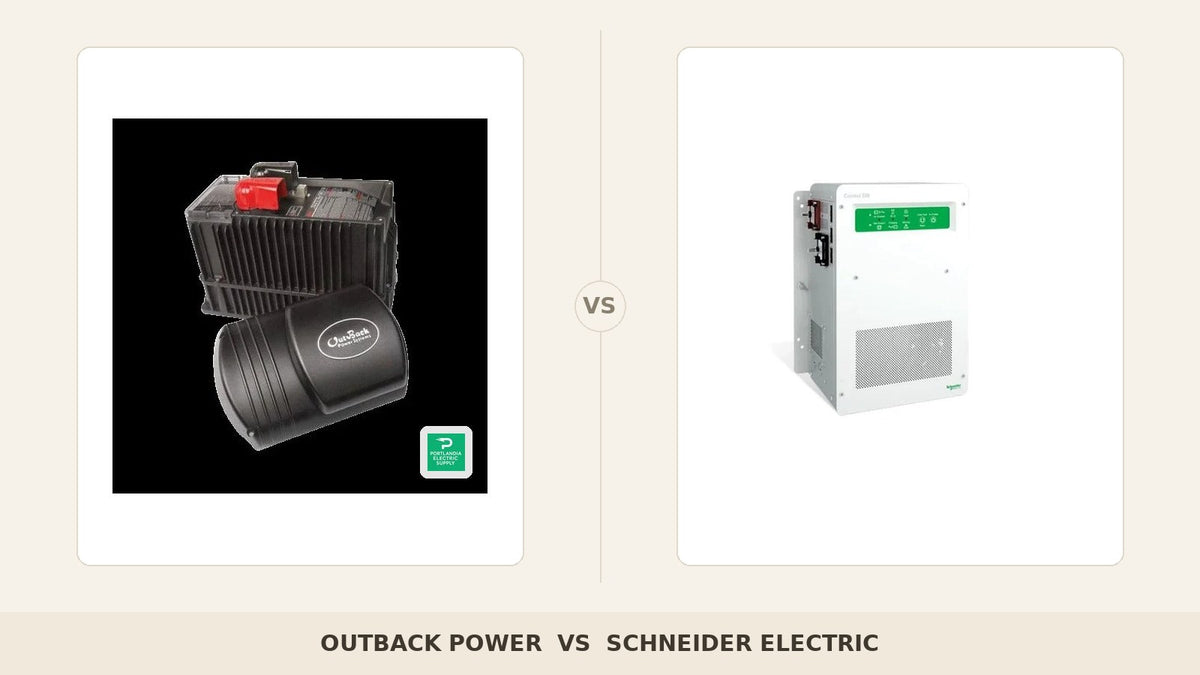
If you are building serious off-grid power with transformer-based hardware, you are almost certainly choosing between these two. OutBack Power is the off-grid native: FXR and Radian inverter-chargers designed by and for the off-grid community, with the deepest installer knowledge base in cabins, homesteads, and remote sites. Schneider XW Pro is the industrial major's entry: equivalent transformer architecture with a global support organization and polished Conext system integration. On capability they overlap almost completely — surge, stacking, 48V openness. The real differences are ecosystem culture and support model: OutBack feels like the off-grid community's own; Schneider feels like infrastructure procurement.
Spec Sheet — OutBack Power vs Schneider Electric at a Glance
- Topology: Low-frequency transformer-based inverter-charger; the legacy off-gr… · Low-frequency transformer-based inverter-charger (off-grid/hybrid)
- Continuous AC Output: FXR 3.6 kW class per unit; Radian 8–9 kW class; stackable to 30 kW+… · XW Pro 6848: 6.8 kW continuous class (stackable to multi-unit syste…
- Surge / Motor Starting: Excellent surge class — designed for motors, pumps, compressors · Strong surge class — transformer-based, starts heavy motors/compres…
- Battery Voltage Options: 48V (also 12/24/36 on select models) — chemistry-agnostic · 48V nominal — chemistry-agnostic (LFP, AGM, flooded)
- Monitoring Platform: MATE3s / OPTICS RE cloud · Conext Gateway / InsightHome-InsightFacility
The Shared Platform: What Both Have in Common
Both are low-frequency transformer-based inverter-chargers running 48V battery banks (OutBack also serves 12/24/36V niches), both deliver excellent surge for motors and compressors, both stack/parallel to multi-unit and higher-power systems, both are chemistry-agnostic with mature charge profiles, and both have 15+ years of field-proven deployments in North American off-grid installations.
Side-by-Side Comparison Table
| Specification | OutBack Power | Schneider Electric |
|---|---|---|
| Topology | Low-frequency transformer-based inverter-charger; the legacy off-grid workhorse | Low-frequency transformer-based inverter-charger (off-grid/hybrid) |
| Continuous AC Output | FXR 3.6 kW class per unit; Radian 8–9 kW class; stackable to 30 kW+ systems | XW Pro 6848: 6.8 kW continuous class (stackable to multi-unit systems) |
| Surge / Motor Starting | Excellent surge class — designed for motors, pumps, compressors | Strong surge class — transformer-based, starts heavy motors/compressors |
| Battery Voltage Options | 48V (also 12/24/36 on select models) — chemistry-agnostic | 48V nominal — chemistry-agnostic (LFP, AGM, flooded) |
| Monitoring Platform | MATE3s / OPTICS RE cloud | Conext Gateway / InsightHome-InsightFacility |
| Warranty | 5 years class (FXR/Radian) | 2–5 years class by model/region (verify per SKU) |
| Typical Price | Mid-premium off-grid tier | Premium off-grid tier (~$3,500–4,500 XW Pro class) |
| Support / Ecosystem | US-rooted off-grid specialist channel; deep installer knowledge base | Global electrical-major support footprint |
System Architecture: MATE vs Conext
OutBack systems revolve around the MATE3s controller and OPTICS RE cloud, coordinating FXR/Radian inverters and FLEXmax charge controllers — a tight, purpose-built off-grid stack. Schneider revolves around the Conext Gateway and Insight platforms, coordinating XW Pro with MPPT controllers and battery comms. Both work well; both require learning their respective configuration languages. OutBack's stack feels built by people who live off-grid (because it was); Schneider's feels built by an industrial controls company (because it was). Installer familiarity usually decides this layer.
Stacking and Scaling
Need 12 kW split-phase? 24 kW? 3-phase for a shop? Both platforms stack. OutBack's Radian series scales elegantly to large split-phase and 3-phase systems; Schneider's XW Pro stacks to comparable totals with strong multi-unit coordination. At the small end, OutBack's FXR (and its 12/24/36V variants) covers tiny cabins and RVs that the 48V-only XW Pro cannot serve. At the large end they are peers. Scaling decisions usually come down to which ecosystem your installer already stocks and services.
Longevity, Parts, and Support Culture
Both brands have kept legacy product lines serviceable far longer than consumer-electronics norms — boards, parts, and repair paths exist for decade-old units on both. Schneider brings a global major's support infrastructure and procurement polish. OutBack brings the off-grid community's institutional memory: nearly every configuration question has been asked and answered in installer forums and distributor tech lines. For a remote site, the best support is the one your installer knows cold — pick the platform your service provider has already fixed in the field.
Quoting this job? We stock OutBack Power products and Schneider Electric products at contractor pricing — or get a system quote with both options priced side by side.
Choose OutBack Power If / Choose Schneider Electric If
Choose OutBack Power if: Choose OutBack if: the build is classic off-grid — cabin, homestead, ranch, marine; you want the deepest off-grid installer knowledge base; 12/24/36V niche support matters (FXR); or your installer is an OutBack shop with parts on the shelf.
Choose Schneider Electric if: Choose Schneider if: the project is infrastructure-grade or commercial; global-major support and procurement formality matter; your installer is a Schneider/Conext shop; or the system must integrate cleanly with industrial monitoring expectations.
Field takeaway: Two equivalent transformer architectures, two different cultures. OutBack is the off-grid community's own platform; Schneider is the industrial major's. Let your installer's ecosystem — not the spec sheet — make this call.
Frequently Asked Questions
Is OutBack or Schneider better for an off-grid cabin?
Both excel. OutBack FXR is the traditional cabin favorite, especially at 12/24/48V small-system scales, with the deepest community knowledge base. Schneider XW Pro suits larger cabins and homes, especially where a Schneider-savvy installer services the area.
Do both work with lithium batteries?
Yes — both are 48V chemistry-agnostic with mature LFP integrations (closed-loop with major brands via their gateways) and decades of lead-acid profile support.
Which has better surge for motors?
Both are excellent — transformer-based designs built for motor starting. In practice the difference is negligible; either starts compressors, pumps, and shop equipment that would trip high-frequency inverters.
Can these grid-tie or sell power?
Both support grid-interactive configurations, but their native habitat is off-grid and backup. For net-metered hybrid duty with sell-back as the primary goal, modern all-in-one hybrids (Sol-Ark, EG4) are more direct fits.
Which brand will support me in 10 years?
Both have strong long-term serviceability records with parts and repair paths for legacy units. Schneider offers global-major infrastructure; OutBack offers the off-grid channel's deep institutional memory. Choose based on who services your region.
Sources & Standards
- OutBack Power FXR/Radian documentation (outbackpower.com)
- Schneider XW Pro / Conext documentation (se.com)
Ready to price your project? Get a free system quote from PES Supply — both options, contractor pricing.
Related Resources: