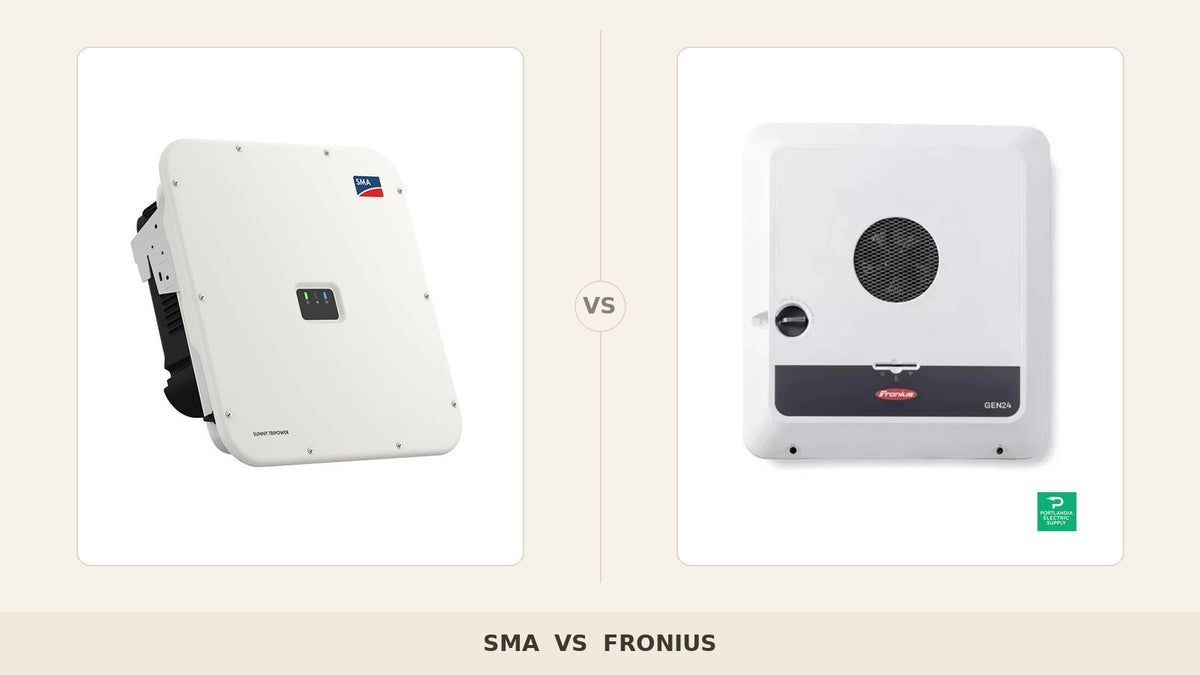
SMA and Fronius are the two European string-inverter incumbents, and after decades of competition the honest truth is that both make excellent hardware at premium-European prices. The differences that matter: SMA wins on shade handling without extra hardware (ShadeFix), passive cooling silence, and typically lower pricing; Fronius wins on hybrid readiness (GEN24 Plus is battery-native), the PV Point battery-free backup outlet, active cooling's superior thermal behavior in hot climates, and a fuller warranty structure in many markets. Choose SMA for a quiet, shade-tolerant string inverter at the sharper price. Choose Fronius when storage is in the future or blackout resilience without a battery has value.
Spec Sheet — SMA vs Fronius at a Glance
- Topology: String inverter (transformerless), German engineering since 1981 · String inverter; GEN24 Plus adds native hybrid (battery-ready)
- Output Range: Sunny Boy 3.0–6.0 kW single-phase class; Smart Energy hybrid 3.8–7.… · Primo 3.0–8.2 kW single-phase; Symo 3-phase to ~20 kW class
- Peak Efficiency: Up to ~98.4% peak (Sunny Boy class) · Up to ~98.2% peak
- Shade Management: ShadeFix — software shade management without per-module hardware · Dynamic Peak Manager (MPPT software); Tigo TS4 compatible for modul…
- Battery Path: High-voltage battery via Smart Energy hybrid (SMA Home Storage/BYD… · High-voltage battery via GEN24 Plus (BYD Battery-Box certified pair…
The Shared Platform: What Both Have in Common
Both are transformerless string inverters with ~98%+ peak efficiency, mature monitoring portals (Sunny Portal vs Solar.web), Tigo TS4 compatibility for module-level needs, NEC-compliant rapid-shutdown paths, and long US market presence through distribution. Both are the "safe premium choice" in their segment — the decision is features and warranty structure, not quality.
Side-by-Side Comparison Table
| Specification | SMA | Fronius |
|---|---|---|
| Topology | String inverter (transformerless), German engineering since 1981 | String inverter; GEN24 Plus adds native hybrid (battery-ready) |
| Output Range | Sunny Boy 3.0–6.0 kW single-phase class; Smart Energy hybrid 3.8–7.7 kW class; Tripower commercial | Primo 3.0–8.2 kW single-phase; Symo 3-phase to ~20 kW class |
| Peak Efficiency | Up to ~98.4% peak (Sunny Boy class) | Up to ~98.2% peak |
| Shade Management | ShadeFix — software shade management without per-module hardware | Dynamic Peak Manager (MPPT software); Tigo TS4 compatible for module-level needs |
| Battery Path | High-voltage battery via Smart Energy hybrid (SMA Home Storage/BYD class) or AC-coupled | High-voltage battery via GEN24 Plus (BYD Battery-Box certified pairing) |
| Backup Without Battery | No battery-free backup outlet on standard models | PV Point — up to ~3 kW daylight backup outlet without a battery (GEN24) |
| Cooling | Passive (silent) | Active fan cooling (audible; superior thermal derating in heat) |
| Rapid Shutdown Path | SunSpec PLC via JMS-F-V2 module (600W class) | NEC 690.12 via Tigo TS4-A-F/A-O pairing |
| Monitoring | Sunny Portal + Smart Connected proactive service | Solar.web portal/app |
| Warranty | 5 years standard (extendable to 10/15/20 paid) | 5–10 years standard by market (extendable to 20) |
| Typical Price | Mid-premium string tier | Premium string tier |
| Origin | Germany; long US channel presence via distributors | Austria (solar division since 1992) |
Shade: ShadeFix vs Dynamic Peak Manager
Both brands handle shade in software rather than requiring per-module hardware. SMA's ShadeFix is the older and more celebrated implementation — string-level optimization that recovers a meaningful share of shade losses with no added BOM. Fronius' Dynamic Peak Manager performs the same job competently. For genuinely shaded roofs, both brands support Tigo TS4 module-level electronics as the honest fix; the software features handle light-to-moderate shade, not chimneys. Practically, this round is a draw with a slight historical edge to SMA — do not let it decide the purchase alone.
Storage and Backup: Where Fronius Pulls Ahead
The Fronius GEN24 Plus is battery-native: add a BYD Battery-Box (a certified pairing) later without replacing the inverter, and PV Point gives you up to ~3 kW of daylight backup power from the panels alone during outages — no battery required. SMA's path is modular: the standard Sunny Boy is grid-tie only, and storage means choosing the Smart Energy hybrid variant upfront or adding AC-coupled storage later. If there is any chance the customer wants batteries within the inverter's life, the GEN24 Plus premium is cheaper than an inverter swap — and PV Point is a genuinely unique resilience feature in this class.
Heat, Noise, and Warranty
Fronius' active fan cooling gives it superior thermal derating behavior in hot installations — Arizona garages, south-facing walls — at the price of audible fan noise and a moving part. SMA's passive cooling is silent and partless but derates earlier in heat. On warranty: SMA runs 5 years standard with paid extensions to 10/15/20; Fronius runs 5–10 standard by market with extensions to 20. Both warranty structures reward registration and extension purchases — price the 10-year-plus configuration into any comparison, because string inverters are the most failure-prone electronics in the system.
Quoting this job? We stock SMA products and Fronius products at contractor pricing — or get a system quote with both options priced side by side.
Choose SMA If / Choose Fronius If
Choose SMA if: Choose SMA if: the roof has light-to-moderate shade and you want zero extra hardware (ShadeFix); silence matters (bedroom-adjacent wall); the design is straightforward grid-tie; or price discipline rules — SMA usually quotes sharper.
Choose Fronius if: Choose Fronius if: storage is plausible later (GEN24 Plus is battery-native); battery-free backup power during outages has value (PV Point); the install is hot and thermal derating matters; or your market's Fronius warranty terms beat SMA's.
Field takeaway: SMA sells silent, shade-savvy value from Germany; Fronius sells hybrid-ready, heat-tolerant flexibility from Austria. Grid-tie today, maybe batteries tomorrow? That single answer picks the winner: GEN24.
Frequently Asked Questions
Is SMA or Fronius more reliable?
Both are premium European brands with strong long-term field records and low failure rates. Fronius' active cooling adds a fan that can eventually need service; SMA's passive design has fewer moving parts. In practice, installer quality and warranty terms matter more than the reliability delta.
Can I add a battery later to either inverter?
Fronius GEN24 Plus: yes, natively — add a certified BYD Battery-Box without replacing the inverter. Standard SMA Sunny Boy: not natively — you would add AC-coupled storage or should have chosen the Smart Energy hybrid model. If storage is plausible, buy the hybrid-ready unit upfront.
What is Fronius PV Point?
A backup outlet feature on GEN24 inverters that supplies up to ~3 kW directly from the panels during grid outages — no battery required. It runs lights, fridge, and device charging in daylight. SMA has no direct equivalent on standard models.
Do SMA and Fronius work with microinverters or optimizers?
Both are string inverters compatible with Tigo TS4 module-level electronics (RSD, monitoring, optimization). Neither works with Enphase microinverters (those replace the string inverter) or SolarEdge optimizers (closed ecosystem).
Which is cheaper?
SMA typically quotes slightly lower for equivalent grid-tie capacity. Fronius' GEN24 Plus premium pays for hybrid readiness and PV Point. Compare 10-year-warranty configurations of both for an honest number.
Sources & Standards
- SMA Sunny Boy/Smart Energy documentation (sma-america.com)
- Fronius GEN24 documentation (fronius.com)
Ready to price your project? Get a free system quote from PES Supply — both options, contractor pricing.
Related Resources: