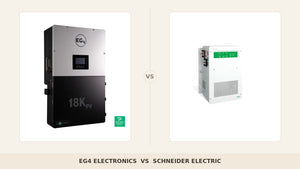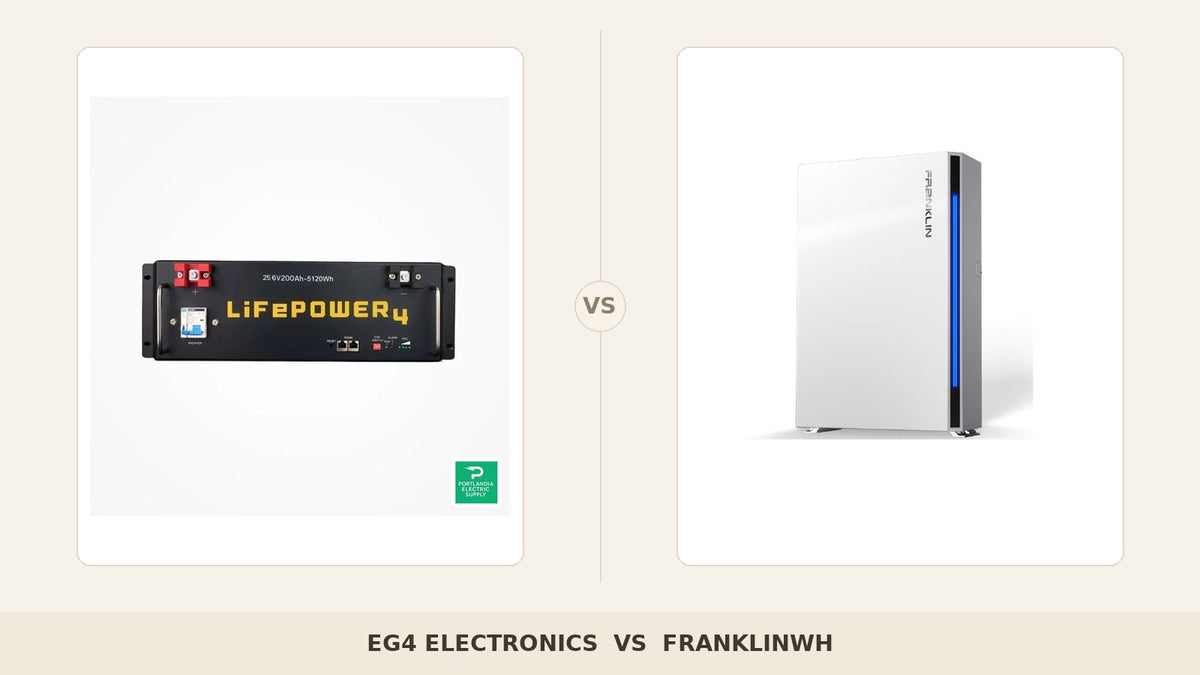
EG4 and FranklinWH both back up homes, but they are different product categories. EG4 is the component path: rack batteries plus a hybrid inverter, assembled by an installer or advanced DIYer, at roughly half the cost per kWh of integrated systems. FranklinWH aPower 2 is the appliance path: a 15 kWh AC-coupled unit with 10 kW continuous output, native generator integration via aGate, per-circuit smart load control, and a 15-year warranty — installed and supported as one system. Handy owners and budget builds take EG4; households that want a set-and-forget whole-home system take FranklinWH.
Spec Sheet — EG4 Electronics vs FranklinWH at a Glance
- System Type: Component build: 48V rack batteries + separate hybrid inverter · Integrated AC-coupled battery appliance (aPower 2 + aGate)
- Chemistry: LiFePO4 prismatic (server-rack 51.2V 100Ah / 5.12 kWh modules) · LFP (100% depth of discharge rated)
- Capacity: 5.12 kWh per rack module; stack to 80 kWh class per bank · 15 kWh per unit (stacks to 15 units / 225 kWh)
- Continuous Output: Set by the paired inverter (e.g., 12 kW class hybrid) · 10 kW continuous, 15 kW 10-sec peak; 185A LRA motor-starting class
- Solar Coupling: DC-coupled through the hybrid inverter · AC-coupled — retrofit-friendly with ANY existing solar inverter/mic…
The Shared Platform: What Both Have in Common
Both use LFP chemistry, both scale by stacking units, both integrate with generators and solar, and both carry real warranties (10-year EG4, 15-year FranklinWH). Either can run a home through an outage — the difference is who designs, installs, and services the system, and how much automation comes in the box.
Side-by-Side Comparison Table
| Specification | EG4 Electronics | FranklinWH |
|---|---|---|
| System Type | Component build: 48V rack batteries + separate hybrid inverter | Integrated AC-coupled battery appliance (aPower 2 + aGate) |
| Chemistry | LiFePO4 prismatic (server-rack 51.2V 100Ah / 5.12 kWh modules) | LFP (100% depth of discharge rated) |
| Capacity | 5.12 kWh per rack module; stack to 80 kWh class per bank | 15 kWh per unit (stacks to 15 units / 225 kWh) |
| Continuous Output | Set by the paired inverter (e.g., 12 kW class hybrid) | 10 kW continuous, 15 kW 10-sec peak; 185A LRA motor-starting class |
| Solar Coupling | DC-coupled through the hybrid inverter | AC-coupled — retrofit-friendly with ANY existing solar inverter/microinverters |
| Generator Integration | Yes — auto-gen-start, AC couple capable | Native automated generator integration via aGate (auto-start, charge, auto-stop) |
| Load Management | Via inverter/transfer-panel configuration | Smart circuit control — shed/prioritize individual loads from the app |
| Monitoring | EG4 app + inverter platform | FranklinWH app with circuit-level visibility (aGate X) |
| Warranty | 10 years (current models) | 15 years — among the longest in residential storage |
| Installed Cost Class | $0.20–0.25/Wh contractor class ($1,050–1,300 per 5.12 kWh) | ~$14,000–20,000 installed class |
Cost per kWh: The Big Number
An EG4-based build lands around $0.20-0.25/Wh for batteries plus inverter and balance-of-system — a 15 kWh-class bank can come in dramatically below an integrated system's $14,000-20,000 installed range. The savings are real, but they buy components, not a system: design, code compliance, generator integration, and load management are the installer's (or owner's) responsibility. FranklinWH's premium buys a factory-integrated answer to all four.
Automation and the Outage Experience
FranklinWH's aGate automates the outage: instant transfer, per-circuit shedding from the app, and native generator auto-start/charge/stop as a supported configuration. An EG4 build can achieve most of the same behavior — EG4 hybrids integrate generators and support critical-load panels — but it is configured, not automatic. For households that will never open an app during a storm, the integrated experience is the product.
Quoting this job? We stock EG4 Electronics products and FranklinWH products at contractor pricing — or get a system quote with both options priced side by side.
Choose EG4 Electronics If / Choose FranklinWH If
Choose EG4 Electronics if: the buyer (or their installer) is comfortable designing a component system and cost per kWh is the driving constraint — especially for larger banks and off-grid-leaning builds.
Choose FranklinWH if: the household wants a turnkey, app-controlled, generator-native whole-home system with a 15-year warranty and one accountable vendor.
Field takeaway: EG4 is the value engineer's path; FranklinWH is the turnkey path. Both run a home — they differ in who owns the design and how automatic the experience is.
Frequently Asked Questions
Is FranklinWH better than EG4?
Different categories. FranklinWH is an integrated whole-home appliance with a 15-year warranty and native generator/load management. EG4 is a component ecosystem that delivers similar capacity at roughly half the cost per kWh when properly designed and installed.
Can EG4 batteries do whole-home backup?
Yes — paired with a hybrid inverter (e.g., an 18KPV-class unit) and a critical-loads or whole-home transfer configuration. It requires proper design and installation; it is not a plug-in appliance.
Which lasts longer?
FranklinWH carries a 15-year warranty; EG4 carries 10 years with ~7,000-cycle class chemistry. In typical backup duty both outlast their warranty terms.
Do both work with generators?
Yes. FranklinWH integrates generators natively through aGate (auto-start/stop as a supported configuration). EG4 hybrid inverters support generator input with configurable charge behavior — setup is manual but capable.
Which is cheaper installed?
EG4 component builds typically land far below FranklinWH's ~$14,000-20,000 installed class at equivalent capacity, especially for larger banks. The trade is design labor and system integration responsibility.
Sources & Standards
- EG4 battery documentation (eg4electronics.com)
- FranklinWH aPower 2 datasheet (franklinwh.com)
- UL 9540 standard (ul.com)
Ready to price your project? Get a free system quote from PES Supply — both options, contractor pricing.
Related Resources: