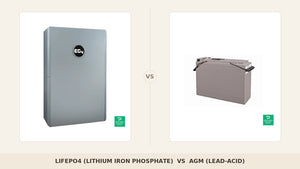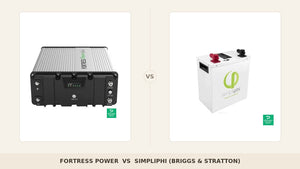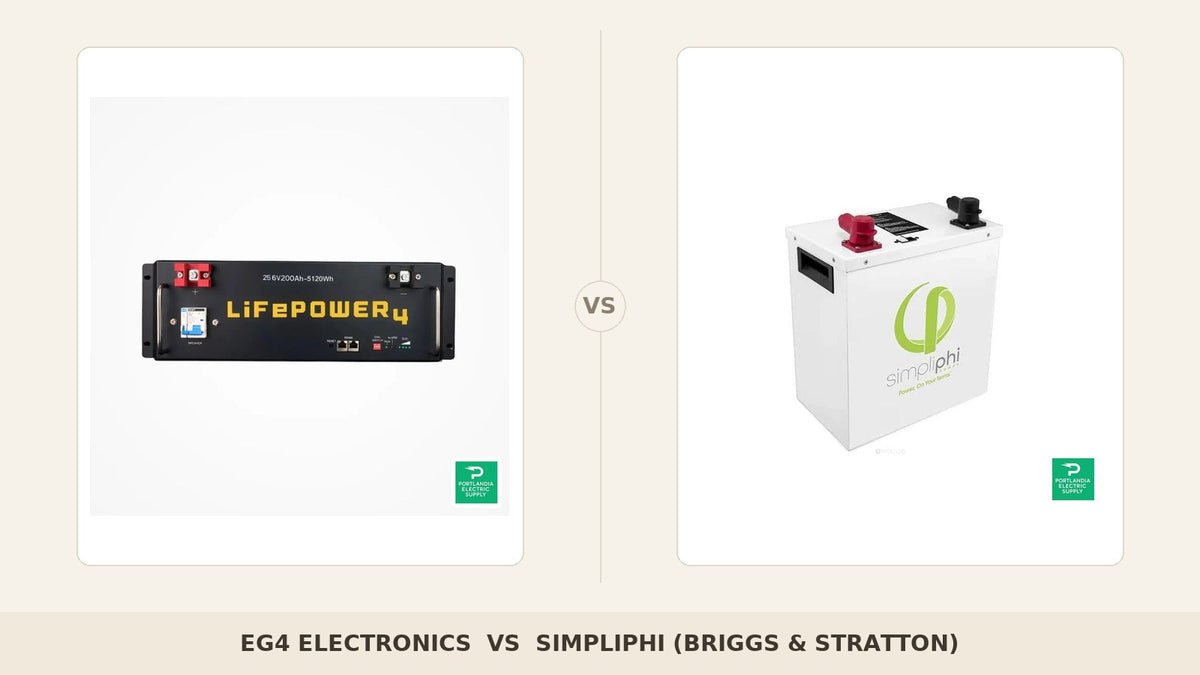
EG4 and SimpliPhi sit at opposite ends of the credible LiFePO4 market. EG4 wins on cost per kWh by a factor of three or more — UL 1973-listed rack modules at $0.20-0.25/Wh class with ~7,000-cycle longevity and a 10-year warranty. SimpliPhi wins on engineering depth — 10,000+ cycle life, 98% operating efficiency, 100% depth-of-discharge rating, California manufacturing, and military/industrial heritage that budget batteries do not match. For grid-adjacent home backup and budget off-grid builds, EG4. For mission-critical, daily-cycling, decades-long deployments, SimpliPhi earns its premium.
Spec Sheet — EG4 Electronics vs SimpliPhi (Briggs & Stratton) at a Glance
- Chemistry & Listings: LiFePO4 prismatic (server-rack 51.2V 100Ah / 5.12 kWh modules) · LiFePO4 (cobalt-free LFP), UL 1642/1973, UL 9540A tested
- Capacity & Form: 5.12 kWh per 51.2V 100Ah rack module · PHI 3.8-M: 3.8 kWh per unit (24V 151Ah or 48V 75Ah); unlimited para…
- Cycle Life: ~7,000 cycles @ 80% DOD class · 10,000+ cycles @ 80% DOD — class-leading longevity
- Depth of Discharge: 80% DOD class recommended · Up to 100% depth of discharge
- Operating Efficiency: Not published — verify with manufacturer · 98% operating efficiency
The Shared Platform: What Both Have in Common
Both are cobalt-free LiFePO4 batteries with UL-listed cell standards, both scale by paralleling modular units, both integrate with mainstream hybrid inverters, and both carry 10-year warranties. Either will run an off-grid cabin or a home backup bank safely. The gap is duty cycle: how hard, how long, and how far from service the bank will run.
Side-by-Side Comparison Table
| Specification | EG4 Electronics | SimpliPhi (Briggs & Stratton) |
|---|---|---|
| Chemistry & Listings | LiFePO4 prismatic (server-rack 51.2V 100Ah / 5.12 kWh modules) | LiFePO4 (cobalt-free LFP), UL 1642/1973, UL 9540A tested |
| Capacity & Form | 5.12 kWh per 51.2V 100Ah rack module | PHI 3.8-M: 3.8 kWh per unit (24V 151Ah or 48V 75Ah); unlimited parallel scalability |
| Cycle Life | ~7,000 cycles @ 80% DOD class | 10,000+ cycles @ 80% DOD — class-leading longevity |
| Depth of Discharge | 80% DOD class recommended | Up to 100% depth of discharge |
| Operating Efficiency | Not published — verify with manufacturer | 98% operating efficiency |
| Discharge Capability | 100A (~5.1 kW) continuous per 5.12 kWh module | 48V: 37.5A (1.92 kW) continuous, 80A 10-min surge; built-in 80A DC breaker |
| Origin | Imported cells; Texas-based brand and support | Designed and manufactured in California, USA (Briggs & Stratton Energy Solutions) |
| Operating Temperature | Standard LFP class (charge above freezing) | Operating −4° to 140°F; charge 32° to 120°F |
| Warranty | 10 years (current models) | 10 years / 10,000 cycles |
| Price Class | $0.20–0.25/Wh contractor class ($1,050–1,300 per 5.12 kWh) | Premium per kWh class (~$0.70–0.90/Wh) |
What the Premium Buys
SimpliPhi's PHI line costs roughly 3-4x EG4 per kWh. What that buys: 10,000+ cycles at 80% DOD (vs ~7,000 class), rated 100% depth of discharge capability, 98% operating efficiency, a -4F to 140F operating envelope, and California manufacturing with engineering-level support. For a bank that cycles hard every day for 15+ years — or one sitting in a remote location where failure is not an option — the amortized cost per delivered kWh narrows dramatically.
The Value Case Is Real Too
Most residential backup banks cycle lightly: a few deep events per year plus occasional peak shaving. At that duty cycle, EG4's ~7,000-cycle rating is decades of theoretical life, and the 3-4x price premium buys longevity the application will never use. The honest sizing question is not "which battery is better" but "how many deep cycles per year will this bank actually see?" Light duty: EG4. Heavy daily cycling or critical loads: SimpliPhi.
Quoting this job? We stock EG4 Electronics products and SimpliPhi (Briggs & Stratton) products at contractor pricing — or get a system quote with both options priced side by side.
Choose EG4 Electronics If / Choose SimpliPhi (Briggs & Stratton) If
Choose EG4 Electronics if: the bank is for home backup or a budget-conscious off-grid build with moderate cycling — UL-listed LFP at the lowest credible cost per kWh.
Choose SimpliPhi (Briggs & Stratton) if: the application is daily deep cycling, mission-critical, remote, or extreme-temperature — where 10,000-cycle engineering and US manufacturing justify the premium.
Field takeaway: EG4 for value, SimpliPhi for duty cycle. Match the battery to the real cycling profile, not the spec-sheet maximum.
Frequently Asked Questions
Is SimpliPhi worth 3-4x the price of EG4?
For heavy daily cycling, remote/critical installations, or extreme temperatures, yes — 10,000+ cycles and 100% DOD rating amortize the premium. For typical home backup with light cycling, EG4 delivers the same service at a fraction of the cost.
Are both batteries safe?
Yes — both use cobalt-free LiFePO4, the safest mainstream lithium chemistry, with UL-listed cell standards and integrated BMS protection.
Which lasts longer?
SimpliPhi rates 10,000+ cycles at 80% DOD with a 10-year/10,000-cycle warranty; EG4 rates ~7,000 cycles class with a 10-year warranty. In light-duty service both outlast their warranties.
Where are they made?
SimpliPhi designs and manufactures in California (Briggs & Stratton Energy Solutions). EG4 is a Texas-based brand using imported cells with US-based support.
Can I mix them in one bank?
No — never mix battery brands or models in a parallel bank. Different BMS behavior and internal resistance cause imbalanced charging. Build each bank from identical modules.
Sources & Standards
- EG4 battery documentation (eg4electronics.com)
- SimpliPhi PHI datasheets (simpliphipower.com)
- UL 9540A test method (ul.com)
Ready to price your project? Get a free system quote from PES Supply — both options, contractor pricing.
Related Resources: