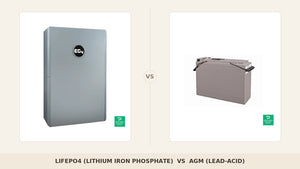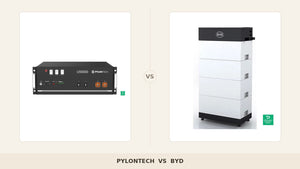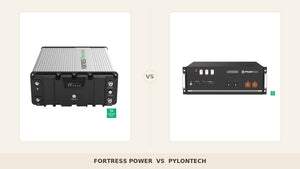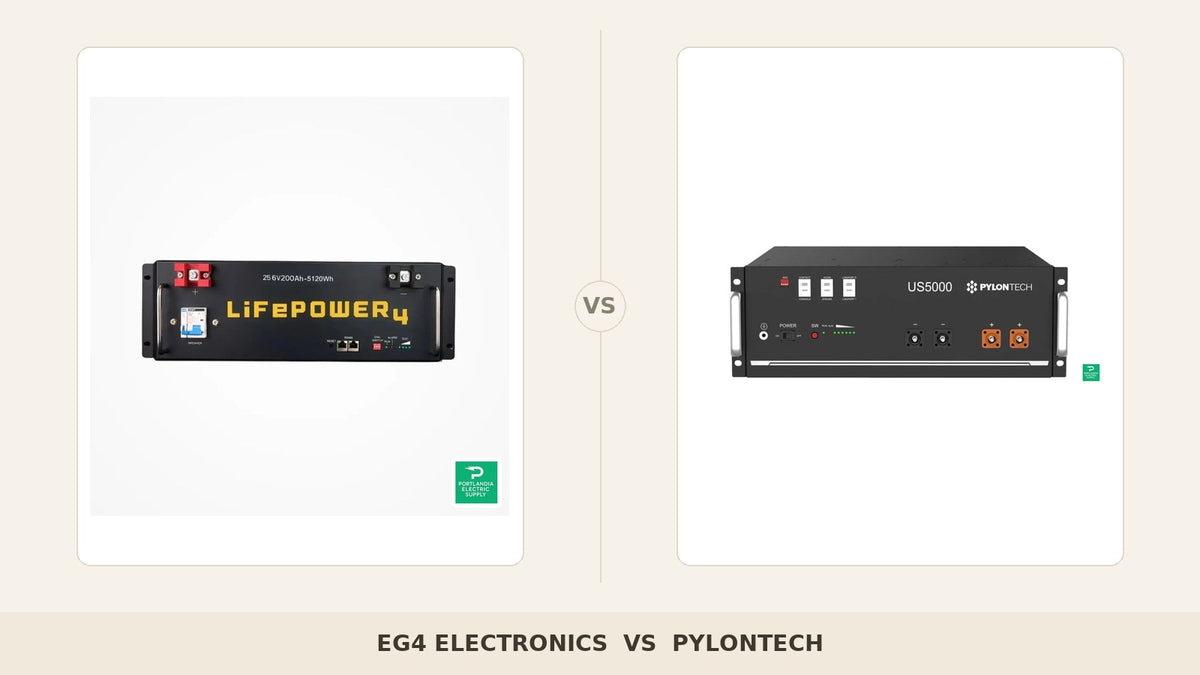
EG4 and Pylontech own the budget end of the 48V rack-battery market, and both are legitimate. EG4 wins on price per kWh — ~$1,050-1,300 per 5.12 kWh module ($0.20-0.25/Wh class) with UL 1973 listing and ~7,000-cycle class longevity. Pylontech wins on compatibility breadth — the US5000's CAN/RS485 integration list is among the broadest in the industry, backed by a decade of global field history and ~95% round-trip efficiency. For EG4-ecosystem builds and tight budgets, EG4. For pairing with third-party inverters worldwide, Pylontech's comms library is the safer bet.
Spec Sheet — EG4 Electronics vs Pylontech at a Glance
- Chemistry: LiFePO4 prismatic (server-rack 51.2V 100Ah / 5.12 kWh modules) · LiFePO4
- Capacity & Form: 5.12 kWh per 51.2V 100Ah rack module; stacks on busbar/rack · US5000: 4.8 kWh per 19-inch rack module (stack to ~16 units class);…
- Cycle Life: ~7,000 cycles @ 80% DOD class · ≥6,000 cycles class @ 90% DOD
- Discharge: 100A (~5.1 kW) continuous per 5.12 kWh module · US5000: 100A class per module (derated continuous ~4.8 kW class pai…
- Round-Trip Efficiency: Not published — verify with manufacturer · ~95% round-trip efficiency
The Shared Platform: What Both Have in Common
Both are LiFePO4 server-rack modules in the ~4.8-5.1 kWh class, both carry ~10-year warranties, both communicate over CAN/RS485 for closed-loop inverter control, and both scale by stacking modules on busbars or racks. Either is a rational choice for off-grid, hybrid, and backup builds in the value tier — the fight is over ecosystem support and compatibility depth.
Side-by-Side Comparison Table
| Specification | EG4 Electronics | Pylontech |
|---|---|---|
| Chemistry | LiFePO4 prismatic (server-rack 51.2V 100Ah / 5.12 kWh modules) | LiFePO4 |
| Capacity & Form | 5.12 kWh per 51.2V 100Ah rack module; stacks on busbar/rack | US5000: 4.8 kWh per 19-inch rack module (stack to ~16 units class); Force-H2 high-voltage towers |
| Cycle Life | ~7,000 cycles @ 80% DOD class | ≥6,000 cycles class @ 90% DOD |
| Discharge | 100A (~5.1 kW) continuous per 5.12 kWh module | US5000: 100A class per module (derated continuous ~4.8 kW class pair) |
| Round-Trip Efficiency | Not published — verify with manufacturer | ~95% round-trip efficiency |
| Listings | UL 1973, UN38.3 | UL 1973 class, UN38.3 (verify per market listing) |
| Inverter Comms | CAN/RS485 — best with EG4 batteries; growing third-party list | CAN/RS485 — among the broadest third-party inverter compatibility lists in the industry |
| Monitoring | EG4 monitoring app + inverter platform | No first-party monitoring app — monitored through the paired inverter platform |
| Warranty | 10 years (current models) | 10 years |
| Price Class | $0.20–0.25/Wh contractor class ($1,050–1,300 per 5.12 kWh) | Budget-to-mid tier per kWh |
Cost per kWh: The Deciding Number for Most Buyers
EG4's 5.12 kWh module at ~$1,050-1,300 lands around $0.20-0.25 per watt-hour — among the lowest for a UL-listed LiFePO4 rack battery with a 10-year warranty. Pylontech's US5000 typically prices a tier above. Across a 20-30 kWh bank, that gap is thousands of dollars — enough to fund the inverter upgrade or an extra module. The trade: EG4's compatibility list is deepest inside its own ecosystem, while Pylontech speaks fluently to nearly every hybrid inverter on the market.
Comms: Closed-Loop Reality Check
Closed-loop CAN communication — where the battery's BMS directly manages inverter charge parameters — is where compatibility lists matter. Pylontech's library has been built over a decade across dozens of inverter brands, making it the default "will just work" rack battery for mixed-vendor builds. EG4 closed-loops natively with EG4 inverters and a growing third-party list. Before buying either, confirm closed-loop support for your exact inverter model — open-loop (voltage-based) operation works but gives up precision charge control.
Quoting this job? We stock EG4 Electronics products and Pylontech products at contractor pricing — or get a system quote with both options priced side by side.
Choose EG4 Electronics If / Choose Pylontech If
Choose EG4 Electronics if: the build uses EG4 inverters or the budget is the primary constraint — UL-listed LFP at the lowest credible cost per kWh, with US-based support.
Choose Pylontech if: the inverter is a third-party brand and guaranteed closed-loop comms plus a decade of global field history are worth the price premium.
Field takeaway: EG4 is the price king with a strong own-ecosystem story; Pylontech is the compatibility king for mixed-vendor builds. Verify closed-loop comms with your inverter before choosing.
Frequently Asked Questions
Are EG4 and Pylontech batteries both LiFePO4?
Yes — both use lithium iron phosphate cells, the cobalt-free chemistry that dominates stationary storage for safety and cycle life. Both carry ~10-year warranties.
Which is cheaper per kWh?
EG4: ~$1,050-1,300 per 5.12 kWh module (~$0.20-0.25/Wh). Pylontech US5000 typically prices a tier above. Both are far below premium batteries on cost per kWh.
Will Pylontech work with my inverter?
Probably — Pylontech maintains one of the broadest closed-loop compatibility lists in the industry (CAN/RS485). Confirm your exact inverter model on the current compatibility list before ordering.
Will EG4 batteries work with non-EG4 inverters?
EG4 closed-loops natively with EG4 inverters and a growing third-party list (CAN/RS485). With unsupported inverters they run open-loop on voltage settings — functional, but without BMS-managed charge control.
How many cycles will these batteries last?
EG4 rates ~7,000 cycles at 80% DOD class; Pylontech rates ~6,000+ cycles at 90% DOD class. In daily-cycling service either projects well past a decade.
Sources & Standards
- EG4 battery documentation (eg4electronics.com)
- Pylontech US5000 datasheet (pylontech.com)
- UL 1973 standard (ul.com)
Ready to price your project? Get a free system quote from PES Supply — both options, contractor pricing.
Related Resources: