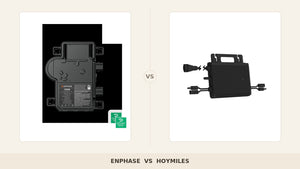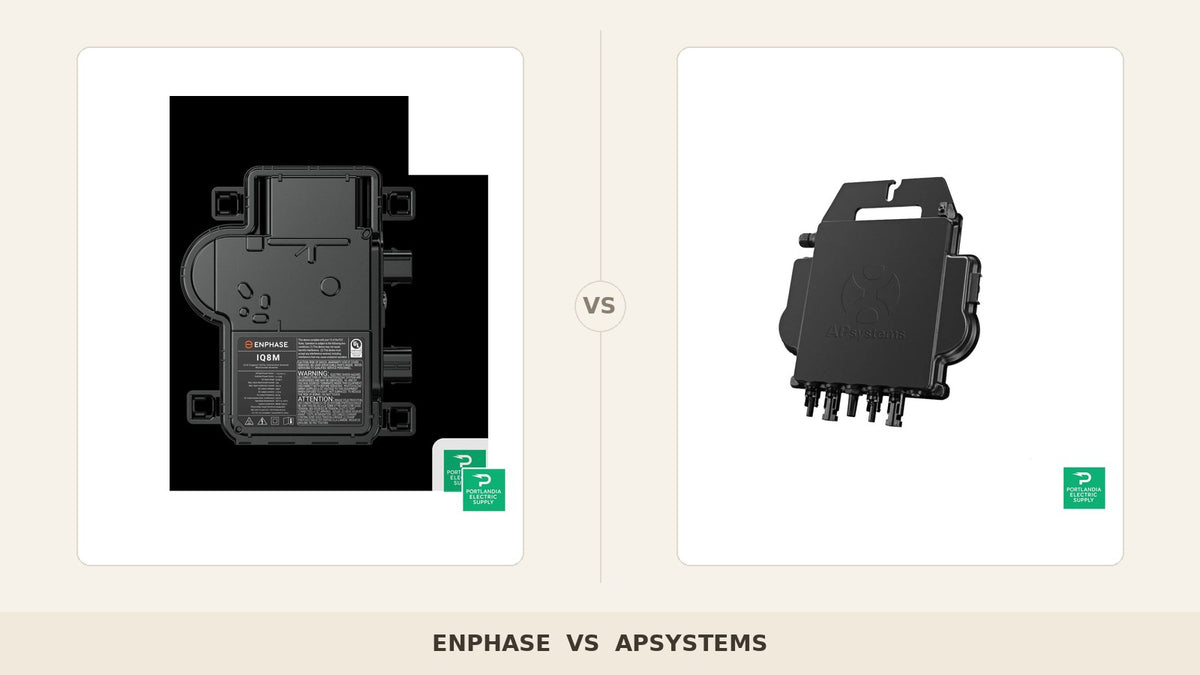
This is the closest fight in microinverters. APSystems leveled the headline spec in February 2025 when the DS3 line went to a standard 25-year U.S. warranty, removing the easiest reason to pay Enphase prices. What remains different: Enphase puts one micro behind one panel with the industry's deepest monitoring and battery-free outage operation; APSystems puts one micro behind two panels at a lower hardware cost, with a mature EMA platform and a strong commercial 3-phase line (QT2) that Enphase only recently matched. For pure residential value, DS3 is genuinely competitive. For ecosystem depth and outage resilience, Enphase still earns its premium.
Spec Sheet — Enphase vs APSystems at a Glance
- Architecture: AC microinverter per module — DC-to-AC on the roof, no central inve… · AC microinverter — 2-in-1 design, two modules per unit, dual indepe…
- Current Lineup: IQ8 / IQ8+ / IQ8M / IQ8A / IQ8HC residential; IQ9 for high-power co… · DS3-S (640 VA) / DS3-L (768 VA) / DS3 (880 VA); QT2 for 3-phase com…
- Efficiency (class): ~97% microinverter efficiency (CEC-weighted class) · Up to ~97% peak efficiency
- Rapid Shutdown (NEC 690.12): Inherent NEC 690.12 compliance — no DC conductors leave the module · NEC 690.12 compliant (module-level AC); RSD-S-PLC SunSpec option fo…
- Warranty: 25 years microinverter; 15 years IQ Battery · 25 years standard in the U.S. on DS3 and QT2 (effective Feb 15, 202…
The Shared Platform: What Both Have in Common
Both are AC microinverter platforms: module-level DC-to-AC conversion, inherent NEC 690.12 compliance, independent per-module MPPT, per-module monitoring, and 25-year warranties on the rooftop electronics. Both are UL 1741 SB listed for smart-grid functions, both support AC-coupled storage retrofits, and both have serious installed bases in North America. If the requirement sheet says "microinverters, 25-year warranty," either brand checks the box.
Side-by-Side Comparison Table
| Specification | Enphase | APSystems |
|---|---|---|
| Architecture | AC microinverter per module — DC-to-AC on the roof, no central inverter | AC microinverter — 2-in-1 design, two modules per unit, dual independent MPPT |
| Current Lineup | IQ8 / IQ8+ / IQ8M / IQ8A / IQ8HC residential; IQ9 for high-power commercial modules (IQ7 is EOL) | DS3-S (640 VA) / DS3-L (768 VA) / DS3 (880 VA); QT2 for 3-phase commercial |
| Efficiency (class) | ~97% microinverter efficiency (CEC-weighted class) | Up to ~97% peak efficiency |
| Rapid Shutdown (NEC 690.12) | Inherent NEC 690.12 compliance — no DC conductors leave the module | NEC 690.12 compliant (module-level AC); RSD-S-PLC SunSpec option for string systems |
| Warranty | 25 years microinverter; 15 years IQ Battery | 25 years standard in the U.S. on DS3 and QT2 (effective Feb 15, 2025) |
| Monitoring | Enlighten — per-panel, requires Envoy/IQ Gateway | EMA portal/app via ECU gateway (encrypted Zigbee) — gateway required |
| Grid-Down Operation (No Battery) | Sunlight Backup with IQ System Controller — daylight operation without a battery | No — grid-following microinverter, requires battery system for outage operation |
| Battery Integration | AC-coupled (IQ Battery 5P/10C; most AC-coupled third-party storage) | AC-coupled third-party storage compatible |
| Single Point of Failure | None — one failed micro costs one panel | One failed 2-in-1 micro costs up to two panels |
| Typical Equipment Cost | Baseline premium — highest $/W of the MLPE field | Mid-value tier — below Enphase, competitive with Hoymiles per module |
1-in-1 vs 2-in-1: The Architecture Trade
APSystems' DS3 carries two modules per unit with dual independent MPPT — each panel still tracks and reports separately, but the conversion hardware, the trunk drop, and the failure domain are shared by two panels. That halves device count versus Enphase on the same roof and is the core of the DS3 cost advantage. The Enphase position: one micro per panel means the smallest possible failure blast radius and the cheapest single-unit RMA. On a 20-panel roof, the difference is 20 devices versus 10 — real money and real install time, in exchange for a two-panel outage when a unit does fail.
Warranty Parity Changes the Conversation
Until early 2025, APSystems shipped a 10-year standard warranty with a paid extension — an easy Enphase talking point. The move to 25 years standard on DS3 and QT2 erased it. What did not change: Enphase's warranty is backed by the largest microinverter service organization in the market, and Enphase's coverage extends to 15 years on its IQ Battery line. APSystems' 25-year promise is newer, and the long-tail service experience will prove itself over the coming decade. Both are written commitments; they differ in institutional depth behind them.
Monitoring and Outage Behavior
Enphase Enlighten remains the reference monitoring platform: per-panel production, fleet-level diagnostics, and — with the IQ System Controller — Sunlight Backup, which runs daylight loads during grid outages with no battery. APSystems' EMA platform delivers solid per-panel monitoring through the ECU gateway but offers no battery-free outage mode; DS3 micros are grid-following. Contractors who sell resilience should price this difference explicitly; customers who only want production visibility will find either platform satisfactory.
Quoting this job? We stock Enphase products and APSystems products at contractor pricing — or get a system quote with both options priced side by side.
Choose Enphase If / Choose APSystems If
Choose Enphase if: Choose Enphase IQ8 if: outage resilience without a battery matters (Sunlight Backup); you want one-panel failure isolation; Enlighten's fleet diagnostics are part of your service model; or the customer is buying the deepest 25-year service organization in microinverters.
Choose APSystems if: Choose APSystems DS3 if: the roof is clean and the BOM decides; halving rooftop device count speeds your crews; you need a native 3-phase microinverter line (QT2) for light-commercial; or you want 25-year-warranty microinverters at the lowest platform price that still carries a proven installed base.
Field takeaway: With warranty parity, this is no longer a spec-sheet decision — it is an ecosystem decision. Enphase sells resilience and diagnostic depth; APSystems sells the same headline coverage at a lower hardware price. Both are correct answers for the right job.
Frequently Asked Questions
Did APSystems really match Enphase's 25-year warranty?
Yes. APSystems announced a standard 25-year U.S. warranty on DS3 and QT2 microinverters effective February 15, 2025 — no paid extension or registration gymnastics required beyond normal product registration.
What is the real difference between 1-in-1 and 2-in-1 microinverters?
Module granularity. Enphase puts one micro per panel; APSystems DS3 puts one per two panels (with independent MPPT each). 2-in-1 halves device count and hardware cost; 1-in-1 halves the failure blast radius.
Can APSystems DS3 run my house during a blackout?
Not without a battery. DS3 micros are grid-following. Enphase offers Sunlight Backup with the IQ System Controller for battery-free daylight operation; APSystems systems need AC-coupled storage to run during outages.
Do both meet NEC 690.12 rapid shutdown?
Yes — both are AC microinverter architectures with no rooftop DC conductors, so compliance is inherent.
Which is better for commercial 3-phase roofs?
APSystems has the longer track record here with the QT2 3-phase microinverter; Enphase's IQ9 addresses the same segment but is newer. For 208V/480V commercial microinverter jobs, QT2 is the incumbent.
Sources & Standards
- APSystems 25-year warranty announcement (Mar 2025) (usa.apsystems.com)
- Enphase IQ8 datasheets (enphase.com)
- APSystems DS3 datasheets (usa.apsystems.com)
Ready to price your project? Get a free system quote from PES Supply — both options, contractor pricing.
Related Resources: