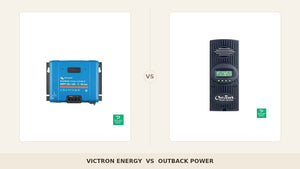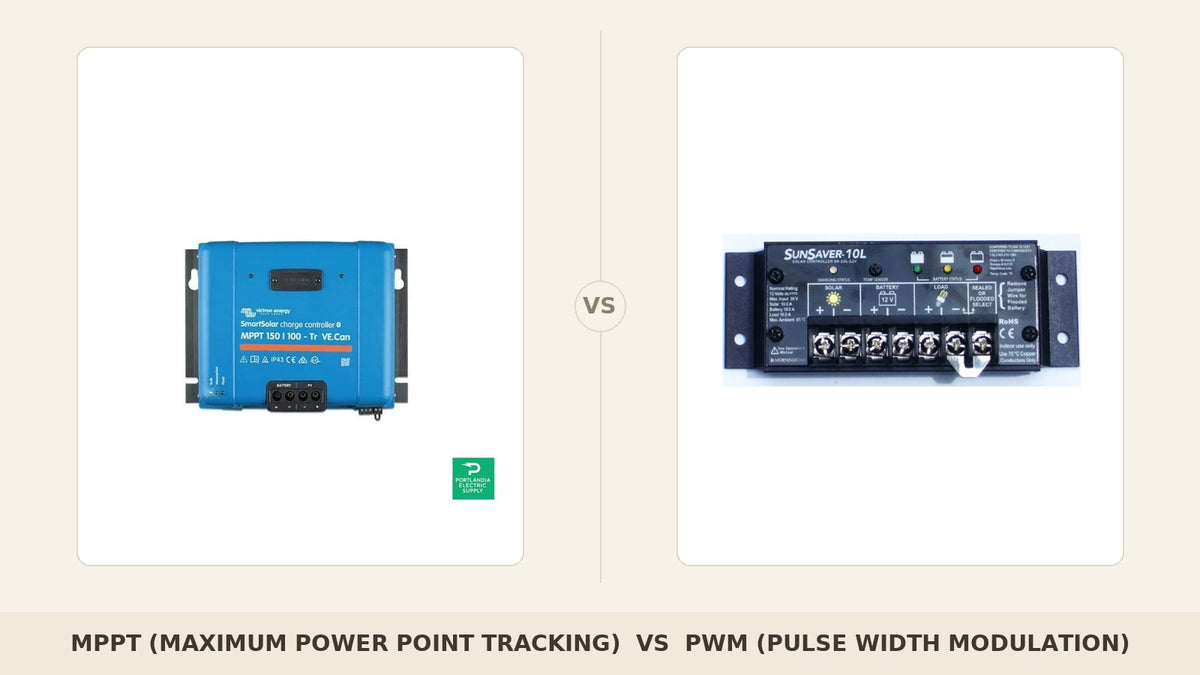
MPPT vs PWM has a clean answer with one exception. MPPT wins on almost everything: it converts excess panel voltage into charging current, harvesting 20-30% more energy than PWM (more in cold weather), and it lets arrays run at higher voltage than the battery — smaller wire, longer runs, series strings. PWM wins on exactly one thing: price — a $15-40 PWM controller versus $150-800 for MPPT. The crossover: on small systems under ~200W (gates, boats, trickle setups), the absolute dollar savings of MPPT's extra harvest is tiny and PWM is rational. Above that line, MPPT pays for itself, usually within the first year.
Spec Sheet — MPPT (Maximum Power Point Tracking) vs PWM (Pulse Width Modulation) at a Glance
- How It Works: DC-DC converter tracks panel max power point; converts excess volta… · Switches panel directly to battery; panel pulls down to battery vol…
- Harvest Gain: Baseline — 20-30% more than PWM (more in cold/low light) · Loses excess panel voltage as waste heat
- Array Voltage: Can exceed battery voltage (e.g., 100-250V strings into 12/24/48V b… · Must match battery voltage (12V panels on 12V banks)
- Wire & Runs: Higher array voltage = smaller wire, longer runs, series strings · Thicker wire, short runs, parallel panels only
- Cold-Weather Bonus: Significant — cold panels make extra voltage, MPPT harvests it · None — excess voltage is discarded
The Shared Platform: What Both Have in Common
Both regulate solar charging to protect batteries from overcharging, both support 12/24V banks (MPPT adds 36/48V classes), and both are available with lithium charge profiles. Neither is unsafe or obsolete — they are different cost/performance points for different system sizes.
Side-by-Side Comparison Table
| Specification | MPPT (Maximum Power Point Tracking) | PWM (Pulse Width Modulation) |
|---|---|---|
| How It Works | DC-DC converter tracks panel max power point; converts excess voltage to current | Switches panel directly to battery; panel pulls down to battery voltage |
| Harvest Gain | Baseline — 20-30% more than PWM (more in cold/low light) | Loses excess panel voltage as waste heat |
| Array Voltage | Can exceed battery voltage (e.g., 100-250V strings into 12/24/48V banks) | Must match battery voltage (12V panels on 12V banks) |
| Wire & Runs | Higher array voltage = smaller wire, longer runs, series strings | Thicker wire, short runs, parallel panels only |
| Cold-Weather Bonus | Significant — cold panels make extra voltage, MPPT harvests it | None — excess voltage is discarded |
| Typical Cost | ~$150-800 (by current class) | ~$15-40 |
| Best System Size | Anything above ~200W | Small systems under ~200W |
| Typical Uses | Homes, cabins, RVs, boats, any serious solar | Gate openers, trickle maintenance, tiny kits |
Why the Harvest Gap Is Real
A "12V" panel actually produces ~18-22V. PWM connects it straight to a ~12-14V battery, discarding everything above battery voltage. MPPT converts that excess voltage into extra charging current. With modern high-voltage residential panels (30-40V class), the PWM waste is even larger — which is why PWM has effectively disappeared from anything but tiny systems. The 20-30% harvest figure is the field-average reality, not marketing.
The 200W Crossover
Under ~200W, the math flips: MPPT's extra harvest on a 100W panel is worth maybe $5-15/year at typical energy values, while the controller costs $100+ more. For a gate opener, a boat trickle kit, or a shed light, PWM is the rational engineering choice. Above 200W, MPPT's harvest gain and wiring savings repay the price difference quickly — and by 400W+, PWM-compatible panel matching becomes impractical anyway.
Quoting this job? We stock MPPT (Maximum Power Point Tracking) products and PWM (Pulse Width Modulation) products at contractor pricing — or get a system quote with both options priced side by side.
Choose MPPT (Maximum Power Point Tracking) If / Choose PWM (Pulse Width Modulation) If
Choose MPPT (Maximum Power Point Tracking) if: the system is 200W or larger — which is nearly every real solar install. The harvest gain and wiring flexibility pay for the controller fast.
Choose PWM (Pulse Width Modulation) if: the system is genuinely small — under ~200W trickle, gate, or maintenance duty — where PWM's $15-40 price is the right engineering call.
Field takeaway: Above 200W, MPPT is the only rational choice. Below it, PWM is fine. Every serious solar system in 2026 runs MPPT.
Frequently Asked Questions
Is MPPT really worth it over PWM?
Above ~200W of solar, yes — 20-30% more harvest plus the ability to run higher-voltage arrays on smaller wire. The controller premium typically pays back within the first year of extra production.
Why is PWM cheaper?
PWM is a simpler device — an electronic switch versus MPPT's DC-DC converter with a tracking algorithm. Fewer components, lower cost, less capability.
Can PWM charge LiFePO4?
Yes, with correct voltage settings — many PWM controllers offer lithium profiles. The chemistry is not the issue; the harvest loss is. Small lithium systems (under ~200W) on PWM are perfectly viable.
How much more power does MPPT actually make?
Field average 20-30% over PWM, higher in cold weather and low light, when panel voltage rises above battery voltage the most. With modern high-voltage panels the gap can be larger.
What size MPPT controller do I need?
Size by array current: array watts divided by battery voltage, plus 25% headroom. Example: 800W on a 24V bank = ~33A, so a 40A-class controller. Also verify the controller's max PV input voltage exceeds your string's cold-weather Voc.
Sources & Standards
- PES charge controller inventory (portlandiaelectric.supply)
- Victron MPPT technology documentation (victronenergy.com)
- NEC Article 690 (nfpa.org)
Ready to price your project? Get a free system quote from PES Supply — both options, contractor pricing.
Related Resources: