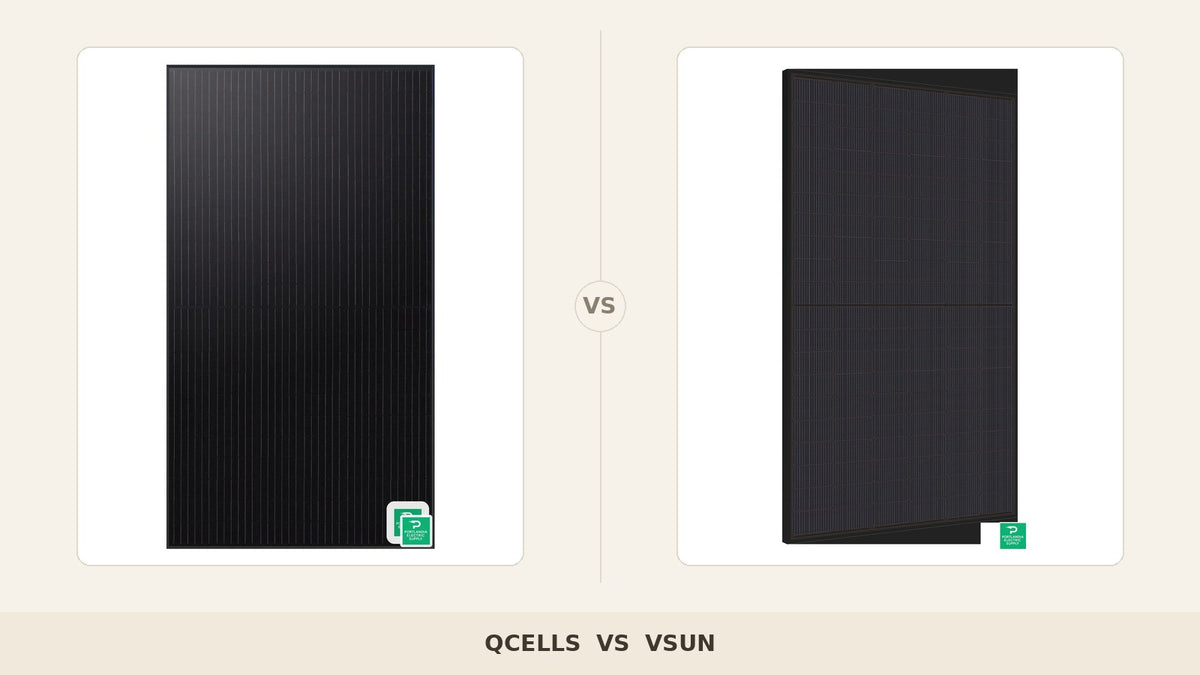
This is the TOPCon-versus-TOPCon fight: same cell-technology generation, different price and warranty tiers. QCells Q.TRON is the premium-domestic option: Dalton, Georgia manufacturing, ~22.5% efficiency, 25/25 warranties with partial labor reimbursement, and Hanwha's bankability. VSUN Vesta N is the value import: BNEF Tier-1 credentials, PVEL-recognized quality, competitive TOPCon specs — with a 12-year product warranty and a lower price per watt. If domestic content, warranty depth, or brand confidence matters, QCells earns its premium. If the project is price-led with a strong installer as first-line support, VSUN delivers the same cell generation for less.
Spec Sheet — QCells vs VSUN at a Glance
- Cell Architecture: N-type TOPCon (Q.ANTUM NEO) · Mono PERC heritage; Vesta N = N-type TOPCon current line
- Residential Wattage Class: ~400–440W residential (commercial siblings to ~500W+) · ~360–450W residential class; utility bifacial siblings higher
- Max Module Efficiency: Up to ~22.5% · ~20.4–21.5% class by series
- Temperature Coefficient (Pmax): ~−0.30%/°C class · Standard N-type class (~−0.30%/°C); verify per series
- Degradation / Long-Term Output: ≤1% class first year, ~0.33–0.40%/yr — ≥86–90.5% at year 25 (by ser… · Standard Tier-1 class (linear power warranty)
The Shared Platform: What Both Have in Common
Both brands' current lines run N-type TOPCon cells — the dominant 2026 technology — with comparable efficiency classes (~21–22.5%), half-cut multi-busbar designs, 25-plus-year performance warranties, corrosion and load certifications for harsh environments, and BNEF-recognized manufacturing. The technology argument is nearly a draw; the decision lives in warranty tier, origin, and price.
Side-by-Side Comparison Table
| Specification | QCells | VSUN |
|---|---|---|
| Cell Architecture | N-type TOPCon (Q.ANTUM NEO) | Mono PERC heritage; Vesta N = N-type TOPCon current line |
| Residential Wattage Class | ~400–440W residential (commercial siblings to ~500W+) | ~360–450W residential class; utility bifacial siblings higher |
| Max Module Efficiency | Up to ~22.5% | ~20.4–21.5% class by series |
| Temperature Coefficient (Pmax) | ~−0.30%/°C class | Standard N-type class (~−0.30%/°C); verify per series |
| Degradation / Long-Term Output | ≤1% class first year, ~0.33–0.40%/yr — ≥86–90.5% at year 25 (by series) | Standard Tier-1 class (linear power warranty) |
| Product / Performance Warranty | 25 yr product / 25 yr performance; Q.PARTNER labor reimbursement up to $250/claim (≤25 kW) | 12 yr product; 25 yr monofacial / 30 yr bifacial performance |
| Manufacturing / Bankability | Assembled in Dalton, Georgia, USA — largest fab in the Western Hemisphere (Hanwha-owned) | Japan-headquartered (Fuji Solar investment); BNEF Tier-1 listed; PVEL-recognized |
| Load / Corrosion Rating | Standard premium class | Certified wind 2400 Pa / snow 5400 Pa; salt & ammonia corrosion resistant |
| Typical Price Position | +$0.15–0.30/W over commodity; best-value premium tier | Value-to-mid Tier-1 pricing |
The Warranty Gap Is the Whole Story
With technology nearly even, the 13-year product-warranty gap (25 vs 12) is the decisive spec difference. QCells covers manufacturing defects for the full financing life of most systems and adds Q.PARTNER labor reimbursement; VSUN's 12-year product term expires mid-loan on many installs, leaving the 25–30-year performance warranty as the long backstop. Panels rarely fail — but when they do, year-14 failures on a 12-year warranty are the owner's problem. For risk-sensitive buyers and lenders, QCells' coverage is worth a premium; for cash buyers with strong installer relationships, VSUN's trade is rational.
Origin, Bankability, and Supply Chain
QCells' Dalton, Georgia fab is the largest in the Western Hemisphere — domestic content for applicable incentives, short supply lines, and Hanwha Group ownership behind the warranty. VSUN is Japan-headquartered with Fuji Solar heritage, BNEF Tier-1 listing, and Asian manufacturing — institutionally credible, but an import supply chain with the tariff and logistics exposure that entails in 2026. For projects with domestic-content requirements or supply-chain-risk sensitivity, QCells is the clean answer; for price-led procurement where import risk is acceptable, VSUN's credentials are legitimate.
Price Per Watt and Where Each Wins
VSUN typically undercuts QCells meaningfully per watt — its structural role as the value Tier-1. On large roofs and ground mounts where panel count is flexible and the budget is hard, VSUN's math wins: same cell generation, Tier-1 credentials, lower capex. QCells wins where its premium buys something specific: constrained roofs (efficiency edge), domestic-content strategies, warranty-sensitive buyers, and brand-driven residential sales. Quote the job, not the brand — these two cover different customers well.
Quoting this job? We stock QCells products and VSUN products at contractor pricing — or get a system quote with both options priced side by side.
Choose QCells If / Choose VSUN If
Choose QCells if: Choose QCells if: you want 25-year product coverage with partial labor reimbursement; domestic manufacturing (Georgia) matters for values or incentives; brand confidence and channel depth count; or the roof is constrained and efficiency matters.
Choose VSUN if: Choose VSUN if: price per watt is the primary metric; the project accepts a 12-year product warranty with a strong installer as backstop; Tier-1 bankability at import value pricing is the requirement; or the roof/ground area is generous.
Field takeaway: Same TOPCon generation, different propositions: QCells sells warranty depth and a Georgia address; VSUN sells Tier-1 credentials at value prices. Risk-sensitive or domestic-driven: QCells. Price-led with installer backup: VSUN.
Frequently Asked Questions
Are QCells and VSUN the same technology?
Essentially, yes — both current lines are N-type TOPCon with comparable efficiency classes. The differences are warranty tier (25 vs 12-year product), manufacturing origin (USA vs Asia), brand channel depth, and price.
Is VSUN reliable despite the shorter warranty?
VSUN is BNEF Tier-1 listed with PVEL-recognized module quality — institutionally legitimate. The 12-year product warranty is a coverage choice, not necessarily a quality signal, but it does transfer mid-life defect risk to the owner. A strong installer relationship mitigates much of this.
Which panel is better for domestic-content incentives?
QCells — assembled in Dalton, Georgia. VSUN is imported. Verify specific model eligibility under current guidance, but the Georgia fab makes QCells the straightforward domestic choice.
Which is more efficient?
QCells holds a modest edge (~22.5% class vs ~21–22% class for VSUN's current lines), with similar temperature coefficients. On constrained roofs the edge matters; on open roofs it is a panel or two.
How much cheaper is VSUN?
Meaningfully per watt at the module level — its position as the value Tier-1 import is structural. Exact spreads move with distribution and tariffs; quote both for your project, and model the warranty difference into the comparison.
Sources & Standards
- QCells Q.TRON documentation (qcells.com)
- VSUN official warranty page (vsun-solar.com)
- PVEL Scorecard (pvel.com)
Ready to price your project? Get a free system quote from PES Supply — both options, contractor pricing.
Related Resources: