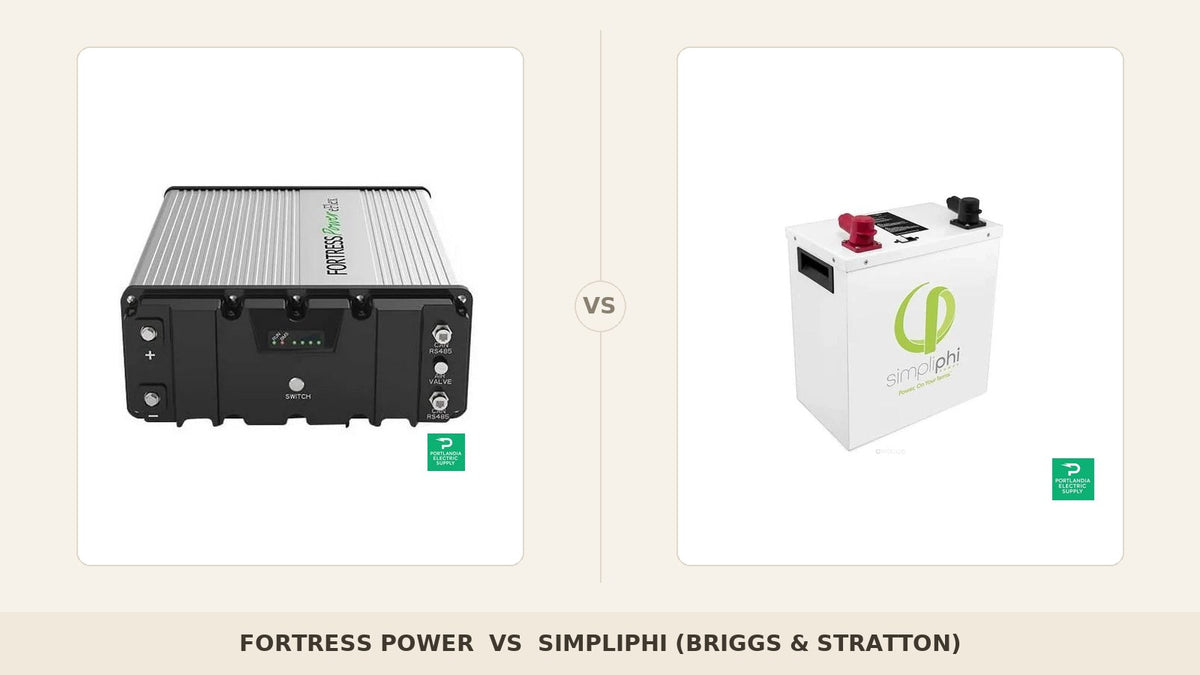
Fortress Power and SimpliPhi are the two US-engineered answers for buyers who will not put imported budget batteries on critical loads. Fortress wins on price per kWh and product range: eFlex rack modules at $0.30-0.35/Wh class plus the 18.5 kWh eVault floor cabinet, with 8,000+ cycle ratings and UL 9540 system listings. SimpliPhi wins on longevity engineering and operating envelope: 10,000+ cycles, 98% operating efficiency, 100% DOD rating, and a -4F to 140F operating range from its California line. Most premium residential installs land on Fortress economics; extreme-duty and extreme-climate installs justify SimpliPhi.
Spec Sheet — Fortress Power vs SimpliPhi (Briggs & Stratton) at a Glance
- Chemistry & Listings: LiFePO4 prismatic · LiFePO4 (cobalt-free LFP), UL 1642/1973, UL 9540A tested
- Capacity & Form: eFlex: 105Ah / 5.4 kWh · eVault: 18.5 kWh single enclosure · PHI 3.8-M: 3.8 kWh per unit (24V 151Ah or 48V 75Ah); unlimited para…
- Cycle Life: 8,000+ cycles @ 80% DOD class · 10,000+ cycles @ 80% DOD — class-leading longevity
- Depth of Discharge: 80% DOD class recommended · Up to 100% depth of discharge
- Operating Efficiency: Not published — verify with manufacturer · 98% operating efficiency
The Shared Platform: What Both Have in Common
Both are cobalt-free LiFePO4 with US-based engineering and support, UL-listed cell standards, closed-loop inverter communications, and 10-year warranties. Both serve installers who stake their reputation on the bank — this is a choice between two premium philosophies, not between good and bad.
Side-by-Side Comparison Table
| Specification | Fortress Power | SimpliPhi (Briggs & Stratton) |
|---|---|---|
| Chemistry & Listings | LiFePO4 prismatic | LiFePO4 (cobalt-free LFP), UL 1642/1973, UL 9540A tested |
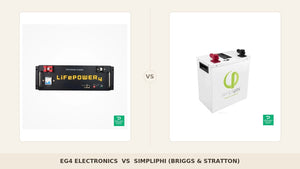
| Capacity & Form | eFlex: 105Ah / 5.4 kWh · eVault: 18.5 kWh single enclosure | PHI 3.8-M: 3.8 kWh per unit (24V 151Ah or 48V 75Ah); unlimited parallel scalability |
| Cycle Life | 8,000+ cycles @ 80% DOD class | 10,000+ cycles @ 80% DOD — class-leading longevity |
| Depth of Discharge | 80% DOD class recommended | Up to 100% depth of discharge |
| Operating Efficiency | Not published — verify with manufacturer | 98% operating efficiency |
| Discharge | eFlex: 100A class · eVault: 200A class continuous | 48V: 37.5A (1.92 kW) continuous, 80A 10-min surge; built-in 80A DC breaker |
| Operating Temperature | Standard LFP class (charge above freezing) | Operating −4° to 140°F; charge 32° to 120°F |
| Origin | US-engineered; Pennsylvania-based support | Designed and manufactured in California, USA (Briggs & Stratton Energy Solutions) |
| Warranty | 10 years | 10 years / 10,000 cycles |
| Price Class | $0.30–0.35/Wh class (eFlex ~$1,700–1,900 per 5.4 kWh) | Premium per kWh class (~$0.70–0.90/Wh) |
Form Factor Strategy
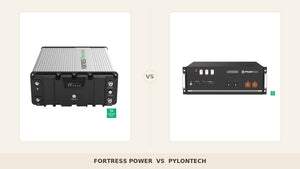
Fortress offers two physical answers: the eFlex 5.4 kWh rack/wall module and the eVault 18.5 kWh floor cabinet for single-enclosure installs. SimpliPhi's PHI 3.8 kWh unit scales by paralleling — compact per unit, unlimited in aggregate, but more enclosures and interconnects at large capacity. Big single-bank installs favor Fortress's cabinet; distributed or space-constrained installs favor SimpliPhi's modularity.
Duty Cycle Economics
SimpliPhi's 10,000+ cycle rating and 100% DOD capability cost roughly 2-3x Fortress per kWh. For a bank cycling deeply every day — off-grid primary power, commercial peak shaving — the cost per delivered lifetime kWh can favor SimpliPhi. For backup-duty banks cycling a few dozen times a year, Fortress's 8,000-cycle rating is already decades of headroom at meaningfully lower cost.
Quoting this job? We stock Fortress Power products and SimpliPhi (Briggs & Stratton) products at contractor pricing — or get a system quote with both options priced side by side.
Choose Fortress Power If / Choose SimpliPhi (Briggs & Stratton) If
Choose Fortress Power if: the project wants US-engineered premium LFP at the better price per kWh — especially larger banks using the eVault cabinet and UL 9540-listed system pairings.
Choose SimpliPhi (Briggs & Stratton) if: the application demands maximum cycle life, 100% DOD capability, wide temperature envelope, or California-made hardware for critical duty.
Field takeaway: Fortress is the premium value play; SimpliPhi is the extreme-duty play. Both are US-engineered with 10-year warranties — size the choice to the cycling profile.
Frequently Asked Questions
Are Fortress and SimpliPhi both made in the USA?
SimpliPhi designs and manufactures in California. Fortress is US-engineered with Pennsylvania-based support. Verify current manufacturing origin per model with each manufacturer.
Which lasts longer?
SimpliPhi rates 10,000+ cycles @ 80% DOD with a 10-year/10,000-cycle warranty; Fortress rates 8,000+ cycles @ 80% DOD class with a 10-year warranty. Both outlast typical residential use.
Which is cheaper per kWh?
Fortress: $0.30-0.35/Wh class (eFlex ~$1,700-1,900 per 5.4 kWh). SimpliPhi: ~$0.70-0.90/Wh class. Fortress is typically less than half the cost per kWh.
Which is better for off-grid daily cycling?
SimpliPhi's 10,000+ cycles, 100% DOD rating, and wide temperature envelope make it the stronger extreme-duty choice — at a premium. Fortress handles daily cycling well at lower cost.
Do both work with my hybrid inverter?
Both integrate over CAN/RS485 with major US hybrid inverters, and Fortress holds UL 9540 system listings with select models. Verify your exact inverter with both manufacturers.
Sources & Standards
- Fortress eFlex/eVault datasheets (fortresspower.com)
- SimpliPhi PHI datasheets (simpliphipower.com)
- UL 9540 standard (ul.com)
Ready to price your project? Get a free system quote from PES Supply — both options, contractor pricing.
Related Resources: