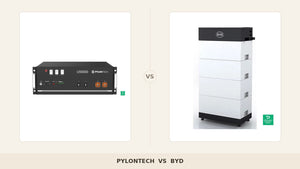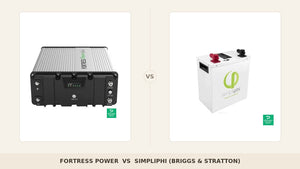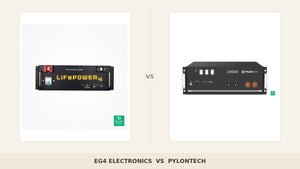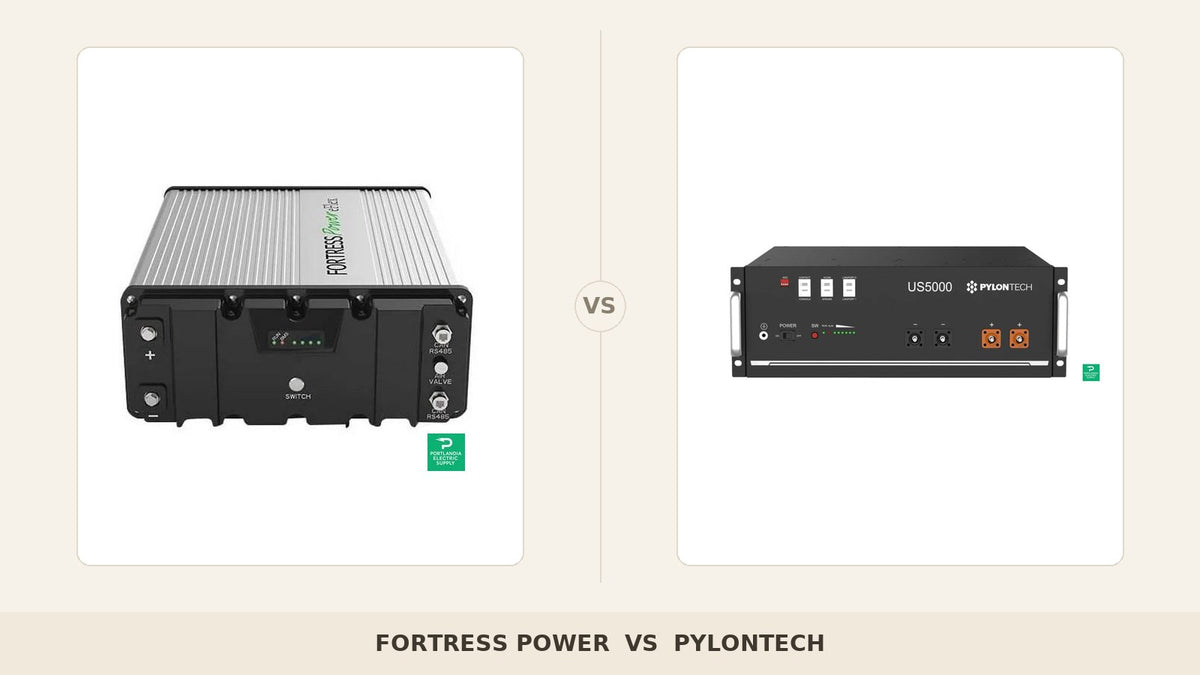
Fortress Power and Pylontech compete head-on in 48V LiFePO4 rack modules. Fortress wins on cycle rating and support: the eFlex carries an 8,000+ cycle class rating at 80% DOD, UL 9540 system listings with select inverters, and Pennsylvania-based engineering-level installer support. Pylontech wins on compatibility breadth and global scale: the US5000's CAN/RS485 integration list is among the industry's widest, with a decade of deployments worldwide and ~95% round-trip efficiency. For US installs where support access matters, Fortress. For exotic inverter pairings or global deployments, Pylontech.
Spec Sheet — Fortress Power vs Pylontech at a Glance
- Chemistry: LiFePO4 prismatic · LiFePO4
- Capacity & Form: eFlex: 105Ah / 5.4 kWh · eVault: 18.5 kWh single enclosure · US5000: 4.8 kWh per 19-inch rack module (stack to ~16 units class);…
- Cycle Life: 8,000+ cycles @ 80% DOD class · ≥6,000 cycles class @ 90% DOD
- Discharge: eFlex: 100A class · eVault: 200A class continuous · US5000: 100A class per module (derated continuous ~4.8 kW class pai…
- Round-Trip Efficiency: Not published — verify with manufacturer · ~95% round-trip efficiency
The Shared Platform: What Both Have in Common
Both are 19-inch-class LiFePO4 rack modules in the ~4.8-5.4 kWh range, both communicate over CAN/RS485 for closed-loop inverter control, both carry UL 1973/UN38.3 cell standards and 10-year warranties, and both scale by stacking modules in racks. Either is a credible mid-market rack battery — the differences are cycle rating, listings depth, and where you call when something needs engineering help.
Side-by-Side Comparison Table
| Specification | Fortress Power | Pylontech |
|---|---|---|
| Chemistry | LiFePO4 prismatic | LiFePO4 |
| Capacity & Form | eFlex: 105Ah / 5.4 kWh · eVault: 18.5 kWh single enclosure | US5000: 4.8 kWh per 19-inch rack module (stack to ~16 units class); Force-H2 high-voltage towers |
| Cycle Life | 8,000+ cycles @ 80% DOD class | ≥6,000 cycles class @ 90% DOD |
| Discharge | eFlex: 100A class · eVault: 200A class continuous | US5000: 100A class per module (derated continuous ~4.8 kW class pair) |
| Round-Trip Efficiency | Not published — verify with manufacturer | ~95% round-trip efficiency |
| Listings | UL 1973, UN38.3, UL 9540 system listing with select inverters | UL 1973 class, UN38.3 (verify per market listing) |
| Inverter Comms | CAN, RS485 | CAN/RS485 — among the broadest third-party inverter compatibility lists in the industry |
| Monitoring | Via paired inverter platform | No first-party monitoring app — monitored through the paired inverter platform |
| Warranty | 10 years | 10 years |
| Price Class | $0.30–0.35/Wh class (eFlex ~$1,700–1,900 per 5.4 kWh) | Budget-to-mid tier per kWh |
Cycle Ratings and What They Mean
Fortress rates the eFlex at 8,000+ cycles at 80% DOD class; Pylontech rates the US5000 at 6,000+ cycles at 90% DOD class. Both figures exceed what most residential banks will ever use — a daily-cycled bank hits ~365 cycles a year. The ratings matter most for daily-cycling off-grid and commercial applications, where the Fortress edge compounds over a 15-year horizon. For backup-duty banks, both ratings are effectively "lifetime."
Support and Listings
Fortress differentiates on depth of US support — Pennsylvania-based engineers who work with installers on commissioning and closed-loop configuration — plus UL 9540 system-level listings with select inverters, which can simplify permitting. Pylontech differentiates on breadth: the broadest third-party inverter compatibility list in the rack-battery business and massive global field history. Permitting-heavy US projects lean Fortress; unusual inverter pairings lean Pylontech.
Quoting this job? We stock Fortress Power products and Pylontech products at contractor pricing — or get a system quote with both options priced side by side.
Choose Fortress Power If / Choose Pylontech If
Choose Fortress Power if: the project is US-based, permit-sensitive, or daily-cycled — where UL 9540 system listings, 8,000-cycle rating, and engineering-level domestic support pay off.
Choose Pylontech if: the inverter pairing is unusual, the deployment is global, or the widest proven comms compatibility is the deciding factor.
Field takeaway: Fortress for US support and cycle rating; Pylontech for compatibility breadth. Both are honest mid-market LFP rack batteries with 10-year warranties.
Frequently Asked Questions
Which has more cycles, Fortress or Pylontech?
Fortress rates the eFlex at 8,000+ cycles @ 80% DOD class; Pylontech rates the US5000 at 6,000+ cycles @ 90% DOD class. Both far exceed typical residential backup duty.
Which works with my inverter?
Pylontech maintains one of the industry's broadest closed-loop compatibility lists. Fortress integrates with major US hybrids and holds UL 9540 system listings with select inverters. Verify your exact inverter model with both manufacturers.
Which is easier to permit?
Fortress holds UL 9540 system-level listings with select inverters, which some AHJs prefer. Both carry UL 1973/UN38.3 cell-level standards. Local requirements vary — confirm with your installer and AHJ.
Where is support located?
Fortress provides Pennsylvania-based, engineering-level installer support. Pylontech supports through global distribution channels. For US installers who want direct engineering access, Fortress has the edge.
Which is cheaper?
Pylontech typically prices a tier below Fortress per kWh (budget-to-mid vs mid-tier). Exact pricing moves with distribution channel and volume — request current quotes.
Sources & Standards
- Fortress eFlex datasheet (fortresspower.com)
- Pylontech US5000 datasheet (pylontech.com)
- UL 9540 standard (ul.com)
Ready to price your project? Get a free system quote from PES Supply — both options, contractor pricing.
Related Resources: