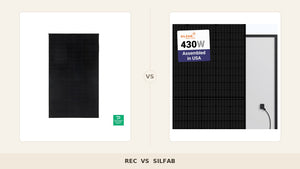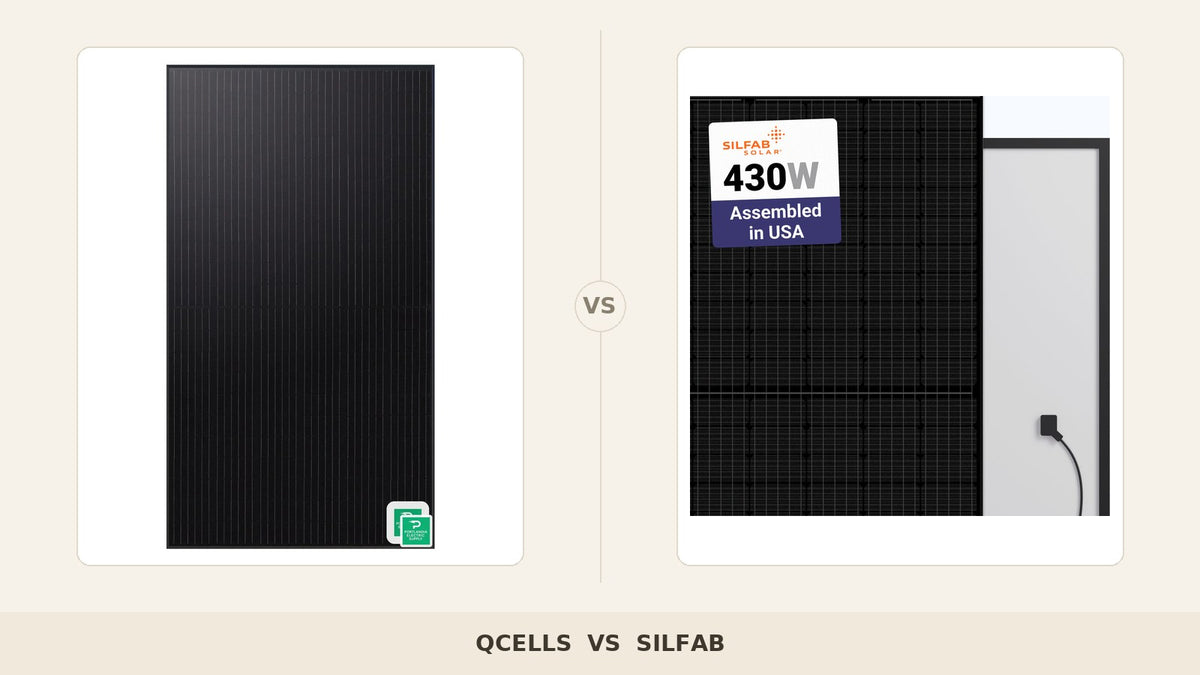
If "made in North America" is the requirement, this is the final round. QCells brings scale and technology: the largest solar fab in the Western Hemisphere (Dalton, Georgia), N-type TOPCon cells (Q.ANTUM NEO), ~22.5% efficiency, 25/25 warranties, and Hanwha's balance sheet. Silfab brings warranty length and craftsmanship positioning: Washington State, South Carolina, and Ontario production, the market's longest standard performance warranty at 30 years, and mid-range pricing. On technology and efficiency, QCells has the current-generation edge. On performance-guarantee length and per-watt value, Silfab counters. You cannot buy wrong here — pick on roof constraints and warranty preference.
Spec Sheet — QCells vs Silfab at a Glance
- Cell Architecture: N-type TOPCon (Q.ANTUM NEO) · Half-cut mono (PERC heritage; N-type on newer lines)
- Residential Wattage Class: ~400–440W residential (commercial siblings to ~500W+) · ~370–430W residential (Elite ~410–430W class); 570W+ commercial bif…
- Max Module Efficiency: Up to ~22.5% · ~20–22% by series (Elite ~21.4–21.5%)
- Temperature Coefficient (Pmax): ~−0.30%/°C class · Average class (~−0.35%/°C)
- Degradation / Long-Term Output: ≤1% class first year, ~0.33–0.40%/yr — ≥86–90.5% at year 25 (by ser… · ~0.50%/yr; ≥82.6–89% at year 30 by series
The Shared Platform: What Both Have in Common
Both manufacture at scale in North America (domestic content for applicable incentives), both offer all-black residential panels in the 400–440W class, both carry 25-year-class product warranties (Silfab via registered installer), both have strong half-cut/TOPCon-era designs with good shade behavior, and both are installer-community favorites with real US support operations.
Side-by-Side Comparison Table
| Specification | QCells | Silfab |
|---|---|---|
| Cell Architecture | N-type TOPCon (Q.ANTUM NEO) | Half-cut mono (PERC heritage; N-type on newer lines) |
| Residential Wattage Class | ~400–440W residential (commercial siblings to ~500W+) | ~370–430W residential (Elite ~410–430W class); 570W+ commercial bifacial |
| Max Module Efficiency | Up to ~22.5% | ~20–22% by series (Elite ~21.4–21.5%) |
| Temperature Coefficient (Pmax) | ~−0.30%/°C class | Average class (~−0.35%/°C) |
| Degradation / Long-Term Output | ≤1% class first year, ~0.33–0.40%/yr — ≥86–90.5% at year 25 (by series) | ~0.50%/yr; ≥82.6–89% at year 30 by series |
| Product / Performance Warranty | 25 yr product / 25 yr performance; Q.PARTNER labor reimbursement up to $250/claim (≤25 kW) | 12–25 yr product (25 with registered Silfab installer); 30 yr performance — longest standard power warranty in NA |
| Manufacturing Origin | Assembled in Dalton, Georgia, USA — largest fab in the Western Hemisphere (Hanwha-owned) | Manufactured in Washington State, South Carolina, and Ontario, Canada |
| Load / Durability Rating | Standard premium class | 5400 Pa snow-load rated class; half-cut shade tolerance |
| Typical Price Position | +$0.15–0.30/W over commodity; best-value premium tier | Mid-range (comparable to other NA-made brands) |
Technology: TOPCon Scale vs Half-Cut Craft
QCells' Q.ANTUM NEO TOPCon is current-volume-leader cell technology: better efficiency (~22.5% class), better temperature coefficient (~−0.30%/°C), and lower degradation than the PERC-era designs it replaced — all at Georgia-fab scale that keeps pricing honest. Silfab's half-cut designs (PERC heritage, N-type on newer lines) are excellent mainstream technology but typically trail QCells by a point or so of efficiency. On a constrained roof, QCells' efficiency wins watts. On an open roof, the difference is a panel or two — meaningful but not decisive.
Warranty Structures, Read Carefully
QCells: 25-year product and 25-year performance (≥86% at year 25), plus Q.PARTNER labor reimbursement up to $250 per qualifying claim on systems ≤25 kW — partial labor coverage, which is more than most. Silfab: up to 25-year product (registered installer) and a 30-year performance warranty guaranteeing 82.6–89% at year 30 — the longest power guarantee in North America. QCells covers the middle game better (product + partial labor); Silfab covers the long game (year-30 output). For a 25-year ownership model it is close to a wash; for a hold-forever buyer, Silfab's year-30 floor is unique.
The Domestic-Content Tiebreaker
Both satisfy "made in North America" for values-driven buyers and applicable domestic-content incentives — QCells from Dalton, Georgia (the hemisphere's largest fab, employing thousands), Silfab from Washington State, South Carolina, and Ontario. QCells' scale generally delivers better availability and sharper pricing through distribution; Silfab's smaller-scale operations position as the craft alternative. On pure logistics and channel depth, QCells wins; on the story a customer tells their neighbors, both win equally.
Quoting this job? We stock QCells products and Silfab products at contractor pricing — or get a system quote with both options priced side by side.
Choose QCells If / Choose Silfab If
Choose QCells if: Choose QCells if: you want current TOPCon efficiency from a US fab; availability and channel pricing matter; partial labor reimbursement (Q.PARTNER) adds value; or the roof is constrained enough that a point of efficiency changes the design.
Choose Silfab if: Choose Silfab if: the 30-year performance warranty appeals to a long-hold owner; per-watt value with NA manufacturing is the goal; the roof has room for mid-efficiency panels; or you prefer the craft-scale North American brand story.
Field takeaway: QCells sells TOPCon technology at American scale; Silfab sells the longest power warranty with Northwestern craft. Both are the good kind of domestic. Efficiency and availability: QCells. Warranty length and value: Silfab.
Frequently Asked Questions
Are QCells and Silfab both made in the USA?
Yes, both. QCells assembles in Dalton, Georgia — the largest solar manufacturing facility in the Western Hemisphere. Silfab manufactures in Washington State and South Carolina, plus Ontario, Canada. Both qualify as North American-made for applicable purposes; verify specific model eligibility for domestic-content incentives.
Which is more efficient?
QCells, typically — its Q.ANTUM NEO TOPCon line reaches ~22.5% class efficiency versus Silfab's ~20–22% by series. QCells also posts a better temperature coefficient (~−0.30%/°C vs ~−0.35%/°C class).
Which has the better warranty?
Silfab for performance length: 30-year power warranty (82.6–89% at year 30). QCells for the middle term: 25-year product AND performance with Q.PARTNER labor reimbursement up to $250 per claim. Both are strong; the preference depends on your ownership horizon.
Which is cheaper?
Silfab usually quotes slightly lower per watt; QCells' Georgia scale keeps it competitive. Both sit in the mid-range NA-made price band — well below REC/Maxeon premiums, above imported value Tier-1s.
Do both qualify for domestic content incentives?
Both manufacture in North America and are commonly used for domestic-content strategies, but eligibility depends on the specific model, bill of materials, and current guidance — verify per model and project before banking the adder.
Sources & Standards
- QCells Q.TRON documentation (qcells.com)
- Silfab product/warranty documentation (silfabsolar.com)
- GreenLancer 2026 warranty guide (greenlancer.com)
Ready to price your project? Get a free system quote from PES Supply — both options, contractor pricing.
Related Resources: