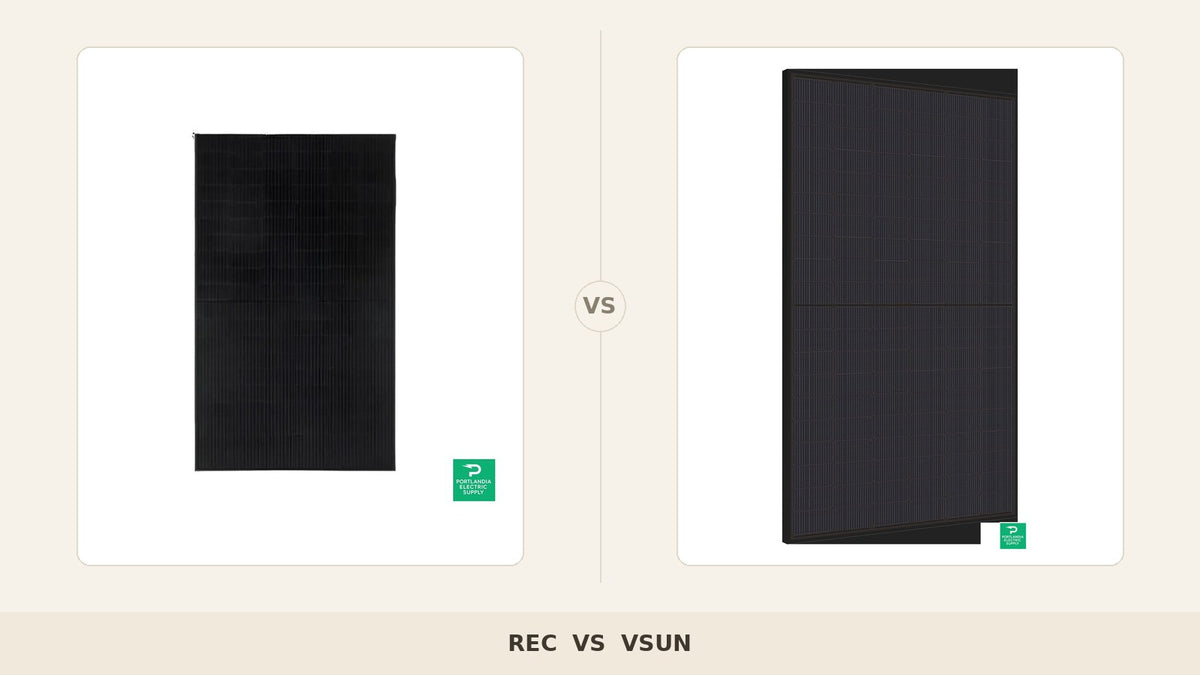
REC and VSUN sit at opposite ends of the Tier-1 price spectrum, and they are both honestly good at what they do. REC Alpha Pure-RX is the premium choice: HJT cells, ~22.6% efficiency, −0.24%/°C tempco, 25-year ProTrust warranty including labor. VSUN is the value Tier-1: BNEF-listed, PVEL-recognized, with a current TOPCon line (Vesta N), 12-year product warranty, and pricing that undercuts premium brands substantially. If the roof is small, hot, or the buyer wants maximum long-term coverage, REC justifies its premium. If the roof is big, the budget is real, and 12-year product coverage plus a Tier-1 name is acceptable, VSUN delivers more watts per dollar.
Spec Sheet — REC vs VSUN at a Glance
- Cell Architecture: HJT (heterojunction), lead-free · Mono PERC heritage; Vesta N = N-type TOPCon current line
- Residential Wattage Class: ~450–470W residential class · ~360–450W residential class; utility bifacial siblings higher
- Max Module Efficiency: Up to ~22.6% (Pure-RX) · ~20.4–21.5% class by series
- Temperature Coefficient (Pmax): ~−0.24%/°C (class-leading) · Standard N-type class (~−0.30%/°C); verify per series
- Degradation: ≤1% first year, ~0.25%/yr thereafter — ≥92% guaranteed at year 25 · Standard Tier-1 class (linear power warranty)
The Shared Platform: What Both Have in Common
Both are bankable Tier-1-adjacent manufacturers with real module testing credentials (PVEL recognition), current-generation cell technology, corrosion/load ratings suitable for harsh climates, and 25-plus-year performance warranty frameworks. Either panel will produce power for decades — the differences are efficiency class, warranty depth, and price tier.
Side-by-Side Comparison Table
| Specification | REC | VSUN |
|---|---|---|
| Cell Architecture | HJT (heterojunction), lead-free | Mono PERC heritage; Vesta N = N-type TOPCon current line |
| Residential Wattage Class | ~450–470W residential class | ~360–450W residential class; utility bifacial siblings higher |
| Max Module Efficiency | Up to ~22.6% (Pure-RX) | ~20.4–21.5% class by series |
| Temperature Coefficient (Pmax) | ~−0.24%/°C (class-leading) | Standard N-type class (~−0.30%/°C); verify per series |
| Degradation | ≤1% first year, ~0.25%/yr thereafter — ≥92% guaranteed at year 25 | Standard Tier-1 class (linear power warranty) |
| Product / Performance Warranty | 20 yr product / 25 yr performance standard; 25/25/25 (incl. labor) via REC ProTrust certified installer | 12 yr product; 25 yr monofacial / 30 yr bifacial performance |
| Manufacturing / Bankability | Singapore manufacturing; owned by Reliance Industries | Japan-headquartered (Fuji Solar investment); BNEF Tier-1 listed; PVEL-recognized |
| Load / Corrosion Rating | High-rigidity frame class | Certified wind 2400 Pa / snow 5400 Pa; salt & ammonia corrosion resistant |
| Typical Price Position | +$0.25–0.40/W premium over commodity Tier-1 | Value-to-mid Tier-1 pricing |
What the Premium Actually Buys
REC's premium is three things, priced together: HJT cell technology (best-in-class temperature coefficient, meaning more hot-day kWh), ~1.5–2 points of module efficiency over VSUN's class (meaning more watts per roof square foot), and the ProTrust 25-year warranty with labor. None of these is marketing — each is measurable in production models and warranty documents. Whether they are worth the price gap depends entirely on roof geometry and climate: constraints make REC worth it; slack makes VSUN smarter.
VSUN's Quiet Credibility
VSUN does not have REC's brand halo in the US consumer market, but its institutional credentials are real: BloombergNEF Tier-1 listed, Japan-headquartered with Fuji Solar investment heritage, PVEL-recognized module quality, and full certifications including 5400 Pa snow load and salt/ammonia corrosion resistance. The 12-year product warranty is the honest weak point — it is half of what premium brands offer and shorter than the financing term on many systems. Buyers should read that as: VSUN is a strong panel with standard-tier coverage, priced accordingly. For budget projects with a quality installer as first-line support, that trade works.
Use-Case Split
The two panels almost never compete for the same job. REC wins premium residential: small roofs, hot climates, design-conscious buyers, ProTrust-channel installs where the labor warranty has real value. VSUN wins value-driven volume: big roofs, ground mounts, budget-constrained homeowners, and price-per-watt procurement where Tier-1 credentials are required but premium pricing is not available. A contractor serving both segments should stock both stories — they cover the market between them.
Quoting this job? We stock REC products and VSUN products at contractor pricing — or get a system quote with both options priced side by side.
Choose REC If / Choose VSUN If
Choose REC if: Choose REC if: roof space or heat constrains the design; you want the 25-year ProTrust warranty including labor; premium aesthetics and top-tier cell tech matter; or the buyer is optimizing for long-term risk, not upfront price.
Choose VSUN if: Choose VSUN if: price per watt drives the decision; the roof or ground area is generous; Tier-1 bankability is required but premium pricing is not; or the project accepts a 12-year product warranty in exchange for meaningfully lower capex.
Field takeaway: REC sells maximum technology and maximum coverage; VSUN sells Tier-1 credibility at value prices. They barely overlap: pick REC when constraints are tight and budgets are flexible, VSUN when the reverse is true.
Frequently Asked Questions
Is VSUN a Tier-1 solar panel?
Yes — VSUN has been listed on the BloombergNEF Tier-1 manufacturer list and holds PVEL quality recognition. Tier-1 is a bankability metric, not a quality seal, but combined with its certifications it signals a legitimate manufacturer.
Why is REC more expensive than VSUN?
HJT cell technology (better temperature coefficient, higher efficiency), the gapless premium build, and a 25-year warranty package that includes labor via ProTrust installers. The premium buys measurable production and coverage advantages, not just brand.
Is a 12-year product warranty (VSUN) a problem?
It is shorter than the 25-year premium standard and shorter than most system financing terms. The performance warranty still runs 25–30 years. Practical read: acceptable on value projects with a solid installer standing behind the job; a real consideration on premium long-hold installs.
Which panel is better in hot climates?
REC, clearly — HJT's ~−0.24%/°C temperature coefficient is among the best in mainstream solar, meaning less production lost on hot afternoons. VSUN's N-type class is competent but not in that league.
Can VSUN panels handle coastal or farm environments?
Yes — VSUN certifies against salt mist and ammonia corrosion, plus 2400 Pa wind / 5400 Pa snow loads. REC is equally robust. Both are suitable for harsh environments; check exact model certifications for your site class.
Sources & Standards
- REC Alpha Pure-RX datasheet (recgroup.com)
- VSUN official warranty/service page (vsun-solar.com)
- PVEL Scorecard / BNEF Tier-1 lists (pvel.com)
Ready to price your project? Get a free system quote from PES Supply — both options, contractor pricing.
Related Resources: