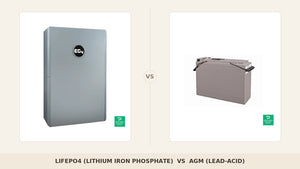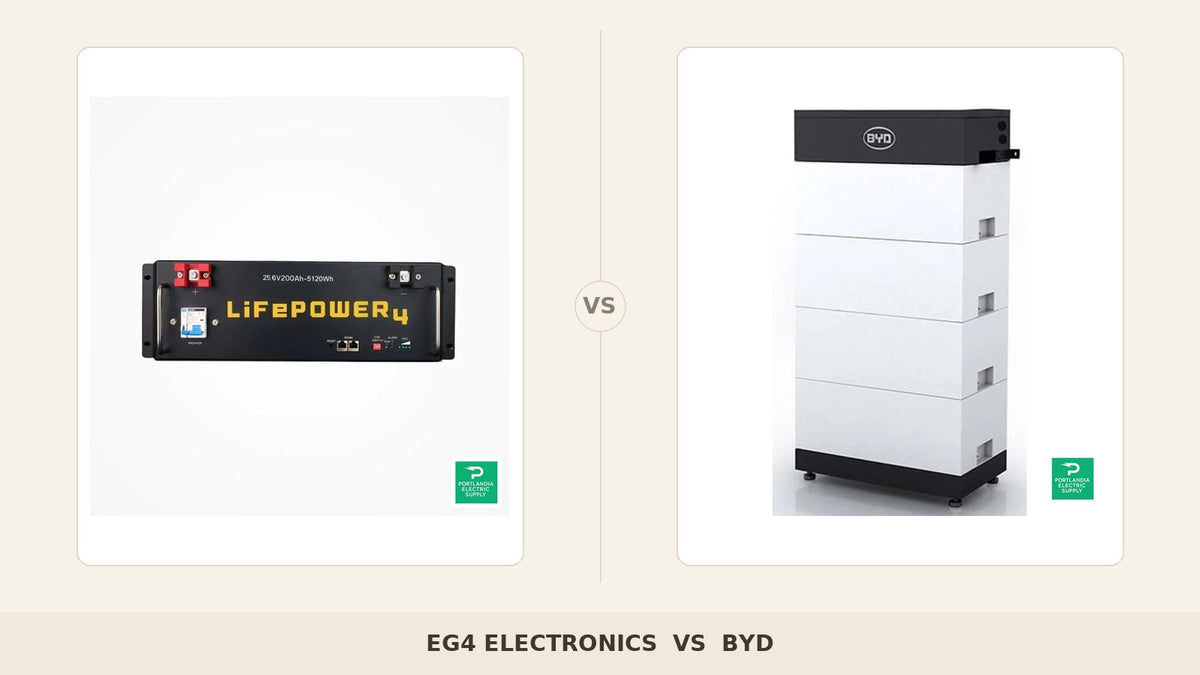
EG4 and BYD solve the same problem from opposite architectures. EG4 is the 48V low-voltage path: 5.12 kWh rack modules that pair with the broad ecosystem of 48V hybrid inverters — the default for off-grid, DIY-friendly, and value builds in North America. BYD Battery-Box is the high-voltage path: stackable ~2.76 kWh LFP modules forming 8.3-22.1 kWh towers at 153-409V, engineered for closed-loop pairing with European-style HV hybrids like the Fronius GEN24 and compatible SMA/Sungrow units. Your inverter choice decides this matchup before price does.
Spec Sheet — EG4 Electronics vs BYD at a Glance
- Architecture: 48V nominal — LFP, lead-acid, AGM compatible · High-voltage (153–409V class by tower) — pairs with Fronius GEN24,…
- Chemistry: LiFePO4 prismatic (server-rack 51.2V 100Ah / 5.12 kWh modules) · LiFePO4 (cobalt-free), high-voltage stack
- Capacity & Scaling: 5.12 kWh per rack module; stack to 80 kWh class per bank · HVM: ~2.76 kWh per module, towers 8.3–22.1 kWh; HVS: ~2.56 kWh modu…
- Cycle Life: ~7,000 cycles @ 80% DOD class · ≥6,000 cycles class
- Inverter Pairing: CAN/RS485 — best with EG4 batteries; growing third-party list · Closed-loop with certified HV hybrid inverters
The Shared Platform: What Both Have in Common
Both are cobalt-free LiFePO4 with ~6,000-7,000-cycle class longevity, 10-year warranties, modular stack scaling, and closed-loop inverter communications. Both are proven at scale — BYD globally in HV residential, EG4 in the North American 48V market. Neither is a bad choice; they are choices for different electrical architectures.
Side-by-Side Comparison Table
| Specification | EG4 Electronics | BYD |
|---|---|---|
| Architecture | 48V nominal — LFP, lead-acid, AGM compatible | High-voltage (153–409V class by tower) — pairs with Fronius GEN24, SMA, Sungrow HV hybrids |
| Chemistry | LiFePO4 prismatic (server-rack 51.2V 100Ah / 5.12 kWh modules) | LiFePO4 (cobalt-free), high-voltage stack |
| Capacity & Scaling | 5.12 kWh per rack module; stack to 80 kWh class per bank | HVM: ~2.76 kWh per module, towers 8.3–22.1 kWh; HVS: ~2.56 kWh modules, 5.1–12.8 kWh |
| Cycle Life | ~7,000 cycles @ 80% DOD class | ≥6,000 cycles class |
| Inverter Pairing | CAN/RS485 — best with EG4 batteries; growing third-party list | Closed-loop with certified HV hybrid inverters |
| Form Factor | 19-inch server-rack modules (rack or stack) | Floor-standing tower, modular stack |
| Warranty | 10 years (current models) | 10 years class |
| Price Class | $0.20–0.25/Wh contractor class ($1,050–1,300 per 5.12 kWh) | Mid-premium per kWh class |
Voltage Architecture Decides Everything
48V batteries (EG4) connect to low-voltage hybrid inverters — the Sol-Ark, EG4, Schneider, and Victron class that dominates North American off-grid and backup builds. High-voltage towers (BYD) connect to HV hybrids — Fronius GEN24, compatible SMA and Sungrow units — with higher round-trip efficiency and smaller conductors, but a different inverter ecosystem entirely. You cannot mix the two worlds: pick the inverter architecture first, and the battery follows.
Scaling Behavior
EG4 scales horizontally — paralleled rack modules on busbars, up to 80 kWh-class banks, with per-module pricing that makes incremental expansion cheap. BYD scales vertically — modules stack in a tower to 22.1 kWh (HVM), with towers paralleled for more. For small-to-mid residential banks both work; for large capacity on a budget, EG4's per-kWh pricing usually wins; for HV-hybrid system owners, BYD is the engineered match.
Quoting this job? We stock EG4 Electronics products and BYD products at contractor pricing — or get a system quote with both options priced side by side.
Choose EG4 Electronics If / Choose BYD If
Choose EG4 Electronics if: the build uses a 48V hybrid inverter (EG4, Sol-Ark, Schneider, Victron class), budget per kWh matters, or the project is off-grid/DIY-friendly.
Choose BYD if: the system is built on a high-voltage hybrid (Fronius GEN24, compatible SMA/Sungrow) where BYD's closed-loop integration is the engineered pairing.
Field takeaway: Architecture first: 48V builds take EG4, high-voltage hybrid builds take BYD. Both are proven LFP with 10-year warranties — the inverter picks the battery.
Frequently Asked Questions
Can I use BYD batteries with an EG4 inverter?
No — BYD Battery-Box HVM/HVS are high-voltage systems (153-409V class) designed for HV hybrid inverters. EG4 inverters are 48V low-voltage. The architectures are not interchangeable.
Which is cheaper per kWh?
EG4 rack modules run ~$0.20-0.25/Wh class; BYD towers price at a mid-premium tier per kWh. At equivalent capacity, EG4 usually costs substantially less.
Which lasts longer?
Both rate ~6,000-7,000-cycle class LFP with 10-year warranties. Service life in typical residential duty is comparable.
Is high voltage better than 48V?
HV systems offer higher round-trip efficiency and lower currents (smaller conductors); 48V systems offer a broader inverter ecosystem, easier DIY service, and lower entry cost. Neither is universally better — they serve different system designs.
Which is more common in the US?
EG4's 48V ecosystem is far more common in North American off-grid and backup builds. BYD HV towers are more common in European-style hybrid installs and through certified HV-inverter installers.
Sources & Standards
- EG4 battery documentation (eg4electronics.com)
- BYD Battery-Box HVM datasheet (bydbatterybox.com)
- Fronius GEN24 compatibility list (fronius.com)
Ready to price your project? Get a free system quote from PES Supply — both options, contractor pricing.
Related Resources: