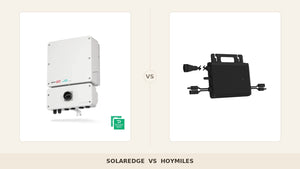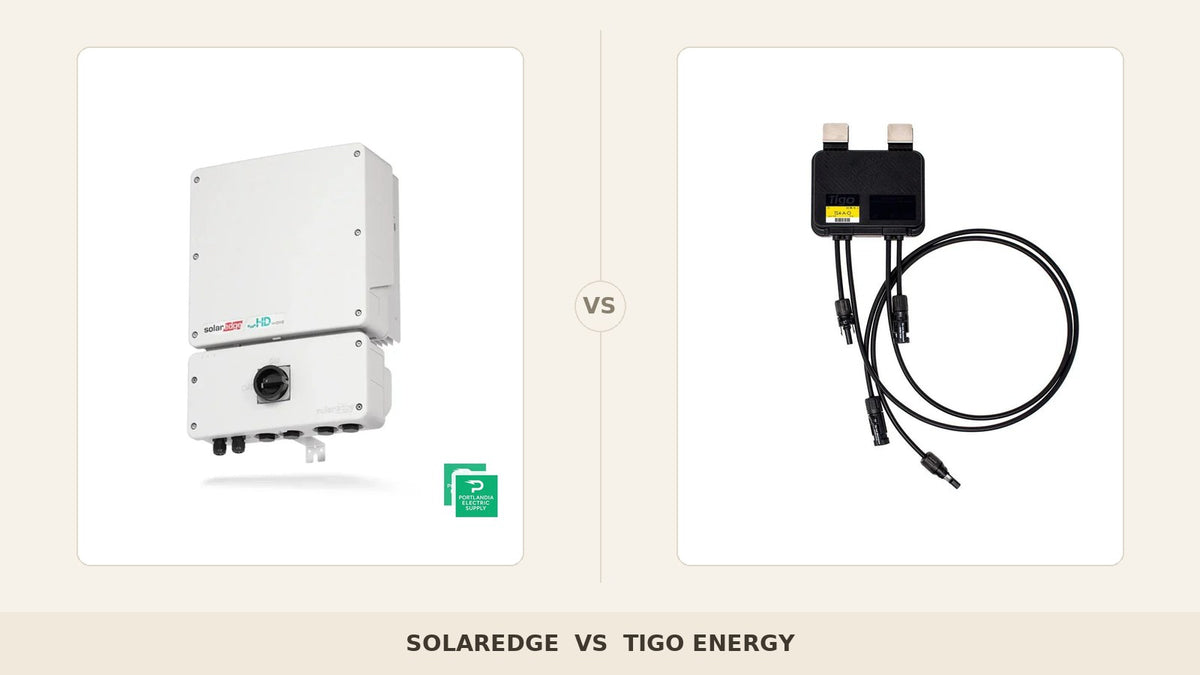
Both are DC-optimizer philosophies, but the business models are opposites. SolarEdge is a closed system: its optimizers only talk to its inverters, and in exchange you get the most integrated optimizer-plus-inverter platform on the market — per-module everything, SafeDC rapid shutdown, and one throat to choke for warranty. Tigo is the open ecosystem: TS4 units clip onto any modules, pair with almost any string inverter (SMA, Fronius, Sol-Ark — not SolarEdge), and deploy selectively so you only buy MLPE for the modules that need it. If you are buying a new, fully integrated system, SolarEdge is coherent. If you are retrofitting, mixing hardware, or fixing shade on a budget, Tigo is the answer.
Spec Sheet — SolarEdge vs Tigo Energy at a Glance
- Architecture: DC optimizer per module + central string inverter (DC-to-DC at the… · Selective-deployment MLPE — TS4 modules add optimization/RSD/monito…
- Current Lineup: P/S-Series optimizers + Home Hub or HD-Wave inverters (3.8–11.4 kW… · TS4-A-F (RSD), TS4-A-S (RSD+monitoring), TS4-A-O (RSD+optimization+…
- System Efficiency (class): ~97.5–99% combined (optimizer + string inverter) · System efficiency set by the paired string inverter (Tigo adds modu…
- Rapid Shutdown (NEC 690.12): SafeDC — optimizers drop to ~1V per module on shutdown (NEC 690.12) · NEC 690.12 via TS4-A-F / RSS transmitter (SunSpec or Tigo RSS)
- Warranty: 12 years string inverter (paid extension to 20/25); 25 years optimi… · 25 years on TS4 optimizers
The Shared Platform: What Both Have in Common
Both put per-module electronics on the roof that handle MPPT optimization, monitoring, and NEC 690.12 rapid shutdown, with 25-year warranties on the rooftop units. Both feed a string inverter that does the actual DC-to-AC conversion, so both inherit a central single point of failure. And both are proven at scale — these are the two optimizer approaches inspectors and utilities see constantly.
Side-by-Side Comparison Table
| Specification | SolarEdge | Tigo Energy |
|---|---|---|
| Architecture | DC optimizer per module + central string inverter (DC-to-DC at the panel) | Selective-deployment MLPE — TS4 modules add optimization/RSD/monitoring to ANY string inverter |
| Current Lineup | P/S-Series optimizers + Home Hub or HD-Wave inverters (3.8–11.4 kW residential) | TS4-A-F (RSD), TS4-A-S (RSD+monitoring), TS4-A-O (RSD+optimization+monitoring), TS4-X for high-power |
| System Efficiency (class) | ~97.5–99% combined (optimizer + string inverter) | System efficiency set by the paired string inverter (Tigo adds module-level recovery on shaded units) |
| Rapid Shutdown (NEC 690.12) | SafeDC — optimizers drop to ~1V per module on shutdown (NEC 690.12) | NEC 690.12 via TS4-A-F / RSS transmitter (SunSpec or Tigo RSS) |
| Warranty | 12 years string inverter (paid extension to 20/25); 25 years optimizers | 25 years on TS4 optimizers |
| Monitoring | SolarEdge portal/app — per-panel, built into inverter | Tigo EI portal via TAP/CCA gateway (when monitoring-equipped TS4s deployed) |
| Grid-Down Operation (No Battery) | No daylight backup — requires battery to operate during an outage | Determined by the paired inverter/storage, not the TS4 |
| Battery Integration | DC-coupled (SolarEdge Home Battery) or AC-coupled third party | Inherits from paired inverter — works with SMA, Fronius, Sol-Ark and others |
| Single Point of Failure | String inverter failure takes the whole array down | None added — string inverter remains the system single point of failure |
| Typical Equipment Cost | ~$0.10–0.20/W below Enphase on typical residential BOM | Lowest MLPE entry cost — deploy only on shaded/at-risk modules (~$25–60 per optimizer class) |
Closed vs Open: What the Lock-In Buys
SolarEdge's closed loop is real: SolarEdge optimizers do not function with other inverters, and SolarEdge inverters require SolarEdge optimizers for module-level anything. The payoff is integration depth — one design tool, one monitoring platform, one warranty chain, and SafeDC compliance engineered end-to-end. Tigo's openness buys flexibility: keep the customer's existing SMA or Fronius inverter, add TS4s, and get module-level shutdown and monitoring without replacing the inverter. For retrofits and mixed fleets, open is not a nice-to-have — it is the whole job.
Selective Deployment vs Full Density
SolarEdge is a full-density platform: every module gets an optimizer, always. Tigo's signature move is selective deployment — optimization on shaded modules, shutdown-only units elsewhere. On a roof with six shaded panels out of twenty-four, Tigo's approach buys the same shade recovery for a fraction of the optimizer spend. SolarEdge's counter: full density means uniform monitoring, uniform behavior, and no per-roof deployment engineering. For contractors with design capacity, selective wins the math; for crews that want one repeatable BOM, full density wins the logistics.
The Inverter Question Decides Everything
Strip the marketing off both and the decision collapses to one question: whose inverter do you want on the wall? If the answer is "a new, integrated system with the best optimizer-inverter pairing," SolarEdge is the coherent buy — price in the 12-year inverter warranty extension. If the answer is "the inverter that is already there, or the one I prefer for other reasons," Tigo is the only path to module-level electronics without ripping and replacing. Note the one hard incompatibility: Tigo does not work on SolarEdge, and SolarEdge accepts nothing but its own.
Quoting this job? We stock SolarEdge products and Tigo Energy products at contractor pricing — or get a system quote with both options priced side by side.
Choose SolarEdge If / Choose Tigo Energy If
Choose SolarEdge if: Choose SolarEdge if: this is a new install and you want the most integrated optimizer-plus-inverter platform; uniform full-density monitoring matters; DC-coupled Home Battery is in the design; or single-vendor warranty accountability outweighs hardware flexibility.
Choose Tigo Energy if: Choose Tigo if: the customer has an existing string inverter worth keeping; shade is localized to a minority of modules; you prefer SMA, Fronius, or Sol-Ark on the wall; or the job is a code-driven rapid-shutdown/monitoring retrofit where open compatibility is the requirement.
Field takeaway: SolarEdge sells integration; Tigo sells freedom. New build with one vendor: SolarEdge makes sense (extend the inverter warranty). Retrofit, mixed fleet, or surgical shade fix: Tigo, and it is not close.
Frequently Asked Questions
Can I use Tigo TS4 with a SolarEdge inverter?
No. SolarEdge inverters only work with SolarEdge optimizers, and Tigo TS4 units require a non-SolarEdge string inverter via SunSpec or Tigo's RSS transmitter. The two ecosystems do not mix — choose one.
Which is cheaper, SolarEdge or Tigo selective deployment?
Tigo, when shade is localized — you only buy optimization for the modules that need it. If every module needs optimization, a full SolarEdge system is usually cheaper than blanketing the roof with TS4s, since the inverter is shared either way.
Do both provide NEC 690.12 rapid shutdown?
Yes. SolarEdge via SafeDC (optimizers drop to ~1V per module). Tigo via TS4-A-F/2F shutdown units or TS4-A-O/S with an RSS transmitter. Both are standard inspection-accepted paths.
What warranties do the optimizers carry?
Both carry 25 years on the rooftop optimizer/TS4 hardware. The difference is the inverter: SolarEdge's string inverter is 12 years standard (paid extension to 20/25); with Tigo, inverter warranty depends on the brand you pair it with.
Is Tigo monitoring as good as SolarEdge monitoring?
At full TS4-A-O/S deployment with a TAP gateway, per-module visibility is comparable. Most Tigo jobs deploy monitoring selectively, so fleet uniformity differs. SolarEdge's platform is the more polished single-pane experience because every module is instrumented by default.
Sources & Standards
- SolarEdge optimizer/inverter documentation (solaredge.com)
- Tigo TS4 documentation (tigoenergy.com)
- NEC 690.12 device survey (surgepv.com)
Ready to price your project? Get a free system quote from PES Supply — both options, contractor pricing.
Related Resources: