EG4 vs Fortress Power: LiFePO4 Rack Battery Shootout
The two most-argued-about 48V rack batteries in the DIY and pro installer channels, compared on $/kWh, cycle life, BMS communication, cold-weather behavior, warranty mechanics, and total cost of a 20 kWh bank — with the math shown.
EG4 and Fortress Power both sell lithium iron phosphate batteries in the server-rack form factor that has taken over residential and light-commercial storage, and both work with the hybrid inverters that dominate the value end of the market. That is where the similarity ends. EG4 sells price-per-kWh that made the category explode; Fortress sells engineering depth, closed-loop communication breadth, and a support bench that picks up the phone. We have commissioned banks of both — from 10 kWh cabin systems to 60 kWh light-commercial installs — and the right answer depends on who is doing the commissioning and how much hand-holding the design needs.
Live inventory lives in the EG4 batteries and Fortress Power collections, with the broader LiFePO4 category and server-rack battery lines for cross-shopping. If you are still working out how much storage the house actually needs, run the home battery bank sizing guide first — brand debates are premature until the kWh target is on paper.
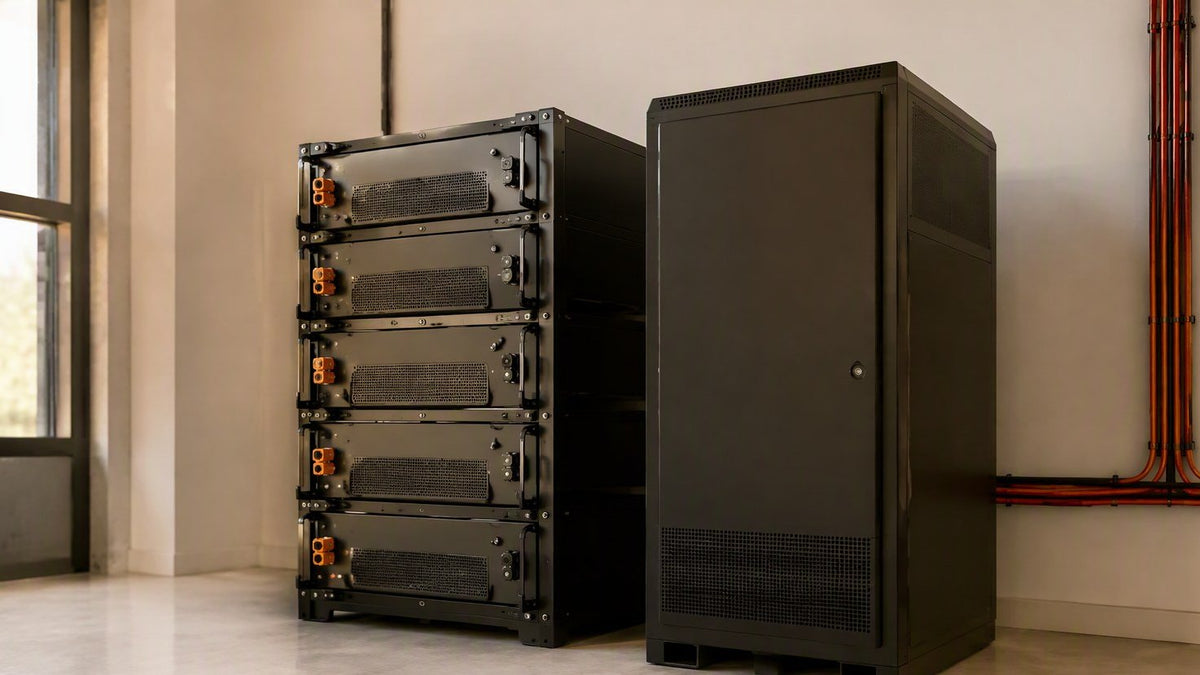
EG4's rack line — the LifePower4 and the LL series — is the value benchmark of the category: 51.2V, 100Ah, 5.12 kWh per module, LFP prismatic cells, rack-mountable in standard 19-inch cabinets, with an onboard BMS that speaks the common inverter protocols. The LL series adds low-temperature charge protection and a heated variant for cold-climate installs. Pricing hovers in the $1,000–$1,300 class per module depending on promos and volume, which put 5.12 kWh of LFP within reach of builds that used to settle for golf-cart lead-acid.
Fortress Power's eFlex Max 5.4 is the premium play: 51.2V, 105Ah, 5.4 kWh per module, with a BMS engineered for closed-loop communication with a long list of inverter platforms — Sol-Ark, Schneider, Victron, OutBack, and EG4's own hybrids among them. The eFlex Max 5.4 carries the full UL 1973 / UL 9540 listing stack and Fortress's US-based engineering support. Pricing runs the $1,700–$2,000 class per module — roughly 60% more per kWh than EG4 at street pricing.
Class-level specs; pull the exact SKU datasheet before design sign-off. Both lines scale to 15+ modules in parallel per bank guidance.
| Spec | EG4 LifePower4 / LL class | Fortress eFlex Max 5.4 |
|---|---|---|
| Nominal voltage | 51.2V | 51.2V |
| Capacity | 100Ah / 5.12 kWh | 105Ah / 5.4 kWh |
| Chemistry | LiFePO4 prismatic | LiFePO4 prismatic |
| Cycle rating class | 6,000+ @ 80% DoD | 6,000+ @ 80% DoD |
| Continuous discharge | 100A class per module | 100A class per module |
| Comms | CAN/RS485, common protocols + closed-loop lists | CAN/RS485, deep closed-loop library |
| Cold-weather | LL series: charge cutoff + heated variants | Low-temp charge management |
| Listings | UL 1973 class | UL 1973 + UL 9540 stack |
| Warranty class | 5–10 yr depending on line/registration | 10 yr class |
| Street price class | $1,000–$1,300 | $1,700–$2,000 |
Storage buyers shop one number first, so here it is with the math exposed:
Street class ranges, early 2026. Freight, cables, rack, and inverter are additional on both paths — see the bank-cost section.
| Module | Street price class | Usable kWh (nameplate) | $/kWh | 20 kWh bank cost (4 modules) |
|---|---|---|---|---|
| EG4 rack (5.12 kWh) | $1,000–$1,300 | 5.12 kWh | $195–$254 | $4,000–$5,200 |
| Fortress eFlex Max (5.4 kWh) | $1,700–$2,000 | 5.4 kWh | $315–$370 | $6,800–$8,000 |
| Delta | — | — | ≈ +60% | +$2,800 on a 20 kWh bank |
A $2,800 delta on a 20 kWh bank is real money. The question the rest of this article answers is what that $2,800 buys: support depth, comms polish, listing paperwork for inspected jobs, and warranty infrastructure. On a permitted residential install where the AHJ wants UL 9540 system-level documentation, Fortress's paperwork can pay back its premium in a single passed inspection. On a barn, cabin, or DIY shop system, EG4's price advantage is the whole ballgame.
Nameplate $/kWh is day-one economics. The number that matters over a decade is cost per kWh actually cycled through the battery. Run both at 80% DoD for their rated 6,000-cycle class:
6,000 cycles × usable kWh = lifetime throughput; mid-price ÷ throughput = storage cost per cycled kWh. Both beat any lead-acid chemistry by 5–10x on this metric.
| Module | Usable per cycle (80% DoD) | Lifetime throughput (6,000 cycles) | Mid-price $/kWh | Cost per lifetime kWh |
|---|---|---|---|---|
| EG4 5.12 kWh | 4.10 kWh | ≈ 24,600 kWh | $0.234 | ≈ $0.0095/kWh |
| Fortress 5.4 kWh | 4.32 kWh | ≈ 25,900 kWh | $0.343 | ≈ $0.0124/kWh |
Under a penny and a half per stored kWh on both paths — that is why LFP rack batteries killed the lead-acid market. The spread between the two brands on this metric (~30%) is smaller than the day-one price spread (~60%) because the Fortress module carries slightly more capacity. For the daily-cycling habits that keep either battery inside its cycle rating, the 20–80 battery rule guide is the operational companion, and our longevity guide covers temperature management.
Closed-loop communication — where the battery BMS tells the inverter exact charge voltage, current limits, and state of charge — is the difference between a system that behaves and one that needs babysitting. Both brands do it; they do it differently in practice.
Fortress built its reputation on a deep, well-tested closed-loop library. Pairing an eFlex Max with a Sol-Ark, Schneider XW, or Victron system is documented, validated, and supported by people who have done the exact combination before. EG4's batteries pair natively and seamlessly with EG4's own inverters — the 18kPV, FlexBOSS21 class — and support the common protocol set (Pylontech-protocol CAN among them) for third-party inverters. In our commissioning log, EG4-plus-EG4 is plug-and-play; EG4-plus-third-party occasionally takes a firmware shuffle and a settings afternoon.
The rule we apply on quotes: EG4 batteries with EG4 inverters, or Fortress batteries when the inverter is third-party premium. Mixed marriages work — we have plenty in the field — but they consume commissioning hours that eat the price advantage if you are paying a professional for those hours. Browse the inverter side in hybrid inverters, 48V inverters, and the FlexBOSS21.
LFP cells cannot accept charge below freezing without lithium plating damage, so every BMS in this category cuts charging near 0°C. The question is what happens next. EG4's LL heated variants warm themselves from the charging source and resume; unheated modules from either brand simply refuse charge until the cells warm above the cutoff. Fortress manages low-temp behavior conservatively and documents it clearly.
Field note from a Montana install: an unheated bank in an uninsulated shed lost three consecutive January mornings of solar harvest because the batteries sat at −4°C until noon. The fix was insulation plus a thermostatic pad heater, not a different battery brand. But if you know the bank will live somewhere cold, buying the heated variant up front is cheaper than my customer's retrofit. Budget accordingly and read the charging behavior primer if cold-weather charging limits are new territory.
Average efficient home overnight loads run 8–15 kWh; a 20 kWh bank covers overnight plus a cloudy morning for most houses. Here is the build both ways:
Equipment only; labor, permits, and panel work are site-specific. Runtime math: 20 kWh ÷ 1.5 kW average overnight load ≈ 13 hours of autonomy.
| Component | EG4 path | Fortress path |
|---|---|---|
| Modules | 4 × 5.12 kWh = 20.48 kWh | 4 × 5.4 kWh = 21.6 kWh |
| Battery cost class | $4,000–$5,200 | $6,800–$8,000 |
| Rack + busbar + cables | $400–$700 | $400–$700 |
| Hybrid inverter (12 kW class) | $3,500–$5,000 | $4,500–$7,000 (premium pairing) |
| System total class | $7,900–$10,900 | $11,700–$15,700 |
| $/kWh installed (equipment) | $386–$532 | $542–$727 |
Cross-check your own load profile with the battery backup runtime calculator and the battery count guide for 4,000 W systems. One design rule from hundreds of banks: oversize the bank 20% past the calculation. Loads grow, occupants add freezers and EVs, and nobody has ever complained about reserve capacity at 9 p.m. during an outage.
Fortress runs US-based engineering support that will get on a commissioning call, review your inverter settings, and stay on the line while the system comes up. On complex or inspected jobs, that is worth real money. EG4's support has scaled with its volume — documentation is strong, the installer community is enormous, and Signature Solar's channel ecosystem means most problems have a forum thread and a YouTube walkthrough before you finish your coffee.
Warranty terms land in the 10-year class for Fortress and the 5–10-year class for EG4 depending on product line and registration. Our warranty-claim experience with both has been professional; Fortress's process is more guided, EG4's is more transactional but faster on straightforward defects. Keep commissioning photos and settings screenshots for either brand — documentation settles claims. For grid-tied whole-home alternatives outside the rack category, the EG4 vs Tesla Powerwall comparison covers the appliance-style path.
Rack batteries go together like network gear, but the DC side is unforgiving. On both brands: land battery terminals at the torque value on the datasheet (typically in the 9–12 N·m class for M8 terminals), use the supplied inter-module cables or listed equivalents, and keep parallel strings balanced in cable length. We have chased phantom imbalance alarms that turned out to be one long cable run creating a voltage-drop differential across modules. Symmetry is not aesthetics on a DC bus — it is current sharing.
On the code side, the inverter feeder and battery interconnects size per NEC ampacity rules; our NEC wire sizing guide and ampacity chart handle the math, and a 12 kW-class inverter at 48V can pull 250A class surge — that is 4/0 copper territory on the battery interconnect, not the 2 AWG somebody had on the truck. Overcurrent protection per the battery manufacturer's required OCPD spec is not optional, and inspected jobs will check it against the listing documentation. Keep disconnects accessible per NEC 480 and 706 working-clearance rules.
Every storage buyer asks whether they can start small and add modules later. Both brands support it, with the same caveat: new modules should match the bank's existing modules in model and firmware, and deeply aged modules mixed with fresh ones will balance toward the weakest. In practice, expansion within the first 2–3 years of the original bank behaves fine in our installs; beyond that, capacity mismatch starts stealing from both the old and new modules.
EG4's price point changes the expansion math in a way worth stating plainly: adding two more EG4 modules later costs roughly what the cables and a Saturday cost. The Fortress expansion conversation is a bigger check each time, which pushes Fortress buyers toward sizing right the first time. Neither is wrong. They are just different financial shapes for the same kWh. Plan the rack footprint for the final bank size on day one — we have moved too many 200-pound battery stacks because the original rack maxed out at six slots.
We pull anniversary reports on serviced systems, and the one-year patterns for both brands are boring in the best way: capacity within a percent or two of commissioning, round-trip efficiency in the mid-90s, and no cell-group drift beyond BMS balancing behavior. The differences that show up are operational, not electrochemical. EG4 banks on EG4 inverters report cleanest through the native monitoring app; third-party pairings occasionally need a settings audit at year one. Fortress banks on premium inverters report beautifully from day one and keep doing it.
The failures we have logged across both brands in three years: one shipping-damaged module (resolved under warranty), two comms-cable faults from pinched RJ45 runs, and a handful of low-temperature charge-cutoff calls that were education issues, not defects. That is a remarkable reliability record for a product category that barely existed at this price five years ago. Both brands earned their market share. For the charging-source side of a healthy bank, the MPPT vs PWM guide and controller sizing guide cover DC-coupled designs.
Buy EG4 when the build is value-led: DIY and advanced-owner systems, cabins, shops, off-grid builds where the installer is you, and any project pairing batteries with EG4's own hybrid inverters. The EG4 ecosystem — inverters, batteries, racks, and comms — is engineered to click together, and at $/kWh nobody in the UL-listed rack category consistently undercuts it.
Buy Fortress when the job is inspected, the inverter is a third-party premium platform, the customer needs white-glove support, or the project is light-commercial where documentation and a 10-year warranty carry financing weight. The eFlex Max's closed-loop polish removes commissioning risk that costs more than the price delta on professional installs.
The bottom line from the field: we deploy both, happily. EG4 made affordable LFP storage a mass-market product; Fortress made rack batteries palatable to inspectors and premium-inverter purists. Match the battery to the commissioning reality, not the logo. Check live stock in battery storage, the 10 kWh and 15 kWh bank classes, and 48V batteries.
Buyers fixate on $/kWh of the modules and forget the system question: how many outage hours does the bank actually buy? A 20 kWh bank at a 1.5 kW average overnight draw gives ~13 hours. Stretch to 40 kWh and you cover a full day-night cycle at the same draw, or overnight with a window AC running. The table below is the runtime math we print for every storage quote:
Runtime = usable kWh ÷ average load. Refrigerators, well pumps, and HVAC are spiky — measure your real average before sizing.
| Bank size | Usable @ 80% DoD | @ 1.0 kW avg load | @ 1.5 kW avg load | @ 2.5 kW avg load |
|---|---|---|---|---|
| 10.24 kWh (2 modules) | 8.2 kWh | 8.2 hr | 5.5 hr | 3.3 hr |
| 20.48 kWh (4 modules) | 16.4 kWh | 16.4 hr | 10.9 hr | 6.6 hr |
| 30.72 kWh (6 modules) | 24.6 kWh | 24.6 hr | 16.4 hr | 9.8 hr |
| 40.96 kWh (8 modules) | 32.8 kWh | 32.8 hr | 21.9 hr | 13.1 hr |
Read the table once and the brand question re-frames itself: for the price of a 4-module Fortress bank you can often field a 6-module EG4 bank — 50% more autonomy for the same money. For outage-driven buyers, autonomy hours are the product. For inspected premium jobs, Fortress's documentation and support are the product. Know which product you are actually buying, and the brand picks itself. One closing habit from our install crews: photograph the rack, the torque marks, and the settings screens at commissioning. Whatever badge you bought, that photo folder is the warranty claim that gets approved without a fight, the insurance answer that takes one email, and the resale documentation that convinces the next owner the system was built by adults.
Is Fortress Power better than EG4?
Better depends on the job. Fortress eFlex Max offers deeper closed-loop inverter integration, a full UL 9540 documentation stack, longer warranty class, and US-based engineering support — at roughly 60% higher $/kWh. EG4 delivers the same LFP chemistry and cycle class at category-leading prices, pairing most seamlessly with EG4's own inverters. Inspected premium installs favor Fortress; value-led DIY and EG4-inverter builds favor EG4.
How many EG4 batteries do I need for a 20 kWh bank?
Four EG4 5.12 kWh rack modules give 20.48 kWh nameplate, about 16.4 kWh usable at 80% depth of discharge. That covers typical overnight loads of 8–15 kWh with margin. Add 20% headroom beyond your calculated need — loads grow, and reserve capacity during extended outages is never regretted.
Do EG4 batteries work with Sol-Ark, Schneider, and Victron inverters?
Yes, via standard CAN/RS485 protocols — including the Pylontech protocol profile many inverters support — but the pairing may require firmware updates and manual charge-parameter setup. Fortress Power's closed-loop library is more deeply validated on those platforms. With EG4's own 18kPV or FlexBOSS21 inverters, EG4 batteries are plug-and-play with native closed-loop communication.
How long do LiFePO4 rack batteries last?
Both EG4 and Fortress rack modules carry 6,000+ cycle ratings at 80% depth of discharge — roughly 15–20 years of daily cycling, and the batteries typically outlive their cycle rating at reduced capacity rather than failing outright. Calendar life, temperature management, and staying within the 20–80% state-of-charge band for daily use matter more than the brand on the label.
What is the cost per kWh difference between EG4 and Fortress?
At early-2026 street pricing, EG4 rack modules run about $195–$254 per kWh versus $315–$370 per kWh for the Fortress eFlex Max 5.4 — a ~60% premium. Measured against lifetime throughput at rated cycles, the gap narrows to ~30%: roughly $0.0095 versus $0.0124 per cycled kWh.
Can I mix EG4 and Fortress batteries in one bank?
No — never parallel different brands, capacities, or firmware families in one DC bus. BMS behaviors, charge profiles, and internal resistances differ, creating imbalance and stress that shortens bank life and complicates warranty coverage. Expansion means adding matched modules from the same product line.
Which brand is better for an off-grid cabin?
EG4, in most cases. Off-grid cabins are value-led, often owner-installed, and usually paired with a value hybrid inverter — exactly the EG4 ecosystem's home turf. The heated LL variants handle cold-climate charging, and the $/kWh advantage lets you carry more autonomy for the same budget. Choose Fortress when the cabin build is permitted and inspected to a standard that wants the UL 9540 documentation stack.
PES Supply stocks both lines at wholesale with design support included: EG4 batteries, Fortress Power, all LiFePO4, and server-rack format. Bring us your load profile and we will return a sized, priced bank with the comms path verified.