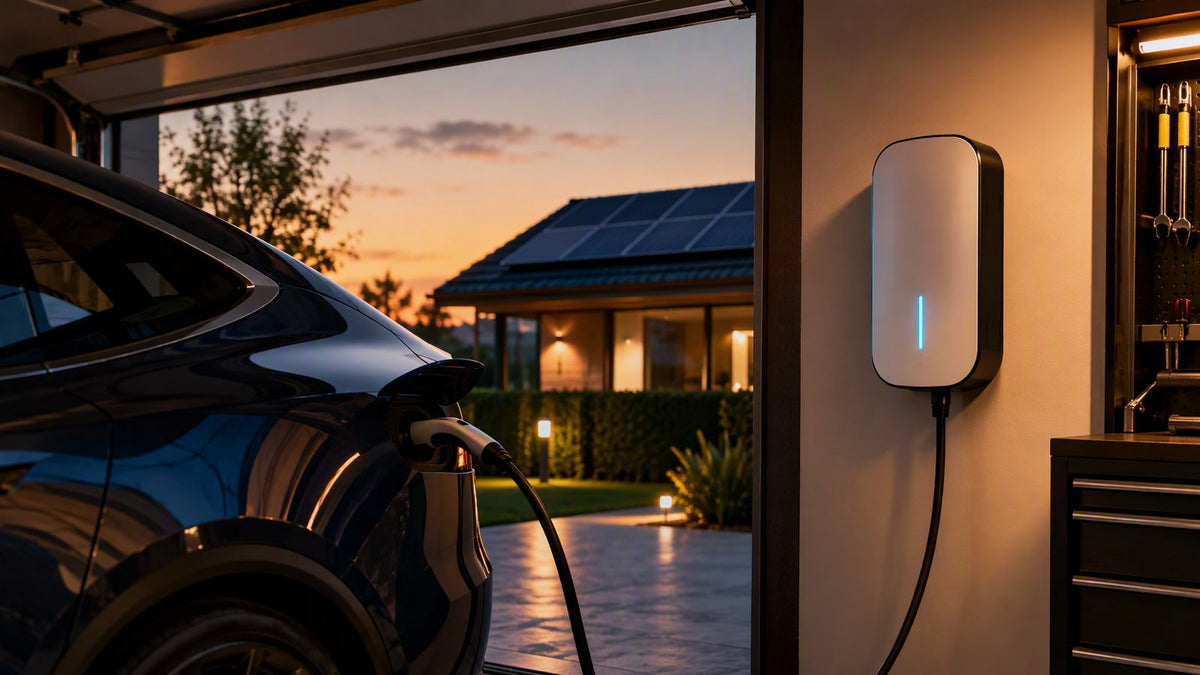
Home EV Charger Benefits & Installation Pros and Cons
Every EV owner runs the same experiment the first month: nursing the car off a 120-volt wall outlet, doing mental math about whether the battery will be full by morning, and wondering if a real charger is worth the money. We've supplied equipment for thousands of home charging setups, and the answer is almost always yes — but the honest answer includes the costs, the electrical realities, and the handful of situations where it genuinely isn't worth it yet. Here's the full picture.

Understanding EV Chargers
Types of EV Chargers
| Charger Type | Details |
|---|---|
| Level 1 (120V) | Plugs into a standard outlet. 1.2–1.9 kW, adds 3–5 miles of range per hour. Fine for plug-in hybrids and sub-30-mile daily drives; frustrating for full battery EVs. |
| Level 2 (240V) | Dedicated circuit, 32–48A typical. 7.7–11.5 kW, adds 25–44 miles per hour. Full overnight charge for any EV. This is what "home charging" means for most owners. |
| DC Fast (Level 3) | 480V three-phase commercial power, 50–350 kW. Not a home product — residential panels and residential rates can't support it. See public charging stations instead. |
Home EV Charger vs. Public Charging Stations
The comparison that matters is cost per mile and time, and home charging wins both by embarrassing margins. Home electricity at $0.10–0.14/kWh works out to roughly $1.00–1.40 per gallon of gasoline equivalent. Public Level 2 typically costs $0.20–0.30/kWh, and DC fast charging runs $0.35–0.55/kWh — three to five times the home rate, plus the time cost of sitting in a parking lot. Drivers who charge 90% at home routinely report annual "fuel" costs under $500 for 12,000 miles. That's the entire economic argument in one sentence.
Reliability belongs in this comparison too. Public charging uptime varies by network and station age; regular DC fast users develop mental maps of which stations to trust. Home charging has no queue, no broken screen, no iced-up connector, and no session fee. The public network is for road trips and emergencies — a role it fills well — but the driver who tries to live on it daily pays a tax in money, time, and patience that the home charger eliminates entirely.
Benefits of Installing a Home EV Charger
Convenience is the benefit people feel daily: plug in when you park, unplug with a full battery, never think about it again. Cost is the benefit that shows up in the budget: overnight off-peak rates in many utility territories drop to $0.06–0.09/kWh, and scheduled charging captures that automatically. Then there's control — no broken public stations, no app roulette, no queue behind someone else's road trip. I've talked to hundreds of EV owners, and the single most common sentence is some version of "I should have done this the week I bought the car."
Installation Process of an EV Charger
Preparing Your Home for EV Charger Installation
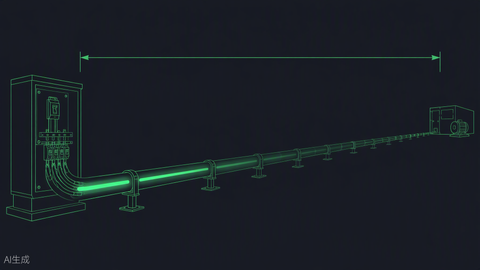
Start at the panel. Read the main breaker: 200A service almost always has room for a 50A or 60A EV circuit; 100A service needs a NEC 220.83 load calculation before anyone promises capacity. Check for open breaker spaces — amperage and physical spaces are separate constraints, and you need both. Then walk the route from panel to parking spot: every foot of distance is wire, conduit, and labor. A garage-adjacent panel is the dream scenario; a panel on the far side of the house from a detached garage is where budgets grow legs. If the load calculation comes back tight, don't panic — a 24A or 32A charger on a 100A panel still adds 18–25 miles of range per hour, which covers most commutes overnight, and load management devices can stretch limited panels further than most homeowners expect.
| Your Situation | Likely Path | Typical Added Cost |
|---|---|---|
| 200A panel, garage-adjacent, open studs | Direct 50A circuit, surface conduit | $400–$900 installed |
| 200A panel, 25–50 ft run, finished walls | Fished wire or exterior conduit route | $800–$1,800 installed |
| 100A panel, moderate existing load | Load calc → smaller circuit or load management module | $500–$1,500 installed |
| 100A panel, heavy electric loads | Panel upgrade to 200A, then circuit | $3,500–$6,000 all-in |
| Detached garage / long distance | Trench + sub-panel, or overhead feed | Add $1,000–$2,500 |
Steps to Install an EV Charger at Home
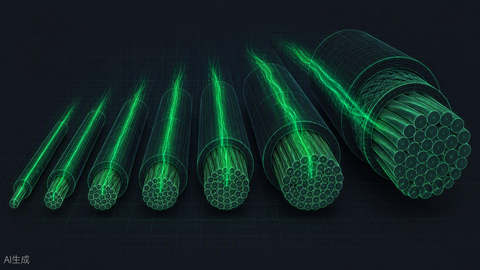
The sequence never changes. One: pick the charger, matching its amperage to your car's onboard charger limit (many EVs cap at 32A or 40A — a 48A unit on a 32A car is wasted money). Two: pull the electrical permit, typically $50–$300. Three: the electrician runs a dedicated 240V circuit sized at 125% of charger rating per NEC 625.42 — 40A charger, 50A breaker, 6 AWG copper per NEC 310.16. Four: mount the EVSE 36–48 inches high, hardwire it or install an EV-duty NEMA 14-50 receptacle, torque every termination to spec. Five: inspection, then commission the app with your utility's off-peak schedule. Done right, it's a one-day physical install wrapped in one to four weeks of permitting and scheduling.
Hiring Professionals vs. DIY Installation
We'll say it plainly as an equipment supplier: hire the electrician. Continuous-load sizing, GFCI coordination, and lug torque specs are unforgiving, and the permit/inspection trail protects you at insurance-claim time and at home-sale time. DIY saves $400–$900 and risks a mis-torqued lug that heats up at 2 AM every night for a year before anyone notices. Licensed, insured, EV-experienced, permit in hand — those four filters, applied to two or three quotes, is the whole hiring process. The step-by-step companion to this article is our EV charger installation walkthrough.
Costs Associated with EV Charger Installation

Average Installation Costs for Home EV Chargers
| Type of Charger | Cost Range |
|---|---|
| Level 1 (existing outlet) | $0–$300 (cordset often included with the car; a dedicated 120V outlet adds the rest) |
| Level 2 hardware | $350–$750 for quality Wi-Fi units; browse Level 2 chargers |
| Level 2 installation | $400–$1,800 for typical runs; $1,800–$4,000 for complex routes |
| Panel upgrade if needed | $1,800–$4,000 |
| All-in typical | $1,200–$2,500 including hardware and permit |
Factors Influencing Installation Costs
Distance from panel to parking is the big lever — every ten feet of circuit is $50–$150. Panel condition is second. Wall construction third. Then the small stuff that adds up: permit fees, drywall patching, trenching, and the difference between a hardwired unit and a receptacle install (the receptacle itself, done right with an EV-duty industrial grade, is $60–$120 of the job). Get route-specific itemized quotes; national averages describe a house that doesn't exist.
Level 1 vs. Level 2: The Five-Year Cost Comparison
| Factor | Level 1 Only | Level 2 Installed |
|---|---|---|
| Upfront cost | $0–$300 | $1,200–$2,500 (before incentives) |
| Nightly range recovered (10 h) | 30–50 miles | 250–440 miles |
| Public charging needed for 40 mi/day driver | Frequent — $400–$900/yr at DC fast prices | Rare — road trips only |
| Battery-friendliness | Gentle | Gentle (both far kinder than habitual DC fast) |
| 5-year total cost (12k mi/yr driver) | ~$2,000–$4,500 in supplemental public charging | ~$1,200–$2,500 install + minimal public use |
The five-year column is where the decision gets made. Level 1 looks free until you price the public charging it forces.
Cost Savings of Charging at Home
Run the payback math against your actual driving. Twelve thousand miles a year in a 3.5 mi/kWh EV is about 3,400 kWh. At $0.12/kWh home rates that's $410 a year. The same energy at $0.45/kWh DC fast prices is $1,540 — a $1,100 annual gap that pays back a $1,800 install in about 20 months, and keeps paying for a decade. Stack the federal 30C credit (30% up to $1,000 for qualifying homes) and a utility rebate ($250–$1,000 in many territories) and the payback can land inside the first year. Our installation cost guide has the full commercial and residential breakdown.
The savings compound in less obvious ways too. Scheduled off-peak charging typically shaves another 30–50% off the home rate where TOU plans exist. Home charging is gentler on the battery than habitual DC fast charging, which matters for long-term pack health and resale value. And there's an option value: the 240V circuit serves future needs — a second EV, a plug-in hybrid for a teenager, a welder, a shop heater. Homeowners who install the circuit discover uses for it. Nobody has ever told us they regretted having 50 amps of 240V capacity in the garage.
Benefits of Home EV Charging
Convenience of Charging at Home
The quality-of-life change is hard to overstate. Your "gas station" is your garage; your tank is full every morning. No detours, no queues, no broken screens. For households with predictable routines, charging becomes invisible infrastructure — like the water heater, you only think about it when somebody asks. The one discipline worth building: plug in every night regardless of state of charge, so a surprise trip never starts at 30%.
Winter and summer both sharpen the convenience argument. In January, preconditioning the cabin and battery while still plugged in means you leave in a warm car with a full battery, and the grid paid for the defrost — not your range. In August, scheduling charging for the small hours keeps the garage cooler and lands you squarely in the cheapest rate window. Neither of those luxuries exists at a public station, where you're paying premium prices to sit in the weather.
Impact on Property Value
EV-ready homes are beginning to price differently in markets with high EV adoption. A permitted, inspected Level 2 installation is a documented improvement — unlike a lot of DIY electrical work, it comes with the paper trail appraisers and buyers' inspectors actually credit. Even where it doesn't move the appraisal dollar-for-dollar, it removes a buyer objection, and removing objections is what sells houses in a slow weekend.
Environmental Benefits of Home EV Charging
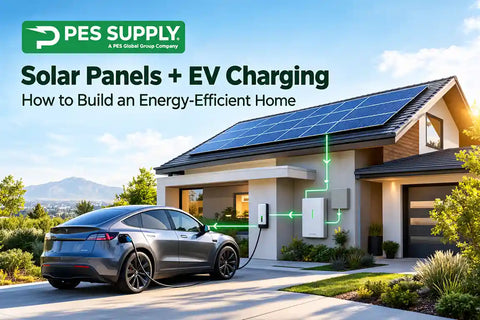
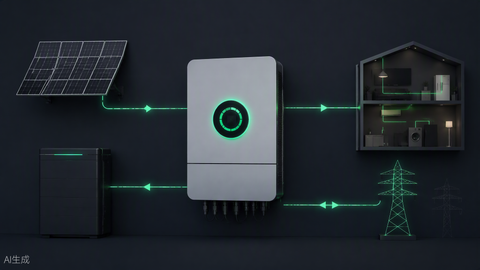
Charging overnight means drawing from the grid's cleanest hours in most regions, when wind and baseload low-carbon generation dominate the mix. Pair the charger with rooftop solar and the calculus improves again — midday solar charging or smart scheduling against solar production through solar EV charging setups can push transportation energy to near-zero marginal emissions and near-zero marginal cost. Battery health follows the same logic: the 20-80 charging rule keeps daily cycling in the chemistry's comfort zone, extending pack life years beyond fast-charge-everything habits.
The Growing Popularity of Electric Vehicles
Trends in Electric Vehicle Adoption
EVs keep compounding: more models at every price point, longer standard ranges, and used EVs now entering the market at prices that compete with economy gasoline cars. Every one of those cars needs somewhere to sleep, and the used-EV wave specifically is creating millions of new first-time home-charging customers — people who bought the car for the deal and then discovered the outlet math. Charger demand follows the car fleet with a lag, and the fleet is still early in its curve.
Practical consequence for homeowners: the electrical work you do today serves a fleet that will keep growing. Conduit capacity, panel headroom, and circuit sizing are the "buy once, cry once" layer of this decision. We've seen the same house go from one EV to two EVs in eighteen months — the second charger install is trivial when the first one was sized with foresight, and a genuine headache when it wasn't. If there's any chance a second EV joins the household, mention it to your electrician now; a slightly larger panel feeder or a junction provision costs almost nothing during the first install.
Future of Home EV Charger Technology
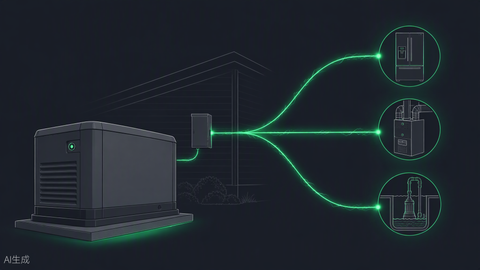
Three developments worth watching from where we sit. Bidirectional charging (V2H/V2G) is moving from pilot programs to shipped product — the EV as a 60–100 kWh home battery changes outage resilience math entirely, and pairs naturally with battery backup systems. Plug-and-charge standards are eliminating the app-and-card dance at public stations. And utility-integrated managed charging is scaling, where the utility modulates your charging in exchange for rate discounts — the charger becomes a grid asset that pays you. All three reward the same foundation: a properly sized, permitted 240V circuit with capacity headroom. Install once, benefit for decades.
Incentives for Installing Home EV Chargers
Federal 30C credit: 30% of hardware plus installation, up to $1,000, for qualifying locations (census-tract eligibility applies — check before you assume). State programs vary widely, from $500 rebates to full make-ready coverage. Utilities are the most overlooked layer: rebates, discounted EV rates, and free managed-charging equipment in some territories. Check incentives by state and call your utility's EV desk — their program money is chronically under-claimed, and ten minutes on the phone is the highest-paid ten minutes of this entire project.
So, Is It Worth It? The Honest Tally
The pros, weighed honestly: fuel savings of $400–$1,100 per year depending on what you're replacing, daily convenience that owners consistently rank as the EV's best feature, resilience when paired with solar or bidirectional capability, and a documented home improvement. The cons, equally honest: $1,200–$2,500 upfront (more with a panel upgrade), a permitting step that takes patience, the project is wasted if you move in six months (though the circuit adds sale appeal), and renters and street-parkers are largely locked out until their buildings catch up.
For the typical EV owner driving 30+ miles daily with a garage or dedicated parking: yes, unambiguously — payback in one to three years, then a decade of savings and convenience. For the low-mileage driver with a plug-in hybrid and a convenient outlet: Level 1 may genuinely suffice, and the honest advice is to try it for a month first — if you're never caught short, you just saved $1,500. For the renter or street-parker: home charging isn't available yet, and the move is workplace charging plus occasional public Level 2, with landlord advocacy as a side project. And for everyone: install once, install permitted, and size the circuit for the next car too — the 50A circuit you run today for a 32A car is the same circuit your 48A next car wants, and the trench you don't dig twice is money you don't spend twice.
Related Products
- Electric Vehicle (EV) Chargers
- Home EV Fast Chargers (240V)
- Level 2 Chargers
- EV Charging Accessories
- Wallbox Chargers