The Jinko 385W mono panel — model JKM385M-72HBL-V, the "Eagle Continental" — occupies an unusual niche in 2026: a US-assembled, all-black residential module with a 25-year product warranty that trades at legacy pricing because the market has moved on to 430W+ formats. For the right project, that is not a weakness. It is the buying opportunity. This guide covers the verified specs, the string-sizing math, the projects where 385W panels still make sense, and when to step up to newer wattage classes instead.

The module is stocked on our site at the Jinko JKM385M-72HBL-V product page, with pallet-quantity pricing in the Jinko Solar collection. For the brand-level picture, our Jinko brand guide covers the newer Tiger Neo TOPCon line.
What the JKM385M-72HBL-V Actually Is
This is Jinko's Eagle Continental series: a 144-half-cell mono PERC module assembled at Jinko's Jacksonville, Florida factory, black frame on black backsheet, UL Fire Type 1 rated, and built around what Jinko calls Diamond cell technology — passivated-emitter rear-contact cells at 158.75mm, half-cut and arranged in a twin-array layout. The verified specifications from the current listing:
| Specification | Value |
|---|---|
| Model | JKM385M-72HBL-V (Eagle Continental) |
| Rated power (Pmax) | 385 W, 0/+3% tolerance |
| PTC rating (real-world test condition) | 356.9 W |
| Module efficiency | 19.13% |
| Cell type | Mono PERC Diamond, 158.75 × 158.75 mm |
| Cell configuration | 144 half-cut cells (6 × 24) |
| Open-circuit voltage (Voc) | 48.4 V |
| Short-circuit current (Isc) | 10.38 A |
| Voltage at Pmax (Vmpp) | 39.37 V |
| Current at Pmax (Impp) | 9.78 A |
| Max system voltage | 1,500 V DC (UL/IEC) |
| Max series fuse rating | 20 A |
| Temp coefficient of Pmax | -0.35%/°C |
| Temp coefficient of Voc | -0.29%/°C |
| NOCT | 45°C ± 2°C |
| Dimensions / weight | 2,008 × 1,002 × 40 mm (79.1 × 39.5 × 1.57 in) / 22.5 kg (49.6 lb) |
| Mechanical load ratings | 5,400 Pa snow (front) / 2,400 Pa wind (rear); 50 mm hail at 35 m/s tested |
| Fire rating | UL Type 1 (highest residential class) |
| Connectors / cables | Stäubli MC4, IP68; 12 AWG PV Wire, 1,400 mm |
| Warranty | 25-year product; 25-year linear performance (≤2.5% year 1, ≤0.6%/yr after, ≥83.1% at year 25) |
Three numbers on that table deserve attention from buyers. The PTC rating of 356.9W — the California Energy Commission's more realistic test condition — tells you this panel delivers about 92.7% of nameplate under field-realistic conditions, an honest ratio. The UL Fire Type 1 rating matters for AHJs enforcing the strictest residential fire classifications. And the 25/25 warranty is a full decade longer on the product side than the 12-year product warranties common on imported value-tier modules.
String Design: The NEC Math With This Exact Module
Generic string-sizing advice is useless; here is the math with this module's actual Voc of 48.4V and the NEC 690.7(A) cold-temperature correction factors:
| Design Low Temp | 690.7(A) Factor | Corrected Voc | Max per String (1,000 V) | Max per String (1,500 V) |
|---|---|---|---|---|
| 0°C | 1.10 | 53.2 V | 18 | 28 |
| -10°C | 1.14 | 55.2 V | 18 | 27 |
| -20°C | 1.18 | 57.1 V | 17 | 26 |
| -30°C | 1.21 | 58.6 V | 17 | 25 |
| -40°C | 1.25 | 60.5 V | 16 | 24 |
Check one row: at -10°C, 48.4 × 1.14 = 55.18V; 1,500 ÷ 55.18 = 27.2, so 27 modules. On residential 600V equipment (the more common case for this panel's market): 600 ÷ 55.18 = 10.9, so 10 modules per string. On the current side, NEC 690.8 gives a design current of 10.38 × 1.56 = 16.2A — which lands neatly on the module's 20A max series fuse rating with standard NEC 240.6 OCPD sizing, and keeps 12 AWG PV Wire comfortably inside its ampacity. Our solar panel wiring guide and the NEC wire ampacity chart cover the conductor side in full.
System Configurations: What Pallets of 385s Build
The module ships 27 per pallet, 594 per 40-foot container. Practical system arithmetic with a 0.80 derate and 4.5 peak sun hours (Mid-Atlantic conditions):
| Panels | System Size | Roof Area | Est. Annual Production | Math Check |
|---|---|---|---|---|
| 13 | 5.0 kW | ~280 ft² | ~7,000 kWh | 5.005 kW × 4.8 × 365 × 0.80 = 7,015 kWh |
| 21 | 8.1 kW | ~450 ft² | ~11,300 kWh | 8.085 × 4.8 × 365 × 0.80 = 11,332 kWh |
| 27 (1 pallet) | 10.4 kW | ~575 ft² | ~14,600 kWh | 10.395 × 4.8 × 365 × 0.80 = 14,567 kWh |
| 54 (2 pallets) | 20.8 kW | ~1,150 ft² | ~29,100 kWh | 20.79 × 4.8 × 365 × 0.80 = 29,135 kWh |
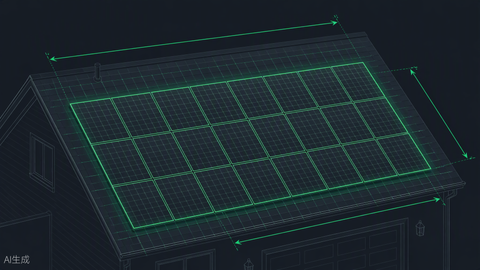
One honest adjustment: those production figures assume 4.8 peak sun hours, reasonable for the Mid-Atlantic and inland California; the Southwest runs 20–30% higher and the Pacific Northwest 25–35% lower. Each panel is 20.05 ft² of module face (2.008 m × 1.002 m = 2.012 m²), and installed rows need 21–22 ft² per panel with racking gaps — the roof-area column builds that in.
Where 385W Panels Win in 2026 — and Where They Don't
The case for this module rests on four pillars. Price: legacy-format pricing has run around $0.34/W at pallet quantity — half the per-watt cost of premium new-format modules. Aesthetics: the all-black construction reads clean on composition-shingle roofs, and HOA-driven projects specify black-on-black constantly. Fire rating: UL Type 1 satisfies the strictest residential AHJs without argument. Domestic assembly: Jacksonville assembly matters for buyers tracking content origin. The case against: 19.13% efficiency is three to four points below current TOPCon modules, so space-constrained roofs surrender real capacity; and 385W means more modules, clamps, and labor per kW than 430W+ formats. My rule of thumb after speccing both for years: if roof area is abundant and budget rules, the 385s win; if the roof is the constraint, spend up for density. Browse both sides of that trade in our 300–399W and 400W+ collections, and the all-black collection if aesthetics drive the spec.
Degradation and the 25-Year Production Curve
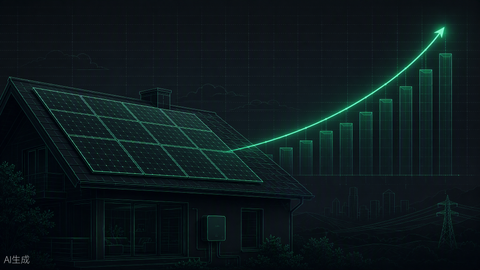
The linear performance warranty — 2.5% first-year, 0.6% annually, 83.1% at year 25 — translates into concrete production for a 10.4 kW pallet system starting at ~14,600 kWh:
| Year | Retention | Annual Production (kWh) |
|---|---|---|
| 1 | 97.5% | 14,200 |
| 5 | 95.1% | 13,850 |
| 10 | 92.1% | 13,420 |
| 15 | 89.1% | 12,980 |
| 20 | 86.1% | 12,540 |
| 25 | 83.1% | 12,110 |
Arithmetic check: year 25 retention = 0.975 − (24 × 0.006) = 0.831, exactly the warranted floor. Summed across 25 years, the system delivers roughly 337 MWh; at $0.17/kWh that is $57,000 of retail-offset value against a module cost near $3,540 for the pallet at $0.34/W. Panels are the cheap part of solar in 2026 — the project economics live or die on installation cost, rate structure, and incentives, which is why we steer buyers to the system size calculator before they fixate on module choice.
Pairing: Inverters and BOS for This Module
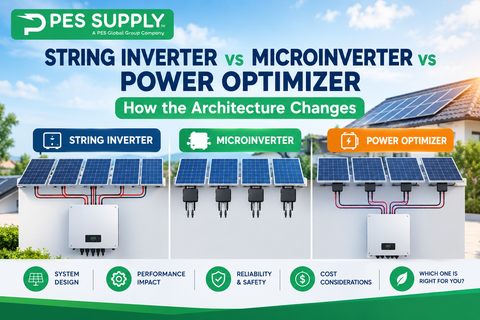
The 385's electrical window (Vmpp 39.4V, Impp 9.78A) is friendly to both architectures. Microinverter pairing lands one unit per module with no string math at all — the right answer for shaded or multi-plane roofs. String-inverter pairing at 10 modules per string gives a ~394V operating string, dead center of the MPPT window for residential hybrids. For battery-backed systems, the twin-array shade behavior complements module-level management well. Our solar inverters and microinverters collections carry both paths; the best panels of 2026 roundup shows where this module sits against current alternatives.
Field Notes on the Eagle Continental

Three observations from handling these in volume. First, the 40mm frame and 22.5 kg weight make them a genuine two-hand module — crews used to featherweight formats notice the difference by the second row, so plan labor accordingly. Second, the black backsheet runs measurably warmer than white-backsheet equivalents on hot days — the -0.35%/°C Pmax coefficient is average, not exceptional, and on a 70°C cell-temperature afternoon you give back about 12–13% of nameplate. That is the honest price of the all-black look. Third, availability is the real constraint: legacy formats come and go in lots, so when a pallet quantity matches your pipeline, buy the spares with it — I keep two attic-stock modules per residential install, and the one time a customer needed a replacement three years in, same-batch stock made it a one-day fix instead of a mismatch headache.
How the 385 Compares to Today's 430W+ Format
The module market did not stand still, and an honest guide has to put the 385 in context against what replaced it:
| Attribute | Jinko 385W (JKM385M-72HBL-V) | Current 430W Class (e.g., JKM430M-72HLM-TV) | Current 580W+ TOPCon Class |
|---|---|---|---|
| Cell technology | Mono PERC, 158.75 mm | Mono PERC bifacial, 166 mm | N-type TOPCon, 182 mm+ |
| Module efficiency | 19.13% | 19.97% + rear-side gain | 22.0–22.8% |
| Power per module | 385 W | 430 W | 580–625 W |
| Degradation schedule | 2.5% / 0.6% per yr | 2.0% / 0.55% per yr (typical) | 1.0% / 0.40% per yr |
| Product warranty | 25 years | 12–15 years (typical) | 12–25 years |
| Typical pallet pricing | ~$0.34/W | ~$0.45–$1.00/W | ~$0.30–$0.40/W |
| Watts per 22 ft² of roof | ~385 W | ~430 W | ~580 W |
Two readings of that table are both true. The 385 loses on efficiency and per-module power — a space-constrained roof gives up 10% to 33% of potential capacity choosing it. But the 385 also carries a 25-year product warranty that most newer modules do not match, a UL Fire Type 1 rating, US assembly, and pallet pricing that competes with anything on the market per watt. The right question is not "old versus new" but "which constraint binds my project" — area, budget, aesthetics, or warranty term.
Procurement: Buying Legacy-Format Modules Smart
Legacy formats move in lots, and lot discipline matters more here than with current-production lines. Five rules from our side of the warehouse:
- Buy the whole lot you need at once. Mixing production batches across two purchases risks subtle frame, connector, or flash-bin differences that complicate both installation and warranty claims.
- Add attic stock. One spare module per ~13 installed (2 per typical residential job, a full spare panel or three per pallet-scale project). Replacement availability for a discontinued format three years from now is not guaranteed at any price.
- Verify the revision letter. JKM385M-72HBL-V's suffix codes matter — frame type, connector brand, and junction box revision ride in those letters, and mixing revisions on one array creates connector-compatibility questions your AHJ may ask about.
- Confirm the flash report and warranty registration path at purchase. A 25-year warranty is only as good as its registration; we register at the point of sale precisely so the year-17 claim does not turn into archaeology.
- Plan freight like a commercial buyer. Pallet quantities ship LTL with liftgate service; a residential driveway delivery of 27 modules needs a plan for the pallet once the truck leaves. Our team confirms freight details within one business day on every order for exactly this reason.
Installation Notes Specific to This Module
The 40mm frame clamps with standard mid- and end-clamps across IronRidge, Unirac, and SnapNrack lines — no exotic hardware required — but confirm clamp compatibility against the frame profile in the racking brand's module-compatibility letter before the crew is on the roof. The 1,400mm leads reach across standard portrait row spacing without extensions. Grounding follows the racking system's integrated bonding hardware; the anodized frame takes standard WEEB-style bonding washers where the racking requires them. And the twin-array layout has one practical installation benefit: with the junction box centered, whip management stays symmetric, which keeps inspectors happy and wire off the roof surface. For the balance-of-system details, our solar wire and cable guide covers conductor selection end to end.
Five Projects Where We Actually Spec This Panel
Abstract positioning aside, these are the real job profiles where the JKM385M-72HBL-V has been the right answer in the last year:
1. The HOA-governed subdivision retrofit. Black-on-black modules with a Type 1 fire rating sail through architectural review boards that reject silver-frame panels outright. On a 9 kW job in a governed community last fall, the aesthetic spec was non-negotiable and the 25/25 warranty closed the sale; roof area was abundant, so efficiency per square foot never entered the argument.
2. The budget-first ranch roof. A 1,800 ft² south-facing ranch plane can host 40+ of these modules with room to spare. When the customer's constraint is dollars rather than area, $0.34/W modules change the whole payback calculation — every dollar not spent on modules is a dollar of payback acceleration.
3. The fire-code-sensitive district. Jurisdictions enforcing the strictest residential fire classifications accept UL Type 1 without a variance conversation. That is a permit-timeline advantage with real dollar value on tight schedules.
4. The matching-addition job. Homes with existing 380–400W PERC arrays expanding their systems get cleaner electrical and aesthetic results matching format class than mixing in 580W giants. String voltage windows and row geometry both stay coherent.
5. The small commercial canopy or carport. Structures engineered around older module dimensions sometimes accept this format where newer, larger modules exceed the purlin spacing. Measure the structure before assuming new-format fits — a module that is four inches too long for the purlins is not a bargain at any price, and I have measured more than one canopy where this exact panel was the only unit on the quote sheet that fit.
Mistakes Buyers Make With Value-Tier Modules
Four patterns, all avoidable. First, comparing $/W without comparing warranty terms — a $0.05/W saving paired with a 12-year product warranty against a 25-year one is not a saving, it is a trade you did not know you made. Second, ignoring the labor multiplier: 27 modules at 385W build 10.4 kW; the same capacity in 580W format is 18 modules. Nine extra modules is nine more attachments, nine more wire management points, and roughly two to three hours of crew time — real money that partially closes the paper gap. Third, assuming "discontinued format" means "unsupported product"; Jinko remains a Bloomberg Tier 1, NYSE-listed manufacturer and the 25-year warranty obligation travels with the module regardless of production status. Fourth, buying without spares. The module you do not buy today for $130 is the mismatch you pay $400 to solve in 2029.
The Bottom Line on the Jinko 385W
Grade this module against what projects actually need, not against spec-sheet fashion. On efficiency and watts-per-module it is a generation behind; on warranty length, fire rating, aesthetics, domestic assembly, and price per watt it competes with anything shipping in 2026. For space-rich, budget-first residential and small commercial work — especially where HOA aesthetics or strict fire codes apply — it remains one of the cleanest value plays on the market. I have specced it onto three roofs this spring alone, all of them HOA-governed, all of them approved on the first architectural review pass. Verify current lot availability and pricing on the product page, and cross-shop the newer Eagle G4 series before you commit either way.
Real-World Output: STC, PTC, and the Hot-Afternoon Truth
The gap between the 385W nameplate and the 356.9W PTC rating (92.7%) is worth understanding because it predicts summer performance better than any marketing number. PTC tests at 45°C cell temperature, 1,000 W/m² — closer to a real rooftop afternoon than the laboratory 25°C of STC. Layer the temperature coefficient on top for genuinely hot days: at a 65°C cell temperature (a dark-roof August afternoon), output is 385 × (1 − 0.0035 × 40) = 385 × 0.86 ≈ 331W before inverter losses. That is not a defect of this module — every crystalline panel behaves this way, and -0.35%/°C is mid-pack for PERC — but it is why production modeling with realistic cell temperatures beats nameplate arithmetic every time. Inverter sizing follows from the same logic: a 27-module, 10.4 kW array with a 7.6–8.2 kW inverter (DC/AC ratio of 1.27–1.37) clips only a handful of hours per year in most climates and harvests meaningfully more morning and evening energy per inverter dollar. Undersizing the inverter within that band is deliberate engineering, not a compromise.
Winter behaves in reverse, and cold-climate buyers should know it: at a 0°C cell temperature on a bright January day, this module can produce 385 × (1 + 0.0035 × 25) ≈ 419W — above nameplate. The Voc math in the string-sizing table above is the safety boundary of exactly this effect; the production upside is the enjoyable side of it. Clear, cold days are when monitored systems post their best instantaneous numbers, and they are also why the 690.7 correction factor exists.
Frequently Asked Questions
What are the specs of the Jinko 385W solar panel?
The JKM385M-72HBL-V is a 385W mono PERC module with 144 half-cut cells, 19.13% efficiency, Voc of 48.4V, Isc of 10.38A, dimensions of 2,008 × 1,002 × 40 mm, weight of 22.5 kg, a 1,500V system rating, and UL Fire Type 1 classification.
Is the Jinko 385W panel made in the USA?
The Eagle Continental JKM385M-72HBL-V is assembled at Jinko Solar's factory in Jacksonville, Florida. Verify current production origin with the distributor when ordering, as manufacturing assignments can change between lots.
How many Jinko 385W panels do I need for a 10 kW system?
10,000 W ÷ 385 W = 26 panels — conveniently one pallet minus one (27 per pallet). Round to 27 and you have a 10.4 kW system with one spare module included in the shipment.
What is the warranty on Jinko 385W panels?
25-year product warranty plus a 25-year linear performance warranty: no more than 2.5% degradation in year one, no more than 0.6% per year after, and at least 83.1% of rated output at year 25.
Are 385W panels still worth buying in 2026?
Yes where roof space is abundant and budget matters — legacy pricing around $0.34/W undercuts current-format modules by 40–50% per watt. Space-constrained roofs are better served by 430W+ modules that pack 15–20% more capacity into the same area.
What inverters work with the Jinko JKM385M-72HBL-V?
Any residential string inverter or microinverter with a compatible voltage window. Ten-module strings operate near 394V — centered in most residential MPPT ranges — and the 9.78A operating current suits per-module microinverter pairing directly.
Is the 385W Eagle Continental bifacial?
No — it is a monofacial module with a black backsheet. Buyers who want rear-side energy harvest should look at the bifacial Eagle G4 line, such as the JKM430M-72HLM-TV, which carries a 70% bifaciality factor and transparent backsheet construction.