Updated September 2026 — refreshed against the live PES catalog; product pricing verified 2026-09-26.
Net energy metering is the policy that built the residential solar industry — and in several states it's being dismantled or devalued, which changes how every new system should be designed from the roof down. We've watched the shift from the supply side: orders for hybrid inverters and batteries from California installers tripled after NEM 3.0 landed, because when the grid stops being a free battery, real batteries become the answer. This guide explains how net metering actually works on your bill, how the policy generations differ, what the 2026 state landscape looks like, and how to design a system that stays economical whatever your utility does next. If you only remember one line from everything below, make it this one: the tariff is the system.

How Net Energy Metering Works Day to Day
The mechanics are simpler than the terminology. Your solar array powers your home's loads first. Any surplus flows out through your meter to the grid, and the meter (or its digital ledger) records that export. When the sun's down and you import power, the meter records that too. Under classic net metering, the utility nets the two flows: if you exported 400 kWh this month and imported 350 kWh, you're billed for nothing — or credited the 50 kWh difference, depending on the tariff's settlement rules. Your array never "sells power" in the way people imagine; it offsets purchases, which is why the retail value of a kilowatt-hour you make yourself is always anchored to the price of a kilowatt-hour you didn't have to buy.
Three details define how generous any given NEM tariff really is:
- The credit rate. Full retail (each exported kWh offsets a kWh at the full cents-per-kWh you pay, including delivery charges) vs. avoided cost (the utility's wholesale-ish value, often $0.02–0.05/kWh) vs. something in between. This single line in the tariff is worth more than any panel upgrade.
- The settlement period. Monthly netting is friendlier than instant netting; annual true-up with rollover is friendlier still. At annual true-up, leftover credits typically cash out at the low avoided-cost rate — pennies on the dollar — which is why we tell customers to size for their consumption, not beyond it.
- Grandfathering. Whether you're locked into the tariff you signed under, and for how long (California's NEM 1.0/2.0 customers keep their terms 20 years from interconnection). Grandfathering status is a real asset — we've seen it influence home sale negotiations, and it has survived every transition fight so far.
The Bill Math: A Worked Example
A concrete month for a full-retail NEM customer with a 9 kW system, $0.17/kWh retail rate:
| Line | Value | Notes |
|---|---|---|
| Home consumption | 1,050 kWh | — |
| Solar production | 1,260 kWh | 9 kW × ~140 kWh/kW-mo (spring month) |
| Self-consumed solar (instant) | 430 kWh | Daytime loads running while sun shines |
| Exported to grid | 830 kWh | 1,260 − 430 |
| Imported from grid (nights) | 620 kWh | 1,050 − 430 |
| Net for the month | −210 kWh (credit) | 620 imported − 830 exported |
| Bill under full-retail NEM | ~$10–15 (fixed charges only) | 210 kWh credit rolls forward |
| Same month under net billing @ $0.05 export | 620 × $0.17 − 830 × $0.05 = $105.40 − $41.50 = $63.90 | Plus fixed charges |
Same panels, same sun, same house: $12 vs. $64. That delta — call it $600–800 per year on this example — is why tariff design matters more than panel brand to your project's economics, and why the storage conversation changed after California's net billing shift. Our solar ROI calculator models both regimes; run your actual tariff, not a national average.
NEM 1.0, 2.0, 3.0: The Generations Explained
| Generation | Export credit | Key features | Status in 2026 |
|---|---|---|---|
| NEM 1.0 (classic) | Full retail | 1:1 netting, monthly settlement, annual true-up | Grandfathered legacy in CA; still the live standard in many states (FL, TX munis vary, much of the Midwest/Southeast) |
| NEM 2.0 | Full retail minus non-bypassable charges (~$0.02–0.03/kWh) | TOU rates mandatory; small interconnection fees | Grandfathered in CA; live variants elsewhere |
| NEM 3.0 / Net Billing (CA, April 2023) | Avoided-cost-based "ACC" export rate, averaging ~$0.04–0.08/kWh, spiking high on summer evenings | 75%+ cut vs. retail; deliberate push to storage | Live for all new CA interconnections |
California's NEM 3.0 (formally the "Net Billing Tariff") is the watershed: export compensation dropped roughly 75% overnight for new systems, payback periods for solar-only installs stretched from ~5–6 years to ~9–11, and battery attach rates on new California installs went from a minority to a large majority within a year. The policy logic was explicit — the grid doesn't need more noon power; it needs evening power — and other states have studied or adopted similar structures since. The design lesson travels even where the tariff hasn't: self-consumed solar is always worth full retail; exported solar is worth whatever your utility feels like paying, this year and maybe not next.
The 2026 State Landscape
Policies shift constantly, but the current broad strokes:
| Policy posture | Examples | Design implication |
|---|---|---|
| Full retail NEM, statutory | Florida (IOUs, § 366.91), much of the Southeast and Midwest | Battery optional; size to consumption, avoid overbuilding past the true-up |
| Net billing / reduced export | California (NEM 3.0), and similar structures studied or adopted in several states since 2023 | Storage near-mandatory; size to maximize self-consumption and evening coverage |
| Utility-specific / muni & co-op variance | Texas (no statewide rule; Austin/San Antonio differ), municipal and co-op territories everywhere | Read the actual tariff — never assume |
| Caps, queues, and successor-tariff transitions | States with NEM capacity caps or periodic reviews | Interconnect early; grandfathering is the asset |
Two durable patterns worth betting a design on. First, export compensation only moves in one direction over time — no state has gone from net billing back to full retail. Second, grandfathering has held: existing systems have kept their terms virtually everywhere. If full retail NEM is available in your territory today, interconnecting sooner rather than later is itself worth money. Our state incentives tracker keeps the policy side current, and the system sizing calculator bakes consumption-matching into the design from the start.
Adding Storage: The Self-Consumption Play

Under net billing, the design objective inverts. Solar-only design maximizes annual kWh; solar-plus-storage design maximizes valuable kWh — the ones you'd otherwise buy at retail. The math from the worked example above: that home's 830 exported kWh/month earned $41.50 at $0.05. Stored and self-consumed instead, those kWh avoid 830 × $0.17 = $141. The battery's monthly value is the difference — about $100/month, $1,200/year — against a typical $9,000–13,000 installed cost for 13.5 kWh class storage. Payback on the battery alone runs 8–11 years in that scenario, within warranty life, before counting any resilience value.
The sizing discipline under net billing: the battery should be big enough to absorb a typical day's surplus and small enough to cycle daily. A 9 kW array overproducing ~15–25 kWh on a spring day pairs naturally with 13–20 kWh of storage. Oversized batteries that never cycle are stranded capital; undersized ones leave evening imports on the table. The battery sizing calculator runs this arithmetic against your interval data, and current storage options live in the batteries collection — LFP is the residential standard now, per the buyer's guide.
One nuance that separates good California designs from great ones: NEM 3.0's export rates aren't flat — they spike dramatically on summer weekday evenings (September evenings can pay $2+/kWh in the ACC table's highest hours). Systems programmed to export stored energy in those windows earn meaningfully more than pure self-consumption strategies. That's a controls-and-commissioning conversation with your installer, and it's worth having; the hardware already supports it.
Getting Interconnected: The Process Under Any NEM Regime
The steps don't change with the tariff's generosity:
- Application: your installer files the interconnection application with system size, equipment listings (UL 1741 SA/SB for inverters), and a one-line diagram.
- Utility review: screens for transformer capacity and local penetration; larger systems and saturated feeders get supplemental review. Timelines run two weeks to two months in normal times.
- Installation and inspection: AHJ permit and inspection, per NEC 705/690/706 as applicable — the NEC compliance guide and permitting guide cover the details.
- Meter and PTO: the utility swaps or reprograms the meter to record bi-directional flow and issues Permission to Operate. Energizing before PTO can violate the interconnection agreement — utilities check, and some have pulled meters over it.
- Tariff enrollment: confirm you're on the intended NEM/net-billing rate and TOU schedule. A wrong default rate can cost real money before anyone notices; we tell customers to verify the first two bills line by line.
Sizing Strategy Under Each Regime
| Regime | Optimal sizing target | Storage? | Orientation strategy |
|---|---|---|---|
| Full retail NEM | ~100–110% of annual consumption | Optional (resilience value only) | South for max annual kWh |
| Net billing (low export rate) | Sized to daytime base load + battery charge | Effectively required | West-facing gains value (production shifts toward evening peak) |
| Net billing w/ spiky evening export (CA) | Consumption + storage with export windows | Required, with export scheduling | Southwest blend; let controls chase the ACC spikes |
| Zero-export / non-export rules | Daytime load only | Required to avoid curtailment | Match load profile, not max yield |
The west-facing row surprises people. Under retail NEM, south wins because total kWh is all that counts. Under net billing, afternoon and evening production coincides with expensive imports, so a west plane producing 15% less energy can save more dollars. Any installer modeling your system should show both orientations' dollar output under your actual tariff — if the proposal shows only annual kWh, the model predates your tariff.
Where NEM Is Heading
Read the trend, not the headline. Export compensation will keep ratcheting toward avoided cost in mature solar markets — that's the direction of every recent regulatory decision. Value-of-solar tariffs and real-time export pricing will spread, rewarding systems with storage and smart controls. Grandfathering will continue to protect existing interconnections, which keeps the early-mover advantage real. And batteries will keep getting cheaper, which is the market's answer to every one of those policy moves: whatever the grid pays for your power, using it yourself always pays retail. Design for that invariant and the policy weather stops mattering much. The system that wins in 2036 is the one that was designed for self-consumption in 2026 — everything else is a bet on a regulator's mood.
Equipment for either regime ships from the same shelves: panels, hybrid inverters, and storage systems, with the 10 kW solar-plus-battery kit as a complete net-billing-ready bundle. For the generation side of the resilience equation, the whole-home generator guide covers the complement.
A Short History: How We Got Here
Net metering started humbly — early 1980s experiments, then Idaho's and Arizona's first formal rules, then the 2005 Energy Policy Act push that put NEM on state agendas nationwide. The original logic was administrative simplicity: residential meters could net flows, solar was a rounding error, and full-retail credit cost utilities nothing measurable. Two decades later, rooftop solar penetration in mature markets turned the rounding error into a midday supply glut, and the cost-shift debate — non-solar customers arguably subsidizing the grid services solar customers still use — gave regulators the policy cover to cut export rates. California's NEM 3.0 was the first big domino precisely because California hit the penetration wall first. Every state's version of this debate is on its own clock, but the direction of travel is consistent, which is why the design principles in this guide emphasize self-consumption regardless of your current tariff.
TOU Rates: The Layer Underneath NEM

Time-of-use pricing interacts with net metering in ways that surprise customers on their first bill. Under TOU, both imports and exports are priced by the hour. A full-retail NEM customer on TOU exports noon power at off-peak retail and imports evening power at peak retail — netting kWh but losing cents. In PG&E-style territory, peak evening power can run two to three times the off-peak rate, so a "netted zero" month can still carry a real bill. The countermeasures are the same levers as net billing: west-facing production, battery shifting, load timing (run the dishwasher at noon, cool the house before peak). When we model a system, the TOU schedule is as important an input as the NEM status — and it's the input most likely to be missing from a competitor's proposal.
Case Study: Two Identical California Homes
Two neighbors, identical 2,400 sq ft homes, identical 8 kW systems installed one year apart — one on NEM 2.0, one on NEM 3.0. The NEM 2.0 home exports freely, nets at near-retail, and sees a bill around $15–25/month plus true-up. The NEM 3.0 home, solar-only at first, exported the same noon power at ~$0.05 and bought the same evening power at $0.40+ — a bill of $90–120/month despite identical production. The NEM 3.0 owner then added 13.5 kWh of storage, programmed for self-consumption plus evening export windows, and pulled the bill down near the neighbor's level — for a $12,000 battery investment the neighbor never needed. That's the whole policy story in one street: same sun, same panels, $12,000 apart. If you're designing in a net-billing territory today, the battery isn't an upgrade — it's the completion of the system.
Virtual Power Plants: The Next Layer
The newest twist on export value is the virtual power plant: utilities paying enrolled battery owners for dispatchable capacity during grid emergencies. Programs in California, Texas, and the Northeast have paid real money — event-based payments or monthly capacity credits — for letting the utility draw on thousands of home batteries for a few dozen hours a year. The trade-offs: you reserve some capacity for the grid, your battery works a bit harder, and you need compatible equipment and enrollment. For storage owners in net-billing territory, VPP revenue stacks on top of self-consumption savings and can shave a year or two off battery payback. Watch this space — it's the first policy mechanism that pays homeowners for having storage rather than merely forgiving them for needing it.
For Installers: Selling Under Net Billing
The pitch that works post-NEM-3.0, refined across our California contractor customers' experience: lead with the tariff, not the panels. Show the customer their export rate and their peak import rate on one page. Model the system three ways — solar-only, solar-plus-storage for self-consumption, and solar-plus-storage with export windows — and let the bill columns sell the battery. Set honest payback expectations (9–12 years, not the 5-year numbers of the NEM 2.0 era), and emphasize the resilience value that solar-only can't offer at all. The installers struggling in net-billing markets are the ones still selling 2019's proposal. The ones thriving rebuilt the proposal around self-consumption and never looked back.
Commercial Net Metering: Different Animal
Everything above is residential-shaped. Commercial NEM differs in three ways: demand charges mean solar's value includes peak-kW shaving, not just kWh; many commercial tariffs credit exports at avoided cost already (net billing was the commercial norm before it hit residential); and system sizes trigger heavier interconnection review — studies, possible facility upgrades, sometimes standby charges. The commercial design conversation therefore starts with the interval data, not the tariff sheet: fifteen-minute demand history tells you whether solar shaves the billing peak (usually yes for daytime-peaking businesses, rarely for evening-peaking ones), and storage sizing follows from the peak shape. The runtime calculator and storage systems catalog cover the equipment end once the interval data says yes.
The Meter Itself: Hardware Behind the Billing

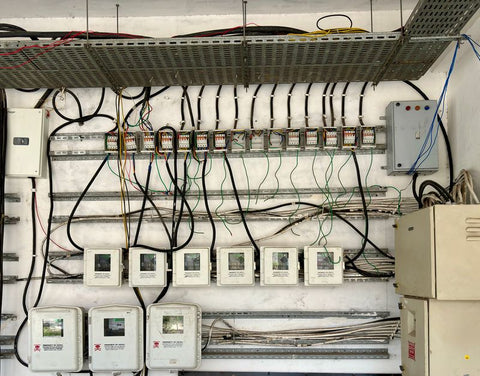
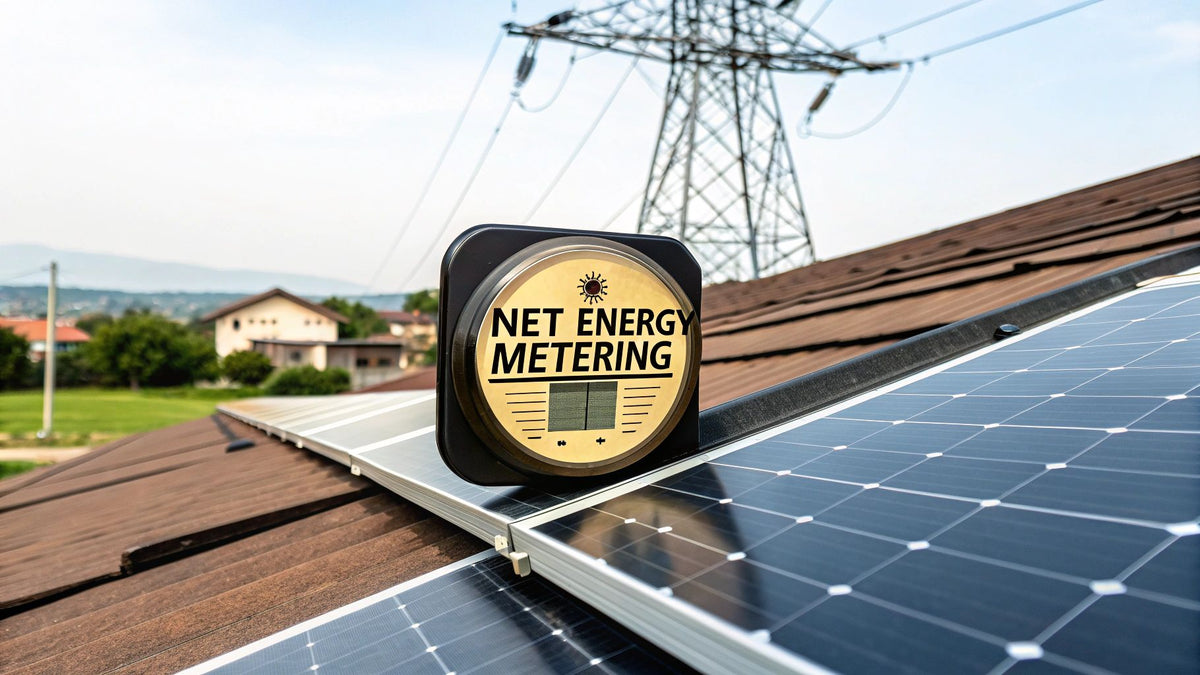
Net metering requires a bidirectional meter — one that records import and export as separate registers. Most utilities swap to a smart meter at interconnection if you don't already have one, and the swap is part of the PTO process. Field notes: the meter's register display can tell you in real time whether you're importing or exporting (the little arrows or alternating screens), which is the fastest sanity check on a new install that the array is actually producing; some older electromechanical meters literally spin backward — charming, but being phased out because they can't record the separate registers modern tariffs need; and if your utility "nets" on a 15-minute interval rather than continuously within the hour, simultaneous production and consumption settle slightly differently than the textbook model. That interval detail is in the tariff, and it's one more reason to read the actual document rather than the brochure.
Billing Traps That Catch New Solar Owners
- Wrong default rate schedule. Post-interconnection accounts sometimes land on the wrong TOU plan. Verify the enrolled rate against the interconnection paperwork on the first bill.
- Non-bypassable charges. Under NEM 2.0-style tariffs, per-kWh charges (public purpose programs, etc.) apply to all imports regardless of netting — a "zero net" month still carries them.
- Minimum bills and fixed charges. Rising fixed charges are utilities' quiet countermove to NEM; a $30/month fixed charge is $360/year no array can offset.
- True-up shock. Customers who overconsume through the year and expect netting magic meet the annual true-up in month twelve. Model annually, not monthly.
- BCA/CCA territory splits. In community-choice aggregation areas, generation and delivery are billed by different entities, and the NEM credit may apply to only one side. Read both line groups.
Grandfathering Strategy: The Interconnection Date as an Asset
Every NEM transition so far has drawn the line at the interconnection date. California's NEM 1.0 and 2.0 customers hold their terms for 20 years from interconnection; systems that interconnected the week before the NEM 3.0 cutoff kept retail netting while their neighbors' new systems didn't. The strategic implication for territories mid-transition: the interconnection application date can be worth more than any equipment choice on the quote. When a successor tariff is in a proceeding, we tell customers the truth — nobody can promise the outcome, but interconnecting before the line is drawn has historically been the winning side of the bet. What we never advise: rushing a bad install to beat a deadline. A compliant, well-built system under the new tariff beats a corner-cut system under the old one, every time, over 25 years.
NEM and the Home Sale
Owned solar with favorable grandfathered NEM terms transfers value at sale — studies keep finding owned systems add roughly 3–4% to sale price, and a documented low bill plus a 20-year legacy tariff is a concrete selling point in high-rate states. The friction points: leased systems (contract transfer or buyout negotiations spook buyers), unpermitted installs (title companies and appraisers increasingly check), and missing production history. Keep the interconnection agreement, the PTO letter, and a few years of production and bill data in the house file. The seller who hands over a folder wins the conversation; the seller who shrugs loses a negotiation point worth thousands.
Community Solar's Different Deal
One adjacency worth disambiguating: community solar subscriptions credit your bill from an off-site array — no roof, no equipment, no interconnection on your side. The credits follow their own program tariffs (often near-retail in the strong programs), the term is typically 20 years, and you build no equity. For renters and shaded roofs it's the only game; for anyone who can own on-site, ownership under even a modest NEM tariff beats a subscription on lifetime value. We covered the Florida version of this comparison in our Florida incentives guide — the logic generalizes to every state with both options.
What We Tell Customers Over the Counter
Boiled down to counter talk: net metering is the deal your utility gives your exports, and that deal now varies enough to change how your system should be built. If you're on full retail NEM, the grid is your battery — size to your usage, skip the storage unless you want outage protection, and enjoy the simplest economics solar ever offered. If you're on net billing or anything reduced, self-consumption is the game: right-size the array to your daytime load, add the battery sized to your evening, and let controls chase any export windows worth chasing. Either way, read your actual tariff before you design, interconnect early if a transition is pending, and never let anyone model your payback on a national-average assumption. The tariff is the system.
Zero-Export and Non-Export Systems: The Edge Case
Some utilities and international markets don't credit exports at all — zero-export rules enforced by the inverter or a dedicated export-limitation device watching the meter. Under these, the array must never push power past the meter, so the design sizes to daytime base load and uses dynamic curtailment: the inverter throttles in real time to keep export at zero. Storage transforms the economics here too, absorbing midday surplus that would otherwise be curtailed away. If your quote includes an "export limiting device" line item, this is why — and the setting deserves verification at commissioning, because an export limiter misconfigured in either direction either wastes production or violates the interconnection agreement.
A Few Common Questions About Net Metering
What is net energy metering?
A billing arrangement where your solar exports to the grid are credited against your imports — under classic NEM, at the full retail rate, so the grid effectively acts as a free battery. What varies by state and utility is the credit rate, the settlement period, and how surplus is treated at annual true-up.
Is net metering going away?
Not uniformly, but export compensation is declining in mature markets. California's NEM 3.0 cut export value ~75% for new systems in 2023; several states have studied or adopted similar net-billing structures since. Existing systems have almost always kept their terms through grandfathering — interconnecting while full retail is available in your territory locks in that value.
What is the difference between net metering and net billing?
Net metering nets kilowatt-hours: an exported kWh cancels an imported kWh. Net billing prices them separately: imports at retail, exports at a lower rate (avoided cost or an avoided-cost-derived schedule). Under net billing, self-consumption is worth full retail while exports earn little — which is why storage becomes central to system design.
Do I need a battery with net metering?
Under full-retail NEM, no — the grid is your battery, and physical storage adds resilience rather than bill savings. Under net billing or reduced-export tariffs, yes, effectively: a battery shifts surplus solar from the low export rate to displacing full-retail evening imports, typically worth $100+/month on an average home.
What happens to my credits at the end of the year?
Most NEM tariffs roll credits month to month and settle any remaining surplus at an annual true-up, paying it out at the much lower avoided-cost rate. That true-up cliff is why systems should be sized to annual consumption rather than overbuilt — oversized systems donate their surplus to the utility at pennies on the dollar.
How does net metering affect solar payback?
Enormously. The same system on the same house pays back in ~10–12 years under full retail versus ~14+ under net billing without storage — and returns toward ~10–12 with properly sized storage. Tariff structure now matters more to payback than equipment pricing, which is why we model the actual tariff before quoting.
Need pricing or availability on anything in this guide?
Portlandia Electric Supply dropships direct from the manufacturer — most items Ship Direct with lead times stated up front, no surprises.
Get a quote from PESBulk, pallet and contractor pricing available.