Updated September 2026 — content reviewed and refreshed by the PES team. For current pricing and availability, see the linked product pages or request a quote.
Every solar project we quote eventually hits the same fork in the road: lithium or lead-acid. The brochure answer is "lithium is better but costs more." The honest answer is longer and more useful — the right choice depends on how often you cycle, how cold your battery room gets, how much weight you can carry, and whether your budget is measured in this month's dollars or this decade's. This guide walks through both chemistries the way we'd explain it at the counter: how they work, where each one wins, what the lifetime math actually says, and the install details that decide whether either one lives up to its datasheet.

Introduction to Batteries
What is a Battery?
A battery is a fuel tank that stores electricity as chemistry. Push current in and a reversible chemical reaction stores the energy; draw current out and the reaction runs backward. Everything else — amp-hours, cycle life, depth of discharge, Peukert losses — is just the fine print on how much of that energy you can actually use, how fast, and for how many years. Two broad families dominate solar storage today: lead-acid (flooded, AGM, and gel variants) which has been cranking engines and powering off-grid cabins for over a century, and lithium-ion (especially the LiFePO4 subchemistry), which took over daily-cycling solar storage in the last decade on the strength of one number: cost per lifetime kilowatt-hour.
Types of Batteries
| Type | Characteristics |
|---|---|
| Lead-acid batteries | Reliability and affordability; includes sealed lead acid (SLA) variants like Absorbent Glass Mat (AGM) and Gel |
| Lithium-ion batteries | Advanced technology with chemistries such as Lithium Iron Phosphate (LiFePO4), Lithium Nickel Manganese Cobalt Oxide (NMC); LiFePO4 batteries are favored in solar applications for safety and efficiency |
Flooded lead-acid is the old workhorse — cheapest per nameplate amp-hour, but it needs watering, ventilation for hydrogen off-gassing, and upright mounting. AGM seals the electrolyte in glass mat: no watering, no gas under normal operation, mountable in more orientations. Gel is the niche variant for extreme deep-discharge tolerance. On the lithium side, LiFePO4 (lithium iron phosphate) is the solar standard — thermally stable, 3,000+ cycle life — while NMC (nickel manganese cobalt) packs more energy per pound and dominates EVs and products like the Tesla Powerwall.
Why the Choice Actually Matters
Because battery banks are the most expensive component in an off-grid or backup system and the one most often sized and specced wrong. A chemistry mistake isn't a rounding error — it's the difference between replacing the bank in year three and year fifteen. We've replaced too many prematurely dead lead-acid banks that were daily-cycled by owners nobody warned, and we've also talked customers out of lithium for applications where it would never pay back. Both mistakes cost real money.
Understanding Lead Acid Batteries
How Lead Acid Batteries Work
Lead plates and lead-dioxide plates sit in sulfuric acid. Discharge converts both plates toward lead sulfate and dilutes the acid; charging drives the reaction back. Simple, rugged, forgiving of sloppy engineering — which is why it survived 160 years. The chemistry's quirks define its limits: sulfate crystals harden on chronically undercharged plates (sulfation, the classic killer), active material sheds with deep cycling, and water electrolyzes into hydrogen and oxygen if you overcharge a flooded cell. AGM immobilizes the electrolyte and recombines the gas internally, buying convenience at the cost of stricter charging-voltage discipline.
Advantages of Lead Acid Batteries
Lowest upfront cost per nameplate amp-hour, period. Charges below freezing without protection circuits. Simple charging hardware — any legacy charger speaks lead-acid. Recyclability is nearly total; the lead-acid recycling loop is the most complete of any consumer product in North America, and core charges come back. For float/standby service — alarm panels, UPS systems, generator starting — lead-acid's weaknesses barely apply and its price wins outright. Check our AGM battery collection for the sealed variants we stock.
Disadvantages of Lead Acid Batteries
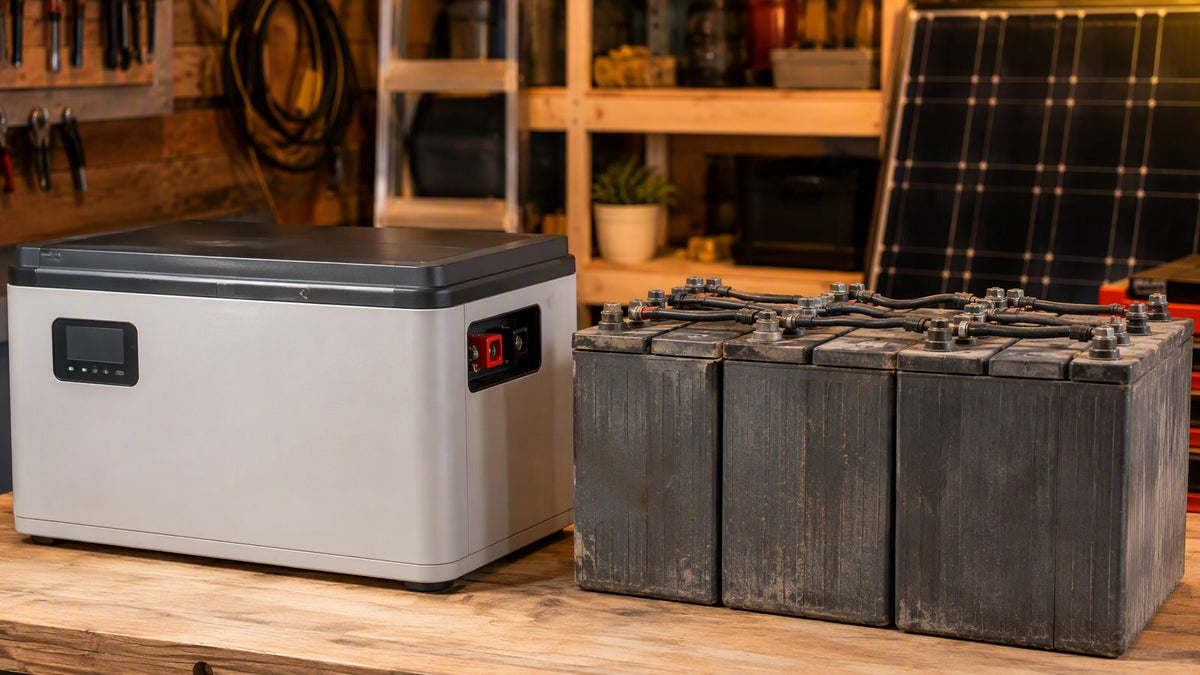
The 50% rule: discharge past half of nameplate regularly and cycle life collapses from ~400-500 cycles to under 200. Weight — a 100Ah AGM runs 60–70 lbs. Peukert losses — pull a heavy inverter load and effective capacity shrinks further. Charge acceptance tops out around 0.2–0.3C, so a depleted bank needs hours to recover. And efficiency: 80–85% round-trip, meaning 15–20% of your solar harvest becomes heat in the battery instead of watts in your house. Daily-cycled, a lead-acid bank is a subscription service you pay in replacement batteries.
Exploring Lithium-Ion Batteries
How Lithium Ion Batteries Work
| Component | Function |
|---|---|
| Anode | Stores lithium, generates free electrons, creates a charge at the positive current collector |
| Cathode | Stores lithium |
| Separator | Ensures safety by preventing contact between anode and cathode |
| Electrolyte | Facilitates the movement of lithium ions between anode and cathode |
| Negative and Positive Current Collectors | Conduct electrons to and from the battery terminals |
Lithium ions shuttle between a cathode (iron phosphate in LiFePO4) and a graphite anode through a liquid electrolyte. No sulfate crystals, no water to electrolyze, no Peukert penalty worth mentioning. A battery management system (BMS) watches every cell — voltage, temperature, current — and disconnects the pack if anything leaves the safe envelope. That BMS is why lithium packs charge fast, discharge deep, and live long, and also why a lithium battery refuses charge below freezing: the BMS is protecting the cells from lithium plating, which is permanent damage.
Advantages of Lithium-Ion Batteries
Eighty to one hundred percent usable depth of discharge, cycle after cycle. Three to seven thousand cycles in LiFePO4 service — ten to fifteen years of daily use. Ninety-five-plus percent round-trip efficiency. A third of the weight. Charge acceptance at 0.5C–1C, so a solar array can refill the bank in a couple of good hours. And zero maintenance: no watering, no equalizing, no terminal corrosion ritual. For daily-cycling solar, off-grid living, RVs, and boats, lithium isn't the premium option anymore — at equal usable capacity it's often the cheaper one on day one. Browse the LiFePO4 collection and lithium batteries to see current pricing.
Disadvantages of Lithium-Ion Batteries
Higher upfront cost per nameplate amp-hour (though not per usable amp-hour). The freezing-charge limit — below 0°C the BMS blocks charging unless the battery has internal heaters. Legacy charging equipment often can't be reprogrammed to lithium setpoints, forcing charger replacements. Cheap lithium with a cheap BMS is genuinely dangerous — buy cells with published UL test data. And end-of-life lithium recycling infrastructure, while improving, isn't the closed loop that lead-acid enjoys.
Lead Acid Battery vs Lithium Ion Battery
Performance Comparison
| Feature | Lithium-ion Batteries | Lead-acid Batteries |
|---|---|---|
| Cycle Life (80% discharge) | Approximately 3,500 cycles | 300-500 cycles |
| Energy Density (Wh/L) | Around 450 | 80-90 |
| Efficiency | About 95% | 50% |
The performance rows hide the two numbers that decide real systems. First, usable capacity: a "100Ah" lead-acid battery is a 50Ah battery if you respect the cycle-life warranty, while a 100Ah LiFePO4 delivers 90–100Ah daily. Second, Peukert: discharge that lead-acid battery at 100A instead of its 5A rating and effective capacity drops to 55–65Ah, while the lithium pack barely notices. Stack both effects and a lead-acid bank feeding serious inverter loads can deliver a third of its brochure capacity. That's not a defect — it's chemistry — but your bank sizing must account for it. Our battery bank sizing guide runs the worksheet with both effects included.
Cost Analysis: The Lifetime Math
| Metric | LiFePO4 12.8V 100Ah (~$350) | AGM 12V 100Ah (~$220) | Flooded 12V 100Ah (~$150) |
|---|---|---|---|
| Usable capacity @ recommended DoD | ~90–100Ah | ~50Ah | ~50Ah |
| Cycle life @ that DoD | 3,000–7,000 | 300–500 | 200–400 |
| Lifetime throughput | ~3,800–7,700 kWh | ~180–300 kWh | ~120–240 kWh |
| Round-trip efficiency | 95–98% | 80–85% | 75–80% |
| Cost per lifetime kWh | ~$0.05–$0.09 | ~$0.73–$1.22 | ~$0.63–$1.25 |
Bottom row, again, because it's the whole argument: daily-cycled, lead-acid costs roughly ten times more per kilowatt-hour delivered than LiFePO4. The flooded battery is cheapest to buy and most expensive to own. Match a lithium bank's lifetime with AGM and you're buying eight to twelve replacement batteries plus the labor to swap them. The off-grid sizing guide turns this into bank-size decisions, and the runtime calculator estimates how long any bank carries your loads.
Charging Requirements: Setpoints That Decide Lifespan
| Charge parameter (12V, 77°F) | LiFePO4 | AGM | Flooded |
|---|---|---|---|
| Absorption voltage | 14.2–14.6V | 14.4–14.8V | 14.4–14.8V |
| Float voltage | 13.4–13.8V or disabled | 13.2–13.8V | 13.2–13.6V |
| Equalization | Never | Never | 15.3–16.2V periodic |
| Temp compensation | None (BMS handles) | -3 to -4 mV/°C/cell | -3 to -4 mV/°C/cell |
| Max charge rate | 0.5C–1C | 0.2–0.3C | 0.1–0.2C |
| Charge below 32°F | Blocked (BMS) unless heated | Allowed, reduced acceptance | Allowed, reduced acceptance |
Any modern MPPT controller ships with profiles for all three — see our MPPT vs PWM guide and controller sizing guide. Program from the battery manufacturer's datasheet, not from internet folklore. I've opened banks where the controller sat on a flooded profile for two years behind an AGM bank — every cell dry as toast, warranty void, lesson expensive.
Applications and Use Cases
Daily-cycling off-grid or solar self-consumption: lithium, decisively — the lifetime math owns this category. Occasional backup (a few cycles a month): AGM competes honestly; cycle wear barely accrues. Float/standby (UPS, alarms, generator starting): lead-acid wins on price. RVs, boats, weight-sensitive builds: lithium — the payload and charge-speed advantages compound. Unheated spaces below freezing: AGM, or self-heating lithium models. Legacy system expansion: match the existing chemistry; never parallel lithium and lead-acid on one bus. For brand-level shopping, our comparisons of Battle Born vs Renogy, EG4 vs SimpliPhi, and LiFePO4 vs AGM go deeper.
Battery Storage Considerations

Optimal Conditions for Battery Storage
Both chemistries want the same Goldilocks zone: 59–77°F, dry, out of direct sun. Heat is the silent killer — lead-acid life halves for roughly every 15°F above 77°F, and lithium degrades faster hot as well. NEC Article 480 governs stationary battery installations: overcurrent protection on the battery circuit, disconnecting means, and for larger lithium systems, UL 1973 listing and NFPA 855 spacing. Ventilation questions apply to flooded lead-acid (hydrogen) and any chemistry under fault conditions. Garages and insulated enclosures beat sheds in cold climates.
Maintenance Tips for Longevity
Lead-acid: keep flooded cells watered with distilled water, terminals clean and torqued, and never let the bank sit discharged — sulfation starts within days. Equalize flooded banks per the manual. AGM: verify charge voltages annually with a meter. Lithium: check the BMS logs occasionally, keep firmware current, and store at 40–60% charge if the system sits for a season. Both: label every battery with its install date, and test before storm season, not during it. Our battery maintenance guide has the full checklist, and the 20-80 rule explainer covers the daily habits that add years.
Environmental Impact of Battery Disposal
Lead-acid wins this category outright: over 95% of a lead-acid battery is recycled in North America, and the core-charge system makes returning one effortless. Lithium recycling is real but younger — LiFePO4 contains no cobalt, which simplifies things, and the long service life means far fewer batteries hit the waste stream per kWh delivered. Either way: never landfill a battery. Every battery retailer, including us, can point you at a take-back path, and most accept cores regardless of where you bought. Auto-parts chains accept lead-acid cores with no purchase required, and most lithium manufacturers now run mail-back programs for end-of-life packs. The fifteen minutes it takes to return a dead battery properly is the cheapest environmental win in the entire energy system — and in most states, dumping one is illegal anyway.
Conclusion
Final Thoughts on Battery Choices
Pick lithium when the system cycles often, when weight or charge speed matter, or when you're building for a decade. Pick lead-acid when the budget is absolute, the application is standby or float, the space freezes hard, or the charging system can't be reprogrammed. The worst choice is the unexamined default — and the second-worst is mixing chemistries on one bus. If the math feels murky, bring us your daily kWh and your cycle expectations; this is the exact conversation our counter exists for.
Future Trends in Battery Technology
Sodium-ion is the chemistry to watch — cheaper materials, excellent cold behavior, and early products already shipping — though LiFePO4's falling prices keep pushing its crossover date out. LFP energy density keeps creeping up, and BMS-integrated heated packs are becoming standard rather than premium. What won't change: the fundamentals in this guide. Depth of discharge, cycle life, and cost per throughput kWh will still be the three numbers that decide the purchase.
Worked Example: Sizing a Bank for a Real Cabin
Concrete numbers beat abstractions. Take a 1,000 sq ft off-grid cabin with LED lighting (150Wh/day), a modern fridge (1,200Wh/day), a laptop and Starlink (500Wh/day), a water pump (300Wh/day), and misc. loads (350Wh/day): 2,500Wh daily. With two days of autonomy and a 48V bank: 5,000Wh ÷ 48V ≈ 104 usable Ah. Lithium answer: two 51.2V 100Ah rack batteries or four 12V 100Ah in series, using ~50% of one battery's rating — call it one battery's worth of usable capacity, so a 100Ah 48V lithium bank is the bare minimum and 200Ah is comfortable. AGM answer: double the nameplate for the 50% rule, then add Peukert margin for the pump surges — you're buying 400+ nameplate Ah, meaning 16 12V batteries. The lithium quote at the counter is lower. This example is why the conversation has changed so completely since 2020.
Charging Sources Beyond Solar
Solar is one input; real systems often have three. Alternator charging (RVs, vans, boats) through a DC-DC charger protects both the alternator and lithium's huge current appetite — direct alternator-to-lithium connections cook alternators, a lesson the RV industry learned expensively around 2019. Generator charging through an inverter-charger tops up dark winter weeks; lithium's 0.5C acceptance means a 2-hour generator run replaces what lead-acid would need all afternoon to absorb. Grid charging on hybrid inverters rounds out the mix. Every source must speak the battery's language: correct setpoints, no equalization for sealed chemistries, and temperature-compensated charging only where the chemistry wants it.
Buying Checklist: What to Verify Before You Pay
Whichever chemistry you land on, the purchase checklist is the same. Cell grade and brand disclosure — for lithium, ask which cells are inside; grade-A new cells from named manufacturers only. BMS specifications — continuous and surge current ratings, low-temp charge cutoff, cell balancing current. Certifications — UL 1973 for stationary lithium, UN 38.3 for transport. Warranty terms — the years, the throughput cap, and who services claims. Cycle-life test data — third-party or manufacturer data at your intended DoD, not marketing round numbers. And a US-based support channel that answers. Run that checklist on any battery in our lithium or AGM collections and you'll never buy a bad one.
Glossary: The Terms That Decide Your Purchase
Five definitions worth memorizing before you talk to any salesperson, us included. Amp-hour (Ah): how much charge a battery holds — but only comparable at the same voltage, which is why watt-hours (Ah × V) are the honest unit. Depth of discharge (DoD): how much of the nameplate you use per cycle; the single biggest driver of lead-acid lifespan. Cycle life: cycles to 80% remaining capacity at a stated DoD — always ask "at what DoD?" C-rate: charge/discharge speed relative to capacity; 1C on a 100Ah battery is 100A. Round-trip efficiency: what fraction of the energy you put in comes back out; 95%+ lithium versus 80% lead-acid compounds over thousands of cycles into a meaningful harvest difference. Any seller who gets fuzzy on these five terms is selling marketing, not batteries.
Frequently Asked Questions
Is lithium worth the extra cost over lead-acid?
For daily cycling, yes — LiFePO4 costs roughly $0.05–$0.09 per lifetime kWh versus $0.73–$1.22 for AGM, because it delivers 80–100% usable capacity over 3,000–7,000 cycles instead of 50% over 300–500. For rare-use standby service, lead-acid's lower upfront price wins.
Can I drop a lithium battery into my existing lead-acid system?
Physically, usually — but reprogram every charging source to lithium setpoints (14.2–14.6V absorption, low or no float, no equalization, no temperature compensation) and add a DC-DC charger for alternator charging. Never parallel lithium and lead-acid on the same bus.
How many batteries do I need for my solar system?
Total your daily watt-hour consumption, multiply by the days of autonomy you want, divide by usable (not nameplate) battery capacity and system voltage. A 5 kWh/day cabin with two days of autonomy at 48V needs about 208 usable Ah — four 100Ah lithium batteries, or eight 100Ah AGM at the 50% rule. Our 4000W system battery guide shows a worked example.
Do lithium batteries really last 10+ years?
Quality LiFePO4 banks regularly reach 10–15 years of daily cycling before falling to 80% capacity — we have customer banks past year seven still above 85%. Lifespan depends on cell quality, BMS quality, temperature management, and charge setpoints. Cheap lithium with a cheap BMS is the exception, and it's why datasheet verification matters.
Which chemistry is safer?
Both are safe when installed to code with quality components. LiFePO4 is the most thermally stable lithium chemistry; lead-acid's risks are hydrogen gas (flooded, during charging) and acid exposure. NEC Article 480 and UL 1973/UL 1989 listings govern installation safety for stationary systems.
Can I mix old and new batteries in one bank?
Don't. A new battery paralleled with aged ones inherits the string's weaknesses — the weak cells drag the fresh ones down within months. When one battery in an older string fails, test the survivors honestly; replacing a single unit in a tired bank usually buys months, not years, and the money is often better applied to a full replacement.
What happens to lithium batteries in freezing weather?
Discharge works (at reduced capacity); charging is blocked by the BMS below 32°F to prevent permanent lithium plating. Self-heating models warm the cells internally before accepting charge. In unheated spaces, AGM remains the simpler choice.
Resources for Further Reading
- EG4 vs Fortress battery comparison and EG4 vs Pylontech 2026 — brand-level lithium matchups
- Battery backup vs generator — when storage beats combustion
- Lithium vs lead-acid vs saltwater 2026 guide
- Generac PWRcell cost guide — whole-home lithium pricing context
- Shop: LiFePO4 batteries · AGM batteries · lead-carbon off-grid batteries · battery backup kits