A hybrid inverter is the Swiss Army knife of solar power electronics: one box that converts solar DC to household AC, charges and discharges a battery, synchronizes with the utility grid, and — when the grid fails — islands your home and keeps the lights on. I've installed string inverters, microinverter fleets, and hybrids across every kind of residential job, and the market's direction is unmistakable: for any homeowner who wants storage now or might want it later, the hybrid architecture has become the default answer. This guide explains how these machines actually work, what's inside the enclosure, how they compare with string and microinverter alternatives, what the data-sheet numbers really mean, and how to size one correctly.

What a Hybrid Inverter Is — and Isn't
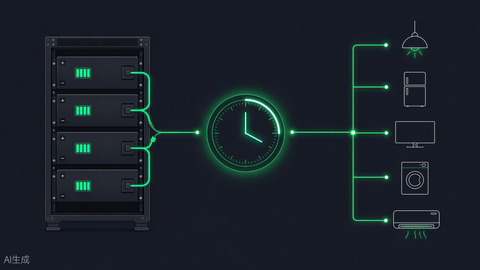
A standard string inverter has one job: take DC from your solar array and push synchronized AC into your home's panel. When the grid drops, it shuts off — anti-islanding rules demand it — and your panels sit useless on a sunny roof during an outage. A hybrid inverter adds two capabilities that change everything: a bidirectional battery port, so the same power electronics can charge a battery from solar or the grid and discharge it back to your loads; and grid-forming capability, so during an outage it can create its own stable 120/240V waveform and run your backed-up circuits from solar and battery with no grid at all.
The "hybrid" name refers to that dual life — grid-tied when the grid is alive, off-grid-capable when it isn't. It's worth being precise about what the term doesn't mean: a hybrid inverter is not a generator, not a battery (you buy that separately), and not magic. It's a traffic controller for every electron in your house, and like any traffic controller, its value shows up most when conditions get complicated — time-of-use rates, export limits, outages, and EV charging all at once.
How It Works: The Power Paths
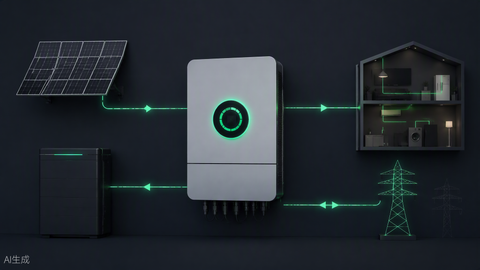
Inside a hybrid inverter, DC from the array and DC from the battery meet at a common internal DC bus; from there, the inverter stage converts to AC for your home, the grid, or both. That shared bus is the architectural advantage — power flows wherever it's needed with a single conversion whenever possible:
| Mode | Power path | Conversion steps | Round-trip efficiency |
|---|---|---|---|
| Solar → home loads | Array → DC bus → AC out | 1 (DC-AC) | 96–97.5% peak |
| Solar → battery (DC-coupled) | Array → DC bus → battery | 0–1 (DC-DC only) | 95–98% |
| Battery → home | Battery → DC bus → AC out | 1 (DC-AC) | 94–96% |
| Grid → battery (off-peak charging) | Grid AC → DC bus → battery | 2 (AC-DC, DC-DC) | 90–94% |
| Solar+battery → grid (export) | DC bus → AC to service | 1 | 96%+ |
| Outage: solar+battery → backup panel | DC bus → grid-forming AC | 1 | 94–96%, transfer in under 20 ms on UPS-class units |
Contrast that with AC-coupled storage, where a separate battery inverter converts solar AC back to DC to charge, then DC to AC again to discharge — two to three conversion steps and a few percent lost each way. The hybrid's DC-coupled path is why retrofit-adds aside, new solar-plus-storage builds overwhelmingly choose hybrid architecture. For the control side — how hybrids hold grid flow at zero and manage export — our zero-grid-flow guide goes deep on CT clamps, meters, and response times.
Inside the Box: Key Components
Open a hybrid inverter (don't — the capacitors hold lethal charge for minutes after shutdown) and you'd find five functional blocks. The MPPT trackers — usually two to four independent maximum power point tracking inputs — each optimize a separate string of panels, so a shaded west string can't drag down a sunny south one. The bidirectional DC-DC converter manages the battery port, handling charge profiles and the voltage translation between battery and bus. The inverter bridge — the IGBT or MOSFET switching stage — synthesizes the AC waveform. The transfer mechanism and grid relay handle islanding, with UPS-class units switching in 10 to 20 milliseconds, fast enough that computers never notice. And the control board runs the whole show: metering inputs, Wi-Fi and Ethernet, CAN and RS-485 ports for battery communication, and the firmware that executes your priorities — self-consumption, time-of-use arbitrage, backup reserve, zero export.
That last block is where hybrids earn their keep long-term. The hardware in a 2020 hybrid and a 2026 hybrid is recognizably similar; the software is a different universe. Scheduling, generator integration, load shedding, EV-charger coordination, and virtual power plant participation all arrive through firmware. Buy from manufacturers with a visible update track record — the box you install today should be smarter in three years, not orphaned.
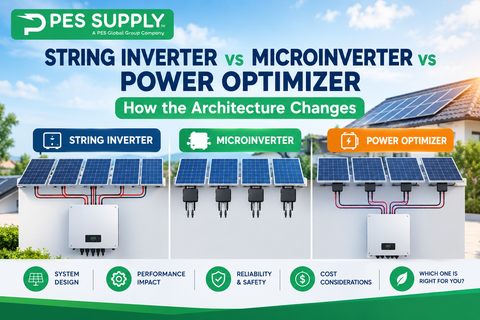
Hybrid vs. String vs. Microinverter: The Honest Comparison
| Attribute | Hybrid inverter | String inverter | Microinverters |
|---|---|---|---|
| Solar conversion | Yes, multi-MPPT | Yes, multi-MPPT | Yes, per-panel |
| Battery-ready | Native DC port | Needs separate battery inverter (AC-coupled) | Needs separate battery inverter (AC-coupled) |
| Backup during outage | Yes, grid-forming | No (without storage add-on) | No (without storage add-on) |
| Storage round-trip efficiency | 94–98% (DC-coupled) | 90–94% (AC-coupled) | 90–94% (AC-coupled) |
| Shade tolerance | Good (per-string MPPT) | Good (per-string MPPT) | Best (per-panel MPPT) |
| Single point of failure | Yes — one box | Yes | No — fleet redundancy |
| Install complexity | Higher (battery, backup panel, comms) | Lowest | Moderate (roof work) |
| Cost position (10 kW system) | +$$ for capability | Cheapest | Highest per watt |
My field rule: simple roof, no interest in storage ever, full-retail net metering — a string inverter is the value play and I'd say so to your face. Heavy shade or a complex roof with no storage plans — microinverters earn their premium; our Enphase guide covers that ecosystem. Everything else — storage now, storage later, outages, export limits, time-of-use — is hybrid territory, and the price difference has narrowed to the point where future-proofing costs less than one battery retrofit's extra labor.
Reading a Hybrid Inverter Data Sheet: Real Examples
Data sheets bury the four numbers that determine whether a unit fits your project: continuous AC output, surge capacity, battery charge/discharge current, and PV input limits. Here's how popular residential and light-commercial hybrids actually stack up (always verify current revisions against manufacturer documentation — specs change between hardware generations):
| Model class | Continuous AC output | Surge (motor starting) | Max PV input | Battery port |
|---|---|---|---|---|
| Sol-Ark 15K | 15 kW | ~24 kVA brief | 19.5 kW DC | 48V, up to 275A charge |
| EG4 18KPV | 12 kW | ~15.5 kW brief | 18 kW DC | 48V, up to 250A |
| Deye/Sunsynk 12K | 12 kW | ~2× rated, seconds | 15.6 kW DC | 48V, up to 240A |
| Schneider XW Pro 6848 | 6.8 kW | 12 kW (1 min) | Via separate MPPT charge controllers | 48V, 140A charger |
| Victron MultiPlus-II 48/5000 | 4 kW | 9 kW brief | Via separate MPPTs | 48V, 70A charger |
Three lessons from that table. First, the Sol-Ark and EG4 classes integrate everything — high PV input, big battery current — which is why they dominate whole-home installs; our Sol-Ark brand guide details that line, and our Sol-Ark catalog has the current models. Second, the Victron and Schneider classes are modular — stack several for bigger output — which suits off-grid and expandable systems; see the Victron brand guide for that ecosystem's logic. Third, surge rating is the quiet spec that decides whether your well pump and AC compressor actually start on battery power — check locked-rotor amps against surge, not against continuous. I've watched a correctly sized 12 kW unit fail to start a 4-ton compressor while a smaller unit with a better surge curve managed a 3-ton easily; the number on the front of the box is not the number that starts motors, and compressors don't care what the brochure promised.
Sizing a Hybrid Inverter Correctly
Sizing has three independent checks, and a system fails when any one is skipped. Check one, solar input: total array DC watts should sit within the PV input limit, and string voltages must land inside each MPPT's operating window across temperature — cold mornings push open-circuit voltage up, and NEC 690.7's temperature-corrected Voc calculation is how you keep from over-volting an input in January. Check two, AC output: the inverter's continuous output must carry your backed-up loads with margin; NEC 690.8 treats inverter output as continuous duty, so conductors and breakers get sized at 125 percent of rated output current — a 12 kW unit pushing 50 amps at 240V lands on a 70-amp breaker and 4 AWG copper per NEC 310.16 (75°C ampacity 85A, well clear of 62.5A required). Check three, interconnection: the NEC 705.12 120-percent rule limits solar backfeed on your panel's busbar — a 200A panel with a 200A main typically allows 40A of backfeed, which caps inverter AC output at 9.6 kW unless you downsize the main breaker, use a line-side tap, or employ a listed power control system. Our NEC compliance guide and inverter sizing calculator work through these checks in order.
| Home profile | Recommended inverter class | Battery pairing | Why |
|---|---|---|---|
| Small home, 6–8 kW array, backup for essentials | 8–10 kW hybrid | 10–15 kWh LFP | Covers critical loads panel with margin |
| Average home, 10–13 kW array, whole-home backup | 12–15 kW hybrid | 20–30 kWh LFP | Surge handles well pump + one AC with soft start |
| Large all-electric home, 15+ kW array, EV | 15 kW hybrid or stacked units | 30–40+ kWh LFP | EV charging and electric heat demand headroom |
| Off-grid cabin, 4–8 kW array | Modular 48V stack (Victron/Schneider class) | 15–30 kWh LFP + generator input | Expandability and generator integration matter most |
Battery Compatibility: The Communication Layer

Modern lithium batteries and hybrid inverters talk over CAN bus or RS-485 using manufacturer protocols — the battery reports cell voltages, temperature, and state of charge, and the inverter obeys the battery's charge-current limits. Closed-loop communication is worth insisting on: it prevents overcharge, manages low-temperature charge lockout (LFP cells shouldn't accept charge below freezing without heating), and gives you accurate state-of-charge instead of voltage-guessing. Every major hybrid publishes a compatibility list — EG4, Pytes, Pylontech, and SOK batteries appear on nearly all of them — and mixing unlisted batteries forces open-loop voltage-based operation, which works but gives up the safety and accuracy benefits. Browse the options in our battery and storage catalog, and size capacity with the battery sizing calculator before falling in love with a form factor.
Installation and Commissioning: Field Lessons
Hybrid installs punish sloppiness and reward preparation. The unit itself is heavy — 60 to 130 pounds — so the wall mount needs structure, not drywall anchors. Clearances matter: these are convection or fan-cooled heat engines, and the manual's clearance spec (typically 12 inches above, more at the sides) is a thermal requirement, not decoration. Conduit runs should separate DC, AC, and communications wiring — I've chased phantom comm errors that turned out to be CAN cable zip-tied to a PV homerun. Commission in daylight with the battery connected and the app open: verify CT orientation before enabling export limiting, confirm the battery's closed-loop handshake, test the transfer to backup mode once with real loads running, and set your backup reserve before you leave. And register the warranty on-site — the serial number is right there, and the customer will never do it later.
Monitoring, Software, and the Myths Worth Burying
A hybrid inverter without its monitoring platform is a Ferrari with the dashboard covered — every major brand ships a cloud portal and app showing solar production, battery state of charge, grid flow, and consumption in near-real-time. Use it, especially in the first month: the consumption graphs teach you your own home's rhythm better than any audit, and the alerts catch the quiet failures — a tripped string fuse, a battery that stopped communicating — before they become season-long losses. As for the folklore: no, hybrid inverters don't "waste more power" than separate components — the conversion-efficiency tables above show the opposite for DC-coupled storage. No, they can't power your whole house indefinitely in an outage — the battery and array size decide endurance, and the inverter just executes. And no, they're not fragile; the failure rates I see in the field track closely with install quality, not architecture. The units that die young are the ones mounted in full western sun with six inches of clearance and a nest of unlabeled conductors — the box gets blamed for the installer's sins, as usual.
Generator Integration: The Hybrid's Hidden Talent
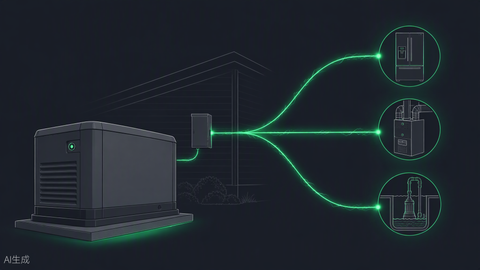
A feature most buyers discover late: quality hybrid inverters include a generator input that turns a modest portable or standby generator into a battery charger and backup source for the backup. During an extended outage, when the battery runs low and the sky stays dark, the inverter starts the generator (automatically on two-wire-start models), charges the battery at a controlled rate, passes power to loads, and shuts the generator down when the battery recovers — sipping fuel at a fraction of a generator-only setup's consumption, because the generator runs at efficient load instead of idling through the night. I've configured this on off-grid and storm-hardened systems alike, and the fuel savings are dramatic: one customer rode out a five-day outage on eleven gallons of propane where a generator-only neighbor burned forty. Check the generator input's charge-current spec and your generator's power quality before pairing — the inverter is pickier about waveform cleanliness than a transfer switch is, and a cheap open-frame generator with dirty output may charge slowly or be rejected outright.
When a Hybrid Inverter Is the Wrong Choice
Honesty section, because hybrids get oversold. If your roof is heavily shaded and storage is a definite no, microinverters produce more energy for less money. If you're adding storage to an existing string-inverter system with years of life left, AC-coupled storage bolts on without touching working equipment — ripping out a healthy string inverter to go hybrid is usually poor economics. And if your utility offers full-retail net metering with no outages worth mentioning, the hybrid premium buys capability you'll never exercise; a string inverter and a good grounding job is the disciplined build. The hybrid case rests on storage, resilience, export limits, or rate arbitrage — when none apply, say so.
The Future: Hybrids as Home Energy Hubs
The trajectory is clear: hybrid inverters are absorbing functions that used to require separate boxes. Current-generation units already integrate transfer switching, generator inputs, smart load management, and EV-charger coordination; virtual power plant enrollment — utilities paying homeowners to dispatch their fleets of batteries during peaks — runs through the same firmware. The inverter is becoming the home's energy router, and purchasing decisions increasingly hinge on software ecosystems as much as silicon. That argues for buying platforms with active development and North American support, and it argues against bottom-shelf units with abandoned apps. Grid codes are pulling the same direction: modern interconnection standards increasingly require the smart-inverter functions — volt-var response, frequency ride-through, remote configurability — that hybrids ship natively. Our inverter buyer's guide tracks the current field across architectures, and the system calculator helps match inverter class to array size before you commit.
The Short Version for Busy People
If you remember nothing else: a hybrid inverter is solar conversion, battery management, and outage protection in one wall-mounted box; it beats separate components on storage efficiency and beats string and micro architectures on resilience; and its real differentiators are surge capacity, battery communication, and software support rather than headline watts. Size it for your backed-up loads, buy from a platform with active development, and commission it with the app open. Everything else is detail — important detail, but detail.
Frequently Asked Questions
What is a hybrid inverter?
A hybrid inverter combines a solar inverter and a bidirectional battery inverter in one unit, with grid-forming capability for outages. It converts solar DC to household AC, charges and discharges a battery through a native DC port, synchronizes with the utility grid, and can island your backed-up loads when the grid fails — all from a single wall-mounted box.
Can a hybrid inverter work without a battery?
Yes — most hybrids operate as standard grid-tied inverters with the battery port empty, which is exactly the "storage-ready" strategy: install the hybrid now, add batteries later without replacing equipment. The one requirement is confirming the specific model supports batteryless operation, since a few units require a battery present to commission.
How long does a hybrid inverter last?
Plan on 10 to 15 years for the power electronics, with warranties typically running 10 years standard and extensions available on premium lines. The cooling fans and capacitors are the wear items — installs with proper clearances and clean airflow consistently outlast hot, cramped ones. Firmware support matters as much as hardware: a supported 10-year-old unit often outperforms an orphaned 5-year-old one.
Is a hybrid inverter better than microinverters?
They solve different problems. Microinverters maximize harvest on shaded or complex roofs and eliminate single points of failure, but they don't provide backup or native storage. Hybrids add battery integration, outage protection, and export control at lower storage round-trip losses. Shade-dominated roof with no storage plans: micros. Storage, outages, or export limits: hybrid. Some projects legitimately use both.
What size hybrid inverter do I need?
Three checks: PV input capacity must cover your array's DC watts, continuous AC output must carry your backed-up loads (with surge capacity for motor starting), and NEC 705.12's 120-percent rule must permit the backfeed on your panel. Most average homes land on a 10–15 kW class unit; the sizing calculators and a load audit settle it precisely.
Choose the Architecture First, the Brand Second
Hybrid inverters won the residential storage era by collapsing three boxes into one and making batteries a first-class citizen instead of a retrofit. Get the architecture decision right — hybrid versus string versus micro versus modular 48V — and the brand choice becomes a matter of ecosystem, support, and price. Explore our inverter catalog, including Sol-Ark and SolarEdge lines; dig into the GoodWe hybrid ecosystem for another strong platform; and when you want a system engineered around your loads, panel, and utility rules, request a quote — we'll spec the inverter, battery, and transfer scheme as one design, which is the only way these systems actually deliver on their promise.