A 10 kW solar system produces between 900 and 1,600 kWh per month in most of the United States — about 1,200 kWh on national-average sun, roughly 40 kWh per day. That is enough to cover the average American home's entire electric bill (about 875 kWh/month) with room to spare. The exact figure depends on where the system sits, which way it faces, and what season it is — and this guide gives you the full tables so you can pin down your own number in about two minutes.

The math is a single multiplication, but each factor in it hides a real-world trap. I will walk through all of them the way I do when a customer asks why their neighbor's identical 10 kW system out-produces theirs by 20%.
The Production Formula
Monthly kWh = System size (kW) × Peak sun hours × Days in month × System efficiency
For a 10 kW system at the national-average 4.5 peak sun hours (PSH) with a 0.80 system efficiency factor:
10 × 4.5 × 30.4 × 0.80 = ~1,094 kWh per month, ~13,100 kWh per year, ~36 kWh per day.
Every variable earns its place. System size is nameplate DC. Peak sun hours collapse a day of varying sun into equivalent full-power hours. System efficiency — sometimes called the derate factor — prices in inverter losses (2–4%), wiring (1–2%), temperature (5–15% depending on climate and season), soiling (2–5%), and shading (0–20%+). Using 0.80 is honest; using 0.90 is marketing.
10 kW Production by City
| City | Avg Peak Sun Hours | Monthly kWh (avg month) | Annual kWh | Daily kWh | Covers Average Home (875 kWh/mo)? |
|---|---|---|---|---|---|
| Phoenix, AZ | 6.5 | ~1,580 | ~19,000 | ~52 | Yes — 180% |
| Las Vegas, NV | 6.4 | ~1,560 | ~18,700 | ~51 | Yes — 178% |
| Denver, CO | 5.5 | ~1,340 | ~16,100 | ~44 | Yes — 153% |
| Dallas, TX | 5.2 | ~1,270 | ~15,200 | ~42 | Yes — 145% |
| Atlanta, GA | 4.8 | ~1,170 | ~14,000 | ~39 | Yes — 134% |
| Kansas City, MO | 4.6 | ~1,120 | ~13,400 | ~37 | Yes — 128% |
| Chicago, IL | 4.2 | ~1,020 | ~12,300 | ~34 | Yes — 117% |
| New York, NY | 4.0 | ~970 | ~11,700 | ~32 | Yes — 111% |
| Portland, OR | 3.9 | ~950 | ~11,400 | ~31 | Yes — 109% |
| Seattle, WA | 3.6 | ~880 | ~10,500 | ~29 | Essentially 100% |
Even the cloudiest major US city on that list nearly covers the average home — a 10 kW system is a big system. If your usage is closer to 1,300–1,500 kWh/month (Southern AC loads, EVs), Phoenix-to-Dallas production levels cover it, while Seattle needs closer to 14–15 kW for the same bill. The solar system calculator runs these numbers for any address, and the system size calculator guide shows the underlying model.
Seasonal Swing: A 10 kW System Month by Month
Annual averages hide the rhythm. Here is a 10 kW system in a mid-sun city (Kansas City, ~4.6 PSH annual average) across the year:
| Month | Effective PSH | Production (kWh) | vs. Annual Average |
|---|---|---|---|
| January | 3.1 | ~770 | −31% |
| February | 3.8 | ~850 | −24% |
| March | 4.7 | ~1,170 | +4% |
| April | 5.3 | ~1,270 | +13% |
| May | 5.8 | ~1,440 | +29% |
| June | 6.1 | ~1,460 | +30% |
| July | 6.2 | ~1,540 | +38% |
| August | 5.9 | ~1,470 | +31% |
| September | 5.1 | ~1,220 | +9% |
| October | 4.2 | ~1,040 | −7% |
| November | 3.3 | ~790 | −29% |
| December | 2.8 | ~690 | −38% |
July produces more than double December. That swing is why net metering matters so much in northern states — the summer surplus banked as credits is what pays for the winter deficit. It is also why battery owners notice their storage cycling hard in December and coasting in July.
What 1,200 kWh a Month Actually Powers
| Load | Monthly kWh | Covered by 10 kW System (1,200 kWh)? |
|---|---|---|
| Average whole house | ~875 | Yes, with ~325 kWh surplus |
| House + one EV (1,000 mi/mo) | ~1,150 | Yes, nearly exactly |
| House + EV + heat pump water heater | ~1,250 | ~96% covered |
| Large Southern home with heavy AC | ~1,500 | ~80% covered |
| House + pool + EV + hot tub | ~1,800 | ~67% covered |
If your loads live in the bottom two rows, the answer is not that 10 kW is small — it is that your usage is large. The companion guides on whether solar can power a whole house and battery sizing for solar systems handle the follow-on questions, and if you are comparing array footprints, how big a 25 kW array actually is gives useful scale.
The Six Factors That Move Your Number
| Factor | Impact on Monthly kWh | Fixable? |
|---|---|---|
| Location (PSH) | ±40% across the US | No — but it is fully predictable |
| Roof orientation/tilt | −10–20% for east/west; −30%+ for north | Design around it; split arrays help |
| Shading | −5–50% depending on severity and inverter topology | Yes — trim trees, use microinverters/optimizers |
| Temperature | −0.4%/°C above 25°C cell temp; hot summer afternoons clip production | Partially — airflow gap, light-colored roof, low-temp-coefficient panels |
| Soiling | −2–7% between cleanings | Yes — rain or an occasional rinse |
| Degradation | −0.4–0.6% per year, permanently | No — but premium panels degrade slower |
Year by Year: What Degradation Does to a 10 kW System
| Year | Annual Production @ 0.5%/yr (from 13,100 kWh) | Monthly Average | Cumulative Production |
|---|---|---|---|
| 1 | 13,100 kWh | 1,092 kWh | 13,100 kWh |
| 5 | 12,840 kWh | 1,070 kWh | 64,600 kWh |
| 10 | 12,510 kWh | 1,043 kWh | 128,000 kWh |
| 15 | 12,190 kWh | 1,016 kWh | 189,800 kWh |
| 20 | 11,880 kWh | 990 kWh | 250,100 kWh |
| 25 | 11,580 kWh | 965 kWh | 308,700 kWh |
| 30 | 11,290 kWh | 941 kWh | 365,900 kWh |
Over 30 years a 10 kW system on average US sun produces roughly 366,000 kWh. At $0.17/kWh that is about $62,000 of electricity — the denominator in every payback calculation worth doing. The ROI calculator runs that math with your rate; premium panels from the solar panel catalog with 0.4%/yr degradation add roughly 9,000 kWh to the 30-year column.
String vs. Microinverters: Does Topology Change Monthly kWh?
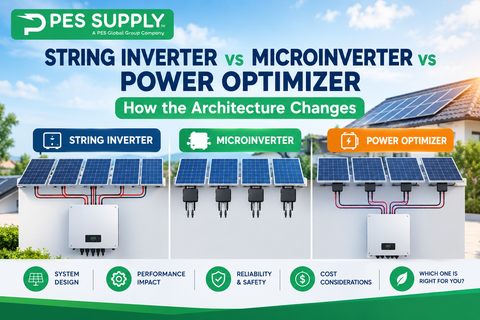
On an unshaded south roof, the difference is 1–3% — noise. On a roof with a chimney shadow, dormers, or mixed orientations, module-level electronics (microinverters or optimizers) recover 5–15% that a single MPPT string inverter would lose. That is a 60–180 kWh monthly difference on a 10 kW system — real money, and the reason I spec microinverters on anything with complicated shade and a string or hybrid unit from the 10–12kW hybrid collection on clean roofs headed for batteries.
Field Notes
Two observations from monitoring hundreds of systems. First, the systems that underperform their forecast almost always have a story — a tree that grew, a string that tripped in May and nobody checked the app until September, a pigeon colony under the array. A healthy 10 kW system hits its modeled number within 5% year after year; if yours does not, something specific is wrong and it is findable. Second, first-year owners underestimate winter: the model says December is 40% of July, but watching it happen in real time still surprises people. Budget your expectations seasonally, not annually, and the monitoring graph will make you smile in June instead of worry in January.
Scaling Table: What Each System Size Produces Per Month

Since 10 kW sits in the middle of the residential range, here is the full ladder at national-average sun (4.5 PSH, 0.80 efficiency), so you can interpolate to any system:
| System Size | Monthly kWh (avg month) | Annual kWh | Daily kWh | Panels @ 450W |
|---|---|---|---|---|
| 4 kW | ~438 | ~5,260 | ~14.4 | 9 |
| 6 kW | ~657 | ~7,880 | ~21.6 | 14 |
| 8 kW | ~876 | ~10,500 | ~28.8 | 18 |
| 10 kW | ~1,095 | ~13,100 | ~36 | 23 |
| 12 kW | ~1,314 | ~15,800 | ~43 | 27 |
| 15 kW | ~1,643 | ~19,700 | ~54 | 34 |
| 20 kW | ~2,190 | ~26,300 | ~72 | 45 |
The ladder is linear — production scales exactly with size, because PSH and efficiency do not care how big the array is (until the array gets big enough to need multiple orientations, which reintroduces the orientation penalty). Double the system, double the kWh; the decision is purely how much of your bill you want to erase and how much roof you have to erase it with.
Where the 0.80 Efficiency Figure Comes From
Transparency beats authority, so here is the standard PVWatts-style loss stack that turns nameplate into reality:
| Loss Mechanism | Typical Value | Running Multiplier |
|---|---|---|
| Irradiance on tilted plane vs. rating conditions | −2% | 0.980 |
| Soiling (dust, pollen, droppings) | −2 to −3% | 0.955 |
| Shading (minimal, good site) | −2% | 0.936 |
| Snow coverage (annual average, northern sites) | −1% | 0.927 |
| Module mismatch & manufacturing tolerance | −2% | 0.908 |
| DC + AC wiring | −2 to −3% | 0.886 |
| Inverter & transformer efficiency | −3% | 0.859 |
| Temperature (annual average, mixed climate) | −6 to −8% | ~0.80 |
| Availability / downtime | −0.5% | ~0.796 |
Multiply it out and you land at 0.79–0.81 — which is why 0.80 is the honest planning number. A quote assuming 0.88+ on a standard rooftop is either located somewhere very cool and clean or is optimistic. Ask which; the answer tells you a lot about the quoter.
What a 10 kW System Physically Is
| Component | Typical 10 kW Spec | Notes |
|---|---|---|
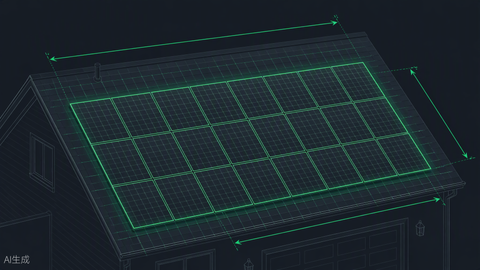
| Panels | 22–25 × 400–450W, or 18 × 550W | ~440–480 sq ft of roof |
| Inverter | 7.6–10 kW string/hybrid, or 22–25 microinverters | DC:AC ratio 1.0–1.25 |
| Strings | 2 strings of 9–12 modules | NEC 690.7 cold-weather voltage check on every string |
| Backfeed breaker | 40–50A on a 200A panel | NEC 705.12 120% rule: 200A bus × 1.2 − 200A main = 40A headroom |
| Conductor | 10–8 AWG home runs | NEC 690.8's 156% rule sets the minimum |
| Monitoring | Module-level or string-level | Non-negotiable for catching the faults that hide |
Net Metering, Time-of-Use, and What Monthly Production Is Worth
The same 1,200 kWh is worth different money under different tariffs. Under full retail net metering, every kWh offsets a kWh at your retail rate — clean and simple. Under time-of-use rates, solar's noon-to-4 PM production peak lands partly in off-peak pricing, while your evening usage lands in peak — California's NEM 3.0 made this structural, which is why batteries moved from luxury to standard there. Under avoided-cost (wholesale) export tariffs, exported kWh earn a fraction of retail and self-consumption becomes the whole game.
The practical guidance: if your utility offers 1:1 net metering with annual true-up, size to annual usage and forget the clock. If you are on TOU or reduced export rates, shift what you can (EV charging, water heating, laundry) into solar hours, and price a battery on the spread between export value and evening import value rather than on raw kWh. A 10 kW system with a 13.5 kWh battery under a TOU tariff routinely out-earns a 13 kW bare system under the same tariff — fewer panels, better timing.
The Owner's Maintenance Calendar for Stable Production
Keeping a 10 kW system at its modeled 1,095 kWh/month takes about two hours per year:
- Monthly: glance at the monitoring app. Any string or module more than 10% below its peers in clear weather gets investigated.
- Spring: rinse pollen and dust if the winter was dry; check for new shading from leaf-out.
- After major storms: walk the perimeter looking for cracked glass, lifted clamps, or debris. Photograph anything suspicious before touching it (insurance).
- Fall: clear leaves from the array edges and gutters; verify no branches will scrape in winter winds.
- Annually: compare total production against the model. Within ±5% is weather; beyond that is a question worth answering.
10 kW With and Without Battery: Two Different Monthly Rhythms
A bare grid-tied 10 kW system and a 10 kW system with 13.5 kWh of storage produce the same monthly kWh but deliver them very differently. The bare system exports 40–60% of its production at noon and buys the evening back — fine under 1:1 net metering, costly under reduced export rates. The battery version self-consumes 75–90% of production, shrinking exports to the summer surplus and imports to winter deficits. On a TOU tariff with a $0.20/kWh spread between noon export value and evening import cost, the battery moves $60–$110 per month — the difference between a good system and a great one in California-style rate structures. Under flat net metering, the same battery is a backup-power purchase, not an economic one. Know your tariff before you size the battery.
Comparing Quotes for a 10 kW System
Three quotes for "10 kW" can describe three different systems. Normalize them with these checks: DC array size in watts (10.0 kW vs 11.2 kW of panels changes clipping behavior), the modeled annual kWh and its stated derate factor, panel model and year-25 warranty floor, inverter topology and warranty term, and the production guarantee in writing. A quote promising 15,000 kWh/yr from 10 kW in Ohio (4.2 PSH implies ~12,300 at 0.80 efficiency) has a derate assumption of 0.97 — physically impossible — and the correct response is to ask for the loss stack. The cheapest quote per watt frequently has the most optimistic model; compare guaranteed kWh per dollar, not watts per dollar, and the honest bids usually win on that basis.
Panel Wattage: Does 18 × 550W Beat 23 × 450W?
Both build the same 10 kW and produce the same monthly kWh within 1–2%, so the decision is practical rather than energetic. The 550W route uses five fewer panels: five fewer roof penetrations, five fewer clamp sets, less wiring, a lighter permitting drawing, and a faster install — commercial-format modules are the labor-saver. The 450W route uses residential-format panels that fit chopped-up roofs more flexibly, cost less per panel when one fails out of warranty, and offer more brands with 25-year residential warranties. My rule: big simple roofs get big modules; complicated roofs get residential modules; and either way, the monthly production number from the tables above does not change. What changes with panel choice is degradation rate, not count — a premium 0.40%/yr panel versus a standard 0.55%/yr panel is worth about 40 extra kWh per month by year 20 on a 10 kW system, roughly $7/month at average rates. Worth having, not worth obsessing over.
Squeezing Winter: The Owner's Cold-Weather Playbook
Since December is the production floor, three cheap habits matter disproportionately. Clear snow only when it is cheap to do so — panels shed light snow quickly from their dark, angled glass, and roof-raking a 10 kW array is more dangerous than the recovered kWh are valuable; exceptions are heavy wet snows that linger a week. Keep the low winter sun's path unobstructed — shadows from the south-side trees are longest in December, and a branch that never touches summer production can erase a string in winter. And check the inverter's production logs on the first clear cold day of the year: cold, clear weather is when a healthy system posts its highest instantaneous power (cold panels are efficient panels), and it is the best free diagnostic of the year. A 10 kW system that cannot touch 9 kW on a clear January noon has a problem worth finding.
10 kW Is the New 6 kW
One industry shift worth noting: 10 kW has quietly become the modal residential system size in the US, up from ~6 kW a decade ago, driven by bigger electric loads, cheaper panels, and the electrification wave. That matters for the reader comparison-shopping production claims: older forum posts and guides quoting "a typical 6 kW system makes 750 kWh a month" are describing 2015's normal, not today's. If your household already includes an EV or a heat pump — or will within five years — 10 kW is not an ambitious size, it is the median choice, and the production tables in this guide are the numbers the median American system actually delivers.
A closing word on confidence. The production figures in this guide are not hopes; they are the same loss-stacked model utilities and lenders use to underwrite solar projects, and modern monitoring has verified them across millions of rooftops for two decades. A 10 kW system in your ZIP code will produce within a few percent of these tables in an average year — the only variables left are the ones you control: shade, orientation, equipment quality, and whether anyone is watching the monitoring app. Size it honestly, build it cleanly, watch it monthly, and the kWh will take care of themselves — as they have for the hundreds of systems whose monitoring graphs taught me every table in this article. Trust the model, verify with the meter, and enjoy the first utility bill that makes you smile for all the right reasons.
Frequently Asked Questions
How many kWh does a 10 kW solar system produce per month?
Between 900 and 1,600 kWh per month across most of the US — about 1,100–1,200 kWh on national-average sun (4.5 peak sun hours). Phoenix sees ~1,580; Seattle sees ~880. The formula is 10 kW × peak sun hours × 30.4 days × 0.80 system efficiency.
How many kWh does a 10 kW system produce per day?
About 30–52 kWh per day depending on location and season — roughly 36–40 kWh on average. Summer days in sunny regions exceed 60 kWh; dark December days in the Northwest can fall below 15 kWh.
Is 10 kW enough to run a whole house?
For the average American home (875 kWh/month), yes — a 10 kW system covers 100–180% of usage in most states. Large all-electric homes using 1,500+ kWh/month will cover 70–90% and may want 12–15 kW for full offset.
How many solar panels does a 10 kW system need?
22–25 panels at 400–450W, or about 18 panels at 550W. The array occupies roughly 430–480 square feet of roof. Panel wattage changes the count and footprint, not the production.
Why is my 10 kW system producing less than expected?
Check in order: season (December is ~40% of July), shading growth, soiling, a tripped string or optimizer, and inverter error codes. Modeled production assumes 0.80 system efficiency — a system consistently 15%+ under forecast in clear weather has a specific, findable fault.
How much is 1,200 kWh per month worth?
At the US-average residential rate around $0.17/kWh, about $200 per month or $2,400 per year. In high-rate states (California, Northeast, Hawaii — $0.25–0.40/kWh) the same production is worth $300–480 per month, which is why solar pays back fastest where power is expensive rather than where it is sunniest.
Related reading: Solar panel kits buyer's guide · Solar kits · 450W solar panels · Best solar panels 2026