UFLPA and Solar Supply Chains: 2022 Polysilicon Sourcing Disruption
June 21, 2022 marked a turning point for U.S. solar module imports. On that date, U.S. Customs and Border Protection (CBP) began full enforcement of the Uyghur Forced Labor Prevention Act (UFLPA), a law requiring importers to prove — with "clear and convincing evidence" — that goods entering the U.S. from China's Xinjiang region were not produced with forced labor (CSIS; Sheppard Mullin). Because Xinjiang produces an outsized share of the world's solar-grade polysilicon, the law hit the solar industry harder than almost any other sector.
Equipment to consider: JA Solar 595W Bifacial Panel or Silfab NTC 530W Domestic Content Panel or Boviet 540W Bifacial Panel. All available with 7-10 business days delivery from PES Supply's 50,000+ SKUs across 169 authorized brands.
Why Polysilicon Was Ground Zero
Xinjiang accounts for a significant share of global polysilicon production, the key raw material used to manufacture solar cells. UFLPA created a rebuttable presumption that any goods originating from the region — or made with materials sourced from it — were produced with forced labor, shifting the burden of proof onto importers rather than requiring the government to demonstrate a violation (Troutman Pepper). For solar manufacturers with polysilicon or wafer supply chains touching Xinjiang at any point — even indirectly, several tiers upstream — this created enormous compliance exposure.
Module Detentions at the Border
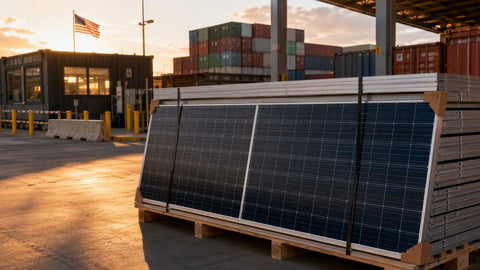
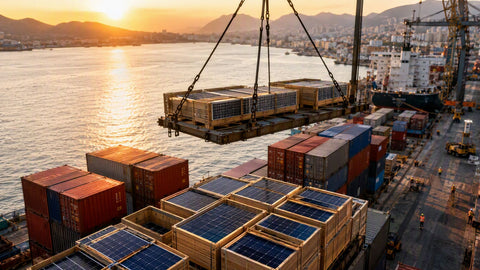
The practical impact showed up immediately in CBP detention data. According to CBP's own dashboard, analyzed by Bernreuter Research, more than 2 GW of solar PV modules were detained at the U.S. border throughout 2022 — 1,423 individual shipments worth roughly $709.9 million (Bernreuter Research; PV Tech). Detentions were heaviest in Q3 2022, then declined about 46% into Q4 as manufacturers began providing satisfactory supply chain documentation (pv magazine analysis via Bernreuter).
| Metric | 2022 Figure |
|---|---|
| Modules detained (est.) | 2+ GW |
| Shipments detained | 1,423 |
| Value detained | ~$709.9 million |
| Share ultimately released | 41% |
| Share rejected outright | 0.8% |
| Q3 to Q4 detention trend | Declined roughly 46% |
Data via Bernreuter Research and PV Tech.
By December 2022, the market saw its first meaningful sign of relief: ROTH Capital Partners reported that detained JinkoSolar modules manufactured with Wacker-sourced polysilicon had begun clearing customs, signaling that clean, well-documented supply chains could work through the review process (pv magazine USA).
Supply Chain Diversification Accelerates
UFLPA compliance pressure — layered on top of ongoing Section 301 antidumping/countervailing duty concerns — accelerated a shift already underway: Chinese-headquartered manufacturers moving final assembly, and increasingly cell and even polysilicon-adjacent production, to Southeast Asia. Manufacturing hubs in Vietnam, Malaysia, Thailand, and Cambodia expanded rapidly as companies sought to establish documented, non-Xinjiang supply chains that could withstand CBP scrutiny.
This diversification effort collided with a separate trade action in 2022: in February, Auxin Solar petitioned the Department of Commerce to investigate whether these same Southeast Asian assembly operations were being used to circumvent existing AD/CVD orders on Chinese solar cells and modules (PV Tech; Steptoe). Commerce opened its formal circumvention inquiry on April 1, 2022 (Federal Register). The overlapping investigations meant manufacturers pursuing Southeast Asian diversification to solve their UFLPA exposure simultaneously faced new tariff circumvention risk — a genuine trade "trilemma" for the industry. President Biden's June 2022 emergency declaration under Section 318(a) of the Tariff Act suspended potential retroactive duties on Cambodia, Malaysia, Thailand, and Vietnam for 24 months, providing temporary relief while the underlying investigation continued (Troutman Pepper).
Market-Wide Impact
SEIA and Wood Mackenzie's U.S. Solar Market Insight 2022 Year in Review cited both the anticircumvention investigation and UFLPA detentions as primary drivers of the year's 16% decline in total installed capacity, with utility-scale solar — the segment most reliant on imported modules — down 31% year-over-year (SEIA). Residential solar, less exposed to import bottlenecks because roughly half the segment already used domestically produced modules, grew 40% over the same period (SEIA).
Practical Lessons for Installers and Buyers
- Documentation matters more than ever: manufacturers with traceable, audited polysilicon supply chains cleared customs faster than those without.
- Single-source module dependency became a real project risk in 2022 — diversified supplier relationships reduced exposure to any single detained shipment.
- Southeast Asian sourcing carried its own risk profile in 2022 due to the overlapping AD/CVD circumvention inquiry, requiring buyers to track both UFLPA and tariff compliance simultaneously.
- Lead time volatility, not just price, became a core planning variable for project schedules throughout the year.
Distributors with access to multiple authorized brands were uniquely positioned to help contractors navigate this environment. PES Supply's network of 169 authorized brands across 50,000+ SKUs gave installers flexibility to pivot between suppliers when any individual manufacturer's shipments were held up in CBP review. Explore our current solar panel and racking selections, all shipped within 7-10 business days of order confirmation.
Looking Forward
By year-end 2022, the industry was still adjusting to a new normal: sourcing decisions now required not just a price and lead-time comparison, but a documented forced-labor compliance trail. The manufacturers and distributors that invested early in supply chain transparency in 2022 were the ones best positioned to keep projects moving as CBP enforcement matured into 2023.
Sources: CSIS, Bernreuter Research, PV Tech, pv magazine USA, SEIA.
🛒 Shop This Article
Find the equipment mentioned in this article across our 50,000+ SKUs from 169 authorized brands. 7-10 business days delivery.