Originally published: August 2022 • Updated: 2026 with safe-harbor and credit-sunset developments • Sources: SEIA, IRS/Treasury guidance, Energy Toolbase
On August 16, 2022, President Biden signed the Inflation Reduction Act into law, committing roughly $369 billion to energy and climate provisions — the largest single climate investment in US history. For solar installers, EPCs, facility managers, and equipment buyers, the IRA didn't just extend a tax credit. It rebuilt the entire federal incentive structure for solar and storage, and it did it with a decade of visibility the industry had never had before.
I remember where our phones were that week — ringing off the hook. Customers who had been sitting on quotes all summer, waiting to see if the ITC step-down would actually happen, suddenly wanted to lock orders before year-end. Distributors who understood the provisions early captured that wave. The ones who treated it as just another policy headline spent the fourth quarter explaining to customers why their competitor's quote included a bigger credit.
This guide walks through the provisions that mattered most to equipment buyers and project developers: the restored 30% Investment Tax Credit, the brand-new standalone storage credit, the stackable bonus adders, the Section 45X manufacturing credits that reshaped the supply side, and the direct-pay and transferability mechanisms that opened solar financing to buyers who could never use a tax credit before.
⚡ Quick Answer
The Inflation Reduction Act (2022) restored the federal solar Investment Tax Credit to 30% for residential (Section 25D) and commercial (Section 48) projects, created a standalone 30% credit for battery storage ≥3 kWh, added stackable bonuses for domestic content (+10 points), energy communities (+10 points), and low-income projects (+10–20 points), launched Section 45X manufacturing credits for US-made components, and introduced direct pay and credit transferability. Later legislation and guidance modified some provisions — see the 2026 status section below.
Before the IRA, the ITC had already begun its scheduled step-down from the original 30% rate, and every installer in the country had lived through the year-end scramble that step-downs create. The IRA restored the credit to a full 30% for both commercial systems under Section 48 and residential systems under Section 25D, with the commercial step-down not resuming until 2033 under the original statutory schedule.
| Credit | Statutory Section | Base Rate | Original IRA Step-Down Schedule |
|---|---|---|---|
| Residential ITC | Section 25D | 30% | 26% in 2033, 22% in 2034, expires 2035 (later sunset early by 2025 legislation — see below) |
| Commercial ITC | Section 48 | 30% with prevailing wage & apprenticeship met (6% base otherwise) | Step-down beginning 2033 under original schedule |
| Technology-neutral successor | Section 48E | 30% (6% base) for zero-emission facilities | Effective 2025+, phases with grid decarbonization targets |
The rate mattered. The certainty mattered more. For the first time in the modern solar era, a contractor could quote a customer in 2022 knowing exactly what federal incentive would apply to a project completed in 2024. Pipeline planning, inventory commitments, and hiring decisions all got easier the day the bill was signed. Commercial projects above 1 MW did have to meet prevailing wage and apprenticeship requirements to capture the full 30% — falling short meant a 6% base rate — which pushed labor compliance from an afterthought to a front-page bid consideration overnight. Apprenticeship ratios, certified payroll, and documentation workflows became part of estimating, and the shops that already ran certified crews found themselves holding a structural advantage over competitors who had to build the capability under deadline.
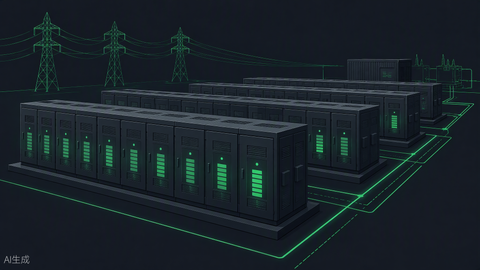
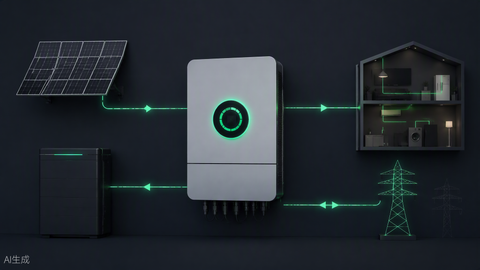
This was the sleeper provision, and in dollar terms maybe the most consequential one for the equipment side of the business. Before the IRA, storage only qualified for the ITC when it was paired with and primarily charged by an on-site solar system. A battery retrofitted onto a building without solar got nothing. The IRA changed the rules: standalone storage systems of at least 3 kWh now qualify for the same 30% credit, no solar array required, effective for expenditures after December 31, 2022.
Think about what that unlocked. Peak-shaving batteries for demand-charge management. Backup systems for facilities that couldn't host panels. Storage retrofits on the millions of solar systems installed before batteries were economical. We watched our battery category go from a niche line item to a top-three category within eighteen months, and the standalone credit is the single biggest reason why. If you're sizing one of these systems today, our battery sizing calculator and battery sizing guide walk the math.
On top of the base 30%, the IRA created three stackable bonus adders for commercial projects — and stacking is where project economics got genuinely aggressive:
| Bonus Adder | Value | Qualification |
|---|---|---|
| Domestic content | +10 percentage points | Meet domestic sourcing thresholds for steel, iron, and manufactured products (initially 40% of manufactured-product cost, rising over time) |
| Energy community | +10 percentage points | Site in areas tied to fossil-fuel employment, closed coal plants or mines, or brownfields |
| Low-income | +10 to +20 percentage points | Projects serving low-income communities or residential buildings; subject to annual capacity allocation |
A qualifying project could plausibly stack to 50% or more of eligible cost. Here's the math on a hypothetical $1,000,000 commercial rooftop project — the kind of calculation that moved procurement decisions in 2023 and 2024:
| Component | Rate | Credit Value on $1,000,000 Eligible Cost |
|---|---|---|
| Base ITC (prevailing wage met) | 30% | $300,000 |
| Domestic content bonus | +10% | $100,000 |
| Energy community bonus (former coal county site) | +10% | $100,000 |
| Total stacked credit | 50% | $500,000 |
Half the project cost recovered through the federal credit — that math changed what got built and where. It also changed what got specified. Suddenly the question on every commercial submittal wasn't just price per watt; it was whether the bill of materials could document domestic content thresholds. Equipment with US sourcing documentation started commanding a premium because it unlocked that extra ten points.
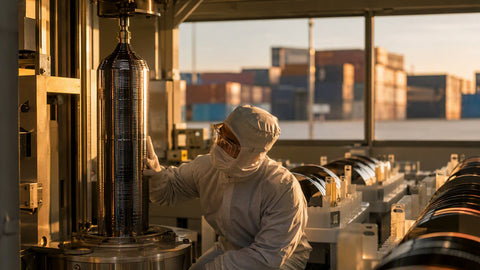
The demand-side credits got the headlines, but Section 45X — the Advanced Manufacturing Production Credit — is what triggered the factory construction boom. Instead of subsidizing projects, 45X pays manufacturers per unit of US-produced component. The published credit rates tell you exactly what Treasury wanted built here:
| Component | 45X Credit Rate |
|---|---|
| PV module | $0.07 per Wdc |
| PV cell | $0.04 per Wdc |
| PV wafer | $12 per m² |
| Polysilicon | $3 per kg |
| Central inverter | $0.11 per Wac |
| Battery cell | $35 per kWh |
| Battery module | $10 per kWh |
| Critical minerals | 10% of production cost |
Run the arithmetic on a module factory: a 2 GW/year US module plant generates $140 million a year in 45X credits at $0.07 per watt — before selling a single panel at margin. That's why, within two years of passage, announced US module nameplate capacity went from under 10 GW to well past 50 GW. We covered that factory wave in detail in our companion piece on the Section 45X factory boom. Brands with US manufacturing — Qcells in Georgia, Silfab's US lines, First Solar — went from "nice to have" to "allocated six quarters out" almost immediately.
Two financing mechanisms in the IRA quietly expanded who could own solar at all. Direct pay lets tax-exempt entities — municipalities, school districts, rural electric co-ops, tribal governments, nonprofits — receive the credit's value as a cash payment instead of needing tax liability to offset. That single change made direct ownership viable for the entire public and nonprofit sector, which had previously been locked into third-party PPA structures.
Transferability did the same job on the taxable side: a developer with more credit than tax appetite can sell the credit to a third party for cash. The transfer market that grew out of this provision became a real financing channel — credits changing hands at roughly 90-plus cents on the dollar — and it reduced the industry's dependence on a handful of tax-equity banks. For mid-market developers who used to spend six months hunting tax equity for a 2 MW project, the ability to simply sell the credit and move on compressed financing timelines more than any other IRA provision.
There's a practical discipline here that doesn't make the policy summaries: transfer pricing and documentation quality became part of project value. A clean file — prevailing wage records, domestic content certifications, placed-in-service documentation — trades tighter than a messy one. Buyers of credits learned fast that they're buying the file as much as the credit, and sellers learned that the distributor who can produce sourcing paperwork on day one is worth real money at closing.
Because we live on the supply side of this industry, this is the part we watched most closely. The IRA's demand-side certainty collided with its supply-side factory credits, and the equipment market whipsawed through three distinct phases between 2022 and 2026.
Phase one (2022–2023): the allocation squeeze. Restored 30% certainty plus bonus-stacking pulled a decade of demand forward at the exact moment the supply chain was still digesting UFLPA detentions and post-pandemic logistics. Transformers and switchgear lead times stretched past 50 weeks. Domestic-content-qualifying modules became the hardest allocation in the country — customers who had never once asked where a panel was made were suddenly asking for certificates of origin before they asked for price.
Phase two (2023–2024): the price collapse. Chinese overcapacity flooded global module markets while US factories were still ramping. Module prices fell by half or more in eighteen months — brutal for anyone holding inventory, spectacular for project economics. Battery cells followed the same curve as EV-scale LFP capacity came online, which is a big part of why storage attachment rates exploded in the same window.
Phase three (2025–2026): the sorting. US module capacity announced under 45X began shipping in real volume, tariffs and trade cases redrew the import map, and the residential credit sunset re-segmented demand. The distributors who came out strongest were the ones who treated the IRA as an operations problem — documented content, dual-sourced BOMs, honest lead times — rather than a sales talking point.
Policy is abstract until it hits a quote. Here's how the IRA's provisions actually showed up in daily contracting work in the months after passage:
- Quotes got simpler and stronger. A flat 30% with a decade of runway replaced the step-down countdown pitch. Close rates improved because the urgency story no longer depended on a calendar cliff.
- BOM documentation became a sales skill. Winning commercial bids required sourcing matrices showing domestic content qualification — distributors who could produce that paperwork won the spec.
- Storage went from add-on to anchor. Standalone eligibility meant batteries could be sold on their own economics, and battery-first conversations became routine.
- Public-sector work opened up. Direct pay brought schools, municipalities, and co-ops into the market as owners rather than PPA hosts.
- Labor compliance moved up the checklist. Prevailing wage and apprenticeship requirements on larger projects made certified labor a competitive weapon instead of a cost line.
We lived every one of those shifts at the counter. In 2021, maybe one commercial customer in ten asked about domestic content. By mid-2023 it was the first question on every C&I quote. The distributors and installers who built the sourcing documentation muscle early — knowing exactly which Silfab, Qcells, or Fronius SKUs carried US content and could prove it — took share that they've never given back.
Ask any commercial developer what mechanism mattered most in practice and many will skip the headline credits entirely and say safe harbor. The IRS "commence construction" doctrine lets a project lock in the credit rules of the year it started — even if it places in service years later — by either beginning physical work of a significant nature or incurring at least 5% of total project cost (the "5% safe harbor"). In an industry where interconnection queues routinely stretch past three years, that doctrine is the difference between a project that pencils and one that dies in the queue.
We've watched the 5% test reshape procurement behavior directly. Developers started buying transformers, switchgear, and module slots early — not because they needed the hardware on site, but because a documented 5% cost incurrence in the right tax year was worth six or seven figures of credit certainty. That pull-forward of equipment purchases is one reason transformer and switchgear lead times blew out in 2023 and stayed extended; everyone in the queue was safe-harboring at once. If you're playing this game now, the current commence-construction guidance after the 2025 legislative changes is covered in our safe-harbor explainer — read it before you sign a module supply agreement.
| Date | Milestone | Market Effect |
|---|---|---|
| Aug 16, 2022 | IRA signed into law | 30% ITC restored; decade of certainty begins; year-end order surge |
| Jan 1, 2023 | Standalone storage credit effective | Battery retrofits and solar-free storage become credit-eligible |
| 2023 | Section 45X production credits begin | Factory announcements cascade; US module nameplate pipeline multiplies |
| 2023–2024 | Domestic content and energy community guidance finalized | Bonus stacking becomes standard in commercial bids; US-content BOMs get premium pricing |
| 2025 | New legislation sunsets residential 25D early; 48E timelines modified | Residential demand pulls forward; commercial safe-harbor activity spikes again |
| 2026 | Safe-harbor and commence-construction rules refined | Documentation quality becomes the credit-qualification battleground |
Read that table as a demand forecast. Every row pulled equipment purchases forward or shifted them between segments — and the companies that managed inventory through those swings were the ones reading guidance as it dropped, not summarizing it a quarter later.
Honest update, because this article has lived through four years of policy weather: the core architecture the IRA built in 2022 — the ITC framework, standalone storage eligibility, 45X manufacturing credits, direct pay, transferability — reshaped the industry permanently. But the details have continued to move. Legislation passed in 2025 accelerated the sunset of the residential Section 25D credit, and Treasury guidance has continued to refine commence-construction and safe-harbor rules for commercial projects. If you're planning a project today, the operative question is no longer just "what's the rate" but "what's the deadline and what qualifies as commencing construction."
For the current rules, read our latest coverage: ITC Safe Harbor & Commence-Construction: What Solar Buyers Must Know After the Residential Credit Sunset and the safe-harbor deadline post-mortem. And for the year-by-year policy arc, see our 2022 industry retrospective, the UFLPA supply-chain analysis, and the 2023 implementation retrospective.
What did the Inflation Reduction Act do for solar tax credits?
The IRA restored the federal Investment Tax Credit to 30% for residential (Section 25D) and commercial (Section 48) solar, created a standalone 30% credit for battery storage of 3 kWh or more, added stackable bonuses for domestic content (+10 points), energy communities (+10 points), and low-income projects (+10–20 points), and introduced Section 45X manufacturing credits plus direct pay and credit transferability.
Does battery storage qualify for the 30% tax credit without solar?
Yes — that was one of the IRA's biggest changes. Standalone storage systems of at least 3 kWh qualify for the 30% ITC independent of any solar array, effective for expenditures after December 31, 2022. Before the IRA, storage only qualified when paired with and primarily charged by on-site solar.
How do the IRA bonus credits stack?
Commercial projects meeting prevailing wage and apprenticeship requirements start at a 30% base credit. Projects meeting domestic content thresholds add 10 points, projects in qualifying energy communities add another 10, and qualifying low-income projects add 10 to 20. A project hitting base plus two bonuses reaches a 50% effective credit on eligible costs.
What is the Section 45X manufacturing credit?
Section 45X pays US manufacturers per unit of domestic production: $0.07/Wdc for PV modules, $0.04/Wdc for cells, $35/kWh for battery cells, and comparable rates for wafers, polysilicon, inverters, and critical minerals. A 2 GW module factory generates roughly $140 million per year in credits, which is why announced US module capacity expanded so dramatically after 2022.
What are direct pay and transferability?
Direct pay lets tax-exempt entities — municipalities, schools, co-ops, tribal governments, nonprofits — receive the ITC's value as a cash payment without needing tax liability. Transferability lets taxable entities sell their credits to third parties for cash. Together they opened solar ownership to buyers who previously couldn't use the credit at all.
Is the residential solar tax credit still available in 2026?
The residential Section 25D credit was sunset early by 2025 legislation, though projects that began construction under safe-harbor rules may still qualify. Commercial Section 48/48E credits continue under modified timelines. Because rules are actively evolving, verify current eligibility with IRS guidance and our safe-harbor coverage before quoting customers.
Sourcing Equipment That Qualifies?
Domestic content documentation, storage-ready BOMs, and Tier 1 supply — PES Supply stocks 50,000+ SKUs across 169 authorized brands with nationwide LTL freight from Louisville, KY.
Shop Battery Storage Request a Project QuoteRelated Guides & Resources
About PES Supply
PES Supply is a nationwide distributor of Tier 1 solar panels, inverters, battery storage, racking, breakers, generators, and complete electrical project kits — 50,000+ SKUs across 169 authorized brands with full OEM warranties and nationwide LTL freight from our Louisville, Kentucky supply house. Phone: 1-888-876-0007 • portlandiaelectric.supply
Sources: SEIA IRA Summary and FAQ, McGuireWoods, Energy Toolbase, IRS and Treasury guidance on Sections 48, 48E, 25D, and 45X.
Disclaimer: Tax law is complex and changes. This article is informational only and is not tax, legal, or financial advice. Confirm credit eligibility with a qualified tax professional before relying on any provision described here.