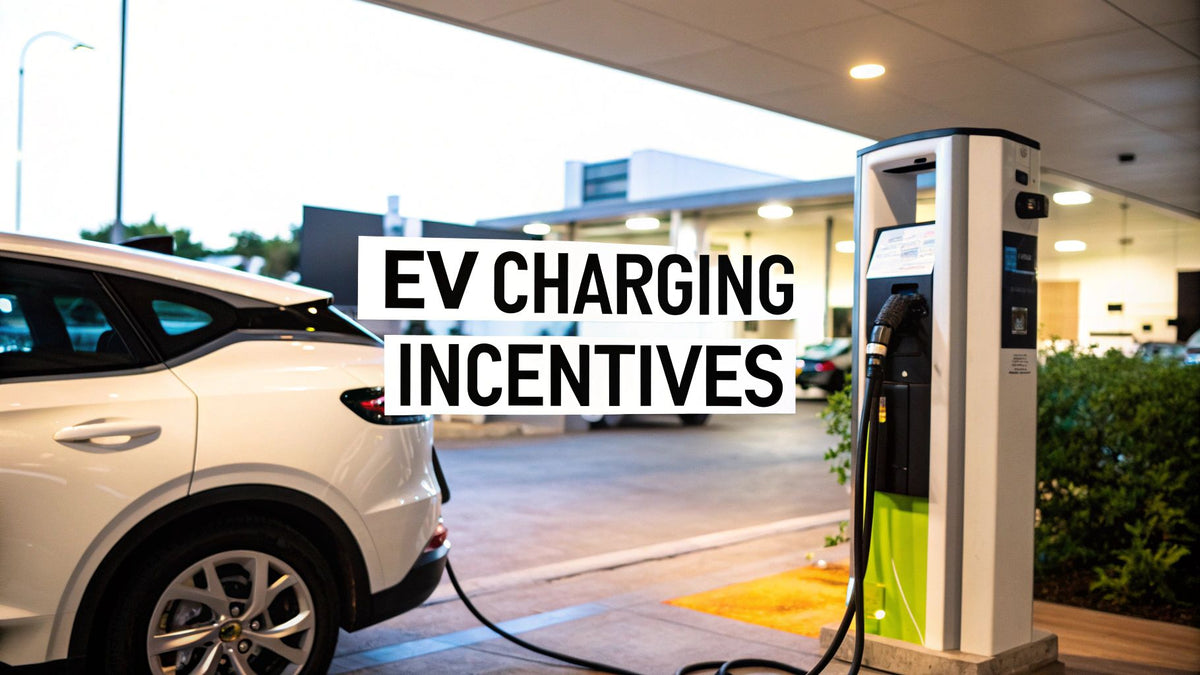
The incentive stack for EV charging infrastructure is the most generous funding environment the electrical trade has ever seen — and also the most paperwork-intensive. We help installers, developers, and EPCs source compliant equipment for funded projects every week, and the ones who capture the money share one trait: they design the project around the incentive rules from day one instead of retrofitting compliance after the fact. This guide maps the full stack — federal, state, utility — with the eligibility traps and the stacking math worked out in real numbers. Whether you are an installer building a bid, a developer pro-forma-ing a corridor site, or a property manager trying to understand why everyone suddenly wants to talk about charging, the mechanics below are the ones that decide who gets funded.

One discipline note before the programs: incentives change. Program budgets exhaust, rules get amended, tax guidance gets updated. Every figure here reflects published program documentation at the time of writing, and every application should verify current status with the program administrator. Treat this guide as the map, not the territory — and verify the map before you drive on it.
Understanding the Federal Incentive Landscape
The three federal pillars
Federal support for EV charging infrastructure runs through three distinct mechanisms, and confusing them is the first application-killer we see:
| Program | Type | Headline benefit | Who it serves |
|---|---|---|---|
| Alternative Fuel Infrastructure Tax Credit (IRC 30C) | Tax credit | Up to 30% of cost, capped at $100,000 per item of property | Businesses installing charging in eligible census tracts |
| National Electric Vehicle Infrastructure (NEVI) Formula Program | Formula funding to states | $5 billion over five years; up to 80% federal share per project | DC fast charging along designated corridors |
| Charging and Fueling Infrastructure (CFI) Grant Program | Competitive discretionary grants | $2.5 billion total | Community and corridor charging, including public entities and fleets |
30C: the credit every commercial installer should quote
The 30C credit was rewritten by the Inflation Reduction Act into a per-item credit with two tiers. The base credit is 6% of eligible cost. Meet the prevailing-wage and apprenticeship requirements and the credit rises to 30%. The cap is $100,000 per single item of property — which, per IRS guidance, means per charging port, not per project. That per-port framing matters enormously: a ten-port depot can carry a $1,000,000 theoretical credit ceiling.
Two eligibility gates catch applicants by surprise. First, the property must be located in an eligible census tract — either a low-income community or a non-urban area under the statute's definitions. The Department of Energy publishes a mapping tool; check the exact address, because eligibility boundaries can run down the middle of a street. Second, prevailing wage and apprenticeship compliance is not a box-check: it requires actual payroll documentation from the electrical contractor. Installers who already run Davis-Bacon-compliant crews inherit a 24-point credit advantage over those who do not.
NEVI: corridor fast charging with real strings attached
NEVI funds flow to state DOTs by formula, and states run their own procurement rounds. The federal minimum standards define the product: stations sited along designated Alternative Fuel Corridors, generally at 50-mile maximum spacing; at least four DC fast charging ports per station, each capable of at least 150 kW simultaneously; 97% uptime requirement averaged annually per port; data reporting to the Joint Office; and Buy America domestic-content requirements for the chargers themselves. That last clause reshaped the hardware market — any charger on a NEVI-funded project must satisfy BABA, which is why we flag domestic-assembly status when quoting funded projects.
Published NEVI formula allocations over the five-year program window (FY2022–2026) show where the money concentrates:
| State | Five-year NEVI formula allocation (published) | Program status pattern |
|---|---|---|
| Texas | ~$407.8 million | Multi-round corridor procurement |
| California | ~$383.7 million | Corridor plus state-administered complements |
| Florida | ~$198.3 million | Interstate corridor buildout phases |
| New York | ~$175.4 million | Corridor rounds via NYSERDA-adjacent channels |
| Pennsylvania | ~$171.5 million | Early-round corridor awards, ongoing phases |
| Ohio | ~$140.2 million | Among the first states to open NEVI-funded sites |
| Georgia | ~$135.1 million | Corridor procurement in rounds |
The practical read: NEVI is not a rebate you apply for — it is a procurement you bid into. Track your state DOT's round schedule, read the solicitation's scoring criteria before writing the bid, and expect site-control documentation, utility letters, and BABA-compliant equipment schedules to decide who scores.
State and Local Programs: Where the Smaller Checks Live
Below the federal layer sits a patchwork of state energy-office programs, air-quality district grants, and municipal incentives. They move fast, exhaust fast, and reward applicants who prepared documentation before the window opened. Representative program structures — verify current rounds before relying on any of them:
| Jurisdiction | Program example | Typical structure | Installer note |
|---|---|---|---|
| California | CALeVIP and regional successors | Per-port rebates for L2 and DCFC, set-asides for disadvantaged communities | Funding windows open regionally and can exhaust in days |
| New York | Charge Ready NY 2.0 | Per-port incentives for L2 at workplaces, multifamily, public sites | Equipment must be on the qualified products list |
| Colorado | Charge Ahead Colorado | Grant rounds covering a percentage of project cost | Community and fleet applications score well |
| Massachusetts | MassEVIP | Workplace, fleet, and public-access incentives with site caps | Multi-use sites need careful use-case declaration |
| Texas | TERP and air-quality programs | Emissions-focused grants in nonattainment areas | Geographic eligibility is strict |
The pattern that pays: subscribe to your state energy office and air district mailing lists now, before you have a project. When a window opens with a 60-day clock, the prepared applicant already owns site control documents, utility letters, and equipment quotes — and the unprepared one is scheduling a site assessment while the fund empties.
The Utility Layer: Make-Ready Programs and Rebates
Investor-owned utilities in most states now run EV infrastructure programs under public-utility-commission direction, and these are often the largest single check in the stack for Level 2 projects. Two structures dominate. Make-ready programs fund the utility-side and sometimes customer-side infrastructure — trench, conduit, wire, panel, transformer — leaving the applicant to buy only the chargers. Per-port rebate programs pay a fixed amount per installed networked port, typically with data-sharing and minimum-uptime conditions attached.
The utility conversation should start before design freezes, for a practical reason beyond money: make-ready programs frequently require the utility to own or specify the service design, and redesigning a permitted project to fit the program after the fact costs more than the rebate saves. Our commercial installation guide covers the utility interconnection sequence in project-management terms; this section is about the money attached to it.
Eligibility and Compliance: Where Applications Die
Across hundreds of program rules, the same compliance themes recur. Treat this as the pre-application checklist:
| Requirement theme | Typical rule | Compliance artifact to prepare |
|---|---|---|
| Network capability | OCPP-compliant networked chargers with data reporting | Manufacturer OCPP certification documentation |
| Uptime | 97% annual uptime on NEVI-funded DCFC; similar thresholds elsewhere | Network reporting configuration plus maintenance contract |
| Domestic content | Buy America on federally funded projects | Manufacturer BABA compliance letter per model |
| Qualified products | Equipment on the program's approved list | QPL listing confirmation at quote time, not order time |
| Site control | Ownership or long-term host agreement | Executed host agreement with term matching program obligation |
| Accessibility | ADA-compliant accessible stalls and reach ranges | Site plan with accessible stall detail |
| Labor standards | Prevailing wage / apprenticeship (30C bonus, many state programs) | Contractor payroll compliance process |
| Reporting duration | Multi-year data obligations, commonly five years | Owner-signed reporting plan and network subscription budget |
Two rows deserve emphasis because they fail most often. The qualified-products row: programs reimburse listed equipment, and equipment gets delisted — confirm the listing the week you order, and keep a screenshot. The reporting row: five years of networked data obligations is an operating cost, and applications that forget to budget network subscriptions and maintenance contracts create stations that lose compliance in year three. We sell the hardware, but we tell every funded buyer to price five years of software and a maintenance agreement into the pro forma on day one.
Stacking Incentives: The Framework and the Math

The stacking rules
Most programs can stack, with two recurring constraints: total incentives cannot exceed 100% of eligible project cost (many cap at 80–90%), and some programs prohibit combining with specific others. Read the "other funding sources" clause in every program guide. The workable sequence we recommend:
- Anchor with the largest program whose geography and use case fit — NEVI for corridor DCFC, utility make-ready for urban L2.
- Layer state energy-office or air-district funds where they explicitly permit combination.
- Apply 30C to the applicant's remaining basis — note that tax-exempt entities can use elective pay, which opened the credit to municipalities, schools, and nonprofits.
- Close gaps with local programs and, on the revenue side, LCFS credits in California or similar clean-fuels programs elsewhere, which pay on dispensed energy rather than capital cost.
A worked stacking scenario
A retail developer builds a four-port 150 kW DCFC station in an eligible census tract, $280,000 all-in installed cost, prevailing-wage compliant:
| Stack layer | Mechanism | Amount | Constraint applied |
|---|---|---|---|
| State NEVI corridor award | 80% federal share cap | $180,000 (scored award, below the 80% ceiling) | BABA-compliant chargers, 97% uptime obligation |
| Utility make-ready | Utility-side service work funded | $25,000 value | Program owns service design |
| 30C tax credit | 30% of remaining eligible basis | ~$22,500 on the applicant's residual basis (subject to tax counsel's basis calculation) | Prevailing wage documented; per-port caps observed |
| Total support | ~$227,500 of $280,000 (≈81%) | Within program stacking limits |
The residual ~$52,500 is the developer's actual exposure on a $280,000 station — that is why the corridor DCFC market is moving. The discipline the table hides: basis calculation after grants is a tax-counsel question, stacking permission must be confirmed in writing from each program, and the 97% uptime obligation is a five-year operating commitment with clawback teeth. Take the money with the obligations priced in.
Documentation: The Installer's Packet
Installers who want repeat funded work should maintain a standing documentation packet: contractor license and insurance certificates; EVITP or equivalent training credentials for the crew; prevailing-wage payroll capability statement; BABA-compliant equipment options with manufacturer letters; OCPP certification evidence for the charger lines you install; and two or three reference projects with named contacts. When a developer assembles a NEVI bid or a utility program application, the installer with the ready packet gets written into the proposal. The one assembling documents loses the slot to the one who already has them.
On the equipment side, our EV charger catalog, Level 2 chargers, and DC fast chargers carry the models we see specified on funded projects, and we provide the spec sheets, listing documents, and origin letters that application packets require. Cost baselines for the application budgets are in EV charging station installation cost.
Application Strategy: Timing and Readiness
Incentive programs reward preparation more than quality of need. A mediocre application submitted in week one of a first-come window beats an excellent application assembled in week seven of an eight-week fund. Build the readiness file before you need it: site control documentation, twelve months of utility bills, a utility capacity letter or pre-application response, stamped or draft single-line drawings, equipment quotes with qualified-products-list confirmation, and a host agreement with a term that matches the program's obligation period. Assembled once, that file serves every program in the stack — the programs ask for the same documents in slightly different fonts.
Timing has a second dimension: tax-credit basis. For 30C projects, the credit applies to eligible basis net of certain other funding, and the interaction between grants and credits is a tax-counsel calculation, not a guess. Bring the CPA into the project at application time, not at filing time. We have seen developers discover in February that their grant structure reduced their credit basis by six figures; the ones who modeled it in advance structured differently and kept the money.
Sector Playbooks: Where the Money Fits Best
Multifamily properties
Multifamily is the most incentivized underserved segment: state per-port programs specifically carve out multifamily set-asides, utility make-ready programs frequently cover the expensive trench-and-panel work that kills apartment charging economics, and eligible-census-tract status for 30C overlaps heavily with where multifamily stock actually sits. The design pattern that works: start with four to eight Level 2 ports on managed load sharing, use the utility make-ready program for the electrical backbone, and structure parking policy so residents register for access rather than compete for plugs. Level 2 chargers with RFID or app authentication are the workhorse hardware here.
Workplace charging
Workplace programs pay for employee retention benefits, not revenue — price the ports at cost-recovery or free, stack the state per-port rebate with utility make-ready, and use the 30C credit where the tract qualifies. The operational trap at workplaces is the 9 a.m. simultaneous-arrival peak; load management under NEC 625.42 turns that peak into a software setting instead of a service upgrade.
Fleet depots
Fleet applications score well on emissions displacement in air-quality programs, and CFI discretionary grants have explicit fleet corridors. The incentive-relevant design decisions: document dwell times and departure schedules (programs ask), size charging to the schedule rather than the nameplate, and declare managed-charging capability — utilities reward fleets that accept off-peak scheduling with both rebates and rate structures.
Retail and corridor DCFC
Public fast charging is where NEVI and CFI money lives. The playbook is the procurement one: site control on or near designated corridors, four-plus 150 kW ports to meet federal minimums, BABA-compliant hardware with manufacturer letters, a credible 97% uptime plan (spare parts, service contract, network monitoring), and a business case that survives the demand-charge math. Pairing DCFC with on-site storage from our energy storage systems lineup is increasingly how winning bids handle the demand-charge line.
The Mistakes That Cost Applicants Money
After watching applications succeed and fail across multiple states, the recurring errors are remarkably consistent:
Applying before site control is real. A letter of intent is not site control for most programs; they want an executed lease or ownership document with a term covering the obligation period. Applications die at threshold review on this line.
Specifying delisted equipment. Qualified products lists change. A charger model listed at application time can be delisted before procurement if certifications lapse. Lock the equipment schedule with a current listing screenshot and a supplier commitment — we timestamp ours on every funded quote.
Ignoring the obligation tail. Five years of uptime reporting, data sharing, and operational requirements are enforceable commitments with repayment provisions. Pro formas that treat incentive money as free create stations that get clawed back.
Designing first, reading rules second. The expensive sequence: design and permit a project, then discover the incentive program requires different networking, different port counts, or a different service design. Every program guide should be read before the design freeze, not after.
Missing the census-tract check. For 30C, tract eligibility is binary and address-specific. Check the DOE mapping tool on the exact parcel before promising anyone a 30% credit.
How Incentives Should Change Your Design

The deepest shift incentives create is architectural. Unfunded design minimizes first cost; funded design maximizes compliant value. Concretely: networked OCPP hardware becomes mandatory rather than optional, which is a genuine upgrade. Load management moves from nice-to-have to program requirement on many utility offers. Port counts grow because per-port caps (like 30C's $100,000-per-port structure) reward more ports per project. And documentation — as-builts, commissioning records, serial-number logs — becomes a deliverable with dollar value attached. We tell installers: on a funded project, the paperwork is part of the product. Build the documentation habit into the construction process and the final report assembles itself.
Modeling Project ROI After Incentives
Post-incentive economics change the payback conversation completely. A $40,000 four-port Level 2 workplace project with 60% stacked support carries $16,000 of net capital. Against that, count energy margin or cost recovery, the 30C credit's effect on basis, LCFS or clean-fuels revenue where available, and the soft returns — tenant retention, employee benefit, ESG reporting value — that justified the project before incentives existed. Run the model at conservative utilization: Level 2 workplace ports averaging one to two sessions per day produce honest numbers; projections built on four sessions per day produce disappointed owners. The installation cost breakdown provides the capital side of the model, and our commercial installation guide covers the operating-cost lines the model needs.
Tax Mechanics: Depreciation, Basis, and Elective Pay
Three tax mechanics decide how much of the 30C headline a project actually keeps. First, basis: the credit applies to eligible basis, and grant funding that is excluded from income can reduce that basis — the interaction is mechanical and material, which is why tax counsel belongs in the application phase. Second, depreciation: charging infrastructure generally qualifies for accelerated cost recovery, and bonus-depreciation provisions have repeatedly shifted the first-year write-off percentage — have the CPA run the current-year schedule rather than assuming last year's number. Third, elective pay: tax-exempt entities — municipalities, school districts, nonprofits, tribal governments — can receive 30C and related credits as direct payments, which converted public-sector charging from a grant-hunting exercise into a straightforward procurement with a federal reimbursement at the end. If you install for public entities, learn the elective-pay pre-filing registration process; it is the question your municipal customers will ask first.
Reading a Program Guide: The 20-Minute Protocol
Every incentive program publishes a guide, and the guides are long. Ours is the twenty-minute extraction protocol we train internally: read the eligibility threshold section first (geography, applicant type, equipment classes) — if you fail threshold, nothing else matters. Second, the funding mechanism (first-come, competitive, or formula) and the window dates. Third, the caps and percentages, with the stacking clause. Fourth, the compliance obligations section — uptime, reporting duration, labor standards — because that is where the true cost of the money lives. Fifth, the disbursement mechanics: reimbursement versus milestone payment, and what documentation triggers payment. Skip the marketing pages entirely. Twenty minutes, five sections, one go/no-go decision.
Three States Worth Studying as Models
California layers the deepest stack in the country: CALeVIP-style regional per-port rebates, utility make-ready programs at the major IOUs, LCFS credits that pay ongoing revenue per dispensed kWh, and air-district grants in the nonattainment zones. The complexity is the price of depth — California projects justify a dedicated incentive consultant on anything above small-L2 scale.
New York runs the cleanest per-port model: Charge Ready NY 2.0 pays fixed incentives per Level 2 port at workplaces, multifamily, and public sites, with a qualified products list and straightforward documentation. It is the template other states copy, and the easiest first program for an installer learning the incentive business.
Colorado shows the grant-round pattern: Charge Ahead Colorado opens periodic competitive windows covering a percentage of project cost, with scoring that rewards community benefit and demonstrated readiness. The lesson generalizes — in competitive programs, the application is a proposal, and proposals win on completeness and scoring-criteria alignment, not on need.
The 97% Uptime Requirement in Operational Terms

NEVI's 97% uptime standard deserves translation into operations, because it is the obligation that separates serious operators from grant collectors. Ninety-seven percent annually per port allows roughly eleven days of downtime per year — across hardware faults, network outages, vandalism, and utility interruptions combined. Meeting it requires: networked monitoring with automated fault alerts, a service agreement with defined response times, spare wear items (connector holsters, cables, screens) in local inventory, and a firmware-management process that tests updates before fleet-wide pushes. Stations that treat uptime as a maintenance contract line item hit 97% comfortably; stations that treat it as a hope do not, and the clawback provisions are not theoretical.
A Second Worked Example: The Multifamily Stack
DC fast charging gets the headlines, but the most commonly funded project in the country is a modest multifamily Level 2 installation. An eight-port project at a garden-style apartment complex in an eligible tract, $52,000 all-in:
| Stack layer | Mechanism | Amount | Condition |
|---|---|---|---|
| Utility make-ready | Trench, panel, and service work funded | $18,000 value | Utility owns service design; easement signed |
| State per-port program | Fixed incentive × 8 networked ports | $16,000 (illustrative $2,000/port class) | Qualified products list equipment; 5-year reporting |
| 30C tax credit | 30% of eligible residual basis | ~$5,400 class (per tax counsel's basis math) | Prevailing-wage crew; tract eligibility confirmed |
| Total support | ~$39,400 of $52,000 (≈76%) | Within stacking caps |
The property's residual exposure is roughly $12,600 for eight ports — about $1,575 per port net, which is less than the trenching alone would have cost unassisted. This is why multifamily charging is finally penciling, and why properties that ran the numbers in 2021 and walked away should run them again.
Managing the Incentive Timeline Against the Construction Timeline
Funded projects run two clocks at once, and the clocks do not care about each other. The program clock: application window, award notification, contract execution, completion deadline, reporting start date. The construction clock: design, permitting, utility capacity work, equipment lead times, construction, commissioning. The collision point is usually the completion deadline against utility lead times — programs grant extensions for documented utility delays far more readily than for contractor scheduling failures, which is one more argument for opening the utility process in week one. Build a single Gantt view with both clocks on it, flag the completion deadline in red, and hold a monthly check against it. The projects that lose funding to expired deadlines are almost never the ones with technical problems; they are the ones that stopped watching the calendar.
Working with PES Supply on Funded Projects
Our role in the incentive ecosystem is the equipment and documentation layer. On funded projects we provide: quotes formatted to program budget templates; qualified-products-list confirmation with timestamps; BABA compliance letters where programs require them; OCPP certification documentation; and delivery scheduling matched to program completion deadlines. If you are building a bid and need the equipment schedule priced and documented, that is a same-week turn, not a research project. Start at the EV charger catalog or contact the commercial desk with the program name and port count — we have probably quoted that program's requirements before.
One offer we make to every funded-project buyer: send us the program guide with your RFQ. We will flag the equipment-schedule requirements that trip up procurement — listing status, origin documentation, delivery windows — before they become change orders. It costs you an email and it routinely saves a resubmittal.
Beyond Capital: Operating-Revenue Programs
The incentive conversation usually stops at capital cost, and that is a mistake. California's Low Carbon Fuel Standard pays credits on dispensed EV charging energy — real, recurring revenue that accrues to the station owner or a designated aggregator, at values that have historically exceeded the wholesale electricity cost of the dispensed energy itself. Oregon and Washington run analogous clean-fuels programs, and other states have legislation in motion. For any public or workplace station in a clean-fuels state, register for the program at commissioning; the credits accrue from the meter, and retroactive claims are limited. A four-port public L2 site generating modest utilization can produce four figures of annual credit revenue — money that never appears in the capital pro forma but materially changes year-three operations.
What to Watch: The Forward Calendar
Program trajectories worth tracking rather than memorizing: state NEVI rounds continue on multi-year schedules, so a corridor site that missed round one remains a candidate. CFI discretionary rounds recur. Utility programs renew and expand through commission proceedings — when your utility files a new transportation-electrification plan, that filing is your eighteen-month forecast. And the 30C credit's tract-eligibility maps update periodically, which can open or close site eligibility without the address moving an inch. Assign someone — internal or an incentive consultant — to a quarterly scan of the four layers: federal tax guidance, state energy office, air district, and utility filings. The scan takes an afternoon per quarter and routinely finds money that was not there the previous quarter.
For Installers: Incentives as a Sales Motion
A closing thought for the contractors reading this. Incentive fluency is the highest-leverage sales skill in the EV charging trade right now. The contractor who can tell a property manager "your utility covers the trench, the state pays $2,000 a port, and the federal credit covers most of the rest — your net is about a quarter of the sticker" wins the job against three competitors quoting gross price. That fluency is not expensive to build: one afternoon per program in your service territory, a standing documentation packet, and a supplier who timestamps qualified-products confirmations on every quote. We do our part on the equipment documentation side; the contractors who pair it with program knowledge are the ones whose calendars stay full.
Frequently Asked Questions
Can I combine federal, state, and utility incentives?
Usually yes, with two constraints: most programs cap total combined incentives at 80–100% of eligible cost, and some programs prohibit specific combinations. Confirm stacking permission in each program's current guide and keep the confirmations in the project file.
What is the difference between a rebate and a tax credit?
A rebate pays cash against documented costs, typically through a program administrator with a funding window. A tax credit (like 30C) reduces tax liability when you file — value depends on tax appetite, though tax-exempt entities can now use elective pay to receive it as a direct payment.
Who qualifies for the 30C charging credit?
Businesses installing charging property in eligible census tracts — low-income communities or non-urban areas per the statute's definitions. The credit is 6% of eligible cost, rising to 30% with prevailing-wage and apprenticeship compliance, capped at $100,000 per charging port.
What does NEVI require of funded stations?
Corridor siting on designated Alternative Fuel Corridors, at least four 150 kW-capable DCFC ports, 97% annual uptime, data reporting, and Buy America-compliant equipment. States procure projects against these federal minimums plus their own scoring criteria.
Are there incentives for workplace and multifamily charging?
Yes — this is the sweet spot for state per-port programs and utility make-ready offerings. Programs like New York's Charge Ready and many utility rebates specifically target workplaces, multifamily properties, and public-access Level 2 sites.
What happens if a program runs out of money?
First-come programs close when funds exhaust — sometimes within days of opening. Competitive programs score remaining applications against the next round. The mitigation is preparation: site control, utility letters, and equipment quotes ready before windows open.
Do funded chargers have to be made in America?
Federally funded projects (NEVI, CFI) carry Buy America domestic-content requirements for the chargers. State and utility programs vary. Verify the specific requirement before specifying equipment — manufacturer BABA letters are standard request items on funded projects.
How long do incentive obligations last?
Commonly five years of operational, uptime, and data-reporting obligations after commissioning. Network subscriptions, maintenance contracts, and reporting processes should be budgeted for the full obligation term, and early decommissioning can trigger repayment provisions.