Explore the Solar Hub → panel sizing guides, brand comparisons, and in-stock kits in one place.
Shopping for a "1000-watt solar panel" puts you in the middle of the most inflated product category in the solar business — so let's start with what's real. Whether you're speccing an RV roof, an off-grid cabin, or a starter array for the house, you need to know two things: how big solar panels actually are in inches, and how many of them add up to a true 1,000 watts. The answers decide your roof layout, your racking, and whether the plan fits the space you have.
This guide gives you the real numbers: actual dimensions of every panel class from 400W to 700W+, the configurations that genuinely make 1,000 watts, the space and clearance math for your install, and the spec-sticker check that exposes inflated marketplace listings before they cost you money. Everything below comes from the same spec sheets and warehouse stock we sell from at PES Supply.
⚠️ Important Clarification: Single 1000W Panels vs. 1000W Systems
True single-panel 1000W solar modules are extremely rare in the residential and light commercial market. Most "1000W solar panel" searches actually refer to either: (1) combining multiple panels to reach 1,000 watts total, or (2) the largest commercially available panels in the 500-700W range. This guide covers both scenarios to help you plan accurately.
In This Guide:
- The Truth About 1,000W Panels in 2026
- Understanding Solar Panel Wattage and Size
- High-Wattage Single Panel Dimensions
- Common 1000W System Configurations
- Panel Size by Technology Type
- How Cell Count Affects Panel Dimensions
- Space Requirements for 1000W Systems
- Efficiency vs. Size: The Trade-Off
- Installation Planning and Layout
- Choosing the Right Panel Size
- Frequently Asked Questions
The Truth About "1,000-Watt Solar Panels" in 2026


Let's clear up the biggest misconception behind this search: a single 1,000-watt residential solar panel does not exist — not from any Tier 1 manufacturer, not in 2026. The largest real single modules top out around 700–760 watts, and those are oversized commercial-format panels that measure nearly 8 feet long, weigh 80+ pounds, and are engineered for ground-mount and warehouse rooftops, not residential installs. Anything advertised as a "1000W solar panel" is one of three things: a kit or bundle of several smaller panels totaling 1,000W, a folding or flexible array marketed to RV and camping buyers, or — too often — a marketplace listing with inflated specs.
What most people searching "1000 watt solar panel" actually need is a 1 kW array, and that's easy to build from real panels: 2 × 500W, 3 × 335W, 4 × 250W, or 5 × 200W. A 1 kW array produces roughly 4–6 kWh per day depending on your sun hours — enough to meaningfully offset a home's usage, fully power an RV or off-grid cabin's essentials, or serve as a serious battery-charging setup.

Real Large-Format Panel Dimensions (Inches)
These are the actual size classes shipping today — the closest you can get to a "1000W panel" with a single module:
| Panel Class | Typical Dimensions | Footprint | 1 kW Array Math |
|---|---|---|---|
| 580–615W (72-cell) class (144 half-cell) | 89.7" × 44.6" × 1.4" | ~27.8 sq ft | 2 panels ≈ 1.1 kW — 56 sq ft |
| 600W class (large-format) | 96.5" × 44.6" × 1.4" | ~29.9 sq ft | 2 panels ≈ 1.2 kW — 60 sq ft |
| 700W class (210mm commercial) | 93.9" × 51.3" × 1.4" | ~33.5 sq ft | Not residential-rated — commercial only |
Pricing a system like this? Get a free solar system quote — PES designs and ships complete kits nationwide.
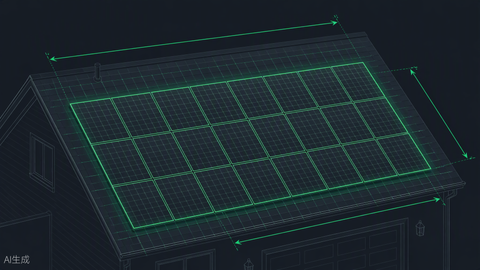
The footprint math for a true 1 kW array: two 500W-class panels need about 56–60 sq ft of mounting area; three 335W panels need about 54–58 sq ft; five 200W panels (common for RV and ground builds) need about 55–60 sq ft. Whichever combination you choose, plan on roughly 55–60 square feet plus setback clearances — fire code typically requires 18–36 inches of clear access at ridges and edges on a roof. For exact module dimensions, check the spec sheets in our solar panel catalog, and for the oversized classes see our commercial solar panels collection.
Field note from the warehouse: We've unloaded enough 210mm-format panels to warn you properly — a 700W module is a two-person, no-wind-day lift, and the "residential" listings selling single 700W+ panels to homeowners skip that part. For a roof, 440–520W modules are the sweet spot: one person can position them, and the racking math is standard.
⚡ Buyer's Warning
If a marketplace listing claims a single 1000W panel the size of a standard residential module (~68" × 45"), the specs are inflated — physics caps a panel that size at roughly 450–500W even at record lab efficiencies. Check the Voc, Isc, and cell count on the spec sticker: watts = volts × amps, and a 12V-class panel simply cannot make 1000W. Buy panels with published datasheets from manufacturers that honor warranties — it's the difference between a 25-year asset and an expensive lesson.
What 1 kW Actually Produces: Daily and Monthly Output by Sun Hours
Dimensions tell you where it fits; sun hours tell you what it earns. A 1 kW array produces its rating × your peak sun hours per day, before losses. The monthly column uses an 80% real-world factor for heat, wiring, and inverter losses:
| Peak Sun Hours | Daily Output (raw) | Monthly Output (after losses) | What That Covers |
|---|---|---|---|
| 3.5 (Pacific NW, upper Northeast) | 3.5 kWh | ~84 kWh | RV/cabin essentials, battery charging |
| 4.0 (Mid-Atlantic, Midwest) | 4.0 kWh | ~96 kWh | Workshop, ~10% of an average home |
| 5.0 (Texas, Southeast) | 5.0 kWh | ~120 kWh | Serious offset of a home's usage |
| 6.0 (desert Southwest) | 6.0 kWh | ~144 kWh | Full off-grid cabin + margin |
| 6.5 (Phoenix, best US sites) | 6.5 kWh | ~156 kWh | Small efficient household |
Panel wattage is measured under Standard Test Conditions: 1,000 W/m² of irradiance, 25°C cell temperature, air mass 1.5. It's a lab number — useful for comparing modules, optimistic for planning production. Two things follow from it: a panel only makes its rating under perfect, cool, noon-sun conditions, and the rating is directly tied to how much silicon is inside the frame. More watts means more cell area, and more cell area means a bigger panel. That's the whole wattage-size story in one paragraph.
The Wattage-Size Relationship
Manufacturers get more watts per panel three ways: pack in more cells, grow the cells themselves (the industry has moved from 156mm wafers to 182mm and 210mm), or raise cell efficiency so the same area converts more sunlight. Every high-wattage panel on the market is some combination of the three — and all three push dimensions up, which is why wattage classes map so predictably to size classes in the tables below.
Power Output Formula:
Panel Wattage = Cell Count × Watts per Cell
Example: 72 cells × 7W per cell = 504W panel
Solar Panel Wattage Categories
Here's where a 1 kW target sits in the real product landscape — from the 100W panels we sell for RV roofs to the 700W commercial formats that need two people and a plan to move:
| Wattage Category | Typical Range | Common Applications |
|---|---|---|
| Small/Portable | 50–150W | RVs, boats, camping, small off-grid |
| Standard Residential Solar | 300–400W | Home rooftop installations |
| Premium Residential | 400–450W | High-efficiency home systems |
| Commercial Grade | 500–600W | Commercial rooftops, ground mount |
| Utility Scale | 600–700W+ | Solar farms, large commercial |
💡 Key Insight: 1000W Requires Multiple Panels
As of 2026, the largest commercially available single solar panels produce approximately 700–770W. Achieving 1,000 watts of capacity requires combining two or more panels. A true single-panel 1000W module would be impractically large for most residential applications—roughly 55-60 square feet.
Since no true 1000W single panel exists, the practical question is how big the largest real modules are — because two of them is how you actually get to 1,000 watts. These measurements include the frame, which adds roughly an inch to each side beyond the active cell area.
Dimensions of High-Wattage Solar Panels
The following table shows typical dimensions for high-wattage panels from major manufacturers. These measurements include the aluminum frame, which adds approximately 1-2 inches to each dimension beyond the active cell area.
| Panel Wattage | Length (inches) | Width (inches) | Thickness (inches) | Area (sq ft) |
|---|---|---|---|---|
| 400W | 69–74 | 41–44 | 1.4–1.6 | ~19.6–22.6 |
| 450W | 75–79 | 41–44 | 1.4–1.6 | ~21.3–24.1 |
| 500W | 79–85 | 43–46 | 1.4–1.8 | ~23.6–27.2 |
| 545W | 87–91 | 44–47 | 1.4–1.8 | ~26.6–29.7 |
| 600W | 90–95 | 45–48 | 1.4–2.0 | ~28.1–31.7 |
| 700W | 95–102 | 50–55 | 1.4–2.0 | ~33.0–39.0 |
Theoretical 1000W Single Panel Dimensions
If a true 1000W single panel existed using current technology, what would it look like? Based on typical power density of modern high-efficiency monocrystalline panels (approximately 200-220 watts per square meter or 18-20 watts per square foot), a 1000W panel would require:
Theoretical 1000W Single Panel:
- Approximate dimensions: 110–120 inches × 55–60 inches (9–10 ft × 4.5–5 ft)
- Surface area: 50–55 square feet
- Estimated weight: 90–110 lbs
- Cell count: 144+ cells (assuming 182mm or 210mm wafers)
Such a panel would present significant handling, shipping, and installation challenges, which is why manufacturers instead produce panels in the 500-700W range and expect installers to combine multiple units for higher capacity systems.
Getting to a real 1 kW means combining panels — and the combination you pick changes your footprint, your wiring, and your install day. Here are the configurations we see ordered most, with honest space numbers:
1000W Configuration Options
| Configuration | Panel Size Each | Total Watts | Total Area | Best For |
|---|---|---|---|---|
| 2 × 500W | ~82" × 45" | 1,000W | ~51 sq ft | Minimal footprint, fewer connections |
| 2 × 545W | ~89" × 45" | 1,090W | ~56 sq ft | Commercial installations |
| 3 × 350W | ~65" × 39" | 1,050W | ~53 sq ft | Budget-friendly option |
| 3 × 440–520W | ~70" × 42" | 1,200W | ~61 sq ft | Standard residential with extra capacity |
| 4 × 250W | ~65" × 39" | 1,000W | ~70 sq ft | Older inventory, flexible layouts |
| 5 × 200W | ~58" × 27" | 1,000W | ~55 sq ft | Small spaces, irregular roofs |
💡 Pro Tip: Fewer Panels = Simpler Installation
Using fewer, higher-wattage panels reduces installation labor, minimizes electrical connections (fewer potential failure points), and simplifies mounting hardware requirements. Two 500W panels are typically faster and easier to install than four 250W panels, even though total wattage is identical.
Layout Dimensions for Common Configurations
The same 1 kW can wear very different footprints depending on orientation and grouping. Portrait stacks run long and narrow; landscape rows run wide and low. Match the layout to the roof plane or ground space you actually have:
| Configuration | Layout Option | Footprint (inches) | Footprint (feet) |
|---|---|---|---|
| 2 × 500W | Side by side (landscape) | 82" × 90" | 6.8' × 7.5' |
| Stacked (portrait) | 164" × 45" | 13.7' × 3.8' | |
| 3 × 400W | Single row (portrait) | 70" × 126" | 5.8' × 10.5' |
| Single row (landscape) | 210" × 42" | 17.5' × 3.5' | |
| 4 × 250W | 2×2 grid (portrait) | 130" × 78" | 10.8' × 6.5' |
| Single row (landscape) | 260" × 39" | 21.7' × 3.3' |
Cell technology is the other lever on panel size. Higher-efficiency chemistry puts more watts in the same frame — or the same watts in a smaller frame. Here's how the three families compare, with the caveat that only one of them matters for new installs in 2026.
Monocrystalline Solar Panels
Monocrystalline is the default today — single-crystal silicon, black cells, and the highest power density you can buy. In 2026 the volume standard is N-type TOPCon, with HJT and back-contact at the premium end; the older P-type PERC lines are end-of-life and only worth buying at liquidation pricing. For equivalent wattage, mono needs 15–25% less roof than the older technologies.
Monocrystalline Characteristics:
- Efficiency range: 19–23% (premium models exceed 22%)
- Power density: 180–230 watts per square meter
- Size advantage: 15–25% smaller than polycrystalline for same wattage
- Appearance: Black cells, black or silver frame
- Cost: Higher initial cost, best long-term value per watt
Polycrystalline Solar Panels
Polycrystalline — the blue, flake-patterned panels — is effectively discontinued for new work. You'll meet it in older systems and surplus lots. It's 15–25% larger than mono for the same wattage, which is exactly why the market moved on: roof space is the scarce resource, not silicon.
Polycrystalline Characteristics:
- Efficiency range: 15–18%
- Power density: 140–180 watts per square meter
- Size comparison: 15–25% larger than monocrystalline for same wattage
- Appearance: Blue cells with visible crystal patterns, silver frame
- Market status: Largely discontinued for new residential installations
Thin-Film Solar Panels
Thin-film deposits photovoltaic material in layers on glass or flexible substrates. It's light and bends, which makes it genuinely useful for curved RV roofs, boats, and building-integrated glass — and genuinely wrong for a space-limited residential roof, because it needs 40–80% more area per watt than mono.
Thin-Film Characteristics:
- Efficiency range: 10–13%
- Power density: 80–130 watts per square meter
- Size comparison: 40–80% larger than monocrystalline for same wattage
- Appearance: Uniform dark appearance, no visible cells
- Applications: Building-integrated PV, flexible installations, low-light conditions
Size Comparison by Technology
The following table compares approximate panel dimensions needed to achieve 500W output (half of a 1000W system) across different technologies:
| Technology | Efficiency | Approx. Size for 500W | Area Required | For 1000W System |
|---|---|---|---|---|
| Monocrystalline | 20–22% | 82" × 45" | ~25.6 sq ft | ~51 sq ft |
| Polycrystalline | 16–18% | 90" × 48" | ~30.0 sq ft | ~60 sq ft |
| Thin-Film | 11–13% | 105" × 55" | ~40.1 sq ft | ~80 sq ft |
Read a panel's size off its label: cell count times cell size, plus frame. Once you know the standard cell formats, you can estimate any module's dimensions within an inch or two before the spec sheet loads — a useful trick when you're screening listings.
Common Cell Configurations
The industry arranges cells in standardized grids. Older residential panels were 60 full cells; modern high-wattage modules use half-cut cells, so a "120-cell" panel is 60 full cells sliced in half — same silicon, lower resistive losses, better shade behavior. The formats you'll actually see in 2026:
| Cell Count | Cell Size | Typical Panel Size | Wattage Range | Application |
|---|---|---|---|---|
| 60-cell | 156mm | 65" × 39" | 280–330W | Legacy residential |
| 66-cell | 166mm | 69" × 41" | 350–440–520W | Standard residential |
| 72-cell | 166mm | 77" × 41" | 380–440–520W | Premium residential/commercial |
| 78-cell | 182mm | 89" × 45" | 480–545W | Commercial installations |
| 96-cell | 182mm | 95" × 48" | 550–600W | Large commercial/utility |
| 108-cell | 210mm | 95" × 52" | 600–670W | Utility-scale |
| 120-cell+ | 210mm | 102" × 55" | 670–750W | Utility-scale, ground mount |
💡 Understanding Half-Cut Cell Technology
Modern high-efficiency panels often use "half-cut" cells, where standard cells are cut in half to reduce resistive losses and improve shade tolerance. A "120-cell" panel actually contains 60 full cells cut into 120 half-cells. This technology improves performance without significantly affecting dimensions.
Field note from the quoting desk: Customers send us marketplace listings weekly asking why our "400W panel" costs more than a "1000W panel" they found online. Nine times out of ten the listing is a folding 12V camping array with fantasy math on the sticker. Check Voc × Isc against the claimed watts — if the numbers don't multiply to the rating, walk away.
A 1 kW install lives or dies on clearances, not panel dimensions. Fire setbacks, ridge pathways, vent clearances, and the airflow gap under the array routinely eat 30–40% of a roof plane that looked "big enough" on paper. Do this math before you order, not on install day.
Calculating Total Installation Space
Total footprint is panel area plus everything the code and the hardware demand around it. Building codes and racking manufacturers both publish clearance requirements — the stricter one wins.
Space Calculation Formula:
Total Area = (Panel Width + Clearances) × (Panel Length + Clearances) × Number of Panels
Example: Two 500W panels (45" × 82" each) with 6" clearances = (45+12) × (82+6) × 2 = ~70 sq ft total
Required Clearances and Setbacks
| Clearance Type | Typical Requirement | Purpose |
|---|---|---|
| Panel-to-Panel Gap | 0.5–1 inch | Thermal expansion, mounting hardware |
| Airflow Gap (under panels) | 2–4 inches | Cooling for improved efficiency |
| Roof Edge Setback | 12–18 inches | Wind load resistance, safety |
| Ridge Setback | 18–36 inches | Firefighter access (varies by jurisdiction) |
| Fire Access Pathway | 36 inches wide | Emergency roof access (if required) |
| Equipment Clearance | 36 inches | Around vents, HVAC, skylights |
Total Space Needed for 1000W Configurations
| Configuration | Panel Area Only | With Clearances | Minimum Roof Area |
|---|---|---|---|
| 2 × 500W | ~51 sq ft | ~65 sq ft | ~80 sq ft |
| 3 × 350W | ~53 sq ft | ~70 sq ft | ~90 sq ft |
| 3 × 400W | ~61 sq ft | ~80 sq ft | ~100 sq ft |
| 4 × 250W | ~70 sq ft | ~95 sq ft | ~120 sq ft |
⚠️ Check Local Building Codes
Fire setback requirements vary significantly by jurisdiction. Some areas require 3-foot pathways on all roof edges, while others have specific ridge clearances. Always verify local requirements with your building department or installer before finalizing system layout.
Efficiency is the spec that shrinks your roof footprint. Every point of module efficiency is roughly 5% less area for the same wattage — which is why a 22% TOPCon panel and a 15% surplus panel differ by a third of a roof plane at 1 kW.
How Efficiency Affects Panel Dimensions
Efficiency is the share of sunlight hitting the glass that comes out as electricity. The jump from 18% to 22% sounds academic until you convert it to square feet:
| Efficiency | Watts per Sq Ft | Area for 500W | Area for 1000W | Size Impact |
|---|---|---|---|---|
| 15% | ~14W | ~36 sq ft | ~72 sq ft | Baseline |
| 18% | ~17W | ~30 sq ft | ~60 sq ft | 17% smaller |
| 20% | ~19W | ~27 sq ft | ~54 sq ft | 25% smaller |
| 22% | ~20W | ~25 sq ft | ~50 sq ft | 31% smaller |
| 24% | ~22W | ~23 sq ft | ~45 sq ft | 38% smaller |
Temperature and Real-World Performance
Ratings are measured at 25°C cell temperature, and roofs are not laboratories. On a hot afternoon cell temperatures hit 60–65°C, and every degree above 25 costs output per the panel's temperature coefficient. This is normal physics, not a defect — but it's why production estimates that assume nameplate output always disappoint.
Temperature Coefficient Impact:
- Typical coefficient: -0.3% to -0.4% per °C above 25°C
- Hot day example: Panel at 65°C loses 12-16% of rated output
- Practical impact: A 500W panel may produce only 420-440W on hot summer afternoons
- Mitigation: Adequate airflow under panels helps maintain lower operating temperatures
A 1 kW system is small enough to fit almost anywhere — which tempts people to skip the layout work and regret it. Ten minutes with a tape measure and these two tables beats re-ordering racking.
Portrait vs. Landscape Orientation
Panels can be mounted in either portrait (vertical) or landscape (horizontal) orientation, affecting how they fit your available space and how mounting rails are configured.
| Orientation | Advantages | Disadvantages |
|---|---|---|
| Portrait | Better for narrow spaces, easier single-row installations, reduced rail material | Taller profile may catch more wind, may not fit under obstructions |
| Landscape | Lower profile, better shade performance, fits low-angle roofs | Requires more mounting rails, wider footprint |
Weight Considerations
Bigger panels are heavier panels, and weight matters twice: getting them up the ladder, and what the roof holds afterward. The good news at 1 kW — no configuration exceeds about 160 lbs of modules, roughly 2.5 lbs per square foot with racking, well inside what any code-built roof carries.
| Panel Wattage | Typical Weight | Weight per Sq Ft | 1000W System Weight |
|---|---|---|---|
| 250W | 35–40 lbs | ~2.5 lbs/sq ft | 140–160 lbs (4 panels) |
| 400W | 45–52 lbs | ~2.3 lbs/sq ft | 135–156 lbs (3 panels) |
| 500W | 55–65 lbs | ~2.2 lbs/sq ft | 110–130 lbs (2 panels) |
| 600W+ | 65–75 lbs | ~2.2 lbs/sq ft | 130–150 lbs (2 panels) |
💡 Two-Person Lift Recommended
Panels over 50 lbs (most 440–520W+ modules) should be handled by two people during installation. The combination of weight and size makes single-person handling risky and potentially damaging to equipment. Professional installers use proper lifting techniques and equipment for safe rooftop placement.
Choosing between two big panels and five small ones isn't a spec-sheet decision — it's a your-roof, your-budget, your-back decision. Match the configuration to the priority that actually constrains you:
Decision Factors
| Priority | Recommended Configuration | Why |
|---|---|---|
| Limited Space | 2 × 500W high-efficiency | Smallest footprint for 1000W capacity |
| Budget-Conscious | 3 × 350W standard | Lower cost per watt, widely available |
| Ease of Handling | 4 × 250W or 3 × 350W | Lighter individual panels, easier one-person carry |
| Future Expansion | Standard sizes (440–520W) | Easier to match additional panels later |
| Commercial Use | 2 × 545W commercial | Professional-grade, excellent warranties |
| Partial Shading | Multiple smaller panels + microinverters | Shaded panels don't reduce entire string output |
How to Measure Your Available Space
Measure twice, order once. This is the same sequence our engineering team runs when customers send roof dimensions with a quote request:
Measuring Steps:
- Measure total roof area: Length × width of each suitable roof section
- Subtract setbacks: Remove 18" from all edges, 36" from ridge
- Subtract obstructions: Remove 36" clearance around vents, skylights, HVAC
- Consider shading: Eliminate areas shaded during peak sun hours (10am–2pm)
- Calculate usable area: Remaining space available for panels
Field note from the roof: The number everyone forgets is the ridge pathway. We've watched homeowners design a perfect edge-to-edge layout, then lose a whole panel column to the 36-inch fire setback at inspection. Mark the setbacks with chalk before you fall in love with a layout — chalk erases, change orders don't.


Shop this guide
Frequently Asked Questions
How big is a 1000W solar panel in inches?
True single 1000W solar panels don't exist in the mainstream market. To achieve 1,000 watts, you'll need multiple panels. Two 500W panels measure approximately 82" × 45" each (~51 sq ft total), while three 350W panels measure about 65" × 39" each (~53 sq ft total). A theoretical single 1000W panel would need to be approximately 110-120" × 55-60" (50-55 sq ft).
What is the largest single solar panel available?
As of 2026, the largest commercially available solar panels produce approximately 700–770W. These utility-scale modules measure roughly 95-102" × 50-55" (about 33-39 square feet). Major manufacturers like Trina, JinkoSolar, and LONGi produce panels in this wattage range for large commercial and utility installations.
How much roof space do I need for 1000W of solar?
For 1,000 watts of solar capacity, plan for approximately 50-70 square feet of panel area depending on efficiency, plus an additional 20-30 square feet for clearances and mounting hardware. Total installation footprint ranges from 70-100 square feet. High-efficiency monocrystalline panels require less space than older polycrystalline technology.
Are bigger solar panels more efficient?
Panel size and efficiency are related but not directly proportional. Larger panels produce more total power but may not be more efficient per square foot. Higher-efficiency panels (22%+) can produce more power in less space than lower-efficiency panels (15-18%). The most efficient panels often come in standard residential sizes (440–520W) rather than the largest commercial formats.
What factors affect solar panel dimensions?
Solar panel dimensions are determined by several factors: cell technology (monocrystalline vs. polycrystalline vs. thin-film), cell size (156mm, 166mm, 182mm, or 210mm), number of cells (60, 66, 72, 78, 96, or more), cell efficiency, and frame design. Higher efficiency cells and half-cut cell technology allow manufacturers to achieve higher wattages in more compact designs.
Should I use fewer large panels or more small panels?
Fewer large panels generally offer advantages: simpler installation, fewer electrical connections (potential failure points), reduced mounting hardware, and often better cost per watt. However, smaller panels may be preferable for complex roofs with multiple orientations, partial shading situations, or when physical handling is a concern. Two 500W panels are typically easier and faster to install than four 250W panels.
How much does a 1000W solar system weigh?
A 1000W solar system weighs approximately 110-160 lbs depending on panel configuration. Two 500W panels weigh about 110-130 lbs total, while four 250W panels weigh 140-160 lbs total. Mounting hardware adds another 15-30 lbs. Most roofs can support this weight without structural modifications, but older roofs or those with damage should be inspected first.
Can I install a 1000W system myself?
Small solar systems can be DIY projects for experienced individuals, but professional installation is recommended for roof-mounted systems. Electrical work typically requires permits and inspections, and improper installation can void warranties, create safety hazards, or violate building codes. Ground-mounted or portable 1000W systems are more DIY-friendly than rooftop installations.
Do 1000 watt solar panels actually exist?
Not as a single residential panel. As of 2026, the largest single solar modules top out around 700–760 watts and are oversized commercial formats nearly 8 feet long. Anything sold as a "1000W solar panel" is a multi-panel kit, a folding array, or an inflated listing.
What does a '1000W solar panel' listing usually mean?
Almost always a bundle: two to five smaller panels sold together totaling 1,000 watts, or a folding/flexible portable array marketed to RV and camping users. Read the spec sheet for Voc, Isc, and individual panel wattage before buying.
How many solar panels make 1000 watts?
The most common combinations are 2 × 500W, 3 × 335W, 4 × 250W, or 5 × 200W. All produce the same 1 kW of nameplate capacity — the choice comes down to your available mounting space and whether you prefer fewer large panels or more small ones.
How big is a 700W solar panel in inches?
The largest commercial-class panels (around 700W) measure roughly 94 × 51 inches — about 33.5 square feet — and weigh 75–85 pounds. They require commercial racking and are not practical for residential rooftops.
How much does 1000 watts of solar panels cost in 2026?
A real 1 kW of quality panels costs roughly $600–$1,100 for the modules alone at current pricing of $0.60–$1.10 per watt, depending on brand and format. Be skeptical of any single "1000W panel" priced far below that — the wattage claim is likely inflated.
Is a 1000W solar system enough to power a house?
Not a typical U.S. home — 1 kW produces about 120–170 kWh per month, covering only 10–20% of average household usage. It's an excellent size for an RV, cabin, workshop, or battery-charging system, or as a starter array you expand later.
The "1000W solar panel" search ends with a layout, not a single product. Check the spec sticker before believing any listing — watts equal volts times amps, and a residential-size panel cannot physically hold 1,000W of silicon. Then pick the configuration that fits your measured space, and buy modules with published datasheets from manufacturers that will still answer the phone in year fifteen.
If you want the short answer for a house or shop roof: two 500W-class panels, about 82" × 45" each, roughly 55–60 square feet with clearances. For an RV or cabin with chopped-up space: five 200W modules arranged around the obstructions. Either way you now have the dimensions to verify the fit yourself — and our quote team will check your layout for free if you send the measurements.
The Bottom Line
A 1000W solar system typically requires 50-70 square feet of panel area using modern high-efficiency panels. The most common configurations use two 500W panels (82" × 45" each) or three 350–400W panels (65-70" × 39-42" each). Plan for an additional 20-30 square feet of clearance space, bringing total installation footprint to approximately 70-100 square feet.
About PES Supply
PES Supply provides high-quality solar panels, inverters, and electrical components to homeowners, contractors, and businesses throughout Kentucky and surrounding regions. Our team combines deep product knowledge with practical installation experience to help customers select the right equipment for their specific needs.
📍 Location: 1507 Portland Ave, Louisville, KY, United States📞 Phone: +1 888-876-0007🌐 Website: www.portlandiaelectric.supply
Article: How Big Is a 1000W Solar Panel in Inches?
Category: Solar Panel Sizing Guides
Last Updated: August 2026
Related Articles: How Many Solar Panels for 1,500 kWh Per Month? | Solar System Size Calculator | Home Battery Bank Sizing Guide
Related Resources:
- Best Solar Panels 2026 — Buyer's Guide
- EG4 vs Tesla Powerwall
- Qcells vs Trina vs JA
- Solar Inverter Buyer's Guide
- Solar Battery Buyer's Guide
- 5kW Solar Kit
- 10kW Solar + Battery Kit
- Off-Grid Cabin Kit
- EG4 Batteries
- Qcells Solar Panels
- Trina Solar
- JA Solar
- REC Solar
- Mission Solar
- Sol-Ark Inverters
- SolarEdge Inverters
- Generac PWRcell
Calculate how much storage you need with our battery sizing calculator.
Use our free solar system calculator to size your array.
Check out our Solar Panel Comparison Tool. Check out our Inverter Sizing Calculator.
Calculate your solar payback and 25-year savings with our Solar ROI Calculator. Follow our complete DIY solar installation guide for step-by-step instructions. Keep your system running at peak performance with our Solar Maintenance Guide.
- NEC Article 690 — Solar Photovoltaic (PV) Systems (nfpa.org)
- NEC Article 705 — Interconnected Electric Power Production Sources (nfpa.org)
- PVEL Module Reliability Scorecard 2025 (pvel.com)
- BloombergNEF Tier 1 module manufacturer list (bankability note — cited by name)
- California Energy Commission (CEC) PV module performance listing (cited by name)
- SEIA / Wood Mackenzie U.S. Solar Market Insight (market data — cited by name)
Related Resources
- Quote My System — free project pricing from PES
- Solar System Calculator
- Battery Sizing Calculator
- Solar Panel Comparison Tool
- Inverter Sizing Calculator
- Solar ROI Calculator
- Solar Installation Guide
- Solar Maintenance Guide
- Solar Permitting Guide
- Battery Installation Guide
- NEC Code Compliance Guide
- Solar Panel Mounting Guide
- Grounding & Bonding Guide
- Solar Incentives by State
- Solar Hub — All Solar Guides
- Generator Hub — All Generator Guides
Shop Related Categories
What size wire do I need?
Wire sizing follows NEC Table 310.16 based on ampacity. A 20A circuit needs 12 AWG copper, a 30A circuit needs 10 AWG, and a 50A circuit needs 6 AWG.
Do I need a permit for electrical work?
Most electrical work requires a permit. Check with your local AHJ (Authority Having Jurisdiction). PES Supply provides spec sheets for permit submittals.
What is the NEC 125% rule?
NEC 210.19(A)(1) requires continuous loads (3+ hours) to be sized at 125% of the rated load. A 16A continuous load needs a 20A breaker (16 x 1.25 = 20A).
PES Supply carries 80,000+ products from 300+ manufacturers. One PO, one invoice, every trade covered.
Need help sizing? Our team can calculate loads, select equipment, and source everything from one PO.
Call (502) 790-0600
Shop the products mentioned in this guide and get everything you need for your project.


Aptos 370W Black On Black 120 Half-cell Mono Solar Panel - DNA-120-MF26-370W
Aptos
$319.36
View Product

Explore our full selection: Silfab Elite 370W N-Type TOPCon All-Blac · Jinko 385W Mono Solar Panel - JKM385M-72 · ZNShine 370W Solar Panel 120 Cell - ZXM6 · Aptos 370W Black On Black 120 Half-cell · Rec Solar TwinPeak 2S 370W Solar Panel -
🔧 Need Help Choosing?
Our team can help you find the right product for your project. Get a free quote today!
Get a QuoteRelated Products:
Silfab Elite 370W N-Type TOPCon All-Black Pan... Jinko 385W Mono Solar Panel - JKM385M-72HBL-V ZNShine 370W Solar Panel 120 Cell - ZXM6-NH12... Aptos 370W Black On Black 120 Half-cell Mono ...Related: Browse PES Supply's in-stock 500-watt solar panel selection with real pricing.