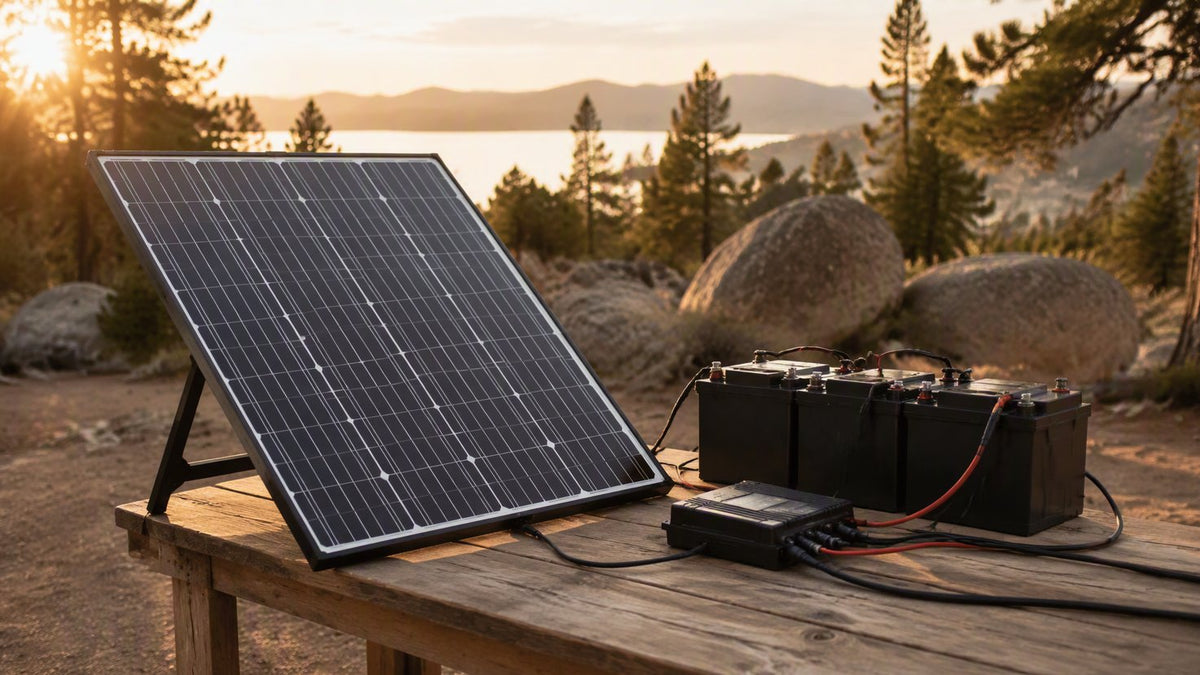
Short answer: a 200-watt solar panel, in decent sun, charges one 12V 100Ah battery from half-empty to full in a single day — or tops off two to three smaller batteries. The long answer depends on peak sun hours, battery chemistry, charge controller type, and how honest you are about system losses. We've built enough small off-grid systems — RVs, gate openers, stock tanks, cabin lighting, boat lifts — to know the spec sheet number and the field number are cousins, not twins. This guide gives you both, with the math shown.

What a 200W Panel Actually Produces in a Day


A 200W rating is a lab number: 1,000 W/m² of irradiance, 25°C cell temperature, perfect angle. Real roofs and real ground mounts give you peak sun hours (PSH) — the equivalent number of full-strength hours your location averages per day. Multiply panel watts by PSH and you get daily watt-hours before losses.
| Peak Sun Hours | Daily Energy Output | Typical Location |
|---|---|---|
| 3 hours | 600 Wh | Pacific Northwest, Northern Europe, winter anywhere northern |
| 4 hours | 800 Wh | Midwest, Northeast US annual average |
| 5 hours | 1,000 Wh | Mid-Atlantic, Central California spring/fall |
| 5.5 hours | 1,100 Wh | Texas, Arizona shoulder seasons |
| 6.5 hours | 1,300 Wh | Desert Southwest summer |
Now the honest part: you never harvest all of that. Heat alone clips 10–15% off a panel's output on a summer afternoon, because silicon cells lose roughly 0.4% of power per °C above 25°C cell temperature — and cells run 20–30°C above ambient in still air. Add wire loss, controller loss, and charge acceptance, and a realistic planning number is 75–80% of the table above with an MPPT controller, less with PWM. We tell customers to plan on a 200W panel delivering about 800 Wh on an average American day. Everything below builds on that.
Seasonal Reality: Same Panel, Half the Battery Charging in Winter
The single biggest planning error we see is sizing a system for June and expecting it to work in December. A site that averages 5.5 PSH in summer can drop to 2–2.5 PSH in winter — and that's before the shorter days give your loads more nighttime hours to drain the bank. Your harvest halves while your consumption rises. That's the double squeeze that kills undersized systems every January.
Our design rule for year-round systems: size for the winter sun-hours, not the annual average, or accept a generator/top-off charging season. For seasonal-use systems — hunting cabins, summer-only camps, RVs that sit in storage October through April — the annual average is fine. Be honest with yourself about which system you're building. A battery bank trickling along at 40% state of charge for three cold months is a battery bank you'll be replacing early, especially if it's lead-acid. Lithium at least tolerates partial-state-of-charge life without sulfating.
Snow deserves a sentence too: a panel under two inches of snow makes nothing. Tilting at 60° for winter both improves the low-angle harvest and sheds snow on the first sunny morning. Ground mounts earn their keep in snow country for exactly this reason.
Series or Parallel: Wiring Multiple Batteries Correctly
When the answer to "how many batteries" is more than one, the wiring question arrives immediately. At 12V, you wire batteries in parallel — positive to positive, negative to negative — and the amp-hours add while voltage stays at 12. Two 100Ah batteries become a 200Ah bank. Three become 300Ah.
Estimating Charging Time for Batteries
Series wiring is a different animal. Two 12V batteries in series give you 24V at the same amp-hours. Why would you? Current. The same 200W of charging power at 24V is 8.3 amps instead of 16.7 — half the current means thinner wire, less voltage drop, and a controller that runs cooler. If you're building anything larger than a two-battery bank, or your inverter is bigger than 1,000W, a 24V system is worth the extra thought. The catch: your 12V loads then need a DC-DC converter, and mixing 12V and 24V gear in one system confuses people during midnight troubleshooting sessions. For simple RV and gate-opener systems, stay at 12V. For cabins with real inverters, go 24V and don't look back.
Practical wiring rules that prevent the failures we get called to fix:
- Connect parallel batteries with the positive take-off on the first battery and the negative take-off on the last (diagonal method). It equalizes cable resistance so each battery carries its share.
- Use identical batteries — same brand, same age, same capacity. A new battery paralleled with a two-year-old battery charges and discharges to the weaker unit's limits.
- Fuse each battery's positive in a multi-battery parallel bank. One shorted cell string without its own fuse turns the other batteries into arc welders feeding the fault.
- Never mix chemistries. Lithium and AGM on the same bus will fight each other's voltage curves forever.
What 800 Watt-Hours Actually Runs: A Load Budget
Customers hear "800 Wh per day" and nod, then ask if it runs their CPAP. Here's the translation table we keep laminated in the service truck:
| Device | Power Draw | Hours/Night | Watt-Hours Used |
|---|---|---|---|
| 12V compressor fridge (cycling ~40%) | 55 W | 10 | 220 Wh |
| CPAP (no humidifier) | 30 W | 8 | 240 Wh |
| CPAP (with humidifier) | 60–90 W | 8 | 480–720 Wh |
| LED lights (4× 5W) | 20 W | 5 | 100 Wh |
| Laptop charging | 60 W | 2 | 120 Wh |
| Phone charging (×2) | 10 W | 2 | 20 Wh |
| 12V vent fan | 24 W | 6 | 144 Wh |
| Water pump (intermittent) | 60 W | 0.5 | 30 Wh |
| Wi-Fi router/hotspot | 8 W | 24 | 192 Wh |
Add it up honestly. The CPAP-with-humidifier row is why some folks need two panels. The humidifier heater draws more than the pump — turn the humidity down or off when running on battery, and the machine sips instead of gulps. A fridge plus lights plus phones plus a fan lands around 480–550 Wh, which is a comfortable single-panel budget. Add the CPAP with humidifier and you're at 900+ Wh — that's a two-panel system, full stop.
Battery Chemistry Decides How Much of That Energy Is Usable
Two batteries with identical amp-hour labels are not the same battery. Flooded lead-acid shouldn't be pulled below 50% depth of discharge if you want it to survive more than a couple of seasons. Lithium iron phosphate (LiFePO4) happily gives up 80–100% daily and lasts a decade doing it.
| Battery Type | Typical Capacity | Usable Capacity | Cycle Life | Maintenance |
|---|---|---|---|---|
| Lead-Acid (Flooded) | 100–200 Ah | 50% | 300–500 cycles | High (water refilling, ventilation, equalization) |
| Lead-Acid (AGM/Gel) | 100–200 Ah | 50% | 400–600 cycles | Low (sealed, but heat-sensitive) |
| LiFePO4 (Lithium Iron Phosphate) | 100–300 Ah | 80–100% | 2,000–6,000 cycles | None (BMS-managed) |
That usable-capacity column is the whole ballgame. A 100Ah AGM holds 1,200 Wh total but only 600 Wh you can spend. A 100Ah LiFePO4 battery gives you 960–1,200 Wh per day, every day, for years. In our shop we stopped quoting lead-acid for daily-cycling jobs in 2022; the lithium price premium paid for itself in one replacement cycle. Lead still makes sense for standby float applications — emergency lighting, backup sump pumps — where the battery sits full 360 days a year.
The Core Math: Panel Watt-Hours vs. Battery Watt-Hours
Convert everything to watt-hours and the question "how many batteries" turns into simple division. A 12V battery's watt-hours are just amp-hours × 12.
Calculating Battery Capacity
| Battery Size | Voltage | Total Capacity | Usable (Lead-Acid 50%) | Usable (Lithium 80%) |
|---|---|---|---|---|
| 50 Ah | 12V | 600 Wh | 300 Wh | 480 Wh |
| 100 Ah | 12V | 1,200 Wh | 600 Wh | 960 Wh |
| 150 Ah | 12V | 1,800 Wh | 900 Wh | 1,440 Wh |
| 200 Ah | 12V | 2,400 Wh | 1,200 Wh | 1,920 Wh |
| 300 Ah | 12V | 3,600 Wh | 1,800 Wh | 2,880 Wh |
Take the 800 Wh realistic daily harvest. Against usable capacity, a 200W panel covers:
- One 12V 100Ah lithium battery (960 Wh usable): a full daily cycle with room to spare in 4+ PSH country.
- One 12V 200Ah lithium battery (1,920 Wh usable): about 40–50% depth of discharge per day — easy duty, long life.
- Two 12V 100Ah AGM batteries (1,200 Wh usable combined): one decent day refills both from half.
- Three 12V 50Ah lithium batteries (1,440 Wh usable): comfortably, with surplus most days.
Number of Batteries a 200-Watt Panel Can Charge
Notice the pattern: the panel doesn't care how many batteries are connected — it cares how many watt-hours you drained the night before. "How many batteries will it charge" really means "how big a bank can one panel keep up with," and the ceiling is your nightly consumption, not the battery count.
Charge Controllers: Where 15–25% of Your Harvest Disappears (or Doesn't)

Factors Affecting Charging Efficiency
Optimizing Your Battery Charging Setup
The controller is the single biggest efficiency lever in a small system. A PWM controller clamps the panel down to battery voltage, throwing away the difference between the panel's 18–22V operating point and the battery's 12–14.6V. An MPPT controller converts that excess voltage into extra charging current. On a cold, clear morning — panels love cold — MPPT gains can hit 30%.
Minimize Wiring Losses
| Efficiency Factor | Typical Loss | How to Minimize |
|---|---|---|
| PWM Controller | 15–25% | Upgrade to MPPT controller |
| MPPT Controller | 2–5% | Choose a quality brand with a high efficiency rating |
| Cable Losses | 2–5% | Use proper gauge wire, keep runs short |
| Panel Temperature | 10–15% (hot climate) | Mount with airflow gap beneath the panel |
| Soiling/Shading | 5–25% | Clean panels monthly; avoid even partial shade |
| Charge Acceptance (lead-acid absorption tail) | 10–20% of harvest window | Switch to lithium, which accepts full current to ~95% full |
Use an MPPT Charge Controller
Sizing the controller: 200W ÷ 12V ≈ 16.7A of charge current at full tilt. A 20A MPPT is the minimum; a 30A unit gives you headroom to add a second panel later, which is what actually happens on most of these jobs. See our MPPT vs. PWM charge controller comparison and the charge controller sizing and selection guide for the full method, or browse charge controllers and 30A charge controllers for current stock.
How Long Does a 200W Panel Take to Charge Common Batteries?
Assume the realistic 75% harvest factor and an MPPT controller. Times below are from roughly half charge to full — a normal daily cycle, not a dead battery rescue.
| Battery Size | Total Capacity | Hours (Full Direct Sun) | Days (4 Peak Sun Hours/Day) |
|---|---|---|---|
| 12V 50Ah (lithium, 80% usable) | 600 Wh | 3–4 hours | ~1 day |
| 12V 100Ah (lithium) | 1,200 Wh | 6–8 hours | 1.5–2 days from low; 1 day on a normal cycle |
| 12V 150Ah (lithium) | 1,800 Wh | 9–12 hours | 2–3 days |
| 12V 200Ah (lithium) | 2,400 Wh | 12–16 hours | 3–4 days |
| 12V 100Ah (AGM, 50% usable) | 1,200 Wh | 6–8 hours | 1.5–2 days, but the absorption tail stretches the last 20% across hours |
| 12V 200Ah (AGM) | 2,400 Wh | 12–16 hours | 3–4 days, with the same slow finish |
One nuance nobody puts on the sales page: lead-acid's absorption phase. The last 20% of an AGM or flooded charge is current-limited by chemistry, not by your panel. You can have perfect noon sun and still watch the battery sip 3 amps for two hours. Lithium takes everything your panel can make until it's practically full. That difference alone is why lithium banks "feel" like they charge faster off the same panel. We covered a specific scenario in how long to charge a 12V 100Ah battery with 200W if you want that exact case walked through hour by hour.
Realistic Daily Yield in Amp-Hours
Some folks think in amp-hours rather than watt-hours. Here's the 200W panel's daily charge yield at 12V, ideal versus field-realistic with MPPT:
| Peak Sun Hours | Ideal Yield (Ah) | Realistic MPPT Yield (Ah) | Typical Regions |
|---|---|---|---|
| 2.5 | 42 | ~39 | Pacific Northwest winter |
| 3.5 | 58 | ~52 | Midwest average |
| 4.5 | 75 | ~65 | Most of the southern US |
| 5.5 | 92 | ~79 | Southwest desert |
Read that as current into the bank. Fifty-two amp-hours a day in Ohio means you can spend 50Ah every night forever — that's LED lighting, a 12V fridge, phone charging, and a fan in a camper. It does not mean running a 1,500W space heater; that's 125 amps at 12V, and no single 200W panel on Earth keeps up with that.
Battery Bank Configurations: What One Panel Can Sustain
Matching bank size to panel output at 5 peak sun hours (a good day in most of the Sun Belt):
| Battery Configuration | Total Capacity | Daily Charge (5 Sun Hours) | Feasibility |
|---|---|---|---|
| 1× 50Ah lithium | 600 Wh | Full charge + surplus | ✓ Excellent |
| 2× 50Ah lithium | 1,200 Wh | ~80% recharge from deep discharge; full on normal cycles | ✓ Very Good |
| 1× 100Ah lithium | 1,200 Wh | Same as above | ✓ Very Good |
| 2× 100Ah lithium | 2,400 Wh | ~40% DoD daily — sustainable if nightly use stays under 800 Wh | ✓ Good with discipline |
| 3× 100Ah lithium | 3,600 Wh | Panel becomes the bottleneck; bank drifts down on cloudy stretches | ⚠ Marginal — add a second panel |
| 1× 100Ah AGM | 1,200 Wh (600 usable) | Full daily cycle | ✓ Good, but expect replacement in 3–4 years |
The rule of thumb we've used for years: one 200W panel per 100–200Ah of lithium at 12V for daily-cycling systems. Below that ratio you're leaving panel capacity unused; above it, the bank starves. RVers running 300–400Ah banks should be looking at 400–600W of array, which you can build from our 300–399W solar panels with two panels instead of four.
Can a 200W Panel Run Things Directly?
Solar Panel Power Basics
Battery Types Compatible With Solar Panels
Sort of. In full sun, 200W runs a 12V compressor fridge (40–60W), LED lights, fans, and device charging simultaneously through the battery as a buffer. Direct loads without a battery are a bad idea — clouds turn into brownouts, and motors hate brownouts. The battery is the shock absorber that makes the whole system behave. We answer the adjacent question in detail in can a 200-watt solar panel run a 12V fridge, and if you're dreaming bigger, can solar panels power a whole house scales the same arithmetic up to residential size.
Wiring Notes From the Field
Small systems die from small mistakes. A 200W/12V system pushes up to ~17A of charge current. Per NEC 310.16 and standard practice, 12 AWG copper handles it with margin, but we run 10 AWG on anything longer than 15 feet one-way to hold voltage drop under 2%. Fuse the battery positive within 7 inches of the terminal — a 25A or 30A ANL or MIDI fuse for this size system. We have opened battery boxes on DIY rigs and found unfused 16 AWG speaker wire; that is a fire that hasn't happened yet, not a system.
Ground-mount or tilt your panel seasonally if you can. A fixed flat-mounted panel in northern latitudes loses 20–30% of winter harvest compared to a panel tilted at latitude + 15°. If the panel lives on an RV roof, accept the loss and add a portable second panel you can aim — that's what we do on our own trailers.
Troubleshooting: When the Batteries Never Seem Full
The service call usually sounds like this: "The panel is new, the battery is new, and by 9 p.m. everything's dead." The cause is almost always one of five things, in this order of frequency:
Build Your Solar Battery System with Confidence
- Partial shading. One shadowed corner — a roof vent, a branch, an air conditioner shroud — can gut a panel's output by half because of how cell strings work. We carry a cheap solar meter on every truck; ten minutes of readings at the panel location beats an hour of guessing. Move the panel or trim the branch.
- Wrong controller settings. An MPPT controller shipped with a "sealed" profile when you've installed lithium will undercharge by design — 14.2V instead of the 14.6V LiFePO4 wants. Set the profile to match the battery, or build a custom profile from the battery manufacturer's sheet.
- Voltage drop masquerading as a full battery. Thin wire between panel and controller means the controller sees a lower panel voltage and throttles back. Measure voltage at the panel terminals and at the controller input in full sun. More than 0.3V difference on a 12V system means bigger wire.
- A tired battery. Lead-acid loses capacity every cycle. A two-year-old AGM that started life at 100Ah may hold 70Ah now. A resting voltage test and a load test tell the truth in fifteen minutes.
- Phantom loads. Inverters left on with nothing plugged in, propane detector boards, stereo memory wires. We've chased a 4-amp mystery draw to a TV booster amplifier inside an antenna wall plate. A DC clamp meter around the battery negative finds these in minutes.
When One 200W Panel Isn't Enough

The upgrade signal is consistent behavior, not one bad week. If your battery monitor shows the bank failing to reach full charge three days out of five in decent weather, the array is undersized for the load. Doubling to 400W is usually the right move — add a second panel in parallel (matched voltage and similar current), confirm your controller's input limit (a 30A MPPT at 12V tops out around 400–440W of array, which is conveniently exactly two 200W panels), and upsize the fuse and wire accordingly. Beyond 600W at 12V, stop and reconsider 24V; the current math gets ugly fast.
There's a psychological trap in the other direction too: the oversized bank that never cycles deeply. A 400Ah lithium bank behind one 200W panel lives its whole life between 60% and 90% charge. It works — lithium tolerates partial cycling beautifully — but you've paid for capacity you never use. Money spent on panel watts beats money spent on unused amp-hours every single time. Balance the system.
Three Complete Builds, Cheapest to Best
Theory is fine. Here's what we'd actually put on an invoice at three budget levels for a 200W-class small system:
| Component | Budget Build (~$350) | Better Build (~$900) | Best Build (~$1,600) |
|---|---|---|---|
| Panel | Used/new-old-stock 200W mono | New 200W mono, name-brand | 2× 200W mono (400W total) |
| Controller | 20A PWM | 30A MPPT | 30–40A MPPT with Bluetooth monitoring |
| Battery | 12V 100Ah AGM | 12V 100Ah LiFePO4 | 12V 200Ah LiFePO4 with low-temp cutoff |
| Protection | 30A inline fuse | 30A MIDI fuse + battery switch | Fused distribution block, main switch, battery monitor shunt |
| Wire | 12 AWG, short runs | 10 AWG | 10 AWG panel / 6 AWG battery |
| Expected service life | 3–4 years (battery-limited) | 10+ years | 10–15 years |
The budget build works — we'd install it for a gate opener or a barn light without hesitation. But look at the service-life row. The lithium builds cost more on day one and less per year over their life, and the best build's 400W array means the bank reaches full charge by lunch instead of sunset, which is where battery longevity lives. Buy once, cry once applies to solar harder than almost any other trade we work in.
Why You Want a Battery Monitor, Not a Voltmeter
A $15 voltmeter tells you battery voltage. On lithium, voltage sits nearly flat from 20% to 90% state of charge — a voltmeter literally cannot tell half-full from nearly-full until it's too late. A shunt-based battery monitor counts actual amp-hours in and out, like a fuel gauge. On any lithium system we install, the monitor is standard equipment, not an option. It also ends the troubleshooting guesswork from the previous section: when a customer says "the battery dies early," the monitor history shows exactly where the watt-hours went.
Choosing the Panel Itself
At 200W you're buying a commodity product, but a few things separate panels that last from panels that disappoint. Monocrystalline cells only — polycrystalline is dead tech at this size. Check the junction box: IP65 or better, with real strain reliefs on the cables. Look at the frame: 35mm anodized aluminum handles snow load and wind better than the 25mm budget frames. And read the warranty structure, not just the headline — 10–12 years product and 25 years performance (typically 80–85% output at year 25) is the industry standard for tier-one glass. We stock panels that meet that bar in our solar panel collection, and for tight RV roofs where one 200W won't fit, two 100W panels in parallel often solve the geometry problem.
Half-cut cell panels are worth a mention at this size. A 200W half-cut panel handles partial shade measurably better than a full-cell panel because its internal wiring splits the panel into independent halves. Shade the bottom half with a cargo box and the top half still produces. For RV and marine use, that feature alone justifies the small price difference.
Installation Sequence That Avoids Callbacks
Our shop sequence for a small system, in order, with the reasons:
- Mount and aim the panel first. Everything else is sized around the panel's real position. South-facing (northern hemisphere), tilt near latitude, unshaded from 9 a.m. to 3 p.m.
- Run and fuse the battery cables before connecting anything. Fuse within 7 inches of the positive post. Land the negative on the load side of the monitor shunt.
- Connect controller to battery before panel. Every MPPT controller we trust wants to see battery voltage first to auto-detect system voltage. Connect the panel first and you can confuse or damage the unit.
- Set the charge profile, then connect the panel. Lithium profile for lithium, 14.4–14.6V absorption, float per manufacturer sheet.
- Verify with numbers, not vibes. Full sun, battery partially discharged: the controller should show current within 20% of rated panel current. If it doesn't, work the troubleshooting list above before you leave.
Label everything. A piece of heat-shrink labeled "PANEL +" saves somebody an hour with a meter in three years, and that somebody might be you.
Battery Placement and Temperature: The Silent Capacity Killer
Where the battery lives matters as much as which battery you bought. Lead-acid loses roughly half its available capacity at freezing and vents hydrogen while charging, so it wants a ventilated, insulated space — not a sealed plastic box in the sun, and not an unheated shed in International Falls. Lithium is the opposite problem: it can't accept a charge below 32°F (0°C) unless it has internal heaters or a BMS with low-temperature charge cutoff. That cutoff feature is not optional in cold climates. Without it, one frosty morning of charging permanently damages the cells in ways that don't show up for months.
Heat shortens every battery's life. The rule of thumb in the trade is that every 15°F above 77°F halves lead-acid life, and lithium isn't immune — sustained 100°F+ ambient accelerates its calendar aging too. A battery box in the shade of the RV, against the north wall of the cabin, or under a vented cover buys you years. We've replaced more "mystery failure" batteries baked in sealed black boxes than any other single cause.
The Grid-Tied Question We Always Get
Folks ask whether a 200W panel helps a grid-tied house. Honestly: not meaningfully on the bill — 800 Wh a day is about ten cents of electricity at average US rates. Where a small panel and battery shine on a grid-tied property is resilience: keeping internet, lights, phones, and a fridge alive through a blackout, independent of the big rooftop system that shuts down with the grid by code. We've set up exactly this for customers in ice-storm and hurricane territory — a $900 insurance policy that also runs the shed. If whole-home backup is the actual goal, that's a different product class entirely, and our solar battery sizing guide for off-grid living walks that math at real scale. For the extreme version of independence, the whole-home generator sizing guide covers the combustion alternative honestly.
Reading the Spec Label Without Getting Fooled
Every panel has a label on the back with four numbers worth understanding. Pmax is the headline wattage — 200W under lab conditions. Voc (open-circuit voltage) matters for controller input limits; a "12V" 200W panel actually shows a Voc around 24–27V, and series strings add up fast on cold mornings when voltage rises above the label value. Vmp (voltage at max power, usually 18–22V) is what your MPPT controller converts. Isc (short-circuit current, around 10–11A for a 200W panel) sizes your wire and fuse. The label number that isn't there is the one you live with: real-world output, which is the NOCT/PTC rating about 75–80% of Pmax on a typical afternoon. When a customer tells us their 200W panel "only makes 150 watts," the panel is almost always fine — that's just physics on a warm roof.
Two panels labeled identically can still behave differently in shade and heat, which is why the half-cut and cell-quality discussion above matters more than the last five watts of nameplate rating.
The Bottom Line
One 200W panel sustainably supports a 12V battery bank up to about 200Ah of lithium — 2,400Wh total — as long as nightly draw stays under roughly 800Wh. It fully recharges a 100Ah lithium battery daily in most of the country. Pair it with an MPPT controller, fuse it properly, and give it airflow. And remember the hierarchy of fixes when a system underperforms: loads first, then controller settings, then wiring, then the panel itself — panels are the least likely culprit and the first thing everyone blames. Need hardware? Check solar panels, battery storage, and charge controllers — or send us your load list through the quote page and we'll size the whole system, wire gauge included.