Updated September 2026 — refreshed against the live PES catalog; product pricing verified 2026-09-26.
2026 product line update
| Product | Class | Price |
|---|---|---|
| Canadian Solar 710W TOPCon Bifacial Solar Panel | 710W | $340.80 |
| Hyundai 640W 156-Cell TOPCon Bifacial Solar Panel | 640W | $220.78 |
| Thornova Solar TS-BGT72(600) 600W Bifacial Solar Panel | 600W | $165.76 |
| Thornova Solar 595W Solar Panel 144 Cell Bifacial TS-BGT72(595) Wholesale 31 panels per pallet | 595W | $164.64 |
| ZNShine Solar 585W 144-Cell Bifacial Solar Panel | 585W | $246.99 |
| Hyundai HiS-S585OJ 585W Clear on Transparent156 Half-Cell Bifacial Solar Panel | 585W | $195.86 |
Live prices verified 2026-09-26. The current pallet line tops out at 550–640W, plus the Canadian Solar 710W TOPCon flagship panel.
For solar installers, EPCs, and developers specifying their next project, the shift to N-type solar panels is a critical decision point impacting system output, long-term bankability, and return on investment. This guide moves beyond marketing hype to provide a technical breakdown of N-type vs. P-type technology, focusing on the real-world performance metrics, Balance of System (BOS) adjustments, and procurement strategies that matter for project success. You'll get actionable insights to optimize system design, reduce project risk, and secure a competitive edge.
This isn't just a minor spec bump. It's a direct upgrade to your project's energy yield and financial performance, especially on space-constrained commercial rooftops or in high-temperature climates where older P-type technology falters.

Let's be clear: the move from P-type to N-type isn't just about chasing a few extra percentage points of efficiency. It’s a fundamental shift that directly impacts a project's bankability and how that asset performs for the next 25-30 years.
The real value of N-type technology, especially the TOPCon (Tunnel Oxide Passivated Contact) cells you see everywhere now, is how it solves the practical, on-the-ground problems that chip away at a system's ROI. We're talking about building solar assets that are more productive and profitable from day one. By fixing the inherent weak spots of older P-type panels, N-type delivers real, measurable advantages that count.
Key Advantages For Solar Professionals
For installers, EPCs, and developers, switching to N-type modules gives you a serious leg up. Here's what that looks like in the real world:
- Maximized Energy Density: You can squeeze more power out of every square foot. That matters most on residential roofs and commercial sites where space is at a premium. It often means hitting your energy targets with fewer panels, which can trim down both labor and Balance of System (BOS) costs.
- Superior Long-Term Yield: N-type cells are practically immune to Light Induced Degradation (LID), which is notorious for causing a significant power drop in the first year with P-type panels. This translates to more predictable energy production and rock-solid financial models for the life of the system.
- Enhanced High-Temperature Performance: These panels have a much better temperature coefficient, meaning they don't lose as much power when it gets scorching hot. In warmer climates, this adds up to a surprising amount of extra energy harvested over the course of a year.
This isn't some future trend—it's happening right now. The global market is making the switch, fast. Projections show that N-type TOPCon cells are on track to grab nearly half the market share by 2025. One recent analysis even predicts that TOPCon N-type modules will account for about 49% of the total module market, officially overtaking P-type as the dominant tech.
To get a handle on the bigger picture, it helps to look at the trends across the entire renewable energy industry.
To really get why N-type solar panels are a big deal, we have to look under the hood at the solar cell itself. The magic difference between new N-type panels and traditional P-type comes down to one key ingredient choice during manufacturing—a choice that completely changes the game for how electrons get to work.
Picture a silicon wafer as a perfectly neat crystal structure. To turn it into a powerhouse that can generate electricity, manufacturers introduce specific impurities in a process called doping. This tweak is what creates the right conditions for the photovoltaic effect to happen when sunlight hits the panel.
For years, the industry standard has been P-type silicon, which is doped with boron. Boron atoms have one less electron than silicon, creating what we call a "hole" or a positive charge. N-type silicon flips the script. It's doped with phosphorus, which has one extra electron, creating a negative charge. This might seem like a small change, but it's the foundation for all of N-type's advantages.
Taming Performance-Killing Degradation
One of the biggest headaches with standard P-type panels is something called Light Induced Degradation (LID). When a P-type cell sees its first dose of sunlight, the boron and oxygen atoms floating around inside can team up to form a complex that literally traps free electrons.
This process robs the panel of electrons that should be generating current, leading to a real, measurable drop in power output. We're talking a loss of 1-3% right out of the gate, typically within the first few hundred hours of operation. While manufacturers bake this loss into their warranties, it’s still an unavoidable performance hit you have to live with.
N-type cells, on the other hand, use phosphorus instead of boron, making them almost completely immune to this boron-oxygen problem. This means they suffer virtually zero LID. They deliver their full, advertised power from day one and give you a far more stable and predictable energy yield over the life of the project.
For the Project Owner: This near-elimination of LID means your financial models are more accurate and your asset performs as expected from the moment it's commissioned. There's no baked-in performance drop to account for, leading to a more reliable long-term investment.
Introducing TOPCon Technology
The next major leap in N-type's evolution is a clever manufacturing technique called Tunnel Oxide Passivated Contact (TOPCon). While switching to N-type doping solves the LID problem, TOPCon technology goes after another efficiency killer: electron recombination.
Inside any solar cell, some electrons will inevitably find their way back to a "hole" and recombine before they can be collected as electricity. It’s a natural process that puts a ceiling on how efficient a cell can be. TOPCon smashes through that ceiling by adding an ultra-thin layer of tunnel oxide and a layer of heavily doped polysilicon to the back of the cell.
Think of this structure as a highly selective one-way door. It lets the valuable electrons pass through to be collected but puts up an energy barrier that stops the "holes" from getting in and causing recombination. The result is a massive drop in these efficiency losses, pushing cell performance far beyond what older P-type PERC technology could ever achieve.
To see how these advancements are being put to work in high-wattage modules, check out our deep dive on the BYD 144 TOPCon Cells 580W Solar Panel.
When you’re sourcing panels for a project, looking at the peak efficiency on a spec sheet is just scratching the surface. For procurement officers, system designers, and EPCs, the real story is in the numbers that dictate long-term energy yield and, ultimately, the project's real-world return on investment.
These metrics tell you how a panel will actually perform out in the field—under the searing summer sun, on cloudy days, and two decades from now. Moving past the headline wattage to understand these deeper specs is how you make a bankable decision.
The chart below breaks down the fundamental differences in material science and durability between N-type and P-type solar cells.

This really drives home how N-type's phosphorus-doped silicon foundation naturally resists the common degradation paths that have always plagued boron-doped P-type cells.
Superior Temperature Coefficient
One of the most important specs for real-world production is the temperature coefficient. All solar panels lose a bit of their power output for every degree the temperature climbs above the standard test condition of 25°C (77°F). In hot climates, this can quietly eat away at your energy harvest during the sunniest hours of the day.
N-type panels consistently beat P-type here. They typically have temperature coefficients around -0.30%/°C, whereas many P-type modules are stuck at -0.35%/°C or higher. That 0.05% difference might seem tiny, but it translates directly into more kilowatt-hours in the bank.
For a big commercial job in a hot state like Arizona or Texas, this small edge can mean thousands of extra kWh produced over the system's life, directly boosting revenue and shrinking the payback period.
Enhanced Bifaciality for Greater Gains
Bifacial technology, which lets panels grab reflected light from their rear side, feels like it was made for N-type architecture. The cell structure is just more symmetrical and efficient on the back compared to bifacial P-type PERC cells.
This gives N-type TOPCon panels a much higher bifaciality factor, often hitting 80% or more. In plain English, the back of the panel can produce up to 80% of the power the front side does when it sees the same amount of light.
Project Application: Think about ground-mount systems installed over light-colored gravel, sand, or even snow. That extra bifacial gain can boost the total energy yield by 5% to 20% or more. It's a powerful tool for squeezing every last watt out of a given piece of land.
When you're comparing spec sheets for your next big order, knowing what to look for is half the battle. This table breaks down the key performance metrics you'll see on a typical N-type TOPCon panel and explains why each one is so critical to your project's bottom line.
Critical Spec Sheet Comparison for N Type Panels
| Metric | Typical N Type (TOPCon) Range | Why It Matters for Project ROI |
|---|---|---|
| Efficiency | 22.5% - 23.5%+ | Higher efficiency means more power from a smaller footprint, reducing racking, labor, and land costs. |
| Temperature Coefficient | -0.29% to -0.32% / °C | Lower losses in hot weather lead to significantly higher lifetime energy production, especially in sunny climates. |
| Bifaciality Factor | 80% - 85% | Maximizes energy harvest from reflected light (albedo), boosting yield by 5-20% in the right conditions. |
| 1st Year Degradation | ≤ 1.0% | A lower initial drop in power means more energy production from day one, accelerating the payback period. |
| Annual Degradation | ~0.40% | Slower long-term degradation ensures the system produces more power and revenue in years 10, 20, and 30. |
| Power Tolerance | 0 ~ +3W (Positive Only) | Guarantees you get at least the rated wattage you paid for, and often a little bit more, eliminating underperformance risk. |
Looking at these numbers, it’s clear why N-type is more than just an incremental improvement—it’s a fundamental shift in what we can expect from a solar asset over its lifetime.
Power Tolerance and Degradation Rates
Two other specs that deserve a close look are power tolerance and the long-term degradation rates. These are the promises a manufacturer makes about quality and longevity.
- Power Tolerance: This tells you the acceptable power output range compared to the panel's nameplate rating. Top-tier N-type manufacturers offer a positive-only power tolerance (e.g., 0~+3%). This is your guarantee that you’ll receive at least the wattage you paid for.
- Degradation: This is where N-type panels really pull away from the pack. They boast a first-year degradation of just 1% or less, followed by a slow and steady linear degradation of around ~0.40% per year. That's a huge improvement over older P-type panels, which often see a bigger hit in the first year and decline faster. Over 30 years, that slower degradation curve means a much healthier power output at the end of the warranty.
Of course, getting the most out of these high-performance panels means taking care of them. For practical tips on upkeep, check out our guide on solar panel maintenance.

For any seasoned installer or EPC, a new panel technology brings up immediate, boots-on-the-ground questions. Do we need to retrain the whole crew? Buy new tools? Scrap our current installation methods?
The good news is, the answer is a firm no. Switching to n-type solar panels doesn’t reinvent the wheel. Your crews will use the same racking, mounting hardware, and techniques they’ve mastered.
The real shift happens on the electrical side. The higher power class and efficiency of n-type modules change the game for your Balance of System (BOS) components, especially for string sizing and inverter matching. These aren't headaches; they're opportunities to build smarter, more powerful systems.
The most obvious win on site? You need fewer panels to hit your target kilowatt (kW) capacity. That means less material to haul, less racking to bolt down, and fewer electrical connections to make, which all adds up to faster project completion and lower labor costs.
Adjusting System Design for Higher Power Modules
The biggest change when you adopt n-type panels is in the design phase, long before anyone steps on the roof. Because these modules pack more wattage into a similar footprint, each string of panels runs at a higher voltage and current.
This has a direct impact on your choice of inverter and how you lay out your strings.
When you're pairing high-wattage n-type panels with workhorse inverters from brands like Sungrow, Fronius, or Sol-Ark, you have to double-check the inverter's input specs. A string design that was perfect for last year's 450W p-type panels will almost certainly need to be reworked for today's 580W+ n-type modules to avoid power clipping or, worse, overloading the inverter.
For Installers and Designers: This is non-negotiable. Always recalculate your string sizing using the n-type panel’s datasheet values (Voc, Isc) and the specific inverter’s MPPT window. Skipping this step is a surefire way to leave performance on the table or even risk damaging expensive equipment.
Logistical and Structural Considerations
While n-type panels are often manufactured in standard commercial sizes, their higher power density can sometimes mean they're a bit larger or heavier than the lower-wattage modules they're replacing. It’s a small detail that can have big consequences for logistics and structural engineering.
Before you finalize a project, make sure the team has verified these key points:
- Structural Load: Can the roof or ground-mount structure handle the total weight? A few extra pounds per panel doesn't sound like much, but it adds up quickly across a large commercial array.
- Physical Dimensions: Do the modules fit the racking plan and any rooftop setback requirements? A panel that’s just an inch or two bigger can throw off your entire row spacing and array footprint.
- Site Logistics: How are you getting these panels onto the roof? Slightly larger or heavier modules might require different handling procedures or equipment for the crew.
This is all standard due diligence, of course, but it becomes extra important when you're moving up to a new class of high-performance modules. A little planning here prevents a lot of headaches later.
BOS Cost Reduction Opportunities
Here's where the upstream efficiency of n-type panels pays dividends downstream. By getting more power out of each panel, you can often reduce the total quantity of other system components.
This is where you’ll see some real, tangible cost savings:
- Less Racking and Hardware: Fewer panels means you buy and install less railing, fewer clamps, and fewer mounting feet. Simple as that.
- Fewer Electrical Connections: A smaller module count means less DC cabling to run, fewer connectors to crimp, and potentially smaller or fewer combiner boxes.
-
Labor Efficiency: With fewer parts and pieces to manage, crews can get the job done faster. That means fewer person-hours and lower labor costs on every project.
Ultimately, while moving to n-type technology requires a few tweaks in the design office, it delivers real-world benefits on the job site. The ability to build more powerful, cost-effective systems with less material and labor makes a compelling financial case for making the switch.
Getting n type solar panels into your project pipeline is about more than just understanding the tech specs; it requires a smart, adaptable procurement strategy. For developers and procurement managers, navigating the supply chain for these next-gen modules is both a challenge and a massive opportunity to lock in better costs.
Right now, the market for high-efficiency n type panels is dominated by a handful of Tier 1 manufacturers. On one hand, this is great—it drives innovation and ensures quality. On the other, it creates some tight supply chain dynamics that can directly hit your project timelines and budget. Lead times can swing wildly with global demand, and the best pricing is almost always tied to big-volume orders.
Navigating Supply Chain Complexities
To secure inventory and get the best price, you have to think beyond one-off orders. The real key is building strategic relationships and using purchasing models that reflect how the global solar market actually works. A proactive approach here means you won't be stuck waiting on panels while your project deadlines are breathing down your neck.
A few strategies that work in the real world include:
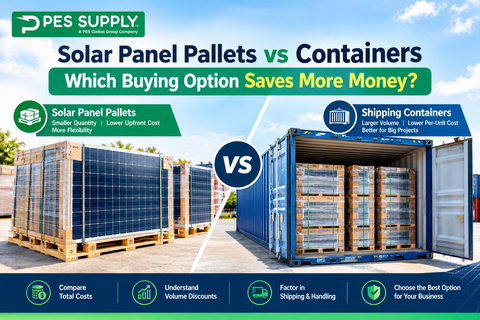
- Bulk Purchasing and Container Deals: Committing to larger volumes, like full container loads, can slash your per-watt cost. This is perfect for developers with a solid pipeline of projects, as it lets you standardize on one module and simplify logistics across multiple job sites.
- Direct Vendor Integration: Working with a distributor like PES Supply gives you a direct line to the manufacturer's inventory. This visibility into stock levels, production runs, and upcoming price changes gives you a serious planning advantage.
- Freight Optimization: The cost of ocean and ground freight can completely change the final landed cost of your panels. A good logistics partner can bundle your shipments, find the best routes, and handle customs to minimize these costs and give you some much-needed price certainty.
Don't forget the global picture. China is the undisputed leader in both solar installation and N-type technology development, driving a huge part of the world's solar capacity growth. These massive installation volumes are key to making advanced N-type TOPCon panels more common and affordable, as the country pushes its own utilities and manufacturers toward higher-efficiency tech. You can dig deeper into this with insights from the National Renewable Energy Laboratory on this topic.
A Practical Procurement Checklist for N Type Panels
Vetting suppliers and structuring deals for n type panels demands a detailed game plan. Simply comparing the sticker price isn't enough—you need to look at the entire value chain to protect your project's bottom line.
Pro Tip for Procurement: Never stop at the module price. The true cost includes freight, tariffs, and all the time and money spent coordinating different vendors. Bundling modules with inverters, racking, and other Balance of System (BOS) gear from one source is a real advantage for cutting down on admin headaches and logistical chaos.
Before you sign any PO, your team should run through a solid checklist to make sure it's a smart investment.
Key Vetting and Logistics Checklist
| Area of Focus | Key Questions to Ask | Why It Matters |
|---|---|---|
| Supplier Vetting | Is the supplier an authorized distributor? Can they provide full warranty docs and tech support? | This protects you from gray market junk and ensures you have manufacturer backup if something goes wrong. |
| Inventory & Lead Times | Do they have actual inventory in U.S. warehouses? What are the confirmed lead times for factory orders? | This prevents project delays caused by "phantom stock" or surprise production backlogs. |
| Freight & Logistics | Can they give you a fully landed cost, including all freight and tariffs? Do they offer freight optimization? | You need total cost transparency. Hidden fees can destroy your project margins. |
| Bundled Deals | Can you bundle modules with inverters, racking, and other BOS in one shipment? | This solves huge logistical problems, cuts shipping costs, and makes project coordination way easier. |
As you look at the financial side of acquiring n-type solar panels, don't overlook funding opportunities. It’s worth your time to research renewable energy grants that can help reduce the initial cash outlay and boost your project's overall ROI. By thinking strategically about procurement, you can turn the challenge of sourcing n type panels into a real competitive advantage.
I've pulled n-type modules off delivery trucks on three continents now, and the first thing I tell every crew lead is the same: treat the nameplate Voc as a starting point, not an answer. Last January on a rooftop job in Spokane we measured cell temperatures of -9°C at sunrise, and our string voltage math from the office was suddenly the difference between a clean inspection and a fried inverter input stage. Do the NEC 690.7 correction every single time.
We also see buyers overpay for wattage they can't use. A 590W panel on a roof that maxes out at 18 modules is not a better deal than a 550W panel that lets you fit 19. Run the layout before you run the purchase order.
One more from the field: our returns desk sees far fewer PID (potential-induced degradation) complaints on n-type product than we ever logged on early PERC lines. The warranty paperwork reflects it, and so does our RMA shelf.
Take a current-generation 580W TOPCon bifacial module with a nameplate Voc of 51.8V and a Voc temperature coefficient of -0.24%/°C. For a site design temperature of -10°C, NEC Table 690.7(A) gives a voltage correction factor of 1.14 for crystalline modules. The math below is the same worksheet our tech desk walks installers through on the phone.
| Step | Calculation | Result |
|---|---|---|
| Nameplate open-circuit voltage (Voc) | Manufacturer datasheet, STC | 51.8 V |
| NEC 690.7(A) correction factor at -10°C | Table 690.7(A), crystalline silicon | 1.14 |
| Cold-corrected Voc per module | 51.8 V × 1.14 | 59.05 V |
| Max modules per 1500 V string | 1500 V ÷ 59.05 V = 25.40 → round down | 25 modules |
| Max modules per 1000 V string | 1000 V ÷ 59.05 V = 16.93 → round down | 16 modules |
| String power at 25 modules (STC) | 25 × 580 W | 14.5 kW |
Rounding down is not optional. A 26th module puts the string at 1,535V on a cold morning — over the 1500V rating of the inverter, the wire insulation, and the disconnect. Inspectors catch this; so does hardware, eventually.
Same module family, nameplate Isc of 14.1A. NEC 690.8(A)(1) multiplies Isc by 125% to get maximum circuit current, and 690.8(B) requires conductors to carry 125% of that value before any adjustment factors — the familiar 1.56× multiplier. Overcurrent devices land on the standard ratings in NEC 240.6(A).
| Step | Calculation | Result |
|---|---|---|
| Module short-circuit current (Isc) | Manufacturer datasheet, STC | 14.1 A |
| NEC 690.8(A)(1) maximum current | 14.1 A × 1.25 | 17.63 A |
| NEC 690.8(B) conductor ampacity floor | 14.1 A × 1.25 × 1.25 | 22.03 A |
| Conductor choice (Cu THWN-2, 75°C termination) | NEC 310.16: 12 AWG = 25 A ≥ 22.03 A | 12 AWG Cu |
| OCPD rating per NEC 240.6(A) | 22.03 A → next standard size up | 25 A fuse/breaker |
| Check: OCPD vs conductor | 25 A OCPD protects 25 A conductor | Pass |
That 25A OCPD on 12 AWG copper is legal under 240.4(B) because 25A is the next standard size above the conductor's 25A ampacity — here they match exactly, so there is nothing to round. Where installers get burned is parallel strings: two strings on one output circuit doubles the current to 44.1A of required ampacity, which pushes you to 8 AWG and a 50A device. Write it down before you pull wire.
Warrantied degradation is where the n-type premium pays you back. Using the standard warranty terms on current datasheets — 2% first-year then 0.55%/yr for mainstream PERC, 1% first-year then 0.40%/yr for TOPCon — the 30-year retained-output math looks like this:
| Checkpoint | P-Type PERC (2% / 0.55%/yr) | N-Type TOPCon (1% / 0.40%/yr) |
|---|---|---|
| Year 1 retained output | 100% - 2% = 98.0% | 100% - 1% = 99.0% |
| Year 10 retained output | 98.0% - (9 × 0.55%) = 93.05% | 99.0% - (9 × 0.40%) = 95.40% |
| Year 20 retained output | 98.0% - (19 × 0.55%) = 87.55% | 99.0% - (19 × 0.40%) = 91.40% |
| Year 25 retained output | 98.0% - (24 × 0.55%) = 84.80% | 99.0% - (24 × 0.40%) = 89.40% |
| Year 30 retained output | 98.0% - (29 × 0.55%) = 82.05% | 99.0% - (29 × 0.40%) = 87.40% |
| Extra energy at year 30 (per 400W panel) | Baseline | +21.4W equivalent nameplate |
Five percentage points of retained output at year 30 is not a rounding error on a 500 kW commercial array — it's roughly 25 kW of capacity you either still own or you don't. That's the number to put in front of a CFO, not the day-one efficiency spec.
Are n-type solar panels worth the premium over P-type PERC?
For most space-constrained or long-hold projects, yes. N-type TOPCon modules typically carry 1% first-year and 0.40% annual warranted degradation versus 2% and 0.55% for PERC, which compounds to roughly five extra percentage points of retained output at year 30. Combined with 22.5-23.5%+ module efficiency and better bifacial behavior, the lifetime energy gain usually outweighs the modest per-watt price gap. For short-hold or land-abundant projects, quality PERC can still pencil.
What is the difference between TOPCon, HJT, and back-contact n-type cells?
All three are n-type architectures. TOPCon adds an ultra-thin tunnel oxide passivation layer and is the volume leader because it upgrades existing PERC production lines cheaply. HJT combines crystalline and amorphous silicon layers for excellent temperature coefficients and low-light performance at a higher manufacturing cost. Back-contact cells (IBC) move all metallization to the rear of the cell, eliminating front-side shading for the highest module efficiencies available today.
Do n-type panels need different inverters or racking?
Electrically, no — they connect to the same string inverters and microinverters as any module. What changes is the design math: higher Voc and Isc values on high-power n-type modules mean you must re-run NEC 690.7 cold-weather voltage correction and NEC 690.8 conductor sizing rather than copying a PERC design. Mechanically, larger-format n-type modules may need different clamp zones and rail spans, so check the racking compatibility sheet.
How much more energy does an n-type panel actually produce?
In side-by-side field data, n-type TOPCon arrays typically deliver 2-5% more annual energy than equivalent-wattage PERC arrays, driven by lower degradation, better temperature coefficients (around -0.29%/C versus -0.35%/C), and stronger low-light response. Bifacial n-type modules with an 80% bifaciality factor can add another 5-15% on reflective ground surfaces.
What should I check before buying n-type panels in bulk?
Verify the supplier is an authorized distributor with traceable serial numbers, confirm the warranty terms in writing (product and performance), check UL 61730 listing for the US market, and confirm the exact bill of materials — glass-glass versus glass-backsheet changes weight, fire rating, and mounting requirements. Ask for the PAN file if you're modeling production in PVsyst.
Any time a new technology starts to take over, the folks on the ground—installers, project managers, and developers—have real-world questions that need straight answers. Let's tackle the most common ones we hear about making the switch to n-type solar panels.
Are N-Type Panels Really More Expensive?
Not like they used to be. A few years ago, n-type panels came with a serious price tag compared to the old P-type PERC standard. But as the big manufacturers have scaled up production, that price gap has all but disappeared.
Today, you're often looking at just a few cents more per watt upfront. When you zoom out and look at the Levelized Cost of Energy (LCOE), the story gets even better. Thanks to their higher efficiency, better performance in the heat, and immunity to LID, n-type systems often end up being cheaper over the long run. That small initial cost is quickly paid back through more energy production, making it a more bankable asset for the next 30 years.
Do I Need Special Inverters or Racking?
Nope. Physically and electrically, n-type panels play nice with all the standard gear you’re already using. They don’t require proprietary inverters or some newfangled racking system. You can hook them up to top-tier inverters from brands like Sungrow, Fronius, and Sol-Ark, and they’ll mount on any UL-listed racking just like a P-type module.
The real trick isn't compatibility—it's design. These panels pack a bigger punch, with higher power classes and different voltage (Voc) and current (Isc) specs. That means you can't just copy-paste old string designs. You’ve got to re-run your calculations to make sure you’re hitting the inverter’s MPPT window perfectly, otherwise, you're just leaving performance on the table.
Is Getting Them for Large Projects a Problem?
It can be if you don't plan ahead. While the market is definitely shifting to n-type, most of the production is still concentrated among a handful of Tier 1 global giants. For procurement managers planning big jobs, this can mean longer lead times or getting stuck in allocation queues when demand spikes.
A Pro Tip on Procurement: This is where a good distribution partner is worth their weight in gold. You need someone with direct relationships with the big manufacturers and, just as importantly, a ton of U.S.-based inventory. That creates a buffer against factory delays and shipping nightmares, ensuring the panels actually show up when your crew is ready to install.
How Much More Energy Do They Actually Make?
This always depends on the site, of course, but the performance boost is real and easy to measure. The extra yield comes from a few key advantages:
- No LID, Period: N-type panels sidestep the 1-3% power loss that hits P-type panels right after they’re installed. That’s pure gain from day one.
- Keeps Cool: In hot climates where panels can really start to drag, that better temperature coefficient can squeeze out an extra 2-4% of energy every year compared to P-type.
- Better Bifacial Gains: For ground-mounts or commercial flat roofs, n-type's higher bifaciality (often 80-85%) can crank up the total energy yield by another 5-20%, depending on what’s on the ground reflecting light.
Add it all up, and you’re looking at a serious increase in the total energy your system will harvest over its lifetime. That goes straight to the project's bottom line.
What’s the Real Lifespan and Warranty?
These things are built to last, and the warranties prove it. Because n-type cells are naturally more resistant to the things that wear down P-type cells, manufacturers are backing them with much stronger guarantees.
A 30-year power performance warranty is quickly becoming the new standard. These warranties don't just promise the panel will work—they typically guarantee it will still be producing at least 87-89% of its original power three decades down the road. For project owners and the people financing them, that's the kind of long-term certainty that makes a project a no-brainer.
Ready to put the superior performance and long-term value of N-type solar panels to work on your next project? PES Supply gives you access to Tier 1 modules with real in-stock U.S. inventory, in-house system design support, and optimized freight logistics that save you time and money. Request a Bulk Quote today and see how we can make your procurement process a whole lot easier.
Related Resources:
- Best Solar Panels 2026 — Buyer's Guide
- EG4 vs Tesla Powerwall
- Qcells vs Trina vs JA
- Solar Inverter Buyer's Guide
- Solar Battery Buyer's Guide
- 5kW Solar Kit
- 10kW Solar + Battery Kit
- Off-Grid Cabin Kit
- EG4 Batteries
- Qcells Solar Panels
- Trina Solar
- JA Solar
- REC Solar
- Mission Solar
- Sol-Ark Inverters
- SolarEdge Inverters
- Generac PWRcell
Calculate how much storage you need with our battery sizing calculator.
Check solar incentives available in your state.
Use our free solar system calculator to size your array.
Check out our Solar Panel Comparison Tool. Check out our Inverter Sizing Calculator.
Calculate your solar payback and 25-year savings with our Solar ROI Calculator. Follow our complete DIY solar installation guide for step-by-step instructions. Keep your system running at peak performance with our Solar Maintenance Guide.
Related Resources
- Solar System Calculator
- Battery Sizing Calculator
- Solar Panel Comparison Tool
- Inverter Sizing Calculator
- Solar ROI Calculator
- Solar Installation Guide
- Solar Maintenance Guide
- Solar Permitting Guide
- Battery Installation Guide
- NEC Code Compliance Guide
- Solar Panel Mounting Guide
- Grounding & Bonding Guide
- Solar Incentives by State
- Pro Account — Wholesale Pricing
- PowerLink Network — Contractor Program
Need pricing or availability on anything in this guide?
Portlandia Electric Supply dropships direct from the manufacturer — most items Ship Direct with lead times stated up front, no surprises.
Get a quote from PESBulk, pallet and contractor pricing available.