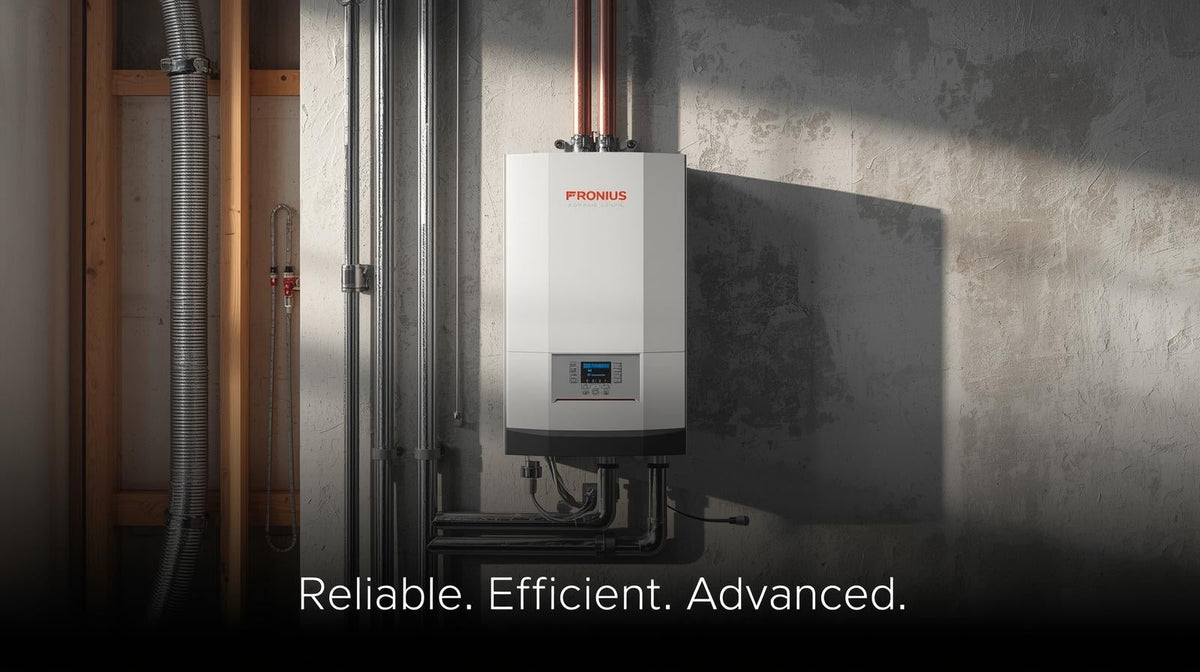
Fronius Symo Advanced 10.0-3 208-240: The 10 kW Three-Phase Inverter for Light Commercial Solar
Datasheet specs, NEC sizing math, string design, and the installation realities of putting a Symo Advanced on a 208/240V three-phase service.

The Fronius Symo Advanced 10.0-3 208-240 occupies a specific and underserved niche: light commercial and agricultural buildings running 208V or 240V three-phase services — the small warehouses, machine shops, schools, dairies, and office suites that make up the backbone of American commercial square footage. Most string inverter families in this class force you into 480V gear and a step-down transformer, or down into residential single-phase equipment that doesn't belong on a three-phase panel. The Symo Advanced speaks 208/240V three-phase natively, carries a NEMA 4X outdoor rating, and brings Fronius's SnapINverter mounting and active cooling to a size class where serviceability matters more than brochure elegance.
This guide covers what the 10.0-3 208-240 actually is, the complete specification picture (verify the current datasheet revision before ordering — Fronius updates firmware-driven ratings periodically), the NEC math for circuit and string design, where it fits against alternatives, and what we've learned installing and supporting three-phase string inverters in the field. Browse current inventory in our Fronius inverter collection or the broader commercial solar inverters lineup.
The naming decodes cleanly: "10.0" is the nominal AC class (9,995W nominal output per the datasheet), "3" is three-phase, and "208-240" is the dual-voltage rating covering the two most common light-commercial services in North America. Inside the NEMA 4X enclosure you get two MPP trackers, an integrated DC disconnect, arc-fault circuit interruption (AFCI) per NEC 690.11, and SunSpec Modbus plus Wi-Fi/Ethernet connectivity feeding the Fronius Solar.web monitoring platform. The SnapINverter chassis splits into a wall-mounted wiring compartment and a power-stage unit that lifts on and off the bracket — a single technician can service the electronics without un-wiring the installation.
The "Advanced" suffix distinguishes this generation from the legacy Symo line: a wider MPPT operating window, integrated SunSpec rapid-shutdown transmitter support on many revisions, and derating behavior tuned for hot rooftop ambient temperatures. Confirm the exact feature set against the datasheet revision shipped with your unit — the fundamentals below are stable across the line, but firmware-contingent details (grid-support functions per UL 1741 SB/IEEE 1547-2018, for example) evolve.
Why does the 10 kW three-phase class matter at all? Because it is the largest inverter size that still installs like residential equipment: wall-mounted, hand-carried, commissioned by a two-person crew in a day. Move up to 20–50 kW central units and you're scheduling lifts, concrete pads, and dedicated electrical rooms. Move down to microinverters and you're managing 25 devices where one would do. The Symo Advanced sits exactly at the sweet spot where commercial-grade three-phase output meets residential-grade serviceability — which is precisely why it shows up on so many farm shops, small warehouses, and municipal buildings across our order book.
| Specification | Symo Advanced 10.0-3 208-240 | Design Relevance |
|---|---|---|
| Nominal AC output | 9,995W | Sets breaker, conductor, and backfeed math |
| AC voltage / phases | 208V or 240V, 3-phase | Native fit for light-commercial services; no transformer |
| Max continuous output current | 27.8A @208V / 24.1A @240V | Drives NEC 690.8 sizing (below) |
| MPP trackers | 2 | Two roof faces or orientations per unit |
| MPPT operating range | 200–800V (1,000V max input) | Long strings, fewer parallel runs |
| Peak / CEC efficiency | 98.0% / ~97.5% | Top-of-class conversion for this size |
| Enclosure / cooling | NEMA 4X, active cooling | Outdoor wall or ground mounting, dusty ag sites |
| Certifications | UL 1741 SB, IEEE 1547-2018, NEC 690.11 AFCI, 690.12-ready | Permit and interconnection acceptance |
Specifications summarized from Fronius published datasheets for the Symo Advanced 208-240 family. Always confirm the current revision — especially grid-support function listings — before submitting interconnection paperwork.
Three-phase inverter circuits confuse even experienced residential installers because the current math uses the square root of three. Here it is worked out for both voltage taps, with the conductor and breaker selections that follow.
At 208V: 9,995W ÷ (208V × √3) = 9,995 ÷ 360.3 = 27.7A continuous. NEC 690.8(B) treats inverter output as continuous duty, requiring 125% sizing: 27.7 × 1.25 = 34.7A. Round up to a 35A breaker from the NEC 240.6(A) standard ratings, with 10 AWG copper (35A at 75°C per Table 310.16) as the minimum conductor.
At 240V: 9,995 ÷ (240 × 1.732) = 9,995 ÷ 415.7 = 24.0A continuous. Applying the 125% factor: 24.0 × 1.25 = 30.1A — and here's the trap: 30.1A exceeds a 30A breaker's rating by a tenth of an amp, so you land on a 35A breaker, not the 30A you'd grab by instinct. Conductor stays 10 AWG copper.
| Service Voltage | Continuous Current | NEC 690.8 ×1.25 | Breaker (240.6(A)) | Min Copper @75°C (310.16) |
|---|---|---|---|---|
| 208V three-phase | 9,995 ÷ 360.3 = 27.7A | 34.7A | 35A, 3-pole | 10 AWG |
| 240V three-phase | 9,995 ÷ 415.7 = 24.0A | 30.1A | 35A, 3-pole | 10 AWG |
| Two units @208V (shared feeder) | 55.5A | 69.4A | 70A, 3-pole | 4 AWG |
| Two units @240V (shared feeder) | 48.1A | 60.1A | 70A, 3-pole | 6 AWG |
Don't forget NEC 705.12 on the load side: a common light-commercial 208V panel with a 200A bus and 200A main accepts only 40A of backfed breakers under the 120% rule — one Symo Advanced on a 35A breaker fits, two do not. If the project plans a second unit later, spec a supply-side (line-side) tap or a 225A bus panel during the initial install. Our NEC code compliance guide covers both paths with diagrams, and the inverter sizing calculator checks the current math for your exact configuration.
Two trackers and a 1,000V ceiling give the Symo Advanced genuine layout flexibility on chopped-up commercial roofs. The discipline is NEC 690.7: module open-circuit voltage must be corrected upward for the coldest design temperature using Table 690.7(A) factors — 1.12 at −1 to −5°C, 1.18 at −16 to −20°C, 1.25 at −36 to −40°C for crystalline silicon.
| String Configuration | STC String Voc | Corrected @−20°C (1.18) | Corrected @−35°C (1.23) | Verdict vs 1,000V Limit |
|---|---|---|---|---|
| 18 × 49.6V Voc (large-format module) | 892.8V | 1,053.5V | 1,098.1V | Fail in cold climates |
| 17 × 49.6V Voc | 843.2V | 995.0V | 1,037.1V | Marginal — fails −35°C sites |
| 16 × 49.6V Voc | 793.6V | 936.4V | 976.1V | Pass to −35°C |
| 20 × 41.5V Voc (residential format) | 830.0V | 979.4V | 1,020.9V | Pass at −20°C only |
| 19 × 41.5V Voc | 788.5V | 930.4V | 969.9V | Pass to −35°C |
The lower bound matters too: the MPPT window starts at 200V, and hot conditions push operating voltage down. A string that dips below the tracker's minimum on a 100°F afternoon simply stops harvesting. Keep strings at least 25% above the window floor at STC to survive summer — every configuration above clears that comfortably. The fundamentals of series stringing are in solar panel wiring basics if you want the refresher before running these numbers.
DC/AC ratio: pair the 10 kW unit with 11–14 kW DC of array (a 1.1–1.4 ratio). Light-commercial roofs with HVAC shading and soiling rarely punish oversizing, and the inverter clips only during perfect cool-sun hours. A 12.5 kW array on this inverter delivers roughly 12% more annual energy than a 10 kW array for the cost of eight extra panels — usually the cheapest kilowatt-hours on the whole project.
| Scenario | Fit | Reasoning |
|---|---|---|
| Small warehouse, 208V/200A service, 25–40 kW goal | Excellent — stack 2–4 units | Native voltage, modular redundancy, per-face MPPTs |
| School or office, 480V service | Poor — use 480V-class inverter | Transformer losses and cost erase the advantage |
| Ag building, dusty, washdown-adjacent | Excellent | NEMA 4X and active cooling are built for exactly this |
| Residential three-phase (rare, 208V network) | Good, if 10 kW is justified | Oversized for most homes; consider single-phase units |
| Heavy shading, many small faces | Moderate | Two MPPTs limit granularity; evaluate microinverters for severe cases |
Against the direct competition — SMA Sunny Tripower CORE1, SolarEdge three-phase with optimizers, and Solectria's smaller units — the Symo Advanced's differentiators are serviceability (the lift-off power stage), the native 208/240 dual rating, and Fronius's monitoring ecosystem. SolarEdge wins where shade granularity dominates; SMA wins on certain fleet-standardization programs; Fronius wins where a service truck and a single tech need to resolve an issue in one visit. For head-to-head brand context, see the Fronius brand guide and SMA vs Fronius in 2026.
Light-commercial solar economics run on different fuel than residential: demand charges, depreciation, and the Section 48/48E commercial investment tax credit rather than homeowner credits. A single Symo Advanced fed by a 12.5 kW DC array in a 4.5 peak-sun-hour region produces roughly 12.5 × 4.5 × 365 × 0.80 (system derate) = 16,425 kWh per year. At a blended commercial rate of $0.13/kWh, that's about $2,135 in annual bill offset per unit. A four-unit, 50 kW DC installation lands near $8,500 per year — before the 30% federal credit (with prevailing-wage compliance), MACRS depreciation, and any state incentives stack on top. The solar ROI calculator models the full stack with your utility's actual tariff, and commercial solar installation costs benchmarks current per-watt installed pricing so you can sanity-check contractor bids.
The modular 10 kW block size has a real financial advantage over one large central inverter at this scale: redundancy. A failed string inverter idles 25% of a four-unit array; a failed central unit idles 100%. For a business whose solar savings are already booked into operating budgets, that difference is the whole risk conversation. Spare-part logistics matter too — a Symo power stage swaps in under an hour with one tech, while central inverter service is a scheduled event with a crane budget on the bigger units.
Monitoring, Grid Support, and the Software Side

Every Symo Advanced reports to Fronius Solar.web out of the box over Wi-Fi or Ethernet: per-string production, inverter-level diagnostics, and automated fault notifications. For contractors managing a fleet, that means catching a failed string or a soiling problem from the office instead of from the owner's utility-bill surprise three months later. SunSpec Modbus TCP opens the same data to third-party SCADA and building-management systems — the standard path for schools and municipal buildings with existing energy dashboards.
On the interconnection side, UL 1741 SB certification with IEEE 1547-2018 grid-support functions (volt-var, frequency-watt, volt-watt ride-through) is increasingly mandatory: California's Rule 21, Hawaii's Rule 14H, and a growing list of utility interconnection agreements require smart-inverter behavior that legacy firmware can't provide. The Symo Advanced ships with these functions; the configuration happens at commissioning via the inverter's web interface, and your utility's interconnection paperwork will specify which function set to enable. Get the utility's settings sheet before the commissioning visit — configuring volt-var curves on a ladder with a laptop is nobody's favorite afternoon.
One practical note on monitoring hardware: production metering for incentive programs (SRECs, SGIP-adjacent performance payments) often requires a revenue-grade meter separate from the inverter's internal monitoring. Budget the meter and CTs at design time; retrofitting revenue-grade metering into a sealed combiner is miserable work that a $200 line item at rough-in would have prevented.
What We've Learned on 208/240V Three-Phase Rooftops
- I've watched two different crews land a Symo on a 240V service and reflexively order 30A breakers — the math says 30.1A after the 690.8 multiplier, so it's a 35A breaker, and the inspector will check.
- My field rule on high-leg delta services: verify the panel is actually three-phase wye before ordering anything; I carry a meter to every site survey because a 208V high-leg delta will cook equipment that assumes balanced 120V legs.
- On a dairy barn install, the NEMA 4X rating earned its keep within a month — pressure-washer overspray that would have killed a vented residential unit rolled right off the sealed chassis.
- We always commission Solar.web monitoring before the crew leaves the site; the one time we didn't, a failed CT sensor went unnoticed for a billing quarter and the owner's production reports were fiction.
At roughly 44 kg for the power stage, the lift-on bracket design turns a two-person service call into a one-person job — but the initial mount still wants two sets of hands and a level. Mount on an unshaded north or east wall where possible; active cooling handles heat well, but every degree of ambient you avoid is efficiency and fan-life preserved. Maintain the clearances on the installation sheet (they're also your service clearances), and torque every AC and DC termination to spec with a witness mark — three-phase lugs loosen under thermal cycling just like single-phase ones.
Maintenance is refreshingly light: keep the heatsink and fan path clear of dust and nests, review Solar.web production monthly against expected kWh, and torque-check terminations at the one-year mark. Warranty support runs through Fronius's U.S. organization, and because we're an authorized channel, we handle RMA logistics directly for our contractor accounts — including advance replacement coordination when a power stage needs service. Contractors speccing these at volume should talk to our desk through PES PowerLink for project pricing and freight scheduling.
Grid Management Capabilities
Pairing guidance: the Symo Advanced is a grid-tie workhorse, not a hybrid — it has no battery bus. If the building needs backup or demand-charge management, that's a separate AC-coupled storage conversation; start with what a battery energy storage system is and our storage lineup. For the PV side, match strings to current Tier 1 commercial modules from the solar panel collection and verify every string against the 690.7 table above.
Light-commercial projects stall in predictable places. This is the order of operations that keeps them moving:
Step 1 — Service verification. Meter the panel before design. Confirm voltage (208 vs 240), phase configuration (wye vs high-leg delta), busbar rating, and main size. Photograph the nameplate. Every downstream decision keys off these four facts.
Step 2 — Structural and layout survey. Confirm rafter or purlin spacing for attachment engineering, map HVAC shadows across the day, and mark two clean faces per inverter (one per MPPT). A drone survey with shading analysis pays for itself on the first avoided redesign.
Step 3 — Interconnection application. Submit with the UL 1741 SB listing, one-line diagram, and the utility's smart-inverter settings form. Utility review is the long pole — start it before equipment arrives, not after.
Step 4 — Permitting. AHJ submittal with string calculations (the 690.7 table above), the 690.8 circuit math, rapid-shutdown method, and structural letter. Our solar permitting guide has the document checklist that survives first-pass review.
Step 5 — Install and torque discipline. Racking, modules, home runs, inverter mount, then terminations torqued to spec with witness marks. Label every string at both ends — the 690.7 math you did at design becomes useless if strings land on the wrong MPPT.
Step 6 — Commissioning. Configure grid-support functions per the utility sheet, verify each tracker's voltage and current against expectation, enroll Solar.web monitoring, and run a full-production test on a clear midday. Hand the owner a commissioning report with baseline numbers; it's the reference for every future maintenance conversation.
Step 7 — PTO and closeout. Utility inspection, permission-to-operate letter, then the warranty registrations (inverter and modules) with serial numbers recorded. We keep a copy in the project file because the year-eight warranty claim always starts with "do you have the serials?"
What size breaker does the Symo Advanced 10.0-3 208-240 need?
At 208V: 9,995W ÷ (208 × √3) = 27.7A continuous; the NEC 690.8 125% factor gives 34.7A, so a 35A three-pole breaker. At 240V: 24.0A × 1.25 = 30.1A — which still rounds up to 35A because it exceeds 30A. Minimum conductor is 10 AWG copper at 75°C per NEC Table 310.16.
How many panels can I connect to each MPPT?
Size strings by corrected voltage, not wattage. With 41.5V Voc residential-format modules, 19 per string stays under the 1,000V limit down to −35°C (788.5V STC × 1.23 = 969.9V). With 49.6V large-format modules, cap at 16 per string for cold climates. Keep STC string voltage at least 25% above the 200V MPPT floor for hot-day operation.
Can the Symo Advanced provide backup power during an outage?
No — it's a grid-tie inverter with no battery bus and no islanded output. It disconnects during outages per anti-islanding requirements. Backup or demand management requires a separate AC-coupled storage system or a hybrid inverter platform instead.
Is the Symo Advanced 10.0-3 suitable for outdoor agricultural installations?
Yes — the NEMA 4X enclosure and active cooling are designed for outdoor, dusty, and washdown-adjacent environments. Maintain the datasheet clearances, mount out of direct afternoon sun where possible, and keep the fan path clean as part of annual maintenance.
How does rapid shutdown work with this inverter?
The Symo Advanced supports NEC 690.12 rapid shutdown configurations; many revisions integrate SunSpec transmitter signaling for module-level shutdown devices. Confirm the exact RSD pairing against your unit's datasheet revision and your AHJ's adopted NEC edition before finalizing the bill of materials.
Can I install two Symo Advanced units on one 200A three-phase panel?
Not with standard backfed breakers — two 35A backfed breakers (70A) exceed the 40A allowance that NEC 705.12's 120% rule grants a 200A bus with a 200A main. Use a supply-side tap, a 225A bus panel, or a main-breaker downsize engineered under 705.12's other provisions.
- Inverter Sizing Calculator
- Solar System Calculator
- NEC Code Compliance Guide
- Fronius Brand Guide
- SMA vs Fronius 2026
- What Is a String Inverter?
- Solar Panel Wiring Basics
- 7 Benefits of Commercial Solar Energy
- Solar Installation Guide
- Solar Permitting Guide
PES Supply carries 80,000+ products from 300+ manufacturers. One PO, one invoice, every trade covered.
Need help sizing? Our team can calculate loads, select equipment, and source everything from one PO.
Call (502) 790-0600