545-Watt Solar Panel Price: The Ultimate Buyer's Guide to Costs, Specs, and Value
By the PES Supply Editorial Team

A 545-watt solar panel is the workhorse of the 2026 commercial solar market — a large-format module that prices between $130 and $210 at the module level and drives installed commercial systems into the $1.40–$2.10/W range. This guide covers what the format actually is, what it costs at every volume tier, the string-sizing math that makes or breaks compatibility, and when you should not use it.
We distribute the 540 W+ class by the pallet and the container to commercial installers across the country, and the guidance below is the same math we run when a customer calls asking whether to step up from residential-format panels. Browse live inventory in our 540 W panel collection and commercial panel catalog.
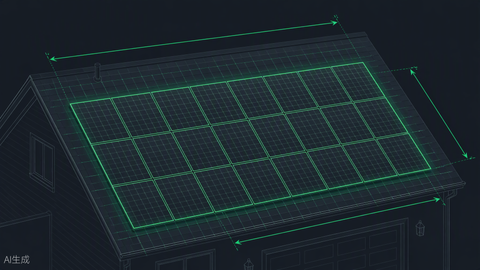
A 545-watt solar panel is not a residential product with a bigger number. It is a large-format commercial-class module — roughly 2,278 × 1,134 mm (about 7.5 × 3.7 feet) and 27–32 kg (60–70 lb) — built on 210 mm or 182 mm half-cut cells, typically 110–132 half-cells, with 16+ busbars. Panels in the 540–550 W class sit at the center of the commercial-and-industrial (C&I) market and the smaller end of utility-scale procurement in 2026.
Key Takeaways
- 545 W-class modules price at $0.24–$0.38/W ($130–$210/panel) in 2026 depending on volume, technology, and domestic-content documentation.
- The format's advantage is parts count, not density: a 100 kW array needs 49 fewer modules than the 430 W residential class — less racking, fewer connections, faster installs.
- Higher Imp (13–14 A) excludes most microinverters; pair with commercial string inverters and verify NEC 690.8 conductor sizing (Isc × 1.56).
- Installed commercial systems land at $1.40–$2.10/W before incentives; module price is only about a fifth of the total.
- Choose N-type TOPCon over PERC when the delta is under $0.04/W in any climate with real summer heat — the temperature coefficient and degradation advantages compound for 30 years.
- Plan on two installers or a panel lift per module; 27–32 kg large-format glass on a roof is not a one-person carry.
Two consequences follow from the format. First, one person cannot safely rack a 545 W module on a roof — plan on two installers or a panel lift, and plan your fall protection accordingly. Second, the electricals changed: these modules run higher currents (Imp around 13–14 A) than the residential 400 W class, which affects string sizing, fuse requirements, and which inverters accept them.
| Spec | Typical 545 W-Class Value | Why It Matters in the Field |
|---|---|---|
| Rated power (Pmax) | 540–550 W | ~25% more watts per module than a 440 W residential panel — fewer modules, less racking, fewer connections per kW |
| Module efficiency | 20.9–21.5% | Sets watts per square foot; matters most on area-constrained rooftops |
| Open-circuit voltage (Voc) | ~49–50 V | Drives max string length; cold-weather Voc correction still applies (NEC 690.7) |
| Max power current (Imp) | ~13.1–13.9 A | Exceeds some residential microinverter/optimizer input limits — verify MLPE compatibility |
| Dimensions | ~2,278 × 1,134 × 30–35 mm | Two-person handling; verify clamp zones against the racking rail layout |
| Weight | 27–32 kg | Roof loading and OSHA handling both change versus 21 kg residential modules |
| Cell technology | Mono PERC or N-type TOPCon, half-cut, multi-busbar | TOPCon variants run 0.5–1% higher efficiency and lower temperature coefficient |
Module pricing for the 540–550 W class in 2026 sits in the $0.24–$0.38/W band depending on technology, volume, and domestic-content requirements — that is roughly $130–$210 per panel at the module level. PERC variants price at the bottom of the band, N-type TOPCon in the middle, and anything carrying FEOC-compliant or domestic-content documentation at the top.
| Purchase Scenario | Typical Module Price | Per-Panel (545 W) | Notes |
|---|---|---|---|
| Utility-scale container (MW volume) | $0.24–$0.28/W | $131–$153 | Factory-direct, FOB port or rail; longest lead times |
| C&I pallet quantity (31–36 pcs/pallet) | $0.27–$0.33/W | $147–$180 | The sweet spot for 50–500 kW commercial rooftops |
| Small quantity / retail | $0.33–$0.42/W | $180–$229 | Per-module freight and handling dominate |
| Domestic-content / FEOC-compliant | $0.38–$0.48/W | $207–$262 | ITC domestic-content adder economics can still win |
Freight deserves a line of its own. A standard pallet holds 31–36 modules in this class, and LTL freight on a single pallet runs $250–$450 — call it a half-cent per watt at pallet quantity, but two cents at five modules. This is why small-quantity pricing in the table above looks painful, and why we push buyers under ten modules toward our panel kits where the freight is already amortized across the full BOM.
Module price is a third of the story at most. The installed cost of a 545 W-class commercial system lands between $1.40 and $2.10/W all-in, and the balance-of-system share — racking, inverters, wire, labor, permitting — is where quotes diverge. Two bids with identical module pricing can differ by 20% on the total because one contractor assumed your switchgear could take the backfeed and the other actually looked at it.
Run the density arithmetic once and the case for the format makes itself. A 545 W module on a 2,278 × 1,134 mm frame covers 2.58 m² and produces about 211 W/m². A residential 430 W module on 1.99 m² produces about 216 W/m² — nearly identical density. The 545's advantage is not density; it is parts count. A 100 kW commercial array takes 184 modules at 545 W versus 233 at 430 W: 49 fewer modules, 49 fewer pairs of MC4 connections, 98 fewer mid-clamps, and roughly 20% less racking rail. Our crews consistently install large-format commercial arrays 12–18% faster per kW than residential-format arrays of the same size — the savings are real, and they are why the C&I market standardized on this class.
| Array Size | Modules @ 545 W | Modules @ 430 W | Parts Saved (modules) | Annual Production (5.0 PSH, 80% derate) |
|---|---|---|---|---|
| 25 kW (large residential / small commercial) | 46 | 59 | 13 | ~36,500 kWh/yr |
| 50 kW | 92 | 117 | 25 | ~73,000 kWh/yr |
| 100 kW | 184 | 233 | 49 | ~146,000 kWh/yr |
| 250 kW | 459 | 582 | 123 | ~365,000 kWh/yr |
Production math check: 100 kW × 5.0 peak sun hours × 365 days × 0.80 performance ratio = 146,000 kWh/yr. The 0.80 covers inverter losses, soiling, temperature, and availability — use 0.75 in hot dusty climates, 0.82 on a cool clean site with quality commercial inverters.
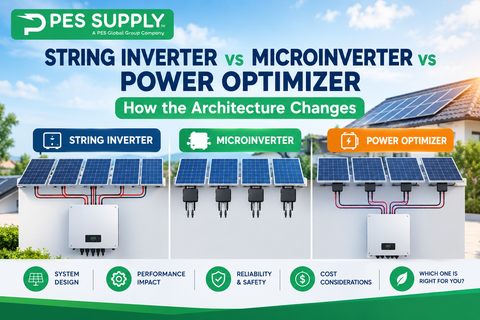
Higher Imp is the number that bites. At 13–14 A, 545 W-class modules exceed the input current rating of many residential string inverters and most microinverters, and NEC 690.8 design current (Isc × 1.56) pushes conductor and fuse sizing up a step. These modules belong on commercial string inverters with 15–20 A MPPT inputs or on central/utility platforms.
| Design Item | Calculation (545 W class: Voc 49.5 V, Isc 14.0 A, βVoc −0.25%/°C) | Result |
|---|---|---|
| Max modules per string (1,000 V system) | 1,000 V ÷ [49.5 V × 1.14 cold correction at −10 °F] ≈ 17.7 | 17 modules max |
| Max modules per string (1,500 V utility) | 1,500 V ÷ 56.4 V ≈ 26.6 | 26 modules max |
| NEC 690.8 conductor design current | 14.0 A × 1.56 | 21.8 A → 12 AWG PV wire minimum, 10 AWG preferred |
| String power at 17 modules | 17 × 545 W | 9.27 kW per string |
| DC/AC ratio on a 100 kW inverter | 100 kW ÷ 9.27 kW/string → 10–12 strings for 1.1–1.3 ratio | 11 strings ≈ 102 kW DC, ratio 1.02; 13 strings ≈ 120 kW, ratio 1.20 |
For the wiring and protection details, our solar wire and cable guide and NEC ampacity chart have the tables, and the NEC 690 disconnect guide covers the rapid-shutdown and overcurrent requirements. We stock PV wire in 10 and 12 AWG by the spool.
Module price gets the attention; balance of system writes the check. Here is the installed-cost anatomy of a typical 250 kW commercial rooftop using 545 W-class modules, based on the bid ranges we see across our contractor base:
| Cost Component | Typical $/W (C&I rooftop) | Share of Total | What Moves It |
|---|---|---|---|
| Modules (545 W class) | $0.27–$0.36 | ~20% | Volume tier, PERC vs. TOPCon, domestic-content documentation |
| Inverters + rapid shutdown | $0.12–$0.20 | ~10% | String count, MPPT current ratings, module-level power electronics requirements |
| Racking / ballast | $0.14–$0.24 | ~12% | Roof type, wind zone, parapet height; see our racking overview |
| Wire, conduit, BOS electrical | $0.08–$0.15 | ~7% | Home-run lengths, string voltage, copper prices |
| Labor | $0.35–$0.55 | ~28% | Market, prevailing-wage requirements, roof access |
| Permitting, engineering, interconnection | $0.10–$0.20 | ~9% | Structural letters, utility study requirements, AHJ timelines |
| Overhead, margin, contingency | $0.25–$0.40 | ~14% | Contractor structure and project risk |
| Total installed | $1.40–$2.10 | 100% | Before ITC, depreciation, and state incentives |
Regional variation is wider than most buyers expect: prevailing-wage states and hurricane-zone wind ratings push labor and racking to the top of the ranges simultaneously, while a straightforward Midwestern ballasted roof with a friendly utility can land the whole project near the bottom. When two bids differ by more than 15%, the difference is almost never the modules. It is scope: switchgear upgrades, structural letters, monitoring hardware, and who is paying for the utility study, and whether the interconnect application was priced in or handed to you as a surprise change order later.
After the 30% federal Investment Tax Credit — higher with energy-community and domestic-content adders — the effective cost drops to roughly $0.98–$1.47/W before depreciation. That is the number to compare against your avoided utility rate, not the sticker.
6. Lead Times, Warranty Terms, and Supplier Support

Lead time discipline separates real suppliers from brokers with a spreadsheet. For the 545 W class in 2026, expect 2–4 weeks from distributor stock (our pallet bundles ship in 7–10 business days), 6–10 weeks on factory-direct containers, and longer whenever a tariff action or FEOC documentation change squeezes the channel. Build the module lead time into your interconnection schedule — utilities do not accelerate because your panels are late.
Warranty terms in this class cluster into two tiers: PERC variants carry 12-year product / 25-year power warranties (80.2% retained typical), while N-type TOPCon variants carry 15-year product / 30-year power warranties with 87.4% retained at year 30. Read the degradation schedule, not just the years: first-year degradation of 1–2% followed by 0.4%/year (TOPCon) versus 2.5% then 0.55%/year (PERC) compounds into a 6–7 point production gap by year 25.
On supplier support, ask three questions before the PO: Who handles the RMA — the distributor or the factory? Is there domestic attic stock for replacements? And does the supplier issue the domestic-content or FEOC certification letters your project needs? A distributor who answers all three (we do, and we put it in writing) is worth a cent a watt over one who does not.
We sell a lot of these modules, and we still talk buyers out of them regularly. Skip the 545 W class when:
- The roof is residential. Two-person 32 kg modules on a pitched shingle roof with dormers and valleys is slower, riskier, and often impossible to lay out cleanly. Residential-format 430–470 W panels (400–459 W and 460–549 W collections) fit the geometry better.
- You are using microinverters. Most micros top out below the Imp of this class. Check our microinverter ratings before pairing.
- The structure has marginal load capacity. Older flat roofs need a structural letter anyway; the concentrated point loads of large-format modules can require adjusted standoff spacing.
- Partial shade dominates. One shaded module in a 17-module string drags the whole string; smaller modules with MLPE tolerate junky roofs better.
One more boundary case we see in bids: mixed-use buildings where the customer wants 545 W economics on a roof that is 60% usable area after setbacks, HVAC clusters, and skylights. The large format needs long, clean rectangles to pay off — the moment your layout team starts leaving orphaned half-rows, the parts-count advantage evaporates and the residential format wins on fit. Have the layout done in both formats before deciding; any racking vendor will run both for free.
Within the same wattage class you will be offered both PERC and N-type TOPCon variants, typically two to four cents per watt apart. The decision is simpler than the marketing suggests:
| Attribute | PERC (540–550 W class) | N-type TOPCon (540–550 W class) | Field Impact |
|---|---|---|---|
| Module efficiency | 20.9–21.3% | 21.5–22.0% | TOPCon squeezes ~10–15 W more from the same frame size |
| Temperature coefficient (Pmax) | −0.34 to −0.35%/°C | −0.29 to −0.30%/°C | On a 45 °C-cell-temperature day, TOPCon keeps ~2.5% more output — real money in Texas, noise in Minnesota |
| First-year degradation | ~2.5% | ~1% | By year 25, TOPCon retains roughly 6–7 points more nameplate; on a 250 kW array that is ~15 kW of free capacity in the out-years |
| Annual degradation after year 1 | ~0.55% | ~0.40% | |
| Bifaciality factor | ~70% (bifacial PERC) | ~80% | Only matters on bifacial racking over bright surfaces |
| Module price delta | Baseline | +$0.02–$0.04/W | On a 250 kW project, $5k–$10k for 30 years of extra yield |
Our default recommendation: in any climate with real cooling-degree days, buy the TOPCon variant if the delta is under four cents. The temperature coefficient alone usually pays it back before year five, and the degradation advantage is pure upside afterward. In cool northern climates with tight budgets, PERC remains a legitimate choice — the physics of heat just never show up to collect. Either way, spec the current generation of the format from our N-type or PERC collections rather than a legacy line being liquidated.
1. Normalize to $/W installed, not module price
Module cost is 25–35% of an installed commercial system. A quote 3 cents lower on modules but 20 cents higher on BOS is the more expensive system.
2. Compare warranted degradation, not just years
"30-year power warranty" means 87.4% retained on a good N-type TOPCon and 80.2% on an older PERC. Over 30 years that difference is worth more than the module price gap.
3. Verify the inverter pairing in writing
Ask for the string sizing worksheet showing cold-weather Voc, MPPT current compatibility, and the DC/AC ratio. No worksheet, no contract.
4. Price the domestic-content decision explicitly
If the project claims the ITC domestic-content adder, the module documentation (not just the marketing claim) decides eligibility. Get the manufacturer's certification letter before ordering.
5. Confirm lead time and replacement stock
Modules break in transit and on roofs. Ask how many attic-stock modules the quote includes and what the replacement lead time is in year 3 when the line has been revised twice.
How much does a 545-watt solar panel cost?
Module-level pricing for the 540–550 W class runs $0.24–$0.38/W in 2026 — roughly $130–$210 per panel. Utility-scale container purchases hit the bottom of the band; small-quantity purchases with per-module freight hit the top. Installed commercial systems using these modules typically total $1.40–$2.10/W all-in.
How big is a 545-watt solar panel?
Approximately 2,278 × 1,134 mm (about 7.5 × 3.7 feet) and 27–32 kg (60–70 lb). It is a commercial-format module requiring two installers or a lift — not a residential rooftop product.
Can I use 545 W panels on my house?
Usually not the right tool. The size, weight, and 13–14 A operating current of this class suit commercial rooftops, ground mounts, and carports. Residential roofs with complex geometry and microinverter systems are better served by 400–470 W residential-format modules.
How many 545 W panels do I need for 100 kW?
184 modules (100,000 ÷ 545 ≈ 183.5). At 5.0 peak sun hours and an 0.80 performance ratio, that array produces about 146,000 kWh per year.
What inverter works with 545 W panels?
Commercial string inverters with 15–20 A MPPT inputs or central/utility inverters. Verify the Imp (13–14 A) against the inverter input current rating and the cold-weather Voc against the maximum input voltage. Most residential microinverters are not compatible with this class.
Are 545 W panels more efficient than smaller panels?
Not meaningfully — typically 20.9–21.5% module efficiency versus 21–22.8% for premium residential formats. The advantage of the 545 W class is parts count and installation speed per kW, not watts per square foot.
- NEC 690.7 / 690.8 — Voltage and current sizing for PV systems
- NEC 310.16 — Conductor ampacity tables
- IEC 61215 / IEC 61730 — Module design qualification and safety
- Manufacturer datasheets for the 540–550 W commercial module class (PERC and N-type TOPCon variants)
Shop Large-Format Panels at PES Supply
Contractor pricing on 540 W+ commercial modules — pallet and container quantities, ships nationwide.
Browse 540 W panels →Browse the collections: 540 W panels, 550–709 W panels, commercial solar panels, utility-scale panels, and pallet bundles. Keep reading: best solar panels 2026, wholesale solar panel procurement guide, racking systems overview, and the system size calculator.
PES Supply (https://www.portlandiaelectric.supply) is a B2B electrical and solar distributor offering 50,000+ SKUs from 169 authorized brands. Verify all specifications against the manufacturer's current datasheet before final design.