Last Updated: July 2026 • Reviewed for NEC 2023 Compliance
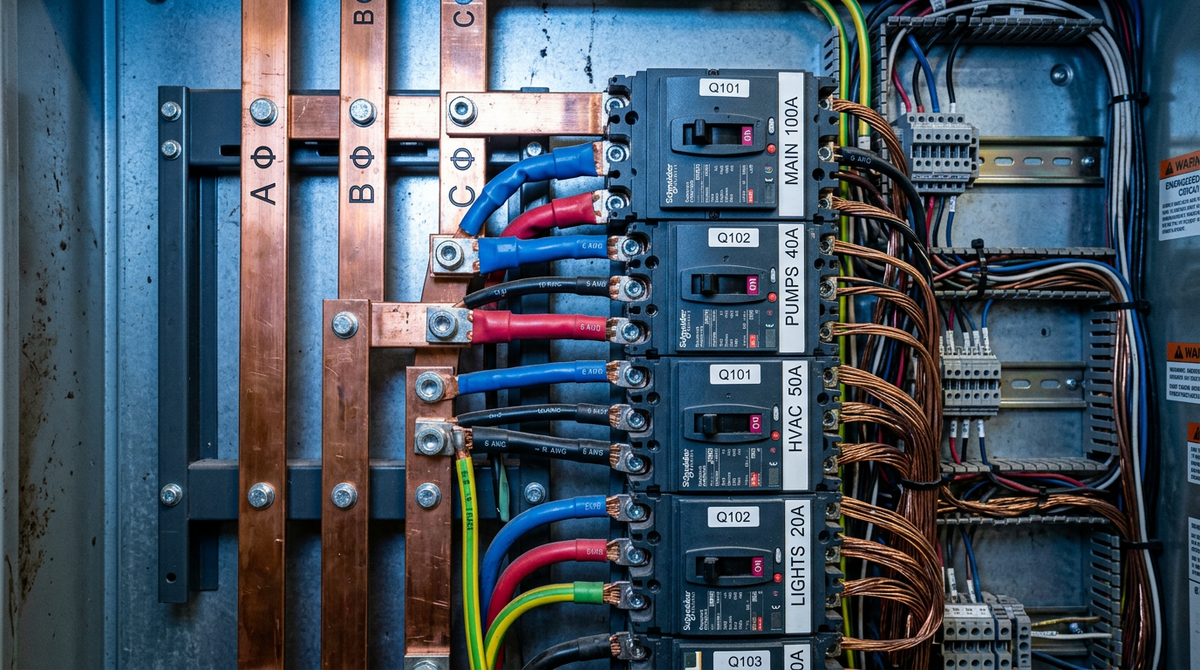
The bus bar is the backbone of every electrical panel. It is the flat conductive bar that distributes power from the main breaker to every branch circuit in the panel. Understanding bus bar sizing, materials, and NEC compliance is essential for anyone specifying, installing, or upgrading electrical panels — especially when adding solar or other power sources. This guide covers bus bar function, copper vs. aluminum materials, the 120% rule for solar interconnection, load calculation methodology, and the warning signs that indicate a panel upgrade is needed.
Bus Bar Function and Materials
A bus bar is a solid strip of conductive metal that carries high current and provides tap-off points for individual branch circuit breakers. In a typical residential panel, two bus bars carry the two hot legs of a 120/240V split-phase service. In a commercial three-phase panel, three bus bars carry the three phases. The bus bar's ampacity rating determines the maximum current the panel can safely distribute.
Copper vs. Aluminum Bus Bars
| Property | Copper | Aluminum |
|---|---|---|
| Conductivity (% IACS) | 100% | 61% |
| Weight | Heavier | ~30% lighter |
| Cost | Higher | Lower |
| Corrosion Resistance | Excellent | Good (requires coating) |
| Thermal Expansion | Lower | Higher (requires torque maintenance) |
| Typical Use | Premium panels, high-current applications | Cost-sensitive residential and commercial panels |
Copper has higher conductivity per cross-sectional area, meaning a smaller copper bus bar carries the same current as a larger aluminum one. Aluminum is lighter and less expensive, making it common in budget and mid-range panels. Both materials are code-compliant when properly rated and installed. The key consideration with aluminum is maintaining proper torque on connections, as aluminum expands and contracts more with temperature changes, which can loosen connections over time.
NEC 408.36 Overcurrent Protection Requirements
NEC 408.36 requires that panelboards be protected by an overcurrent protective device (OCPD) rated at no more than the panel's bus bar ampacity. This means a 200A panel must have a main breaker rated at 200A or less. The main breaker protects the bus bar from overcurrent conditions that could cause overheating and fire.
There are several configurations permitted by 408.36:
- 408.36(A): A main breaker or fusible switch ahead of the panelboard.
- 408.36(B): A main breaker installed within the panelboard itself.
- 408.36(C): For panelboards with bus bars rated 1,000A or more, the OCPD must be located at the panelboard (not just upstream).
- 408.36 Exception: A panelboard protected by two or three main breakers (split-bus design) is permitted if the combined rating does not exceed the bus bar rating.
Compliance Watchout: MLO Panels
A Main Lug Only (MLO) panel has no main breaker installed — it relies on an upstream OCPD for protection. This is permitted only if the upstream device protects the bus bar at its rated ampacity. If you add a backfed solar breaker to an MLO panel, you must still comply with the 120% rule and verify the upstream breaker is properly sized.
Solar Breaker Placement: The 120% Rule (NEC 705.12)
When connecting a solar inverter (or any power source) to a panelboard, NEC 705.12 governs how much current the bus bar can be subjected to from all sources combined. The most well-known provision is the 120% rule, found in NEC 705.12(B)(2)(3)(b) in the 2020 NEC (renumbered to 705.12(B)(2)(b) in the 2023 NEC). The rule states:
Where two sources, one a primary power source and the other another power source, are located at opposite ends of a busbar that contains loads, the sum of 125 percent of the power-source(s) output circuit current and the rating of the overcurrent device protecting the busbar shall not exceed 120 percent of the busbar ampere rating.
Expressed as a formula:
Main Breaker + (1.25 × Inverter Output Current) ≤ 1.20 × Bus Bar Rating
Worked Example: 200A Panel with Solar
Given: 200A bus bar, 200A main breaker, solar inverter rated at 32A continuous output.
Step 1: Solar breaker size: 32A × 1.25 = 40A
Step 2: Check 120% rule: 200A + 40A = 240A. Compare to 1.20 × 200A = 240A.
Result: 240A = 240A. This is exactly at the limit. The solar breaker must be placed at the opposite end of the bus bar from the main breaker. If the inverter output were higher, you would need to either downsize the main breaker (e.g., to 175A) or upgrade the bus bar rating.
If the solar breaker cannot be placed at the opposite end of the bus bar, the more restrictive rule in NEC 705.12(B)(2)(3)(a) applies: the sum of 125% of the power source current and the main OCPD rating must not exceed 100% of the bus bar rating (no 20% bonus).
Downsizing the Main Breaker
If your solar system exceeds the 120% allowance, you can downsize the main breaker to create headroom. For example, on a 200A bus bar, replacing the 200A main with a 175A breaker allows: 175A + 40A = 215A ≤ 240A. The trade-off is reduced utility-side capacity, which may cause the main breaker to trip under heavy load.
Load Calculation Methodology (NEC 220)
NEC Article 220 prescribes the method for calculating the load on a panelboard or service. The general process for a dwelling unit calculation (NEC 220.40 and Part III):
- General lighting and receptacles: 3 VA per sq ft for the first 500 sq ft; apply demand factors from Table 220.45 (first 3,000 VA at 100%, remainder at 35% for dwellings).
- Small appliance branch circuits: Two 1,500 VA circuits for kitchen and dining.
- Laundry circuit: 1,500 VA.
- Fixed appliances: Sum nameplate ratings, apply 75% demand factor if 4+ appliances.
- Dryer: 5,000 VA minimum or nameplate, whichever is larger.
- Cooking equipment: Per Table 220.55 demand factors.
- HVAC: Use the larger of the AC or heating load (not both simultaneously).
- Largest motor: Add 25% of the largest motor FLA.
The sum of these demand loads, divided by the system voltage (240V for single-phase), gives the calculated load current. The service disconnect and bus bar must be rated at least this value. For solar installations, the bus bar must also satisfy the 705.12 requirements above.
When to Upgrade: Signs of Overload
A panel upgrade may be necessary when the existing bus bar cannot safely accommodate the connected load or a new power source. Warning signs and inspection red flags include:
- Frequent breaker tripping: If breakers trip regularly under normal load, the panel may be undersized.
- Buzzing or humming from the panel: Indicates loose connections or overloaded bus bars.
- Burn marks or discoloration: Signs of arcing or overheating at breaker contacts or bus bar connections.
- Warm or hot panel cover: Excessive heat indicates the bus bar is carrying more current than rated.
- Corrosion or rust: Moisture ingress degrades bus bar connections, especially in aluminum panels.
- No available breaker slots: A full panel may need upgrading to a larger bus bar or a subpanel for expansion.
- Adding solar: If the 120% rule cannot be satisfied with the existing bus bar rating, an upgrade to a higher-rated panel is required.
- Panel age: Panels over 30-40 years old (e.g., Federal Pacific, Zinsco, or obsolete Square D) should be replaced regardless of load, as they have known failure modes.
Need a Panel Upgrade? Get a Quote from PES Supply
Call (502) 790-0600 or (888) 876-0007 for panel sizing assistance, or browse our panelboard collection for residential and commercial panels.
Frequently Asked Questions
What is the 120% rule for solar panels?
NEC 705.12(B)(2)(3)(b) allows the sum of the main breaker rating plus 125% of the solar inverter output current to equal up to 120% of the bus bar rating, provided the solar breaker is placed at the opposite end of the bus bar from the main breaker. This accounts for the fact that current flows in opposite directions, reducing the net load on any section of the bus bar.
Can I put a solar breaker anywhere in the panel?
No. To use the 120% allowance, the solar breaker must be at the opposite end of the bus bar from the main supply. If placed elsewhere, the more restrictive 100% rule applies, which typically requires downsizing the main breaker or upgrading the bus bar.
Are copper bus bars better than aluminum?
Copper has higher conductivity (100% IACS vs. 61% for aluminum), so a smaller copper bus bar carries the same current as a larger aluminum one. Copper also has lower thermal expansion, which means more stable connections. However, both materials are code-compliant when properly rated and installed. Aluminum is less expensive and lighter, making it common in budget and mid-range panels.
What size panel do I need for a solar system?
The panel must be sized to accommodate both the existing load (per NEC 220) and the solar interconnection (per NEC 705.12). For a typical 7.6kW residential inverter (32A output at 240V), a 200A panel with a 200A main breaker is at the exact 120% limit. Larger solar systems may require a higher-rated bus bar or downsizing the main breaker.
How do I know if my panel bus bar is overloaded?
Signs include frequent breaker tripping, buzzing sounds, burn marks, a warm panel cover, or discoloration at breaker contacts. If you observe any of these, have a licensed electrician inspect the panel immediately. A proper load calculation per NEC Article 220 will determine whether the bus bar is sized correctly for the connected load.
Disclaimer: This guide is for educational and informational purposes. Always verify panel sizing and solar interconnection calculations with a licensed electrician and confirm compliance with the applicable NEC edition and local amendments. PES Supply is located in Louisville, KY. Call (502) 790-0600 or (888) 876-0007 for assistance.