Last Updated: June 2026 • Based on EnergySage Market Intelligence, NREL Financial Analysis, and Lawrence Berkeley Lab Tracking the Sun Report
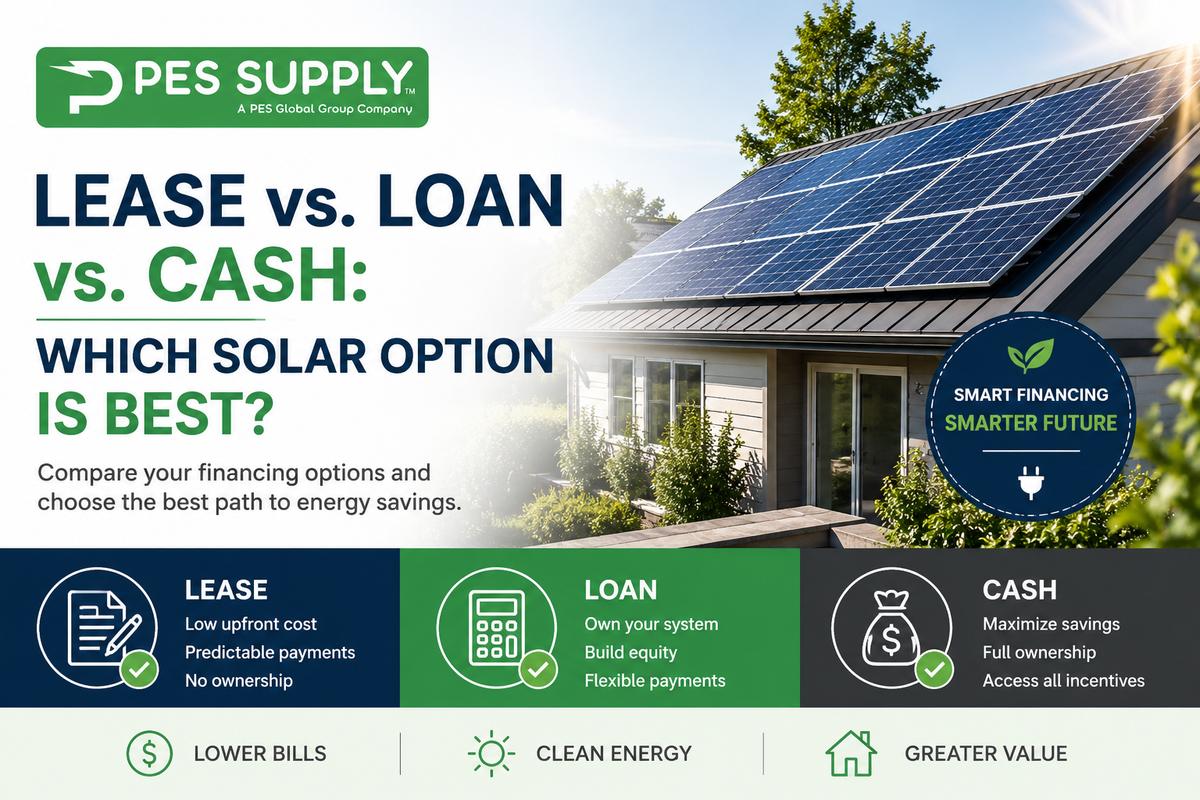
When you decide to go solar, the next question most people face is: how should I pay for it? You will likely hear about three options from solar installers and sales reps: pay cash, take out a solar loan, or sign a lease. Each one works very differently, and the choice you make has a bigger impact on your total savings than almost any other decision in the process.
This guide breaks down all three options with real numbers, honest pros and cons, and a clear recommendation for most homeowners based on your situation.
⚡ Quick Answer
Cash purchase gives you the most total savings. A solar loan gives you ownership and all the same incentives with no money down. A lease gives you the smallest savings but requires no upfront commitment and no ownership. For most homeowners who can qualify for a loan, the loan beats the lease by $15,000 to $30,000 over 25 years. Cash beats a loan by the amount of interest you would have paid.
Key Takeaways
- Cash Purchase: Highest lifetime savings. You own the system outright and claim the full 30% federal tax credit yourself. No monthly payments ever.
- Solar Loan: No money down. You still own the system and claim the 30% ITC. Monthly loan payment is typically offset by bill savings from day one. Best option for most homeowners.
- Lease or PPA: No money down and no ownership. The solar company owns the system and keeps the 30% tax credit. You pay a monthly fee for the electricity produced. Smallest long-term savings.
- The ITC is Worth $6,000 to $9,000: On a typical system, the federal tax credit is a large sum. It goes to whoever owns the system. If you lease, the solar company keeps it.
- Lease vs. Loan Over 25 Years: A homeowner with a solar loan typically saves $15,000 to $30,000 more over 25 years than a homeowner with the same system on a lease.
- Selling Your Home: Owned systems add value to your home. A leased system requires the buyer to take over the lease, which can complicate or slow a home sale.
- Storage Matters: If you want to add a battery in the future, ownership is essential. Leased systems do not allow you to add or control storage upgrades independently.
In This Guide
- Side-by-Side Overview of All Three Options
- Option 1: Cash Purchase
- Option 2: Solar Loan
- Option 3: Lease or Power Purchase Agreement (PPA)
- Why the Federal Tax Credit Changes Everything
- Real Numbers: 25-Year Cost and Savings Comparison
- How Each Option Affects Selling Your Home
- Which Option Is Right for You?
- Decision Guide: Pick Your Path
- Frequently Asked Questions
Side-by-Side Overview of All Three Options
Before diving into the details, here is a clear comparison of how all three financing options differ on the things that matter most.
| Feature | Cash Purchase | Solar Loan | Lease or PPA |
|---|---|---|---|
| Upfront Cost | Full system cost | $0 (most lenders) | $0 |
| Monthly Payment | None | Yes, loan repayment | Yes, lease/PPA payment |
| System Ownership | You own it | You own it | Solar company owns it |
| Federal 30% Tax Credit | You keep it | You keep it | Solar company keeps it |
| State Tax Credits | You keep them | You keep them | Solar company keeps them |
| 25-Year Savings | Highest | High | Lowest |
| Adds Home Value | Yes, approx $4/watt | Yes, approx $4/watt | No. Can complicate home sale. |
| Maintenance Responsibility | You (covered by warranties) | You (covered by warranties) | Solar company handles it |
| Battery Storage Option | Add anytime you choose | Add anytime you choose | Limited, requires lease company approval |
Option 1: Cash Purchase
Paying cash for your solar system is the simplest financial path and delivers the highest total savings over the life of the system. You pay the full cost upfront, own the system outright from day one, and then receive all the financial benefits: the federal tax credit, any state incentives, and 100% of the electricity savings for 25 or more years. There are no monthly payments and no interest charges.
Cash Purchase: Pros and Cons
| Pros | Cons |
| Highest total 25-year savings | Requires significant upfront capital |
| No monthly payments after installation | Ties up cash that could be invested elsewhere |
| You keep the full 30% federal tax credit | Full financial risk if system underperforms (mitigated by warranties) |
| No interest charges reduce your net savings | |
| Adds full market value to home resale |
The main thing to consider with a cash purchase is opportunity cost. If you pay $20,000 cash for solar instead of investing it at 7% annual return, you are giving up roughly $107,000 in portfolio growth over 25 years. However, your solar system is simultaneously saving you $1,500 to $2,000 per year in electricity, which works out to $37,500 to $50,000 over 25 years at flat rates and significantly more when rising electricity rates are factored in. For most people with the cash available, solar is a competitive investment with a predictable, guaranteed return.
Option 2: Solar Loan
A solar loan lets you own your system and collect all the same benefits as a cash purchase, with one key difference: you finance the cost over 5 to 25 years and pay monthly installments. Most solar loans require no money down, and the monthly payment is typically close to or less than your previous electricity bill from the very first month.
The 30% federal tax credit becomes a powerful tool here. When you file your taxes in the year your system is installed, you receive a credit worth about $7,200 on a $24,000 system. Most financial advisors recommend applying that tax credit directly toward your loan principal to dramatically reduce your remaining balance and total interest paid.
Solar Loan: Pros and Cons
| Pros | Cons |
| $0 upfront in most cases | Interest paid reduces total savings compared to cash |
| You own the system and keep all incentives | Requires credit approval |
| Monthly payment often offset by bill savings from day one | Dealer fees on some solar loan products (2 to 10%) inflate effective system cost |
| Use tax credit to pay down principal immediately | |
| Adds full market value to home at resale |
⚠ Watch Out for Dealer Fee Loans
Some solar loans marketed as low interest (1.99% to 3.99%) include a hidden dealer fee of 15 to 30% that the installer charges to the lender. That fee is quietly baked into your total loan amount, inflating your system cost by thousands of dollars. Always ask your installer: "Does this loan include a dealer or installer fee? If so, how much?" Compare the total financed amount against the quoted cash price for the same system.
Common Solar Loan Types
| Loan Type | Typical Rate | Term | Notes |
|---|---|---|---|
| Unsecured Solar Loan | 5 to 9% | 10 to 25 years | Most common. No home equity required. Offered by solar lenders like Goodleap, Sunlight Financial, Mosaic. |
| Home Equity Loan (HELOC) | 6 to 8% | 10 to 20 years | Uses home equity as collateral. Lower rate. Interest may be tax deductible. Requires equity in your home. |
| Personal Loan | 8 to 15% | 3 to 7 years | Higher rate. Useful if you want a shorter payoff period and have strong credit. |
| Cash-Out Refinance | Current mortgage rates | 15 to 30 years | Refinance existing mortgage and pull cash for solar. Lowest monthly payment but extends mortgage term. |
Option 3: Lease or Power Purchase Agreement (PPA)
A solar lease and a solar PPA are two slightly different versions of the same basic idea: a solar company installs panels on your roof, owns and maintains them, and charges you a monthly fee. With a lease, you pay a fixed monthly amount for the system regardless of how much it produces. With a PPA, you pay per kilowatt-hour for the electricity the panels actually generate, at a rate lower than your utility charges.
The appeal is simple. No money down, no ownership responsibility, and an immediate reduction in your monthly electricity bill. The problem is that you give up significant financial value in exchange for that simplicity. Because the solar company owns the system, they claim the 30% federal tax credit, any state tax credits, and all renewable energy certificates (RECs). They use those financial benefits to fund the leasing program and generate their own profit.

Lease or PPA: Pros and Cons
| Pros | Cons |
| $0 upfront | You do not own the system |
| No credit score required (in most cases) | You do not receive the 30% federal tax credit or state incentives |
| Maintenance handled by the solar company | Lowest total savings over 25 years |
| Immediate monthly bill reduction | Lease payments typically escalate 2 to 3% per year |
| Can make your home harder to sell | |
| Does not add value to your home at resale | |
| Adding battery storage is difficult or impossible without approval |
⚠ Escalation Clauses Can Eliminate Your Savings
Most solar leases include an annual escalation clause that raises your monthly payment by 2 to 3% each year. This is designed to stay slightly below grid rate increases, but if your utility's rates flatten or drop, your lease payment could end up higher than what you would have paid on the grid. Always read the escalation clause carefully before signing any lease agreement. Ask the installer: what happens to my payments if electricity rates drop?
Why the Federal Tax Credit Changes Everything
The 30% federal Investment Tax Credit is the most valuable incentive in residential solar. On a $24,000 system it is worth $7,200. On a $30,000 system it is worth $9,000. This credit applies to the full installed cost: panels, inverter, racking, labor, permits, and battery storage.
The credit belongs to whoever owns the system when it is installed and activated. If you buy or finance the system, you own it and you get the credit. If you lease it, the solar company owns it and they get the credit. That single difference is worth thousands of dollars and is the primary reason a loan almost always beats a lease for homeowners who can qualify.
How to Use the ITC Smartly with a Solar Loan
- Install your solar system and take out a solar loan with $0 down.
- Make monthly loan payments for the first year.
- File your taxes. Claim the 30% ITC on IRS Form 5695.
- Receive the tax credit (this reduces your tax bill, not a cash refund, but lowers what you owe by the credit amount).
- Apply the full tax credit amount directly to your loan principal as a lump-sum payment.
- This typically reduces your loan balance by 30% immediately, cutting your remaining payments and total interest significantly.
Real Numbers: 25-Year Cost and Savings Comparison
The following example uses a standard 8 kW solar system costing $24,000 gross, installed in a state with average electricity rates of $0.16 per kWh, producing 10,000 kWh per year. All three financing options are compared over 25 years.
| Metric | Cash Purchase | Solar Loan (7%, 20 yr) | Lease (PPA at $0.11/kWh, 3% escalator) |
|---|---|---|---|
| Gross System Cost | $24,000 | $24,000 | $0 |
| Federal Tax Credit (30%) | You keep: -$7,200 | You keep: -$7,200 | Solar company keeps it |
| Your Net System Cost | $16,800 | $16,800 (plus interest) | $0 |
| Total Interest Paid | $0 | Approx $11,000 (after ITC lump paydown) | N/A |
| Total Payments to Solar Company | $24,000 (one time) | Approx $27,800 total loan payments | Approx $22,000 total lease payments over 25 years |
| Electricity Savings (25 yr, 2.5% rate escalation) | $54,000 | $54,000 | $12,000 (net, after lease payments) |
| Home Value Increase | +$32,000 | +$32,000 | $0 (may complicate sale) |
| Net Financial Benefit (25 yr) | $69,200 | $58,200 | $12,000 |
The key takeaway from these numbers: A solar loan produces about $46,200 more in financial benefit than a lease over 25 years on the same system. The cash purchase produces about $11,000 more than the loan, representing the interest saved. The lease is not a bad deal in absolute terms, but it leaves a significant amount of money on the table compared to ownership.
How Each Option Affects Selling Your Home
Solar financing has a significant impact on what happens when you decide to sell your home. This is a factor many homeowners do not think about when they sign up but regret when they list their property.
| Financing Type | Impact on Home Sale | Buyer Perspective |
|---|---|---|
| Cash Purchase | System transfers to buyer as part of the home. Adds approximately $4 per watt to market value. | Buyers see it as a valuable feature. They get free electricity immediately. |
| Solar Loan | If the loan is paid off, same as cash. If not, you can pay off the loan at closing or transfer it to the buyer with their consent. | Buyers generally accept a paid-off system. An outstanding loan must be disclosed and negotiated. |
| Lease or PPA | Buyer must agree to take over the lease agreement. Many buyers decline. This can slow or prevent the sale. | Some buyers are comfortable with it. Many are not willing to take on a 15 to 20-year financial commitment they did not choose. |
⚠ Leased Solar Systems and Home Sales
Real estate agents consistently report that leased solar systems complicate home sales. Buyers must qualify with the solar company to assume the lease. If they cannot or will not, the seller must pay a buyout fee (often $10,000 to $20,000) to end the lease early before closing. Before signing a solar lease, always ask for the early buyout schedule in writing.
Which Option Is Right for You?
The best financing option depends on your specific situation. Here is a practical guide based on common homeowner profiles.
| Your Situation | Best Option | Why |
|---|---|---|
| You have the cash available and want maximum savings | Cash Purchase | No interest, highest lifetime savings, cleanest financial picture |
| You want ownership but prefer not to pay upfront | Solar Loan | $0 down, you keep the tax credit, system adds home value, high lifetime savings |
| Your credit score is low and you cannot qualify for a loan | Lease or PPA | Only option available. Still delivers some monthly bill savings with no upfront commitment. |
| You plan to sell your home within 3 to 5 years | Cash or Short-Term Loan | Paid-off system transfers cleanly. Lease complicates the sale significantly. |
| You have home equity and want the lowest interest rate | HELOC or Home Equity Loan | Lower rate than unsecured solar loans. Interest may be tax deductible. |
| You want to add battery storage in the future | Cash or Loan (avoid lease) | Ownership lets you add storage anytime without asking permission from a solar company |
Decision Guide: Pick Your Path
Question 1: Do you have enough cash available to pay for the system outright without financial strain?
Yes: Consider a cash purchase for maximum lifetime savings.
No: Move to Question 2.
Question 2: Do you have a credit score of 650 or above and stable income?
Yes: A solar loan is almost always your best option.
No: Move to Question 3.
Question 3: Do you have significant equity in your home?
Yes: A HELOC or home equity loan offers competitive rates for solar financing.
No: Move to Question 4.
Question 4: Are you unable to qualify for any loan product?
Yes: A lease or PPA is your remaining option. Read the escalation clause carefully.
Frequently Asked Questions
Is a solar loan better than a lease?
For most homeowners who can qualify for a loan, yes. A solar loan gives you ownership, which means you keep the 30% federal tax credit worth $6,000 to $9,000 on a typical system. You also add approximately $4 per watt to your home's resale value. Over 25 years, a loan typically saves $15,000 to $30,000 more than a lease for the same system. The only scenario where a lease makes more financial sense is when you genuinely cannot qualify for a loan.
What credit score do I need for a solar loan?
Most solar lenders require a minimum credit score of 650 to 680 for a standard unsecured solar loan at reasonable rates. The best rates (below 6%) typically require a score of 720 or above. If your score is below 650, a HELOC using home equity may still be available, or you may need to explore a lease or PPA. Some solar companies offer programs for below-average credit, but rates will be significantly higher.
Can I switch from a lease to ownership later?
Yes, but it is not free. Most solar lease agreements include a buyout option after a set number of years. Buyout prices are typically the fair market value of the system at the time, which can range from $10,000 to $20,000 depending on the system age and original size. If you initially sign a lease and later want to own the system, ask for the buyout schedule at the time of signing so you know what you are committing to.
What happens to a solar loan when I sell my house?
If the loan is fully paid off, the system transfers to the buyer as a standard part of the home sale. If there is an outstanding balance, you have two main options. You can pay it off at closing from the sale proceeds, or you can negotiate with the buyer to assume the loan (which requires lender approval and is less common). Most sellers pay it off at closing and the net proceeds reflect the home value increase the solar system added.
Is a 25-year solar loan a bad idea?
A 25-year term keeps monthly payments low, which is helpful if cash flow is tight. But you will pay significantly more in total interest over 25 years than with a 10 to 15-year term. The best approach is to take the longer-term loan for the low monthly payment, apply your federal tax credit as a lump-sum principal payment in Year 1, and then pay extra toward principal whenever possible to shorten the effective loan life without being locked into a higher minimum payment.
Ready to Source Your Solar System?
Whether you are buying cash, financing with a loan, or helping a client get the most from their solar investment, PES Supply has Tier 1 solar panels, inverters, battery storage systems, racking, and complete project kits. Nationwide delivery from 12+ distribution hubs. 3,800+ in-stock SKUs. NABCEP-certified design support.
Shop Solar Panels Request a System QuoteRelated Guides
- How Much Can I Save With Solar Panels? - Calculate your annual and lifetime savings by state
- Solar Panel Cost: What Should I Actually Pay? - 2026 pricing guide with state-by-state cost data
- Solar Panel Output Guide - How to estimate your system's annual kWh production
- Solar Installation Guide - Complete system design and installation walkthrough
- Request a Quote - Get competitive pricing on Tier 1 panels and complete system kits
About PES Supply
PES Supply is a nationwide distributor of Tier 1 solar panels, inverters, battery storage systems, EV charging hardware, racking, circuit breakers, generators, and complete electrical project kits. With 12+ distribution hubs, 3,800+ in-stock SKUs, NABCEP-certified design support, and a network of 8,500+ solution providers, PES Supply serves contractors, EPCs, developers, and homeowners with fast delivery and expert procurement guidance.
Location: 1507 Portland Ave, Louisville, KY, United States | Phone: 1 888-876-0007 | Website: www.portlandiaelectric.supply
Article: Lease vs. Loan vs. Cash: Which Solar Option Is Best? Complete 2026 Financing Comparison Guide
Category: Solar Energy | Solar Financing | Solar Loans | Solar Leases | Residential Solar
Last Updated: June 2026 - Based on EnergySage Market Intelligence, NREL Financial Analysis, and Lawrence Berkeley Lab Tracking the Sun Report
Disclaimer: Financial projections, savings estimates, and tax credit information are based on national averages as of June 2026. Individual results vary based on system size, location, electricity rates, credit terms, and tax situation. Consult a licensed financial advisor and tax professional before making solar financing decisions.
Related Resources:
- Best Solar Panels 2026 — Buyer's Guide
- EG4 vs Tesla Powerwall
- Qcells vs Trina vs JA
- Solar Inverter Buyer's Guide
- Solar Battery Buyer's Guide
- 5kW Solar Kit
- 10kW Solar + Battery Kit
- Off-Grid Cabin Kit
- EG4 Batteries
- Qcells Solar Panels
- Trina Solar
- JA Solar
- REC Solar
- Mission Solar
- Sol-Ark Inverters
- SolarEdge Inverters
- Generac PWRcell
Calculate how much storage you need with our battery sizing calculator.
Check solar incentives available in your state.
Use our free solar system calculator to size your array.
Check out our Solar Panel Comparison Tool. Check out our Inverter Sizing Calculator.
Calculate your solar payback and 25-year savings with our Solar ROI Calculator. Follow our complete DIY solar installation guide for step-by-step instructions. Keep your system running at peak performance with our Solar Maintenance Guide.
Related Resources
- Solar System Calculator
- Battery Sizing Calculator
- Solar Panel Comparison Tool
- Inverter Sizing Calculator
- Solar ROI Calculator
- Solar Installation Guide
- Solar Maintenance Guide
- Solar Permitting Guide
- Battery Installation Guide
- NEC Code Compliance Guide
- Solar Panel Mounting Guide
- Grounding & Bonding Guide
- Solar Incentives by State
- Pro Account — Wholesale Pricing
- PowerLink Network — Contractor Program