Last Updated: July 2026 • Based on Generator Pros, TT Power Group, and Ferrellgas Fuel Comparisons
The right fuel for your standby generator depends less on which fuel is "best" overall and more on your specific circumstances: whether you have pipeline access, how long outages typically last in your area, and how much you value zero on-site fuel storage versus complete independence from utility infrastructure [web:622][web:627].
This guide breaks down how natural gas, propane, and diesel compare on cost, energy density, run time, maintenance, emissions, and reliability during disasters, so you can match the fuel type to your actual backup power priorities.
⚡ Quick Answer
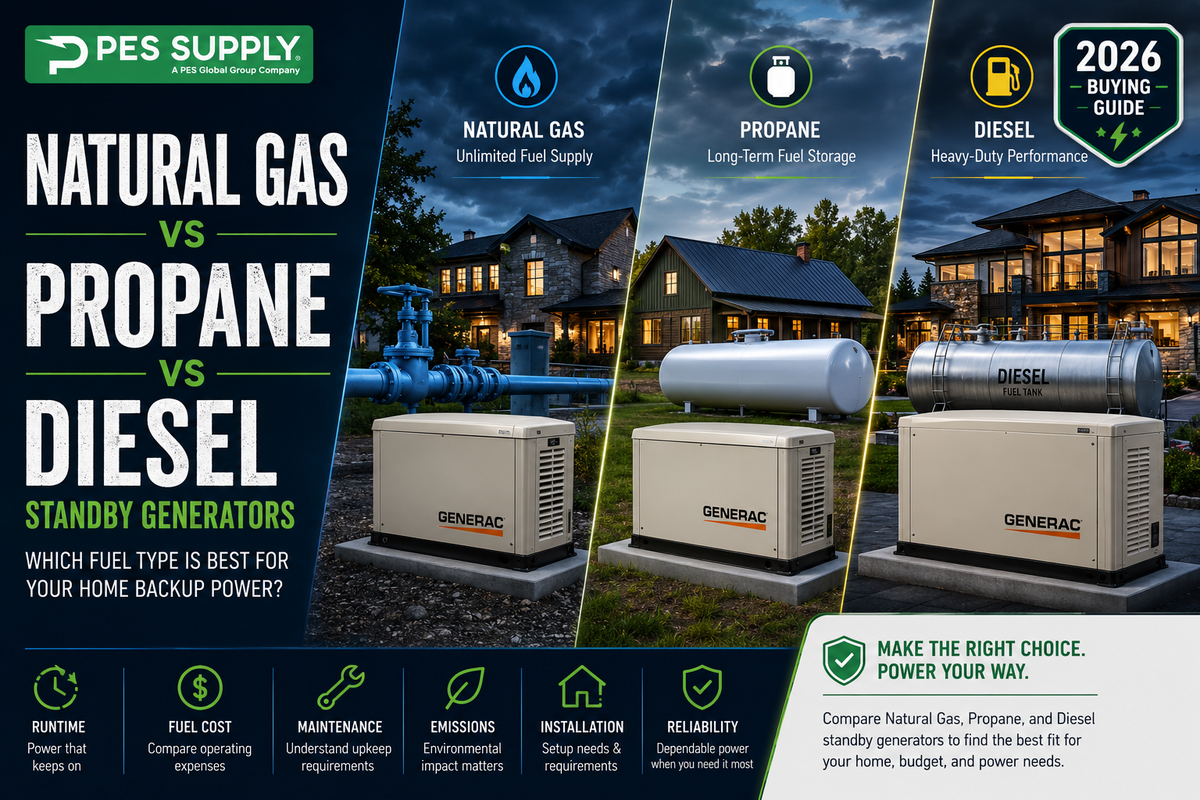
Natural gas is best if you have a pipeline connection and want unlimited runtime with zero fuel storage. Propane is best for remote properties without gas lines, offering a long fuel shelf life and reliable cold-weather starting. Diesel is best for maximum energy density and long-duration reliability, though it costs more upfront and requires more fuel maintenance [web:622][web:624][web:627][web:632].
Key Takeaways
- Natural Gas Never Runs Out (Usually): Direct pipeline connection means no refueling and no on-site storage, but supply can be interrupted during severe weather or seismic events.
- Propane Has the Longest Shelf Life: Unlike diesel, propane doesn't degrade over time, making it ideal for generators that sit idle for months between uses .
- Diesel Has the Highest Energy Density: This means less fuel is needed for the same runtime, which is why diesel dominates large commercial and industrial backup applications.
- Propane Packs More Punch Per Volume Than Natural Gas: One cubic foot of propane yields roughly 2.4x the BTUs of the same volume of natural gas.
- Diesel Costs More Upfront But Can Be Cheaper Long-Term at Scale: Diesel is cheaper to buy and simpler to install; natural gas is generally cheaper to run over time.
- Diesel Requires the Most Maintenance: Fuel degradation, wet-stacking risk, and cold-weather starting issues make diesel more maintenance-intensive than gas or propane.
- Natural Gas and Propane Burn Cleaner: Both produce meaningfully fewer particulates and lower emissions than diesel.
In This Guide
How the Three Fuel Types Actually Differ
The three standby generator fuel types differ primarily in how the fuel is supplied, how much energy it packs per unit of volume, and how well it holds up in storage. Natural gas arrives continuously through a pipeline with no storage needed, propane is stored in a tank on your property and delivered by truck, and diesel is stored in an integrated or external tank that requires periodic fuel management.
Energy density varies significantly between the three: propane delivers about 93 megajoules per cubic metre compared to natural gas's 38 megajoules, while diesel offers the highest energy density of all three, allowing it to run longer on a proportionally smaller fuel volume.
Natural Gas Generators
Natural gas generators connect directly to your home's existing gas line, eliminating fuel storage entirely and providing what is effectively unlimited runtime as long as the pipeline stays intact.
Natural Gas: Pros and Cons
Pros: No fuel storage or refueling needed; continuous supply during extended outages; cleaner burning with lower emissions than diesel; generally lower cost per unit of energy
Cons: Requires an existing pipeline connection or new line installation; supply can be interrupted during severe weather, earthquakes, or infrastructure damage; lower energy density means larger engines needed for the same output
Propane Generators
Propane generators store fuel in an on-site tank that you control, making them the go-to choice for rural or remote properties without natural gas pipeline access .
Propane: Pros and Cons
Pros: Doesn't degrade over time like diesel, so it's ideal for equipment that sits idle for months; starts reliably in cold weather; quieter operation than diesel; cleaner burning with fewer particulates
Cons: Requires an on-site tank and scheduled deliveries; owner is responsible for ensuring adequate supply before a disaster hits; large tanks add meaningful upfront cost; higher-output units become disproportionately expensive [web:634]
Diesel Generators
Diesel generators are the standard for large commercial and industrial backup applications thanks to superior fuel efficiency and long-duration reliability, though residential use requires weighing higher upfront cost against that efficiency advantage [web:622][web:627][web:633].
Diesel: Pros and Cons
Pros: Highest energy density of the three fuels, meaning less fuel needed for the same runtime; generally cheaper to purchase and simpler to install than comparable natural gas units; long track record in demanding commercial applications [web:622][web:633]
Cons: Fuel degrades over time and requires periodic testing/treatment; susceptible to wet-stacking when run without adequate load; can struggle to start in cold weather; produces more emissions, particulates, and noise than gas or propane [web:624][web:627][web:632]
Full Comparison Table
| Factor | Natural Gas | Propane | Diesel |
|---|---|---|---|
| Fuel Supply | Pipeline, no storage | On-site tank, truck refills | On-site tank, truck refills |
| Energy Density | ~38 MJ/m³ (lowest) | ~93 MJ/m³ | Highest of the three |
| Runtime | Effectively unlimited | Limited by tank size | Longest runtime per fuel volume |
| Fuel Shelf Life | N/A (continuous supply) | Does not degrade | Degrades over time, needs treatment |
| Maintenance | Minimal, cleaner burning | Low, no wet-stacking | Highest, fuel testing and additives needed |
| Cold Weather Starting | Good | Reliable, easy starting | Can struggle in cold climates |
| Emissions | ~117 lbs CO2/MMBtu (lowest) | ~139 lbs CO2/MMBtu | Highest particulates and pollutants |
| Noise Level | Moderate | Quieter than diesel | Louder |
| Disaster Reliability | Risk if pipeline is damaged | Risk of delivery bottleneck | Risk of delivery bottleneck |
| Best For | Urban homes with pipeline access | Rural/remote properties | Large loads, commercial-grade reliability [web:627][web:633] |
Which Fuel Should You Actually Choose?
Use this decision framework based on your property and priorities [web:623][web:627]:
- Choose natural gas if you already have a pipeline connection and want zero fuel storage with effectively unlimited runtime
- Choose propane if you're in a rural area without gas lines, want a fuel that never degrades, or need reliable cold-weather starting
- Choose diesel if you have a large power requirement, want the longest runtime per fuel volume, and don't mind more hands-on fuel maintenance
- Consider a dual-fuel unit if you want flexibility to switch between natural gas and propane depending on availability [web:624]
⚠ Consider Disaster Resilience, Not Just Everyday Convenience
Natural gas feels the most convenient day-to-day, but pipeline infrastructure can be damaged in the exact severe weather events or earthquakes that trigger prolonged outages [web:624][web:634]. If you live in an area prone to infrastructure damage, an on-site propane or diesel tank sized for several days of runtime provides a layer of independence that pipeline-fed systems can't guarantee.
Frequently Asked Questions
Can a natural gas generator be converted to run on propane?
Yes, most natural gas generators can be converted to propane with a conversion kit, and some models come dual-fuel capable from the factory [web:624][web:631]. This gives homeowners flexibility if pipeline access changes or if they want a backup fuel source available.
Which fuel is cheapest to run long-term?
Natural gas is generally the cheapest to run per unit of energy since it's priced as a commodity delivered through existing infrastructure, while propane typically costs more per equivalent unit due to tank delivery logistics [web:622][web:626]. Diesel's higher energy density can offset its per-unit cost for high-load, long-duration applications, but for typical residential standby use, natural gas usually wins on ongoing cost [web:622].
Why do diesel generators need more maintenance than gas or propane?
Diesel fuel degrades over time and requires periodic testing or fuel additives to stay usable, and diesel engines run without adequate load can suffer from "wet-stacking," where unburned fuel builds up in the exhaust system [web:627][web:632]. Natural gas and propane don't have these issues, which is part of why they're increasingly preferred for residential standby applications [web:624].
Is propane or natural gas better for a home with no pipeline access?
Propane is the clear choice for homes without natural gas pipeline access, since it only requires an on-site storage tank with scheduled truck deliveries rather than new pipeline infrastructure [web:623][web:627]. It's especially well suited to rural or remote properties where running a new gas line would be impractical or prohibitively expensive.
Do diesel generators produce more pollution than natural gas or propane?
Yes, diesel generators produce more particulates, contaminants, and overall pollution compared to natural gas or propane units, which burn considerably cleaner [web:624][web:626]. If local emissions regulations or personal environmental preference are a priority, natural gas has the lowest emissions profile of the three fuel types [web:626].
Find the Right Fuel Type for Your Backup Generator
Portlandia Electric Supply stocks natural gas, propane, and diesel standby generators from leading manufacturers, along with fuel tanks and transfer switch hardware. Our team can help you match the right fuel type to your property and backup power priorities. Nationwide delivery from 12+ distribution hubs.
Shop Standby Generators Request a Sizing ConsultationRelated Guides
- 12kW vs 16kW vs 20kW vs 24kW Standby Generator - Which size does your home actually need
- How Automatic Transfer Switches Work - Managed vs whole-house switch options
- How Much Can I Save With Solar Panels? - Compare solar-plus-battery vs generator backup
- What Are the Main Types of Solar Panels? - TOPCon, HJT, bifacial, and thin-film comparison
- Request a Quote - Get pricing on generators and backup power systems
About Portlandia Electric Supply
Portlandia Electric Supply is a nationwide distributor of Tier 1 solar panels, inverters, battery storage systems, standby and portable generators, EV charging hardware, racking, circuit breakers, and complete electrical project kits. With 12+ distribution hubs, 3,800+ in-stock SKUs, NABCEP-certified design support, and a network of 8,500+ solution providers, Portlandia serves contractors, EPCs, developers, and homeowners with fast delivery and expert procurement guidance.
Location: 1507 Portland Ave, Louisville, KY, United States | Phone: 1 888-876-0007 | Website: www.portlandiaelectric.supply
Article: Natural Gas vs Propane vs Diesel Standby Generators: Fuel Type Comparison Guide
Category: Standby Generators | Home Backup Power | Generator Fuel Types | Electrical Systems
Last Updated: July 2026 - Based on Generator Pros, TT Power Group, and Ferrellgas Fuel Comparisons
Disclaimer: Fuel comparisons, cost figures, and performance characteristics provided are approximations based on industry sources and may vary by region, generator model, and local fuel pricing. Always consult a licensed electrician or generator dealer for a site-specific recommendation before purchase.
Frequently Asked Questions
What size generator do I need for my home?
A typical whole-home generator is 22-26kW. Size based on your essential loads (AC, refrigerator, well pump, lights). A 26kW Generac runs two AC units plus standard household loads.
What is the difference between LP and NG generators?
LP (propane) generators produce more power than NG (natural gas) models. A 26kW Generac outputs 26kW on LP vs 24kW on NG.
Do you install generators?
PES Supply is a distributor, not an installer. We can connect you with a qualified installer through our PowerLink contractor network.
Shop Related Products
PES Supply carries 80,000+ products from 300+ manufacturers. One PO, one invoice, every trade covered.
Need help sizing? Our team can calculate loads, select equipment, and source everything from one PO.
Call (502) 790-0600