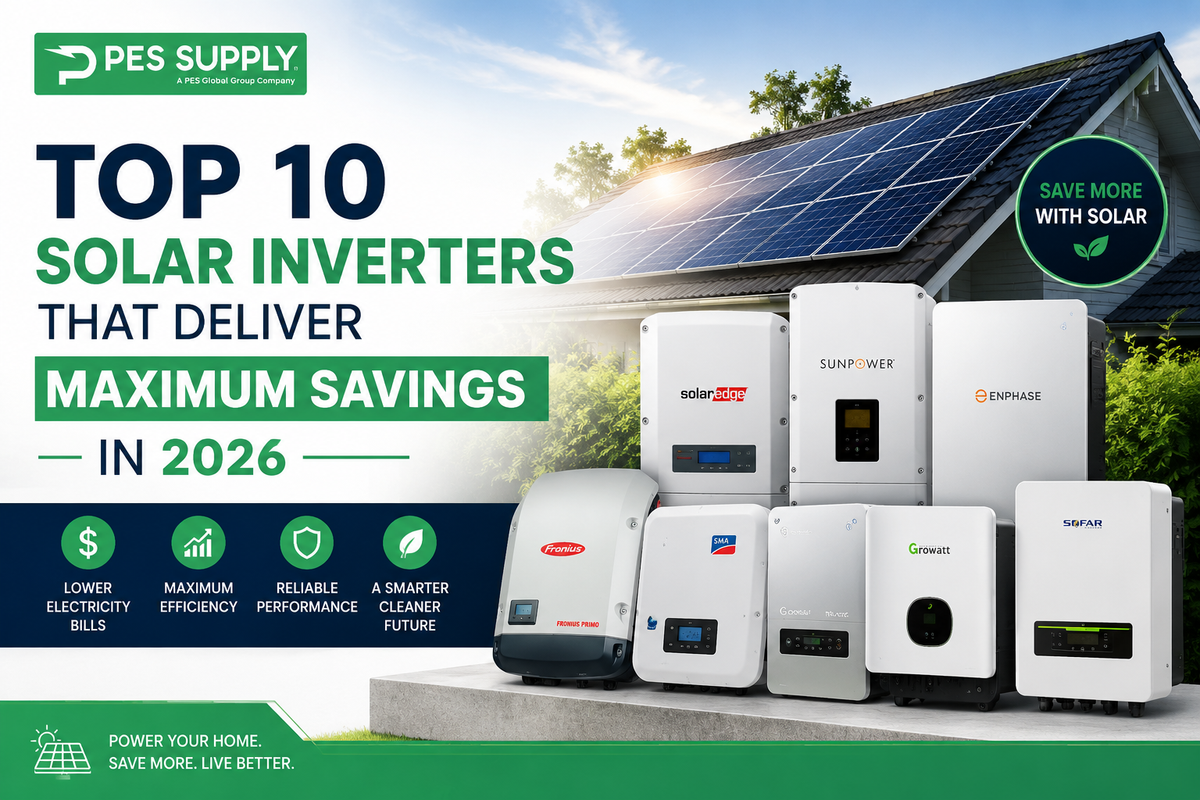
Last Updated: June 2026 • Based on Manufacturer Specifications, EnergySage Market Data, and NREL Performance Testing
Your solar inverter is the most important component in your solar system after the panels themselves. It converts the DC electricity your panels produce into the AC electricity your home actually uses. Choose the wrong inverter and your system underperforms for 25 years. Choose the right one and you get maximum energy from every hour of sunlight, real-time monitoring, seamless battery integration, and a warranty that protects you for the long haul.
This guide covers the top 10 home solar inverters in 2026, with honest comparisons of efficiency, warranty, cost, monitoring capability, and which home situations each one is best suited for.
⚡ Quick Answer
The best solar inverter for most homes in 2026 is the Enphase IQ8 microinverter for shaded or complex rooftops, and the SolarEdge HD-Wave with power optimizers for standard rooftops that want panel-level monitoring. For homeowners adding battery backup, the Enphase IQ8 with IQ Battery or Tesla Solar Inverter with Powerwall 3 are the leading integrated options. String inverters from Fronius and SMA remain the most cost-effective choice for simple, unshaded roofs.
Key Takeaways
- Inverter Type Matters More Than Brand: Choosing the right inverter type (string, micro, hybrid) for your specific roof and goals has more impact on performance than brand choice within the same category.
- Efficiency Range in 2026: Top-tier home inverters achieve 97 to 99% peak efficiency. A 1% difference in efficiency costs or saves $300 to $500 over 25 years on a typical system.
- Microinverters Win on Shaded Roofs: If any part of your roof is shaded by trees, chimneys, or dormers, microinverters from Enphase or APsystems prevent one shaded panel from reducing output across the entire array.
- Warranty Is a Critical Differentiator: String inverter warranties are typically 10 to 12 years. Microinverter warranties (Enphase) are 25 years. This difference significantly affects lifetime ownership cost.
- Hybrid Inverters Are the Future: Hybrid inverters that manage solar, battery, and grid simultaneously are the fastest-growing inverter category. If you plan to add storage within 5 years, start with a hybrid-ready inverter.
- Budget for Replacement: String inverters typically need replacement once during a 25-year system life. Budget $1,500 to $3,500 for this at some point in years 10 to 15.
- Portlandia Electric Supply: Stocks Enphase, SolarEdge, SMA, Fronius, Growatt, and other leading inverter brands with nationwide delivery and NABCEP design support.
In This Guide
- Inverter Types: Which One Is Right for Your Home?
- How to Choose the Right Inverter Before Reading Reviews
- Top 10 Best Home Solar Inverters in 2026
- Side-by-Side Comparison Table
- Best Inverter by Home Situation
- Inverter Cost Guide for 2026
- Warranty Comparison
- Monitoring and Smart Home Integration
- Frequently Asked Questions
Inverter Types: Which One Is Right for Your Home?
Before comparing specific models, you need to understand the four inverter types. The right type for your home is more important than any brand name on the label. Getting this decision wrong can cost you 15 to 30% of your system's lifetime energy output.
| Type | How It Works | Best For | Avoid If | Cost Range |
|---|---|---|---|---|
| String Inverter | All panels in a string connect to one central inverter that converts DC to AC | Simple, unshaded, south-facing roofs | Any shading, multiple roof orientations | $1,000 to $2,500 |
| Microinverter | One inverter per panel. Each converts DC to AC independently at the panel. | Shaded roofs, multiple orientations, panel-level monitoring | Very large systems where cost per watt becomes prohibitive | $150 to $250 per panel |
| Power Optimizer + String | DC optimizers on each panel condition power before feeding one string inverter | Partial shading, panel-level monitoring at lower cost than microinverters | Off-grid systems, sites with no shade concerns | $1,800 to $3,500 total |
| Hybrid Inverter | Manages solar panels, battery storage, and grid connection from one unit | Homes with or planning battery storage, time-of-use rate optimization | Systems with no storage plans and lowest upfront cost priority | $2,000 to $5,000 |
How to Choose the Right Inverter Before Reading Reviews
Answer these four questions before looking at specific models. Your answers will narrow the field to one or two inverter types, which makes the rest of the decision straightforward.
Question 1. Does any part of your roof get shaded by trees, chimneys, vents, or nearby buildings between 9 AM and 3 PM?
Yes: Choose microinverters (Enphase IQ8) or power optimizers (SolarEdge).
No: A string inverter is sufficient and more cost-effective.
Question 2. Does your roof have panels facing more than one direction?
Yes: Microinverters or dual-MPPT string inverters handle multiple orientations correctly.
No: A standard string inverter works fine.
Question 3. Do you want battery backup now or within the next 5 years?
Yes: Choose a hybrid inverter (Enphase IQ8 with battery, SolarEdge StorEdge, Tesla, Fronius Symo GEN24).
No: A standard string or microinverter system works well.
Question 4. Do you want panel-level monitoring to see exactly which panel is producing what?
Yes: Microinverters or power optimizers both provide panel-level data.
No: A string inverter with system-level monitoring is sufficient.
Top 10 Best Home Solar Inverters in 2026
1. Enphase IQ8 Series Microinverter

Best Overall for Residential Solar in 2026
| Peak Efficiency | 97.5% (IQ8+), 97.6% (IQ8M) |
| Warranty | 25 years (industry-leading) |
| Key Feature | Sunlight Backup: produces limited power during grid outages even without a battery |
| Monitoring | Enphase Enlighten app, panel-level real-time data |
| Battery Compatible | Yes, Enphase IQ Battery 5P and 10T |
| Cost per Unit | $175 to $250 per microinverter |
| Best For | Shaded roofs, complex layouts, homeowners who want the longest possible warranty with battery upgrade path |
The Enphase IQ8 is the best overall choice for most residential solar installations in 2026. Its unique Sunlight Backup feature allows it to produce limited power during grid outages even without a battery installed, a capability no other microinverter offers. The 25-year warranty matches the lifespan of the panels themselves, meaning you will likely never pay for an inverter replacement. Panel-level monitoring through the Enlighten app is the best in the industry.
2. SolarEdge HD-Wave with P370 Power Optimizers

Best String Inverter System for Panel-Level Monitoring
| Peak Efficiency | 99.2% (highest efficiency string inverter currently available) |
| Warranty | 12 years standard, 20 to 25 years with extended plan. Optimizers: 25 years. |
| Key Feature | 99.2% peak efficiency is the highest of any home string inverter. DC-coupled optimizers for panel-level monitoring. |
| Monitoring | SolarEdge Monitoring Portal, panel-level with power optimizers |
| Battery Compatible | Yes via SolarEdge StorEdge or Home Hub. LG Chem and Solax compatible. |
| Cost Range | $2,200 to $3,500 total (inverter and optimizers for 8 kW system) |
| Best For | Homeowners who want the highest efficiency string system with panel-level monitoring at lower cost than microinverters |
The SolarEdge HD-Wave achieves 99.2% peak efficiency, the highest of any string inverter for home use. Paired with SolarEdge P370 power optimizers, it delivers panel-level monitoring and shade mitigation at a lower installed cost than a full microinverter system. The main limitation is the 12-year base warranty, which means budgeting for a potential replacement around year 12 to 15.
3. Tesla Solar Inverter with Powerwall 3

Best Integrated Solar Plus Battery System
| Peak Efficiency | 97.5% |
| Warranty | 10 years (inverter only) |
| Key Feature | Powerwall 3 is the first Tesla battery with a fully integrated solar inverter. One unit handles solar, battery, and grid management. |
| Monitoring | Tesla app with real-time solar, battery, and home consumption data |
| Battery Included | Yes, Powerwall 3 (13.5 kWh usable, 11.5 kW peak output) |
| Cost Range | $11,500 to $14,000 including Powerwall 3 hardware |
| Best For | Homeowners who want solar and whole-home backup in a single integrated system with the simplest app experience |
The Powerwall 3 combines solar inverter and battery storage in a single wall-mounted unit. This simplifies installation, reduces wiring complexity, and delivers the most seamless solar plus backup experience available in 2026. The 11.5 kW peak output is powerful enough to run central air conditioning during an outage. The main limitation is that it requires a Tesla Solar installation and does not integrate with third-party panels as freely as standalone inverters.
4. Fronius Primo Gen24 Plus

Best Premium Hybrid String Inverter
| Peak Efficiency | 98.1% |
| Warranty | 10 years standard, extendable to 20 years |
| Key Feature | Emergency power supply function works without batteries. Dual MPPT for two independent string orientations. |
| Monitoring | Fronius Solar.web, free lifetime cloud monitoring with detailed production graphs |
| Battery Compatible | Yes, BYD Battery-Box, Fronius Solar Battery, and other BYD-compatible units |
| Cost Range | $2,200 to $3,200 |
| Best For | Homeowners who want a European-engineered premium inverter with battery readiness and excellent long-term reliability |
Fronius has one of the best reliability track records in the residential inverter market. The Primo Gen24 Plus is a hybrid unit that can power a limited emergency circuit directly from the panels even without a battery, a useful safeguard for daytime outages. Dual MPPT supports two different roof orientations in the same string system. Free lifetime monitoring through Solar.web is a meaningful cost saving over systems that charge ongoing subscription fees.
5. SMA Sunny Boy 7.7-US

Best String Inverter for Reliability and Serviceability
| Peak Efficiency | 97.0% |
| Warranty | 10 years standard, extendable to 20 or 25 years |
| Key Feature | Secure Power Supply: provides up to 2,000W daytime power from a dedicated outlet during a grid outage with no battery required |
| Monitoring | SMA SunnyPortal, SMA Home Manager compatible for home energy management |
| Battery Compatible | Via SMA Sunny Boy Storage or Sunny Island for off-grid applications |
| Cost Range | $1,800 to $2,800 |
| Best For | Simple unshaded rooftops where long-term reliability and service network depth matter more than panel-level monitoring |
SMA has been making solar inverters since 1981 and their Sunny Boy line is the most widely serviced string inverter brand in the US. The Sunny Boy 7.7-US includes a Secure Power Supply outlet that delivers up to 2,000W from solar during daytime grid outages, enough to run a refrigerator and charge a phone while waiting for power to return. SMA's nationwide service network is among the deepest in the industry.
6. APsystems EZ1-M Microinverter

Best Budget Microinverter for Small Systems
| Peak Efficiency | 96.7% |
| Warranty | 10 years standard (shorter than Enphase) |
| Key Feature | Dual-module design: one unit handles two panels, cutting hardware costs by nearly half compared to single-panel microinverters |
| Monitoring | APsystems ECU, module-level monitoring via EMA app |
| Battery Compatible | Not natively. Requires separate AC-coupled battery system. |
| Cost Range | $130 to $170 per unit (handles 2 panels) |
| Best For | Small systems of 4 to 16 panels, budget-conscious buyers who need shade tolerance without Enphase pricing |
APsystems brings microinverter technology to a more accessible price point through its dual-module design. Instead of one microinverter per panel, one EZ1-M unit handles two panels, significantly reducing hardware cost while preserving most of the shade tolerance benefits. The 10-year warranty is shorter than Enphase but the lower cost may make it the better choice for small systems where full 25-year microinverter coverage is less critical.
7. Growatt MIN 6000TL-X

Best Value String Inverter for Budget-Conscious Buyers
| Peak Efficiency | 98.4% |
| Warranty | 10 years standard, extendable to 20 years |
| Key Feature | High efficiency at significantly lower cost than European brands. Dual MPPT trackers for two independent strings. |
| Monitoring | ShinePhone app, ShineServer cloud platform. Wi-Fi and Ethernet connectivity built in. |
| Battery Compatible | Via Growatt SPF hybrid inverter series. Not directly on this model. |
| Cost Range | $900 to $1,400 |
| Best For | Budget-conscious homeowners with simple unshaded roofs who want high efficiency without premium European pricing |
Growatt has grown rapidly from a budget option to a legitimate mid-tier inverter brand with competitive efficiency ratings. The MIN 6000TL-X achieves 98.4% peak efficiency at roughly half the price of a comparable SMA or Fronius unit. It is best suited for straightforward, unshaded residential installations where the cost savings justify accepting a less established US service network compared to European brands.
8. Sungrow SH8.0RT Hybrid

Best Hybrid Inverter for Value
| Peak Efficiency | 98.4% |
| Warranty | 10 years |
| Key Feature | Full hybrid functionality with EPS (Emergency Power Supply) mode. Compatible with Sungrow SBR lithium battery series. 100% uninterruptible switching during outages. |
| Monitoring | iSolarCloud app with remote monitoring, fault diagnosis, and firmware updates |
| Battery Compatible | Yes, Sungrow SBR series (stackable from 9.6 to 38.4 kWh) |
| Cost Range | $1,800 to $2,800 |
| Best For | Homeowners who want hybrid solar plus battery capability without paying premium prices for Fronius or SolarEdge hybrid units |
Sungrow is the world's largest inverter manufacturer by volume and their hybrid SH series brings full solar plus battery management to a competitive price point. The SBR battery series is modular, allowing you to start with 9.6 kWh and add capacity later without replacing the inverter. The 100% uninterruptible switching during outages ensures no power interruption to backed-up circuits.
9. Enphase IQ8X-BAT Microinverter

Best Microinverter for High-Wattage Panels (500W+)
| Peak Efficiency | 97.0% |
| Warranty | 25 years |
| Key Feature | Handles panel input up to 540W DC. Designed for next-generation high-wattage bifacial and 66-cell panels entering the residential market in 2025 and 2026. |
| Monitoring | Enphase Enlighten, full panel-level data |
| Battery Compatible | Yes, Enphase IQ Battery 5P |
| Cost Range | $200 to $270 per unit |
| Best For | Systems using large-format panels (450W to 540W) where standard IQ8 models would be under-matched |
As panel wattages increase, matching the microinverter capacity to the panel becomes increasingly important. The IQ8X-BAT handles up to 540W DC input, making it the right microinverter choice when installing the newest high-wattage bifacial residential panels. Pairing an undersized microinverter with a high-wattage panel wastes production and can reduce system output by 5 to 10% at peak hours.
10. Solax X1-Hybrid G4

Best Compact Hybrid Inverter for Small Homes
| Peak Efficiency | 97.6% |
| Warranty | 10 years |
| Key Feature | Single-phase hybrid with EPS. Very compact and lightweight. Available in 3.7 kW to 7.5 kW sizes suitable for smaller homes and apartments. |
| Monitoring | Solax Cloud via Wi-Fi dongle, SolaxApp with near-real-time data |
| Battery Compatible | Yes, Solax T-BAT and compatible third-party LFP batteries |
| Cost Range | $1,200 to $2,000 |
| Best For | Small homes, condos, or accessory dwelling units with modest solar capacity and a desire for battery storage without full-sized inverter pricing |
The Solax X1-Hybrid fills an important gap in the market: a compact, single-phase hybrid inverter for homes that do not need a full 8 to 10 kW string system. Its 3.7 to 7.5 kW size range fits well for smaller homes, accessory dwelling units, or apartments where space and system size are limited. Third-party LFP battery compatibility gives more storage flexibility than closed ecosystem inverters.
Side-by-Side Comparison Table
| Inverter | Type | Peak Efficiency | Warranty | Battery Ready | Cost Range |
|---|---|---|---|---|---|
| Enphase IQ8 | Microinverter | 97.5% | 25 years | Yes | $175 to $250/unit |
| SolarEdge HD-Wave | String + Optimizers | 99.2% | 12 to 25 yrs | Yes | $2,200 to $3,500 |
| Tesla Powerwall 3 | Hybrid (integrated) | 97.5% | 10 years | Included | $11,500 to $14,000 |
| Fronius Primo Gen24 | Hybrid String | 98.1% | 10 to 20 yrs | Yes | $2,200 to $3,200 |
| SMA Sunny Boy 7.7 | String | 97.0% | 10 to 25 yrs | Via add-on | $1,800 to $2,800 |
| APsystems EZ1-M | Microinverter | 96.7% | 10 years | Via AC couple | $130 to $170/unit |
| Growatt MIN 6000TL-X | String | 98.4% | 10 to 20 yrs | Via separate unit | $900 to $1,400 |
| Sungrow SH8.0RT | Hybrid | 98.4% | 10 years | Yes | $1,800 to $2,800 |
| Enphase IQ8X-BAT | Microinverter | 97.0% | 25 years | Yes | $200 to $270/unit |
| Solax X1-Hybrid G4 | Hybrid | 97.6% | 10 years | Yes | $1,200 to $2,000 |
Best Inverter by Home Situation
| Your Situation | Best Choice | Runner-Up | Why |
|---|---|---|---|
| Shaded roof, trees nearby | Enphase IQ8 | SolarEdge HD-Wave | Panel-level optimization prevents one shaded panel from dragging down the whole system |
| Simple unshaded south-facing roof | SMA Sunny Boy 7.7 | Fronius Primo Gen24 | Best service network and reliability for simple systems. No need for panel-level electronics. |
| Want solar and whole-home battery backup | Tesla Powerwall 3 | Enphase IQ8 + IQ Battery | Single integrated unit, simplest installation, 11.5 kW peak output handles whole-home backup loads |
| Want battery readiness without paying for it yet | Fronius Primo Gen24 | Sungrow SH8.0RT | Hybrid-ready from installation. Add battery later without replacing the inverter. |
| Tight budget, simple roof | Growatt MIN 6000TL-X | APsystems EZ1-M | High efficiency at a price 40 to 60% below European brands. Acceptable reliability for low-risk simple installations. |
| Panels facing two different directions | Enphase IQ8 | SolarEdge HD-Wave (dual MPPT) | Microinverters handle any number of orientations independently. Dual-MPPT string inverters handle two orientations at lower cost. |
| Small home under 1,500 sq ft | Solax X1-Hybrid G4 | APsystems EZ1-M | Right-sized for smaller systems with battery storage option without paying for a full 8 kW inverter |
Inverter Cost Guide for 2026
Inverter cost is typically 10 to 15% of total system cost for string inverters and 15 to 25% for microinverter systems. Here is what to expect at different system sizes.
| System Size | String Inverter Cost | Microinverter Total Cost | Hybrid Inverter Cost |
|---|---|---|---|
| 4 kW (10 panels) | $900 to $1,800 | $1,750 to $2,500 | $1,800 to $3,000 |
| 6 kW (15 panels) | $1,200 to $2,200 | $2,625 to $3,750 | $2,000 to $3,500 |
| 8 kW (20 panels) | $1,500 to $2,800 | $3,500 to $5,000 | $2,200 to $4,500 |
| 10 kW (25 panels) | $1,800 to $3,200 | $4,375 to $6,250 | $2,500 to $5,000 |
Important Note on Microinverter Cost: While microinverters cost more upfront, they typically do not need replacement during the system's 25-year life (Enphase warranty). A string inverter at $1,800 today plus a replacement in year 12 to 15 at $2,000 to $2,500 can match or exceed the lifetime cost of an Enphase microinverter system. Factor replacement costs into any direct comparison.
Frequently Asked Questions
Which solar inverter brand is the most reliable?
Enphase and SMA consistently rank highest in independent reliability studies and industry surveys. Enphase microinverters have a particularly strong track record because each unit handles only one panel, so a failure affects only one panel rather than the whole array. SMA has the longest history in the residential inverter market and the deepest US service network. For hybrid inverters, Fronius has the strongest European reputation for long-term reliability.
How long do home solar inverters last?
String inverters typically last 10 to 15 years before requiring replacement. Enphase microinverters are designed and warranted for 25 years, matching the lifespan of solar panels. The main failure mode for string inverters is capacitor degradation from heat cycling. Inverters installed in cooler, shaded, well-ventilated locations consistently outlast those installed in hot direct-sun locations.
Can I add battery storage to my existing inverter?
It depends on what inverter you have. If you have an Enphase IQ system, you can add an IQ Battery at any time. If you have a SolarEdge system, you can add a compatible battery through their StorEdge or Home Hub products. If you have a standard string inverter from SMA, Fronius, or another brand, you can add an AC-coupled battery (like a Tesla Powerwall) without replacing your inverter, though this is slightly less efficient than a DC-coupled system. If your inverter is not battery-compatible at all, adding storage will require replacing or supplementing it.
Is a more expensive inverter always better?
Not always. For a simple, unshaded south-facing roof, a reliable string inverter from Growatt or SMA performs nearly as well as a premium SolarEdge or Enphase system at significantly lower cost. The premium features of power optimizers and microinverters deliver their value only when shading or multiple orientations create uneven panel performance. Match the inverter capability to your actual situation rather than buying the most expensive option by default.
Does inverter efficiency really matter for electricity bill savings?
Yes, but the difference between the best and worst modern inverters is small. A 97% efficient inverter versus a 99% efficient one loses 2% more of your solar production to heat. On a 10,000 kWh per year system at $0.16 per kWh, that is $32 per year. Over 25 years that is $800, not enough to justify a large price premium for efficiency alone. Shade tolerance, warranty length, and battery compatibility are more financially significant differences between inverter choices.
Source Your Solar Inverter and Panels in One Order
Portlandia Electric Supply stocks Enphase, SolarEdge, SMA, Fronius, Sungrow, Growatt, and other leading inverter brands alongside Tier 1 solar panels, battery storage, racking, and all balance-of-system components. Buy everything for your project in one order with bundled freight. Nationwide delivery from 12+ distribution hubs. NABCEP-certified design support available.
Shop Solar Inverters Request a Project QuoteRelated Guides
- Solar Panel Cost: What Should I Actually Pay? - Complete 2026 pricing guide
- How Much Can I Save With Solar Panels? - Calculate your annual savings
- Lease vs. Loan vs. Cash: Which Solar Option Is Best? - Financing comparison
- What Questions Should I Ask My Solar Company? - 40 questions before you sign
- Request a Quote - Get pricing on inverters, panels, and complete system kits
About Portlandia Electric Supply
Portlandia Electric Supply is a nationwide distributor of Tier 1 solar panels, inverters, battery storage systems, EV charging hardware, racking, circuit breakers, generators, and complete electrical project kits. With 12+ distribution hubs, 3,800+ in-stock SKUs, NABCEP-certified design support, and a network of 8,500+ solution providers, Portlandia serves contractors, EPCs, developers, and homeowners with fast delivery and expert procurement guidance.
Location: 1507 Portland Ave, Louisville, KY, United States | Phone: 1 888-876-0007 | Website: www.portlandiaelectric.supply
Article: Top 10 Best Solar Inverters for Home in 2026: Complete Buyer's Guide for Efficient Solar Energy
Category: Solar Energy | Solar Inverters | Home Solar | Residential Solar Equipment | Buyer's Guide
Last Updated: June 2026 - Based on Manufacturer Specifications, EnergySage Market Data, and NREL Performance Testing
Disclaimer: Inverter specifications, prices, and availability are based on manufacturer data and market conditions as of June 2026 and are subject to change. Always verify current specifications and pricing with your distributor or installer before making purchasing decisions.
Related Resources:
- Best Solar Panels 2026 — Buyer's Guide
- EG4 vs Tesla Powerwall
- Qcells vs Trina vs JA
- Solar Inverter Buyer's Guide
- Solar Battery Buyer's Guide
- 5kW Solar Kit
- 10kW Solar + Battery Kit
- Off-Grid Cabin Kit
- EG4 Batteries
- Qcells Solar Panels
- Trina Solar
- JA Solar
- REC Solar
- Mission Solar
- Sol-Ark Inverters
- SolarEdge Inverters
- Generac PWRcell
Calculate how much storage you need with our battery sizing calculator.
Check solar incentives available in your state.
Use our free solar system calculator to size your array.
Check out our Solar Panel Comparison Tool. Check out our Inverter Sizing Calculator.
Calculate your solar payback and 25-year savings with our Solar ROI Calculator. Follow our complete DIY solar installation guide for step-by-step instructions. Keep your system running at peak performance with our Solar Maintenance Guide.
Related Resources
- Solar System Calculator
- Battery Sizing Calculator
- Solar Panel Comparison Tool
- Inverter Sizing Calculator
- Solar ROI Calculator
- Solar Installation Guide
- Solar Maintenance Guide
- Solar Permitting Guide
- Battery Installation Guide
- NEC Code Compliance Guide
- Solar Panel Mounting Guide
- Grounding & Bonding Guide
- Solar Incentives by State
- Pro Account — Wholesale Pricing
- PowerLink Network — Contractor Program
Frequently Asked Questions
What size solar panel do I need?
Sizing depends on your daily energy consumption, available roof space, and peak sun hours in your area. A typical home uses 15-25 panels (400W each) for full offset. Call (502) 790-0600 for a free sizing consultation.
How much do solar panels cost in 2026?
PES Supply distributes panels from major manufacturers including Jinko, Mission Solar, and more. Pricing varies by wattage and quantity. Request a quote for current pricing.
Do you offer BABA-compliant solar panels?
Yes. PES Supply provides BABA documentation at no extra charge. All our solar products meet Build America, Buy America requirements.
Shop Related Products
PES Supply carries 80,000+ products from 300+ manufacturers. One PO, one invoice, every trade covered.
Need help sizing? Our team can calculate loads, select equipment, and source everything from one PO.
Call (502) 790-0600