Updated September 2026 — refreshed against the live PES catalog; product pricing verified 2026-09-26.
The average American home needs a 7–11kW solar system for full bill offset — but "average" sizes nobody's house. Your required kW falls out of three numbers: your annual kWh consumption, your roof's effective peak sun hours, and a 0.86 system derate for real-world losses. The formula is system kW = annual kWh ÷ (effective PSH × 365 × 0.86), and the rest of this guide is working it honestly, with tables you can check with a calculator and the field adjustments I've learned from sizing hundreds of systems off real utility bills rather than rules of thumb.

Step 1: Get Your Real Annual kWh
Everything starts with consumption. Pull 12 consecutive utility bills and total the kWh — not the dollars, which hide rate games. One summer-only or winter-only bill will mislead you by 40% or more; air conditioning and electric heat swing usage that hard. If your utility offers a Green Button data download, take the hourly data and note your peak month too — you will want it later for battery and inverter decisions.
No bills handy — new construction, a recent purchase, an off-grid build? Estimate from the load side. These are measured 2026-era figures for efficient equipment, not 1990s nameplates:
| Load | Typical Draw | Duty Pattern | Monthly kWh |
|---|---|---|---|
| 3-ton central AC (SEER2 15) | 2,800W running | ~8 hr/day, 4 summer months | ~670 (summer months) |
| Heat pump (heating, 2.5-ton, HSPF2 8.5) | 2,400W running | ~6 hr/day, winter | ~430 (winter months) |
| Electric water heater (50 gal) | 4,500W elements | ~3 hr/day total | ~400 |
| Refrigerator (modern) | 150W avg | Continuous duty cycle | ~45 |
| EV charging (~1,000 mi/mo) | 7.2kW Level 2 | ~0.30 kWh/mile | ~300 |
| Electric dryer | 5,000W | ~1 hr per load, 20 loads | ~100 |
| Electric range/oven | Varies | Daily cooking | ~70 |
| Lighting + electronics + base load | — | Whole house | ~250 |
Add the rows that describe your house and most families land between 700 and 1,300 kWh/month — 8,400 to 15,600 kWh/yr. The power consumption calculator and consumption calculation guide handle the arithmetic if your appliance list is longer, and how many watts to power a home covers the demand side.
Step 2: Find Your Effective Peak Sun Hours
Peak sun hours compress a whole day of variable sunshine into equivalent hours of full 1,000W/m² irradiance. Effective PSH goes further: it applies your roof's tilt and azimuth penalty, which is the only number that belongs in a sizing formula. Weather-station PSH (horizontal surface) flatters production by 10–20% on a typical roof.
| Region | Raw Horizontal PSH | Effective PSH (typical 20–30° roof, S/SW) | Sizing Consequence |
|---|---|---|---|
| Southwest (AZ, NM, SoCal deserts) | 6.0–6.5 | 5.3–5.8 | Smallest system per kWh |
| South / Gulf (TX, FL, GA) | 5.0–5.5 | 4.5–5.0 | Baseline |
| Mid-Atlantic / Midwest | 4.2–4.6 | 3.9–4.3 | +15% vs Gulf |
| Northeast | 3.8–4.2 | 3.5–3.9 | +25% vs Gulf |
| Pacific NW / Great Lakes cloud belt | 3.2–3.7 | 3.0–3.4 | +40% vs Gulf |
Pin your exact address down with the peak sun hours calculator — a half-hour of PSH error mis-sizes a system by a full kilowatt.
Step 3: Run the Formula
System kW = annual kWh ÷ (effective PSH × 365 × 0.86)
Worked example, a Dallas home using 12,000 kWh/yr with 4.8 effective PSH: 4.8 × 365 × 0.86 = 1,506.7 kWh per installed kW per year. 12,000 ÷ 1,506.7 = 7.96kW → call it 8kW. Same house in Seattle at 3.2 effective PSH: 3.2 × 365 × 0.86 = 1,004.5; 12,000 ÷ 1,004.5 = 11.9kW. Geography moved the answer by 4kW and roughly $10,000. This is why "how many kW do I need" has no national answer, only a personal one.
| Monthly Usage | Annual kWh | kW Needed @ 3.2 PSH | kW Needed @ 4.5 PSH | kW Needed @ 5.5 PSH |
|---|---|---|---|---|
| 600 kWh | 7,200 | 7.2kW | 5.1kW | 4.2kW |
| 900 kWh | 10,800 | 10.8kW | 7.7kW | 6.3kW |
| 1,200 kWh | 14,400 | 14.3kW | 10.2kW | 8.3kW |
| 1,500 kWh | 18,000 | 17.9kW | 12.8kW | 10.4kW |
| 2,000 kWh | 24,000 | 23.9kW | 17.0kW | 13.9kW |
Spot-check the 900 kWh row at 4.5 PSH: 4.5 × 365 × 0.86 = 1,412.6; 10,800 ÷ 1,412.6 = 7.64 → rounds to 7.7kW. Every cell follows the same formula, so adjust any row to your own PSH without trusting me blindly. The solar system calculator and panel sizing calculator automate it.
Step 4: Sanity-Check Against Roof and Budget
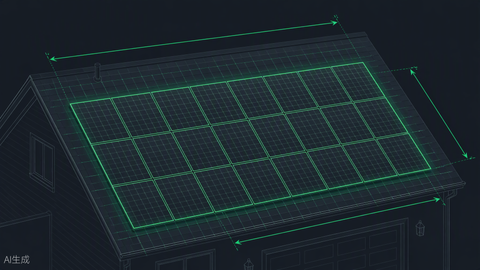
kW from the formula is an energy answer; now it needs a physical answer. Divide system watts by module watts for panel count, then multiply by ~18 sq ft per panel for roof area:
| System Size | Panels (430W) | Panels (460W) | Roof Area Needed |
|---|---|---|---|
| 5kW | 12 | 11 | ~230 sq ft |
| 8kW | 19 | 18 | ~360 sq ft |
| 10kW | 24 | 22 | ~450 sq ft |
| 12kW | 28 | 27 | ~540 sq ft |
| 15kW | 35 | 33 | ~680 sq ft |
If the formula says 14kW and your unshaded south roof holds 9kW, you have three honest options: use east and west planes with microinverters (production drops ~15% per panel but the kWh still count), ground-mount the difference, or size to the roof and accept partial offset. Partial offset is not failure — a 70% offset at good economics beats a forced 100% offset on bad roof planes.
Where the 0.86 Derate Comes From
Skeptics should be — a sizing constant deserves a receipt. The 0.86 factor multiplies the standard loss stack that NREL's PVWatts uses as its default:
| Loss Mechanism | Typical Loss | Remaining Factor |
|---|---|---|
| Inverter conversion (CEC efficiency) | 3.0% | 0.970 |
| DC + AC wiring | 2.0% | 0.951 |
| Soiling (dust, pollen, snow film) | 2.5% | 0.927 |
| Module temperature above STC | 5.0% | 0.881 |
| Mismatch, diodes, availability | 2.0% | 0.863 ≈ 0.86 |
Hot climates and string-inverter systems on complex roofs run worse — 0.80–0.83. Cool coastal roofs with micros run better — 0.88–0.90. Shade is deliberately excluded: shade is a site defect to design around, not a loss to accept into the formula.
Sizing for the Home You Will Have, Not the One You Have
The most expensive sizing mistake I see is a system specced against last year's bills on a house whose loads are about to grow. Electrification is the pattern: a heat-pump conversion adds 300–500 kWh/month in heating climates; a first EV adds 250–350; a hot tub adds 250–400; an ADU or a teenager-with-gaming-PC adds what it adds. If any of those are in your five-year plan, add their kWh to the annual total before running the formula. Upsizing by 1–2kW at install costs roughly $1,300–$2,000 per kW; retrofitting capacity later — new rails, inverter swap, panel re-permit — costs double that. We tell customers to size for the 2029 version of their house and let conservative production modeling protect the downside.
Service Panel and Code Constraints That Cap System Size
Your electrical service can veto the formula's answer. Under NEC 705.12(B)'s 120% rule, a 200A bus with a 200A main accepts at most a 40A solar backfeed breaker — about 7.7kW of inverter AC at 240V. Bigger answers need a main-breaker derate (where the dwelling load calculation per NEC 220.83 permits), a supply-side tap per 705.12(A), or a panel upgrade. On the wire side, NEC 310.16's 75°C copper column drives conductor choice: 25A inverter output (6kW) wants 8 AWG after the 125% continuous multiplier of 690.8; 50A output (12kW) wants 6 AWG and a 70A breaker from the 240.6 standard sizes. Our NEC wire sizing guide and code compliance guide carry the full tables.
| Service Setup | Max Backfeed Breaker | Max Solar AC Size | Path to Bigger |
|---|---|---|---|
| 100A bus / 100A main | 20A | ~3.8kW | Panel upgrade, almost always |
| 200A bus / 200A main | 40A | ~7.7kW | Derate main to 175A → 65A breaker (~12.5kW) |
| 200A bus / supply-side tap | Up to 200A | ~38kW | Tap between meter and main per 705.12(A) |
| 400A service | 80A | ~15.4kW | Usually enough headroom as-is |
I have had two jobs this year where the "right" system per the formula was 13kW and the panel said 7.7kW. Both customers chose the supply-side tap — $1,200–$1,800 installed, cheapest path to full size. Knowing this table before the site visit is the difference between a quote that holds and a quote that grows.
Off-Grid Sizing Is a Different Animal
Grid-tied sizing targets annual kWh balance. Off-grid sizing targets the worst week of the year plus autonomy days, and the array commonly comes out 30–50% larger than the grid-tied answer for the same house, with a battery bank sized to 2–3 days of loads. If that is your project, the off-grid cabin kit page and the off-grid design guide are the correct next reads — the formula above will under-build you.
Frequently Asked Questions
How many kW of solar does a 2,000 sq ft house need?
Square footage is a proxy, not an input — usage is the input. A 2,000 sq ft home typically uses 900–1,200 kWh/month, needing 7.7–12.8kW depending on sun hours. Run the formula with your actual bills.
Is 5kW enough for a house?
At 4.5 effective PSH, 5kW produces about 7,060 kWh/yr — full offset for usage up to ~590 kWh/month. That fits efficient smaller homes with gas heat and no EV.
How do I size solar if I'm adding an EV?
Add 250–350 kWh/month per EV to your annual total before applying the formula — roughly +1.5–2.5kW of array depending on region and miles driven.
Should I oversize beyond 100% offset?
Only to about 110–115%. Beyond that, export compensation is usually poor, degradation eats the excess anyway (0.5%/yr), and many utilities cap system size at 100–120% of historical usage for net-metered interconnection.
What if my roof can't fit the system I need?
Spread across east and west planes, consider higher-efficiency N-type panels from our panels collection (more watts per square foot), or ground-mount the balance. Partial offset with good economics beats forced full offset.
kW vs kWh: The Confusion That Mis-Sizes Systems

Kilowatts are power — the speed of energy flow. Kilowatt-hours are energy — the amount that actually moves. Your array is rated in kW (its peak flow) but your bill is charged in kWh (the total delivered). The bridge between them is time in full sun: 1kW of array running one peak sun hour delivers about 0.86 kWh to your panel after the loss stack. That single conversion — kW × hours × 0.86 = kWh — is the entire sizing discipline. Anyone quoting you a system without converting between the two units explicitly is guessing, and the kWh-to-watts calculator exists precisely because this mix-up is so common.
Three Worked Examples, Start to Finish
The efficient ranch. 1,500 sq ft in Raleigh, gas furnace and water heater, no EV. Twelve bills total 8,100 kWh. Effective PSH 4.6. Formula: 8,100 ÷ (4.6 × 365 × 0.86) = 8,100 ÷ 1,444 = 5.6kW → 6kW of 13–14 panels, about 280 sq ft of roof, 35A backfeed breaker, no panel work. Done.
The electric everything colonial. 2,400 sq ft outside Columbus, heat pump, electric water heater, one EV driving 900 miles/month. Bills total 16,800 kWh; the EV came home in month 8, so we add four months of its 270 kWh to annualize honestly: 16,800 + 1,080 = 17,880 kWh. Effective PSH 4.0. Formula: 17,880 ÷ (4.0 × 365 × 0.86) = 17,880 ÷ 1,256 = 14.2kW → 14.5kW. That is 32 panels at 460W, roughly 620 sq ft, and a supply-side tap because the 200A panel caps at 7.7kW of backfeed. The tap added $1,500 and kept the project at full size.
The shaded Cape. 1,900 sq ft in Portland, Maine, 11,400 kWh/yr, effective PSH 3.6 on the good south plane — but only 500 sq ft of it is shade-free. Formula says 11,400 ÷ (3.6 × 365 × 0.86) = 11,400 ÷ 1,130 = 10.1kW; the roof holds about 7.5kW. The answer was 7.5kW on the south plane plus 2.5kW facing west with microinverters (west planes lose ~15–18% per panel, which we priced into the model), landing the customer at ~92% offset with zero tree removal. Partial-plane thinking, not single-plane dogma, closed that gap.
Why 100% Offset — Not 80%, Not 130%
Two economic forces bracket the target. Under-building wastes fixed costs: the permit, the engineering, the truck roll, and the interconnection fee are identical for 6kW and 10kW, so each added panel carries the best marginal $/W on the job. Over-building wastes energy value: exports beyond your annual usage are compensated at avoided-cost rates in most territories — often 2–4¢/kWh against a 15–18¢ retail rate — and several utilities simply refuse net-metered interconnection above 110–120% of documented usage. The sweet spot is 100–110% of forward-looking annual kWh, where "forward-looking" means including the EV you are about to buy. The ROI calculator shows how quickly returns decay past that line.
The Five Sizing Mistakes We Correct Most Often
Sizing from one bill. August's AC-heavy bill annualizes a 6kW need into a phantom 11kW. Twelve months or nothing. Using horizontal PSH. It flatters production 10–20%; the effective number belongs in the formula. Ignoring future loads. Electrification is coming for your gas appliances; size for it now. Forgetting degradation. At 0.5%/yr, a system sized to exactly 100% of current usage covers ~92% by year 15 — the 110% target exists to absorb this. Assuming the panel allows it. The 120% rule has quietly killed more oversized designs than shade ever has; check service capacity before falling in love with a system size.
Tools and Next Steps
The workflow, in order: total your bills, then run the system calculator for the kW answer, the PSH calculator if you want to verify its sun assumption, and the electrical load calculation guide if your service panel situation is unclear. When the kW number feels solid, price the hardware in complete kits matched to that size, and read the installation guide so the permit-to-PTO sequence holds no surprises. If the answer landed over 12kW, the racking and layout discussion in solar panel racking systems becomes relevant fast — big arrays live and die on layout efficiency.
Bottom Line
"How many kW do I need" is a three-input formula, not a brochure question: your kWh, your sun, your losses. Divide annual kWh by (effective PSH × 365 × 0.86), sanity-check the answer against roof area and the 120% rule, and size for the loads you will own in five years rather than the ones on last year's bills. Do that, and the system you buy in 2026 still fits the house you live in during 2036 — which is the only sizing test that matters over a 30-year asset life. Bring us your twelve-month kWh total and your utility tariff, and we will run the formula with you, show the work, and tell you plainly when the right answer is smaller than the one you expected.
Does a Battery Change the kW You Need?
Slightly, and in the helpful direction. Grid-tied sizing assumes the grid absorbs your noon surplus and returns it at night at roughly equal value. Where net metering is weak — California's NEM 3.0 structure is the famous case — exports are worth a fraction of imports, so the design goal shifts from annual energy balance to daily self-consumption. A battery lets a modestly smaller array serve the same bill by storing the midday hump for the evening peak. In practice we see customers in weak-export territories size 5–10% smaller on array and put the difference into 10–13.5kWh of storage, coming out money-ahead on both hardware and tariff arbitrage. The battery sizing calculator and the storage sizing guide cover the kWh side of that trade.
Quick Reference: Usage to System Size
For the readers who scrolled straight here — the cheat table, at a middle-of-the-country 4.5 effective PSH:
| Your Avg Monthly Bill Usage | System Size @ 4.5 PSH | Panels (430W) | Roof Area |
|---|---|---|---|
| 500 kWh | 4.3kW | 10 | ~195 sq ft |
| 750 kWh | 6.4kW | 15 | ~290 sq ft |
| 1,000 kWh | 8.5kW | 20 | ~385 sq ft |
| 1,250 kWh | 10.6kW | 25 | ~480 sq ft |
| 1,500 kWh | 12.8kW | 30 | ~575 sq ft |
| 2,000 kWh | 17.0kW | 40 | ~770 sq ft |
Adjust for your sun: multiply the system size by 1.4 for the cloudiest tier (3.2 PSH) or by 0.82 for the desert Southwest (5.5 PSH). The factor is just 4.5 ÷ your PSH. Then verify against roof and panel constraints before treating the number as real.
A Word on Production Guarantees
When an installer guarantees annual kWh, read which PSH and derate they modeled. A guarantee built on horizontal PSH and a 0.90 derate is a guarantee written to be "met" on paper while underdelivering at your meter. The honest version specifies effective PSH for your roof planes, a derate at or below 0.86, and a per-kWh make-whole payment if monitoring shows a shortfall. Anything vaguer is marketing wearing a warranty costume, and I have reviewed enough of them to recognize the costume at arm's length.
Estimating Usage When You Have No Bills
Three situations lack bill history: new construction, a home you just bought, and off-grid builds. For new construction, ask the builder's HVAC designer for the Manual J load report — heating and cooling loads in BTU convert to seasonal kWh with the equipment's SEER2/HSPF2 ratings, and it is startlingly accurate. For a purchase, the seller's utility can release 12 months of usage data with their authorization, and most will. For off-grid, the load-side table near the top of this guide is your budget sheet: list every appliance, its watts, and its honest daily hours, then multiply and sum. My rule on off-grid estimates: whatever total you reach, add 25%. Nobody has ever complained that their cabin system was too capable in February.
Summer Peaks, Winter Valleys, and What "Enough" Means
A system sized to 100% annual offset still runs a winter deficit and summer surplus in most of the country — annual netting is a billing construct, not a physical one. If your utility true-ups monthly instead of annually, or credits exports poorly, the shape of production matters as much as the total. South-facing arrays maximize annual kWh; west-facing arrays shift production toward the expensive late-afternoon hours and can beat south on a time-of-use tariff despite making 10% less energy. This is the level of nuance a good designer prices in and a form-letter quote ignores, and it is why we ask for the tariff sheet alongside the bills before we size anything.
Need pricing or availability on anything in this guide?
Portlandia Electric Supply dropships direct from the manufacturer — most items Ship Direct with lead times stated up front, no surprises.
Get a quote from PESBulk, pallet and contractor pricing available.