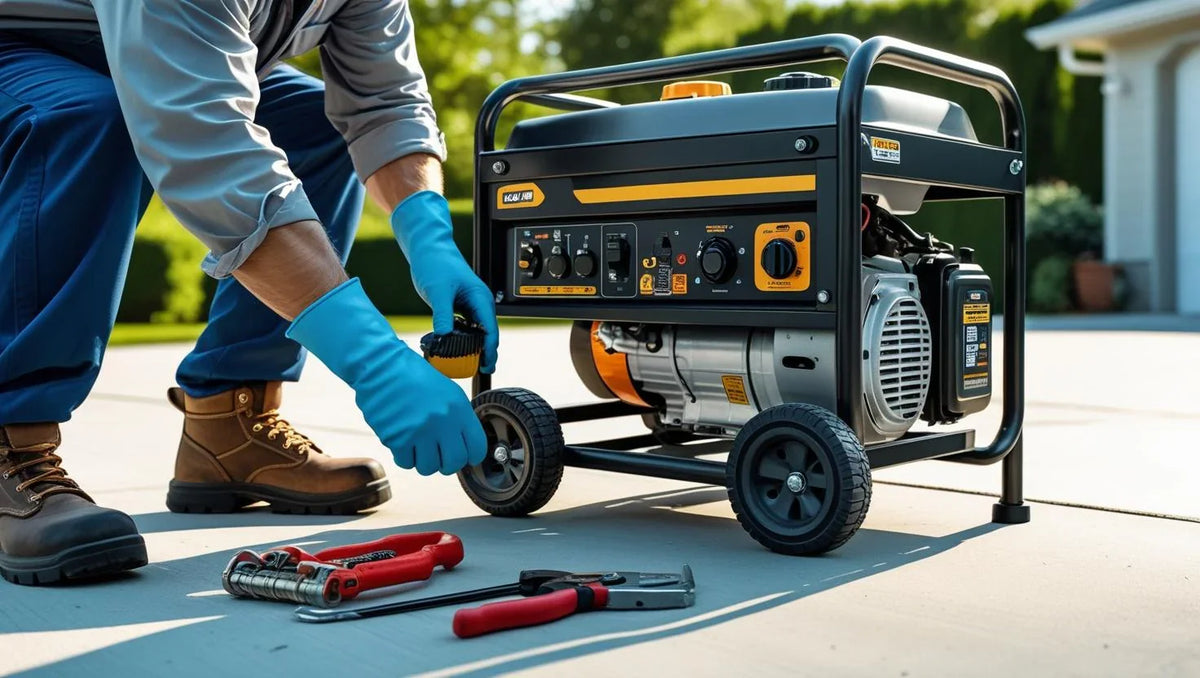
Every generator I've been called out to "fix" in the last decade fell into one of two piles: machines with actual broken parts (a short list) and machines that were simply never maintained (the rest of the list). Portable generators are brutally honest equipment — they fail exactly where you skipped a task, and they fail on the worst possible night. This is the complete service guide I hand to customers: the intervals, the procedures, the torque-and-spec details, and the storage protocol that keeps a generator starting on the first pull for fifteen years instead of seizing in year three.

Know Your Machine Before You Wrench on It
Service intervals only make sense against the architecture. Nearly every portable generator sold today is one of these:
| Component | Conventional Open-Frame | Inverter Generator | Service Implication |
|---|---|---|---|
| Engine | Side-valve or OHV, 3,600 RPM fixed | OHV/OHC, variable speed | OHV valves need clearance checks; higher RPM wears oil faster |
| Oil system | Splash lubrication, often no filter | Splash or pressure, some with filters | No filter = shorter oil intervals, non-negotiable |
| Ignition | Single plug, magneto/coil | Same, sometimes with electronic advance | Plug and air gap are annual items |
| Electrical | Alternator + AVR or capacitor regulation | Alternator + inverter module | Inverter modules aren't field-serviceable; protect them from moisture |
| Starting | Recoil, or electric with small battery | Recoil and/or electric | Electric-start batteries are the #1 "won't start" cause after fuel |
Two tools pay for themselves immediately: an hour meter (if the unit doesn't have one — $15, zip-tied to the frame) because every interval in this guide runs on hours, and a maintenance log taped inside the cover. I write date, hours, oil, and anything touched. When a unit comes in for service, that log tells me its whole life story in ten seconds.
The Master Maintenance Schedule
This schedule covers the overwhelming majority of air-cooled gasoline and dual-fuel portables. Where your manual differs, the manual wins — but it rarely differs by much.
| Task | First 5 Hours (Break-In) | Every Use | Every 25–50 Hrs / Season | Every 100 Hrs / Year | Every 250–300 Hrs |
|---|---|---|---|---|---|
| Change engine oil | Yes — mandatory | Check level | Change (no-filter engines) | Change (all engines) | Change + inspect magneto area for oil mist |
| Air filter | — | Visual check | Clean foam element | Replace paper element; clean foam | Replace regardless of appearance |
| Spark plug | — | — | Check condition | Replace; set gap to spec (commonly 0.028–0.031 in) | Inspect coil air gap |
| Fuel system | — | Fresh fuel only | Check lines for cracking | Replace fuel filter; clean carb bowl | Inspect tank interior for rust/varnish |
| Valve clearance (OHV) | — | — | — | Check/adjust per manual (typically 0.004–0.006 in intake, 0.006–0.008 in exhaust) | Re-check; inspect valve cover gasket |
| Battery (electric start) | — | — | Charge/inspect terminals | Load-test; replace if below spec | Replace preventively at 3 years |
| Cooling | — | Clear debris from shrouds | Blow out cooling fins | Deep-clean fins and shroud | Inspect flywheel fins for damage |
| Frame & fasteners | Re-torque after break-in | — | Check mounts and AVR bolts | Torque check engine mounts | Inspect frame welds and anti-vibration mounts |
| Electrical output | Verify voltage & frequency at break-in | — | — | Verify ~120V/60Hz unloaded under load | Full-load output test |
Oil: The Fifteen-Minute Job That Saves the Engine
Most portable generators under 10 kW use splash lubrication with no oil filter. That means the oil itself is the filter — it holds wear metals and combustion soot in suspension until you drain them out. Miss the interval and the oil turns into grinding compound.
Break-in change (first 5 hours): Non-negotiable. Ring seating sheds metal into the sump. I've drained break-in oil that glittered in the drain pan — that's normal, and it's exactly why it has to come out. Refill with the manual's specified weight (commonly 10W-30, or 5W-30 synthetic for cold climates) to the top of the fill neck threads.
Running changes: Every 25–50 hours for splash-lube engines in dusty or hot service; up to 100 hours for pressure-lubed engines with filters. Change it hot — warm oil carries contaminant out and drains in two minutes instead of ten. The drain plug crush washer is a 50-cent part; replace it and stop chasing drips.
Overfill is also failure. Oil above the full mark gets whipped by the crankshaft, foams, and blows out the breather into the air filter. A generator "making smoke" after an oil change is usually an overfill, not a ring job. Fill to the threads, run two minutes, recheck.
Fuel System: Carburetors, Ethanol, and Stale Gas
Fuel kills more generators than everything else combined. Ethanol-blended pump gas (E10) absorbs water, and within 4–8 weeks of sitting, the light ends evaporate and varnish starts forming in the pilot jet — a passage smaller than a pin.
The protocol I enforce:
- Use fuel less than 30 days old, or fuel treated with stabilizer at fill time (stabilizer added to old gas does nothing — it preserves, it doesn't resurrect).
- Ethanol-free fuel if you can get it. Recreation fuel from a hardware store is expensive per gallon and cheap per avoided carburetor cleaning.
- Drain the float bowl before any storage over 30 days. Most carburetors have a bowl drain screw or hose. Ninety seconds, no tools beyond a screwdriver, and the jet stays clean indefinitely.
- Annual bowl-off inspection at 100 hours. Drop the bowl, check for sediment and white corrosion (aluminum + ethanol water = white powder), spray the pilot and main jets with carb cleaner, reassemble with a fresh bowl gasket if the old one has taken a set.
Fuel lines deserve a squeeze test every season — ethanol hardens rubber, and a cracked line at the tank fitting is a fire waiting for a spark. Replace at the first sign of stiffness or surface checking; fuel line is sold by the foot and costs less than the gas you'll spill learning otherwise.
Spark, Air, and Compression: The Ignition Side
Spark plugs: Replace annually or at 100 hours. Gap to the manual's spec — commonly 0.028–0.031 inches on small OHV engines — and read the old plug like a report card: tan and dry is healthy; black and sooty means rich running (choke sticking or dirty air filter); white and blistered means lean or overheating (check fuel delivery and cooling fins); oil-fouled means rings or valve guides, and that's a bench job. Anti-seize on the threads, torque to spec (finger-tight plus a half-turn on a new gasketed plug if you've lost the manual), and never gap by hammering the electrode — use a gapping tool.
Air filter: Foam elements wash in warm soapy water, dry completely, then get a tablespoon of clean engine oil worked through and squeezed out. Paper elements don't wash — tap them out and replace annually. A starved engine runs hot and lean; I've seen scored cylinders from a $6 filter nobody replaced.
Compression check: If a generator cranks with suspicious ease — the pull cord feels "light" — do a compression test before replacing anything else. Healthy small engines read roughly 90–150 psi. Below that, check valve clearance first (tight valves hold the valve open and mimic ring failure), then decide whether the unit earns a ring job.
Battery and Electric Start Service
The sealed AGM battery in an electric-start portable lives a hard life: small capacity, long sits, temperature swings. Keep it alive with three habits: a float charger (battery maintainer) whenever the unit is stored more than two weeks, terminal cleaning with a baking-soda solution at the first sign of white fuzz, and an annual load test. A battery that reads 12.6V at rest but collapses under cranking load is dead — resting voltage lies. Replace preventively at three years; the $35 battery is cheaper than the midnight pull-cord workout, and our battery life and maintenance guide covers the deeper science of why float charging works.
Valve Clearance: The Interval Everyone Skips
OHV engines (the vast majority of modern portables) need valve lash checked around 100 hours and periodically after. Tight valves cause hard starting hot and burned valve seats; loose valves clatter and shed power. The check takes twenty minutes: remove the valve cover, rotate to top dead center on the compression stroke, and measure with feeler gauges against the manual's spec — typically in the 0.004–0.008 inch range. Adjust by loosening the rocker locknut, turning the adjuster to a light drag on the gauge, and re-torquing the locknut. If you're not comfortable finding TDC on compression, this is the one job worth paying a shop for — misadjusted valves are worse than unadjusted ones.
Storage: The 30-Day and 6-Month Protocols

| Storage Length | Fuel | Engine | Battery | Environment |
|---|---|---|---|---|
| Under 30 days | Stabilized fuel, tank full (less air = less condensation) | Nothing special | Maintainer optional | Covered, dry |
| 30 days – 6 months | Drain tank and carb bowl, or fill with treated ethanol-free fuel and run 10 minutes | Change oil (acids in used oil attack bearings) | Maintainer connected | Cover breathable, off concrete if possible |
| 6+ months | Fully drained; fog cylinder with storage oil through plug hole | Oil changed; plug out, pull cord slowly to distribute fogging oil | Battery removed to maintainer indoors | Rodent-proofing matters — nests in cooling shrouds cause fires |
The concrete-floor detail is real: bare concrete sweats seasonally and rusts tank bottoms from the outside. A sheet of plywood or a rubber mat under the frame ends that. And the rodent line isn't folksy wisdom — I've pulled a mouse nest out of a cooling shroud that was one hot run from ignition. Mothballs or dryer sheets in the cover work; poison near a spark source does not.
Electrical Output Verification
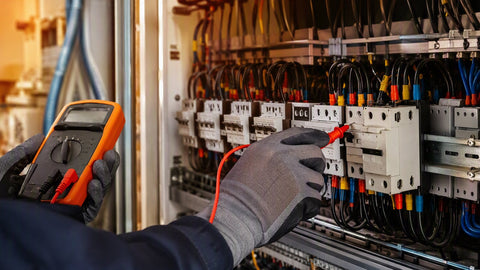
Once a year, verify the generator actually makes what it claims. Unloaded, expect roughly 120–124V per leg and 61–63 Hz on a conventional unit (the governor droops into 60 Hz under load); inverter units should hold 120V/60 Hz nearly flat at any load. A $25 plug-in kill-a-watt style meter or a multimeter with frequency does the job. Voltage that sags badly under a known load points to the AVR (conventional) or a failing inverter module — both are replaceable, and on a quality brand both are stocked parts. Test through whatever connection hardware you actually use; a corroded 30 A inlet prong shows up here as voltage drop, and our wire sizing and ampacity guide covers the cord-and-inlet side of that chain.
When to Service It Yourself vs. When to Call the Shop
DIY-appropriate: oil, filters, plugs, battery, fuel-line and bowl service, valve cover gasket, output verification, cleaning. Shop-appropriate: valve adjustment if you're unsure, governor problems (surging that survives a clean carb and fresh fuel), AVR or inverter module replacement, compression-related anything, and all warranty-period internal work — opening the engine yourself can void coverage. Keep receipts and that maintenance log; warranty claims go remarkably smoother with a documented service history.
If your unit is a Briggs & Stratton, parts support is one of the deepest in the industry — carb kits, AVRs, and gaskets are stocked items. See our Briggs & Stratton collection and the Briggs & Stratton generator overview for model-specific notes.
The Service Kit: Consumables Worth Stocking
The difference between a 15-minute service and a week of waiting is a shelf with the right consumables. I keep a dedicated bin per generator, and the bin contents below cover a full year of scheduled service for one machine. Exact part numbers come from your model's manual — but the categories are universal across the portable class:
| Consumable | Stocking Quantity | Typical Replacement Interval | Buying Notes |
|---|---|---|---|
| Engine oil (manual-specified viscosity) | 2–3 quarts | Every 25–100 hours by engine type | Synthetic 5W-30 covers most climates; small engines under 10 kW typically hold 0.5–1.2 quarts |
| Spark plug | 2 | 100 hours / annually | Buy the OEM-specified plug; cross-references often change heat range |
| Air filter element | 2 | Annually (paper) or as needed (foam) | Dual-element setups need both foam pre-filter and paper main |
| Fuel filter | 2 | 100 hours / annually | Match line diameter; in-line filters are model-generic |
| Drain plug crush washers | 6 | Every oil change | The cheapest insurance against drips on the shelf |
| Fuel stabilizer | 1 bottle | Every fill for stored fuel | Dose at fill time; it preserves, it does not restore |
| Carburetor cleaner + bowl gasket | 1 can / 1 gasket | As needed; gasket at bowl removal | Gaskets take a set — reuse invites leaks |
| Feeler gauge set | 1 (tool, not consumable) | Valve checks | Buy the angled type for tight rocker access |
Total shelf cost is under $80. Compare that to one emergency service call at shop rates during a storm week — when every generator shop within fifty miles has a two-week backlog and your freezer is thawing. If you're still shopping for the machine itself, our portable generators collection, 3–6 kW range, and 6–10 kW range are organized by the output classes this guide references.
A Seasonal Service Calendar That Matches Real Weather
Intervals measured in hours are correct but abstract. Most owners think in seasons, so here's the calendar I actually tape to the shop wall — built around the reality that generator weather arrives in waves:
| Season | Trigger | Service Actions |
|---|---|---|
| Late spring (pre-hurricane / pre-storm season) | Before your region's storm window opens | Full annual service: oil, plug, filters, valve check if due, output test, fuel system inspection, fresh stabilized fuel supply |
| Mid-summer | After any multi-day run | Oil change (heat shears oil fast at sustained load), cooling fin cleaning, retorque head bolts on high-hour units |
| Fall | Storm season winding down | Post-season inspection, repair anything deferred, deep clean, evaluate battery before winter |
| Winter (ice-storm regions) | Before first freeze | Switch to winter-viscosity oil, battery to maintainer, verify cold-start with an actual test at temperature |
The late-spring full service is the one that matters most. A generator that enters storm season with fresh oil, a new plug, clean filters, and verified output will run the whole season on nothing but fuel and level checks. One that enters it "probably fine" enters it as a coin flip.
Cold-Weather Service Notes
Winter is when deferred maintenance collects its debts. Before the first hard freeze: switch to the winter oil viscosity in your manual (commonly 5W-30 synthetic), move the battery to a maintainer, verify the choke operates through its full travel (stiff choke linkages are a classic cold no-start cause), and test-start the unit at actual temperature — a generator that fires reluctantly in a 60°F garage may not fire at all at 10°F. If your region's outage risk is ice storms, your annual full service belongs in the fall, not the spring.
Service Records, Warranty, and Resale
Three times in my career a maintenance log has paid out real money: twice on warranty claims that the manufacturer approved in one phone call because the log showed every interval met, and once on a used sale where the log added $150 to the price of a six-year-old unit. Buyers of used generators — and there is a healthy market for them, alongside the larger 10–12 kW portables and standby units that buyers graduate to — pay for documented care the same way truck buyers do. Date, hours, task, parts used, initials. Five fields, thirty seconds per entry.
If you're weighing whether your aging portable deserves a full overhaul or replacement, the rule of thumb I use: if parts plus my bench time exceed half the replacement cost of a comparable new unit — and the machine has no sentimental or fleet-standardization value — replacement wins. The exception is quality frames with deep parts support; those earn rebuilds. Our best whole-house generators guide and whole-home sizing guide are the next read if the overhaul-versus-replace math is pushing you toward standby power instead, and the runtime calculator helps if you're considering supplementing with battery backup for the quiet overnight hours.
What a Professional Annual Service Actually Includes
If you'd rather pay a shop — a defensible choice for anyone without a dry workspace — know what you're paying for so you can verify it. A legitimate annual portable-generator service covers: oil and filter change; air filter replacement; spark plug replacement with gap verification; fuel filter and fuel-line inspection; carburetor bowl drain and inspection; battery load test and terminal service on electric-start models; valve clearance check on OHV engines; cooling fin and shroud cleaning; fastener and mount torque check; full output verification under load with voltage and frequency recorded; and a written report. That list runs one to one-and-a-half hours of bench time, so shop pricing in the $120–220 range for a small portable is honest math, not padding. If a "full service" quote is $40, ask which items are being skipped — because some are.
Frequently Asked Questions
How often should I change my portable generator's oil? After the first 5 hours (break-in), then every 25–50 hours for splash-lubricated engines without an oil filter, and up to 100 hours for pressure-lubricated engines with a filter. In dusty or hot conditions, use the short end of the range.
Why won't my generator start after sitting all winter? Almost always fuel. Ethanol gasoline varnishes the carburetor's pilot jet within weeks of sitting. Drain the float bowl, try fresh fuel, and if it still won't fire, the carburetor needs a jet cleaning. Prevention: stabilize fuel and drain the bowl before storage over 30 days.
Should I run my generator every month? Yes — 15 to 20 minutes under a real load (space heaters work) every month keeps fuel circulating, lubricates rings and seals, exercises the battery, and proves the unit works before you need it. Generators that sit for a year-plus usually need carburetor service.
What's the correct spark plug gap for a portable generator? It varies by engine, but most small OHV generator engines spec between 0.028 and 0.031 inches. Check your manual; measure with a wire feeler gauge, and replace the plug annually or every 100 hours.
Can I use synthetic oil in my generator? Yes, and for cold climates it's recommended — 5W-30 synthetic cranks far easier below freezing. Match the viscosity grade in your manual for your temperature range; synthetic doesn't extend the change interval on splash-lube engines, though, because contamination — not oil breakdown — is the limiting factor.
How do I store a generator for six months or more? Drain the fuel system completely (tank and carburetor bowl), change the oil, remove the spark plug and fog the cylinder with storage oil, pull the cord slowly a few times, reinstall the plug, remove the battery to a maintainer indoors, and cover the unit in a dry, rodent-resistant space off bare concrete.