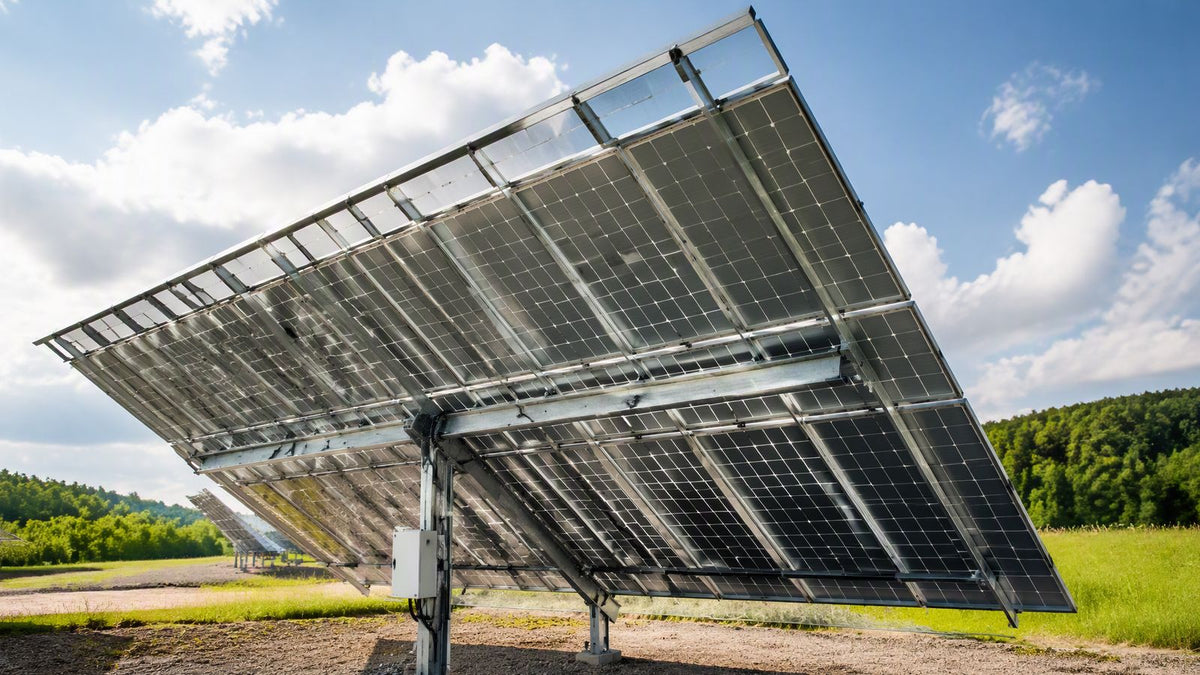
Updated September 2026 — content reviewed and refreshed by the PES team. For current pricing and availability, see the linked product pages or request a quote.
SEG Solar 550W Bifacial Solar Panel (SEG-BMA-TB-550): The Commercial Workhorse, Spec by Spec
144 half-cut cells, dual-glass bifacial construction, 620 panels per container — a complete engineering breakdown for developers, EPCs, and commercial buyers.

Utility developers and commercial EPCs don't buy solar panels the way homeowners do. They buy watts per dollar, watts per acre, and watts per container — and they need a module that survives thirty years of hail, heat, and humidity without a warranty fight. The SEG Solar 550W 144-cell bifacial panel (SEG-BMA-TB-550) has become one of the most specified modules in our commercial pipeline for exactly those reasons. This guide walks through the engineering, the electrical math you need for string design, real bifacial gain expectations, and the logistics numbers that decide whether a module pencils out at scale.
SEG Solar is an American-led, globally recognized PV manufacturer with a reputation for bankability — the unglamorous quality that decides whether a project gets financed. The SEG-BMA-TB-550 targets three buyer profiles: utility-scale ground-mount developers chasing the lowest LCOE, commercial rooftop owners who need maximum watts per square foot, and industrial facilities building behind-the-meter generation. If you're comparing options across the market, our roundup of the most efficient solar panels of 2026 puts this module in context against its direct competitors, and our overview of commercial solar panels covers the broader category.
What it is not: a residential panel. At roughly 2.28 m × 1.13 m and over 30 kg of dual-glass weight, this is a two-person, racking-rated module for engineered mounts. For smaller rooftop formats, browse the 400–459W solar panel collection instead.
The table below consolidates the nameplate values that matter for design work. Always confirm against the datasheet revision shipped with your lot — bifacial modules carry both STC (front-only) and BSTC (bifacial) ratings.
| Specification | Value | Design Note |
|---|---|---|
| Model | SEG-BMA-TB-550 | Bifacial, dual-glass construction |
| Rated power (Pmax, STC) | 550 W | Front-side nameplate at 1000 W/m², 25°C cell temp |
| Cell configuration | 144 half-cut monocrystalline | Lower resistive loss than full-cell layouts |
| Module efficiency | ~21.3% | High module conversion; varies slightly by lot |
| Bifaciality factor | ~70% ± 5% | Rear-side output relative to front at same irradiance |
| Temperature coefficient (Pmax) | ≈ −0.34%/°C | Power derate above 25°C cell temperature |
| Construction | Dual-glass, framed | Glass-glass laminate resists PID and microcracking |
| Certifications | IEC 61215, IEC 61730, salt mist, ammonia | Design qualification + safety; coastal and ag sites |
| Container loading | 620 panels / 40' HC | ≈ 341 kW of nameplate per container |
Cutting each cell in half quarters the cell current (I²R losses scale with the square of current), which is why half-cut modules run cooler and deliver more of their nameplate in the field. Two practical consequences for designers:
- Lower resistive loss at high irradiance. At solar noon in July, a half-cut module typically holds 1–2% more of its STC rating than an equivalent full-cell module.
- Superior shade tolerance. The 144-cell layout is internally wired as two parallel halves. Shade the bottom row from a parapet wall or a row ahead, and the top half keeps producing — critical on commercial rooftops with HVAC obstructions.
- Reduced hot-spot stress. Lower cell current means cooler bypass events and less long-term degradation at the junction box.
If you're evaluating the efficiency claims across brands, our guide to high-efficiency solar panels explains how half-cut topology, cell pitch, and bifaciality interact in real production numbers.
Bifacial marketing routinely promises "up to 30%" rear-side gain. That number is real — but only on fresh snow or white TPO with high ground clearance. What you model in PVSyst should reflect your actual albedo, height, and row spacing. The ranges below are what we see in delivered production data:
| Ground Surface | Typical Albedo | Realistic Bifacial Gain | Notes |
|---|---|---|---|
| Green grass / vegetation | 0.20–0.23 | 5–8% | Default assumption for most ground-mounts |
| Gravel (gray/brown) | 0.25–0.30 | 7–11% | Common on utility sites |
| Concrete / light gravel | 0.30–0.40 | 10–16% | Carport and rooftop ballast decks |
| White TPO / white membrane roof | 0.60–0.75 | 15–22% | Best commercial rooftop scenario |
| Fresh snow | 0.80+ | 25–30% | Seasonal bonus, not annual average |
Two structural factors move you within those bands: module height above the surface (every extra foot of clearance helps rear irradiance) and row-to-row spacing. A tight fixed-tilt layout at 0.5 m clearance on grass will land at the bottom of the table; an elevated carport over white concrete lands at the top. Model it honestly and bifacial still wins — a 12% energy gain on a 10 MW site is roughly 1.9 GWh of extra annual production at 1,600 kWh/kWp.
Large-format modules push string voltages up fast. NEC 690.7(A) requires you to correct module open-circuit voltage for the coldest expected cell temperature, and with modern 1500V inverters the math decides your string length. Here's a worked example using typical 550W-class 144-cell electricals (Voc ≈ 49.9 V, Voc temperature coefficient ≈ −0.26%/°C — confirm against your lot's datasheet):
| Design Low Temp | Voc Correction Factor | Corrected Voc per Module | Max Modules per 1500V String |
|---|---|---|---|
| −5°C (23°F) | 1 + 0.0026 × 30 = 1.078 | 53.8 V | 27 (27 × 53.8 = 1,453 V) |
| −10°C (14°F) | 1 + 0.0026 × 35 = 1.091 | 54.4 V | 27 (1,470 V) |
| −20°C (−4°F) | 1 + 0.0026 × 45 = 1.117 | 55.7 V | 26 (1,449 V) |
| −30°C (−22°F) | 1 + 0.0026 × 55 = 1.143 | 57.0 V | 26 (1,483 V) |
Notice what the math gives you: in most of the continental U.S. you can run 26–27 modules per string on 1500V gear — that's a 14.3–14.9 kW string, which is exactly why this module class dominates utility design. Fewer strings per megawatt means less trenching, less wire, fewer combiner inputs, and lower BOS cost. If you're new to series stringing, our explainer on connecting solar panels in series covers the fundamentals before you scale to this level, and what a string inverter actually does clarifies the DC/AC handoff.
Thermal Behavior: Degradation Math for Pro Formas

Every watt you model in year one shrinks in year twenty-five. For pro forma work, two numbers matter: the power temperature coefficient (≈ −0.34%/°C for this class) and the annual degradation rate. The worked table below shows what a 550W module delivers at realistic cell temperatures, and how a conservative 0.45%/yr linear degradation path compounds:
| Condition | Calculation | Effective Output |
|---|---|---|
| STC (25°C cell) | 550 W × 1.00 | 550 W |
| Warm day (45°C cell) | 550 × (1 − 0.0034 × 20) | 512.6 W (−6.8%) |
| Hot day (60°C cell) | 550 × (1 − 0.0034 × 35) | 484.6 W (−11.9%) |
| Year 1 with 12% bifacial gain | 550 × 1.12 | 616 W front-equivalent |
| Year 10, 0.45%/yr linear | 550 × (1 − 0.0045 × 10) | 525.3 W |
| Year 25, 0.45%/yr linear | 550 × (1 − 0.0045 × 25) | 488.1 W (88.8% of nameplate) |
| Year 25 + 12% bifacial gain | 488.1 × 1.12 | 546.7 W front-equivalent |
That last row is the commercial case for bifacial in one line: a 25-year-old bifacial array on a reflective surface can still out-produce a brand-new monofacial array of the same nameplate. When you run the payback numbers, our solar ROI calculator lets you plug in degradation and yield assumptions directly.
The SEG-BMA-TB-550's glass-glass construction costs more at the dock and saves more over the asset life. The failure modes it eliminates are the ones that plague glass-backsheet modules in years 10–20:
- Potential-induced degradation (PID): The glass-rear laminate is effectively impermeable to the moisture pathways that drive PID in high-voltage strings.
- Backsheet cracking and chalking: There is no polymer backsheet to UV-degrade, embrittle, or delaminate.
- Microcrack propagation: The symmetric glass stack mechanically balances the cells, reducing flex-induced cracking during handling, transport, and wind loading.
- Fire class and hail: Dual-glass modules routinely achieve Class A fire ratings and survive impact testing that fails backsheet panels; salt mist and ammonia certifications make them safe specs for coastal and agricultural sites.
SEG backs the module with IEC 61215 design qualification and IEC 61730 safety certification — the baseline documentation your lender's independent engineer will ask for. The practical warranty question to ask any module vendor is not the headline years but the claims process: who pays removal and re-installation labor, how degradation is measured on a bifacial rear side, and whether the performance guarantee is linear or tiered. Get those answers in the supply agreement before the first container ships. For verification technique in the field, our guide on how to test solar panel output covers IV-curve tracing and flash-test verification on receipt of goods.
Procurement at scale is a logistics problem as much as an engineering one. The SEG-BMA-TB-550 ships 620 panels per 40' high-cube container — roughly 341 kW of nameplate per box. The arithmetic for a 5 MW project:
| Logistics Metric | Value | Project Impact |
|---|---|---|
| Panels per 40' HC container | 620 | ≈ 341 kW DC per container |
| Containers for 5 MW DC | 5,000,000 ÷ (620 × 550) ≈ 14.7 → 15 | 15 truckloads, 15 crane picks |
| Comparable 400W-class module | ~660/container but 264 kW | ~19 containers — 27% more freight |
| Panels to install for 5 MW | 9,091 (550W) vs 12,500 (400W) | 3,409 fewer clamps, lugs, and terminations |
| Racking linear footage delta | ~27% less rail | Direct BOS savings on steel and labor |
That's the real meaning of "550W class": not bragging rights, but 27% fewer touches per megawatt across freight, handling, clamping, and electrical termination. For buyers consolidating BOMs, our pages on bulk solar panel purchasing and affordable solar panels cover container pricing mechanics, and current 545W-class pricing gives a market benchmark for this exact format.
| Decision Factor | SEG-BMA-TB-550 | Typical Monofacial 550W | Older 400–450W Class |
|---|---|---|---|
| Front-side power | 550 W | 550 W | 400–455 W |
| Bifacial gain potential | 5–30% by surface | None | None |
| Construction | Dual-glass | Glass-backsheet typical | Glass-backsheet |
| String length @1500V, −10°C | 27 modules | ~27 modules | ~33 modules (lower Voc each) |
| Panels for 5 MW | 9,091 | 9,091 | 11,000–12,500 |
| Best use | Ground-mount, white-roof, carports | Dark roofs, tracker rear-shade | Space-constrained retrofits |
For a head-to-head against other high-wattage formats — including assembled-in-USA alternatives like the Axitec 550W bifacial — our solar panel comparison tool and the Best Solar Panels 2026 buyer's guide keep current pricing and availability in one place.
What is the real-world efficiency of the SEG Solar 550W bifacial panel?
Front-side module efficiency is approximately 21.3% at STC, varying slightly by production lot. With rear-side bifacial gain of 5–30% depending on surface albedo, total energy yield per module routinely exceeds what a 23%-efficient monofacial panel delivers on the same racking — efficiency per square meter and yield per installed watt are different metrics, and bifacial wins the second one.
How many SEG 550W panels fit in a shipping container?
620 panels per 40-foot high-cube container, which works out to roughly 341 kW of DC nameplate per container. A 5 MW utility project requires about 15 containers at that loading rate.
Can I use the SEG-BMA-TB-550 on a residential roof?
Technically yes, but it's rarely the right tool. At ~2.28 m × 1.13 m and 30+ kg, it needs engineered racking and two-person handling, and most residential setbacks and rafter spans favor smaller 400–460W formats. It excels on commercial flat roofs, carports, and ground-mounts.
How much extra power does bifacial actually add?
Expect 5–8% over grass, 10–16% over concrete or light gravel, 15–22% over white membrane roofing, and up to 30% over fresh snow. Height above the surface and row spacing move you up or down within those bands.
What string length can I run with a 1500V inverter?
Using NEC 690.7 cold-weather correction with a typical Voc of 49.9V and −0.26%/°C coefficient, you can run 27 modules per string down to about −10°C design low, and 26 modules down to −30°C. Always verify against your lot's datasheet coefficients before stamping the design.
Does dual-glass construction really matter for longevity?
Yes. Glass-glass laminates eliminate backsheet cracking, dramatically reduce PID susceptibility, and mechanically protect cells from microcrack propagation. Over a 25–30 year asset life, those are the failure modes that separate a smooth pro forma from a warranty claim. In our own receiving inspections we have found that dual-glass modules also arrive with measurably fewer transport-related cell cracks than comparable glass-backsheet pallets.
Dual-glass 550W modules change crew behavior on site. Each panel weighs north of 30 kg, so plan two-person lifts or mechanical handling from the first pallet — a crew that tries to hand-carry these solo on day one is a crew with back injuries by day five. Clamp zones matter more on glass-glass laminates than on backsheet modules: follow the datasheet's clamping range exactly, because clamping outside the specified zone voids the mechanical-load warranty and can crack the rear glass under wind suction loads. Torque the mid-clamps to spec with a calibrated driver; over-torquing is the leading cause of the "mystery crack" that shows up on EL imaging six months later.
On bifacial rows, keep the torque tubes, purlins, and cable management off the rear face as much as the racking design allows. Every structural shadow on the rear cell area is a direct production loss — rear-side shading costs roughly twice what the equivalent front-side shading geometry suggests, because the rear cells are already working at 70% of front-side responsivity. Run homerun cables along the torque tube, not draped across the module backs, and use the wire-management clips the racking vendor rates for glass-glass frames.
Ground clearance is the cheapest bifacial gain you can buy. Raising the lower module edge from 0.5 m to 1.0 m typically adds 1.5–2.5 percentage points of bifacial gain on grass sites — on a 10 MW block, that is real money for the cost of longer piles. If the civil budget allows only one upgrade, spend it on pile height before you spend it on premium ground cover.
Levelized cost of energy is where bifacial modules stop being a technology story and become a finance story. Take a simplified 10 MW AC ground-mount comparison at $0.85/W DC installed for the monofacial case. The bifacial premium on the module line is typically $0.02–0.04/W — call it $0.03/W, or roughly $390,000 on 13 MW DC. In exchange, at a conservative 10% bifacial gain on a grass site at 1,600 kWh/kWp first-year specific yield, the array produces an extra 2.08 GWh per year. At a $45/MWh PPA, that is about $93,600 of additional annual revenue — a 4.2-year simple payback on the premium alone, before counting the degradation advantage of glass-glass construction.
The sensitivity table below shows how the bifacial premium payback moves with albedo-driven gain and PPA price:
| Bifacial Gain | Extra Energy / Year (13 MW DC, 1,600 kWh/kWp) | Revenue @ $35/MWh | Revenue @ $45/MWh | Revenue @ $60/MWh |
|---|---|---|---|---|
| 6% (grass, tight rows) | 1.25 GWh | $43,700 | $56,200 | $74,900 |
| 10% (grass, standard rows) | 2.08 GWh | $72,800 | $93,600 | $124,800 |
| 14% (light gravel) | 2.91 GWh | $101,900 | $131,000 | $174,700 |
| 18% (white membrane / elevated) | 3.74 GWh | $131,000 | $168,500 | $224,600 |
Against a ~$390,000 module premium, every scenario in that table pays back in under nine years, and the base case pays back in a little over four. That is why independent engineers now treat bifacial as the default utility spec rather than an upgrade line item.
- Pull the lot-specific datasheet. Confirm Voc, Isc, temperature coefficients, and bifaciality factor against the revision your containers will actually ship from.
- Lock the flash-test protocol. Agree in writing on sampled flash or IV testing at delivery, with pass/fail thresholds and remedy language.
- Confirm pallet and container loading. 620 panels per 40' HC is the standard pack; verify pallet count and weight against your receiving dock's forklift rating.
- Verify certifications for your AHJ. IEC 61215/61730 plus the UL 61730 listing for U.S. interconnection, and salt-mist certification within 5 miles of coast.
- Check clamp compatibility. Confirm your racking vendor's clamps are approved for glass-glass laminates in the datasheet clamp zones.
- Model albedo honestly. Commit the ground cover plan (grass, gravel, or membrane) to the energy model before financing, not after.
Buying for a commercial or utility project? We stock the SEG Solar 550W bifacial (SEG-BMA-TB-550) at 620 panels per container, plus the rest of the SEG line including 585W formats. Call 866-607-3636 for container pricing, freight quotes, and lot-specific datasheets.